Financial statements are a “panoramic picture” reflecting the assets, capital, revenue and operating efficiency of a business in an accounting period. A set of financial statements usually includes:
- Balance sheet
- Business performance report
- Cash flow statement
- Financial statement notes
Four core components help managers, investors, and tax authorities accurately assess a company's financial health. In the context of 2026, with increasing demands for transparency and data standardization, preparing and analyzing financial reports correctly is not only a legal obligation but also a foundation for sustainable business growth and increased trust with partners and investors.
What is a financial report?
Financial statements are a system of general accounting tables, reflecting the overall situation of assets, capital sources, business performance and cash flow of an enterprise in a certain accounting period. All enterprises belonging to all economic sectors and sectors must prepare and present annual financial statements. However, enterprises with affiliated economic units, in addition to preparing annual financial statements, must prepare a general financial statement at the end of the accounting period. This is an important basis for assessing the "financial health" and management and operation efficiency of the enterprise.
According to the regulations of the Ministry of Finance of Vietnam, a complete set of financial statements includes 04 main parts:
- Balance sheet (B01-DN): Reflects all assets and sources of assets of the enterprise at the time of reporting.
- Business performance report (B02-DN): Shows revenue, expenses and profit during the period.
- Cash flow statement (B03-DN): Records cash inflows and outflows from operating, investing and financing activities.
- Notes to the financial statements (B09-DN): Provide details, explanations and accounting policies applied.
Purpose of financial reporting

According to Article 97 of Circular 200/2014/TT-BTC, the purpose of financial statements is stipulated as follows:
“Financial statements are used to provide information on the financial situation, business situation and cash flows of an enterprise, meeting the management requirements of business owners, state agencies and the useful needs of users in making economic decisions."
Source: Law Library
Financial statements must ensure that they provide information about a business's:
- Asset
- Liabilities
- Equity
- Revenue, other income, production and business costs and other expenses
- Profit, loss and division of business results
- Cash flows
Financial statement users
Financial reports not only serve the internal needs of the enterprise but are also an important source of information for many different stakeholders. Each subject has its own goals and ways of exploiting financial information, specifically as follows:
| Object | Purpose |
| Business Owners, Board of Directors and | Monitor financial situation and performance to develop development strategies and optimize business. |
| Investors, shareholders | Evaluate profitability, growth potential and risk level before investing. |
| Tax authorities | Check compliance, tax obligations and financial transparency |
| Banks, credit institutions | Analyze financial capacity and debt repayment ability when businesses borrow capital |
| Partners, suppliers | Determine the reliability, solvency and reputation of the business. |
In short, financial reports are a tool of information transparency, helping all stakeholders understand the financial situation of the business to make appropriate decisions, contributing to building trust and brand reputation in the market.
The role of financial reporting
Some important roles of financial statements, specifically as follows:
- Providing honest and comprehensive information on the financial situation: Financial statements reflect all assets, liabilities, equity, revenue, expenses and profits during the period. This is an authentic and reliable source of data, helping the board of directors, investors or management agencies grasp the "financial health" of the enterprise at a certain point in time.
- As a basis for making management and investment decisions: Through analyzing financial indicators, businesses can evaluate operational efficiency, determine the causes of profit increases and decreases, and then make strategic decisions such as expanding investment, cutting costs or restructuring capital sources. For investors, financial reports are the basis for comparison, selecting potential businesses and limiting risks when investing.
- Ensuring transparency and legal compliance: Every business is obliged to prepare and submit financial reports in accordance with regulations. Strict implementation not only helps businesses comply with the regulations of tax authorities and the Ministry of Finance, but also demonstrates transparency, professionalism and reputation in the market - an important factor in cooperation and investment attraction.
- Tools to evaluate capital efficiency and financial capacity: Indicators in financial reports such as capital turnover, payment capacity, and profit margin help businesses measure the efficiency of resource use. From there, the board of directors can adjust financial strategies, optimize costs, and improve profits in the following periods.
- Strengthening trust with partners, investors and credit institutions: A set of transparent and accurate financial reports helps businesses affirm their financial capacity and reputation, creating favorable conditions for capital mobilization, signing contracts or long-term cooperation with related parties. This is the "ticket of trust" in the modern business environment.
Financial reporting is not simply an accounting procedure but a strategic tool that helps businesses evaluate, operate and develop sustainably.
What does a financial report include?
To better understand what financial reports include, businesses need to understand the structure and content of each type of report in the financial report set according to current regulations. Each type of report has its own purpose, scope of reflection and form, helping to comprehensively present the financial situation and business results of the business. Below is a summary of the basic types of financial reports and the role of each type:
| Report type | Main purpose | Reflective content |
| Balance sheet | Show assets and capital | Short-term assets, long-term assets, liabilities, equity. |
| Business performance report | Reflects profit for the period | Revenue, expenses, profit or loss. |
| Cash flow statement | Track cash inflow or outflow | Cash flow from operating, investing, and financing activities. |
| Financial statement notes | Explain the indicators in detail | Accounting policies, changes, item details. |
From the table above, it can be seen that each type of financial report has its own role but is closely linked together, creating a comprehensive picture of the financial situation and operating results of the enterprise. In which, the balance sheet is considered the most important foundation, reflecting all assets, liabilities and equity at a certain point in time, helping the enterprise clearly identify its "financial health" before analyzing other reports.
Balance sheet
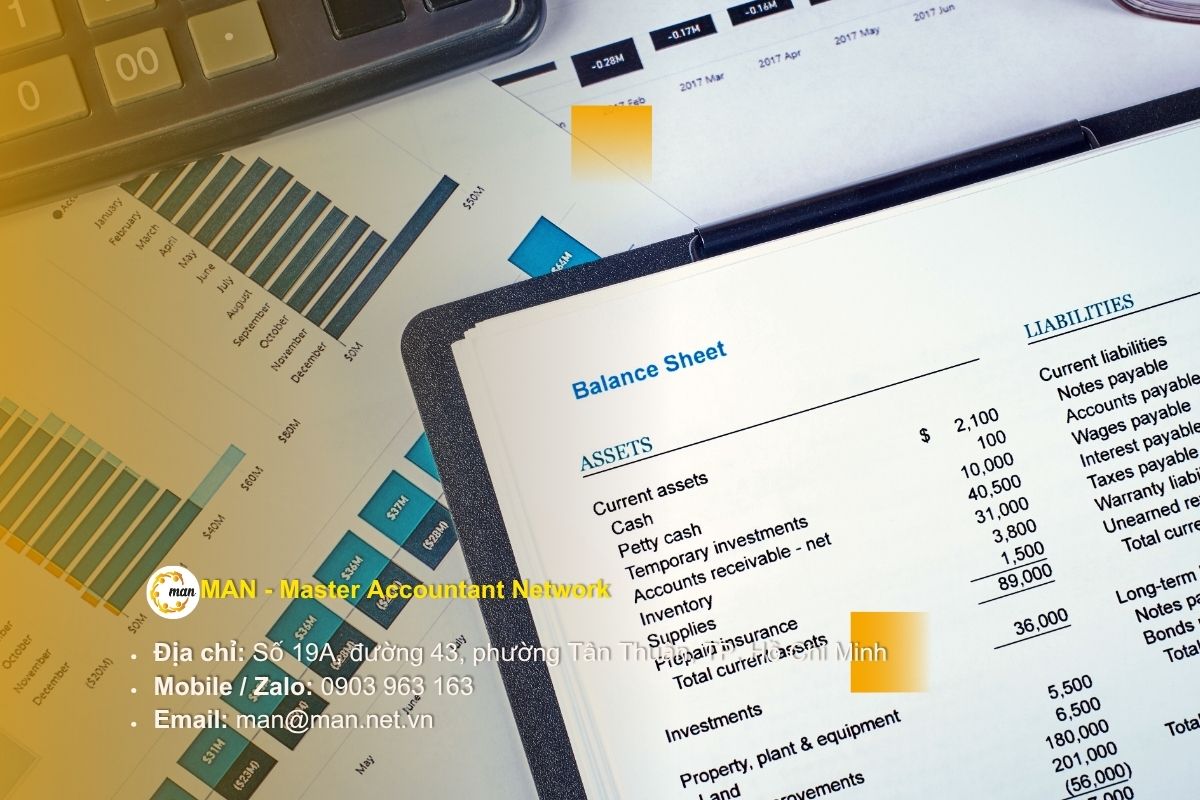
The balance sheet is one of the most important parts of a financial statement, reflecting all of a company's assets, liabilities, and equity at a given point in time, usually the end of a month, quarter, or fiscal year. This report provides a detailed overview of the financial situation, including current assets, investments, receivables, liabilities, owners' equity, retained earnings, and corporate funds. This allows managers and investors to assess the company's solvency, capital structure, and financial stability.
| Item | Detailed ingredients |
| Asset | Cash and cash equivalents
Fixed assets, inventories Accounts receivable, financial investments Investment real estate Cost of unfinished basic construction Other assets. |
| Liabilities | Accounts payable to vendors, employee salaries
Buyer pays in advance, internal payment for business capital Amount payable to the State Bonus fund, welfare, payable provisions Other payables |
| Source of capital (Equity) | Owner's equity
Funding sources and other types of funds |
From the above structure, it can be seen that the balance sheet helps businesses clearly see the size of assets, capital structure and financial safety at a specific time. However, to evaluate how effectively the business is operating, how much profit it is generating or what risks it is facing, the business needs to consider the business performance report. The next part of the financial statements reflects the details of revenue, expenses and profits during the accounting period.
Business performance report
The income statement is an important part of the financial statements, reflecting all the revenue, expenses and profits of the business in a certain accounting period. This report helps managers and investors evaluate the operational efficiency, profitability and growth potential of the business. Specifically, the main contents of the income statement include:

- Revenue or net sales from sales and service provision
- Profit or gross profit on sales and service provision
- Net profit from business contracts
- Financial costs, selling costs and administrative costs
- Cost of goods sold
- Total accounting profit before tax
- Corporate income tax expense
- Profit after corporate income tax
From the income statement, a business can determine its profitability during the period, but to understand how cash flow is actually working, it is necessary to consider the cash flow statement. This report shows the cash inflows and outflows from three main activities: business, investment and finance, helping the business assess its ability to generate cash, maintain liquidity and balance capital sources in each period.
Cash flow statement
The cash flow statement helps reflect the entire process of cash receipts and disbursements during the period, showing where the business makes money and what it uses it for. Below are the main components of the cash flow statement that businesses need to pay attention to.:
| Activity Group | Content |
| Cash flows from operating activities | Cash receipts from sales, services and other revenues.
Money paid to suppliers of goods and services. Money paid to workers. Payment of corporate income tax, taxes and other amounts to the State. Other revenues and expenses related to business operations. |
| Cash flows from investing activities | Money spent on purchasing, constructing fixed assets or long-term investments.
Proceeds from liquidation, sale of fixed assets, financial investments. Loans, loan recovery or capital contributions to other entities. Dividends, profits received from investment activities. |
| Cash flows from financing activities | Proceeds from issuing shares, receiving capital contributions from owners.
Loan received from a bank or credit institution. Money to pay principal, dividends, and profits to owners. Other revenues and expenditures related to financial activities. |
Through the cash flow statement, businesses can see the overall picture of cash flow, assess the actual cash generation ability, as well as the sustainability of financial activities in each period. However, to understand more deeply the causes of financial fluctuations, businesses need to see more Notes to financial statements which will provide details, explanations and specific analysis of the indicators presented in the 03 main reports mentioned above, helping readers understand the nature and transparency of the financial situation of the business.
Financial statement notes
The financial statement notes will clarify the numbers and information stated. This is the part that helps readers understand the nature of each financial indicator, as well as explain the reasons for fluctuations, the accounting policies applied and the factors affecting the financial situation of the enterprise. Below are the detailed contents of the financial statement notes.
| Content | Detailed description |
| General information about the business | Name, address, type of business, field of operation.
Organizational structure and scale of production and business. Accounting period, currency used in the report. |
| Applicable accounting standards and regimes | Vietnamese Accounting Standards (VAS) or IFRS are applied.
Method of recording revenue, expenses, depreciation, provisions, exchange rates... Principles of financial statement consolidation (if there are subsidiaries or associates). |
| Explain in detail the indicators on the financial statements | Interpret items in the Balance Sheet, Income Statement, and Cash Flow Statement.
State the reason for the change and compare it with the previous period. |
| Other additional information | Commitments, financial obligations, contingent liabilities, long-term contracts.
Information on related party transactions, salary and benefits policies, and employee benefits. Events occurring after the reporting date that may affect the financial position. |
| Off-balance sheet indicators (if any) | Operating leases, guarantee commitments, or long-term investment projects not yet recognized in the main statements. |
The notes to the financial statements act as a “decoding” of the entire reporting system, helping readers not only see the numbers, but also understand the nature, reasons and context behind each indicator. This is also the part that shows the level of transparency and compliance with accounting standards of the enterprise.
Financial statement analysis
To effectively analyze financial statements, businesses need to clearly identify key indicators that reflect financial health and business performance. Monitoring these indicators not only helps to identify risks early but also supports more accurate investment, management and financial strategy planning decisions. Below are important indicators to monitor when analyzing financial statements:
Indicators to monitor in financial statements
To comprehensively evaluate the financial situation and performance of a business, managers need to pay attention to the following important financial indicators:
- Solvency: Reflects the ability of a business to meet its short-term financial obligations. This indicator helps determine whether a business has enough resources to pay its debts and maintain continuous operations.
- Capital turnover: Measures the efficiency of capital use, showing the speed of capital circulation in production and business. The faster the capital turnover, the more effectively the business manages cash flow and optimizes resources.
- Profit margin: A measure of a company's profitability based on revenue or equity. This indicator helps assess the ability to generate profits and investment efficiency in each period.
- Liabilities: Represents financial obligations that a business needs to pay in the future. Tracking debt helps businesses control financial risks, balance debt and equity, and ensure long-term financial security.
Monitoring and analyzing financial statements not only helps businesses grasp their performance and profitability, but also lays the foundation for making timely and accurate financial decisions. When indicators are monitored regularly, businesses can proactively adjust their business strategies, control costs and optimize cash flow, thereby strengthening their financial health in a sustainable manner. This is also an important prerequisite before making an overall assessment and conclusion on the financial situation of the business.
Conclude
Financial reporting is not only an obligation of the enterprise to the management agency but also a strategic tool to help managers, investors and partners clearly see the financial capacity, profitability and development potential. A transparent, accurate and accounting standards-compliant reporting system will help the enterprise build trust, attract investment capital and affirm its position in the market.
In the context of a constantly fluctuating economy, professional financial reporting, analysis and control is the key to helping businesses maintain stability and sustainable development.
Contact us now Contact MAN – Master Accountant Network for advice and support.
Contact information MAN – Master Accountant Network
- Address: No. 19A, Street 43, Tan Thuan Ward, Ho Chi Minh City
- Mobile / Zalo: 0903 963 163
- E-mail: man@man.net.vn
Content production by: Mr. Le Hoang Tuyen – Founder & CEO MAN – Master Accountant Network, Vietnamese CPA Auditor with over 30 years of experience in Accounting, Auditing and Financial Consulting.
Editor MAN – Master Accountant Network