In the context of a rapidly transforming economy in 2025, tax policies, especially commercial VAT, play a crucial role in regulating the market and supporting businesses. Understanding tax declaration and calculation regulations, and taking advantage of tax incentives and reductions, not only helps businesses comply with the law but also optimizes their cash flow.
What is VAT on trade?
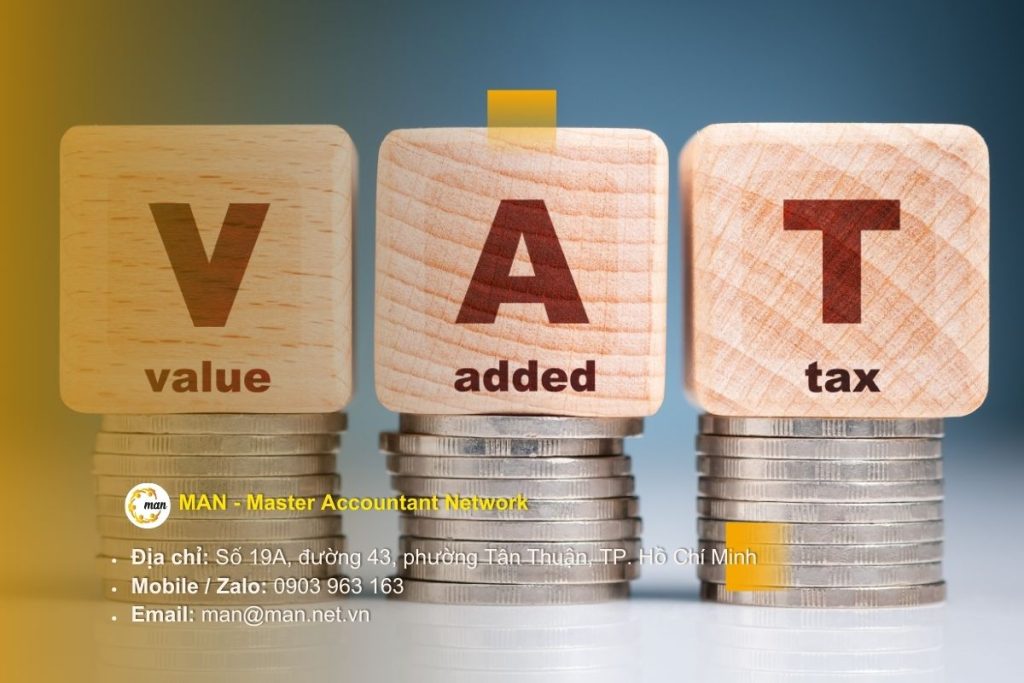
Value Added Tax (VAT) is an indirect tax levied on the added value of goods and services generated during the process from production and distribution to consumption. In the commercial sector, VAT arises when businesses engage in buying, selling, and distributing goods. Unlike manufacturing businesses, commercial enterprises primarily act as intermediaries; therefore, tax management focuses on the difference between input and output values.
Why are commercial enterprises a key target?
Commercial businesses typically have a high frequency of transactions, a large number of invoices, and a diverse range of goods. This makes managing VAT in commerce more complex, requiring accountants to be extremely meticulous in classifying tax rates and reconciling payment documents.
Taxable and non-taxable items in trade.
Correctly identifying the taxable entity is the first step in accurately calculating the amount of commercial VAT payable.
Taxable goods
Most types of mobile goods, machinery, equipment, and consumer goods that are bought and sold in stores, supermarkets, and dealerships are subject to Value Added Tax (VAT).
Goods not subject to tax
Some specific items in the trade sector are not subject to taxation, including:
- Agricultural products, livestock, aquaculture products (both farmed and wild-caught) that have not been processed into other products or have only undergone basic processing at the production or harvesting stage before being sold.
- Goods imported or transiting through Vietnamese territory.
- Computer software (as regulated by law).
However, it should be noted that not every case of "tax-free" goods means that the business has no obligation to declare taxes. In fact, VAT law specifically stipulates a group of goods that are not required to declare or pay taxes. This concept is easily confused if accountants do not clearly distinguish it from goods that are not tax-free. Understanding this boundary correctly is especially important in accounting and deducting input VAT.
Subjects not required to declare or pay taxes.
This is a common mistake made by commercial VAT accountants. According to Article 5 of Circular 219/TT-BTC, businesses and cooperatives paying VAT using the deduction method that sell unprocessed agricultural, livestock, and aquatic products, or products that have only undergone basic processing, to businesses and cooperatives in the commercial trading stage are not required to declare or pay VAT, but are entitled to deduct input VAT.
Commercial VAT rates for 2025
The year 2025 will see a clear differentiation in tax rates aimed at supporting business recovery.
- Level 0%: Applies to commercial goods exported abroad, into free trade zones. Mandatory requirements include an export contract, bank payment documents, and a customs declaration.
- Level 5%: Applies to essential items such as clean water, fertilizers, animal feed (according to specific categories), and medical equipment.
- Level 8% (Special Preferential Rate): Continued application in 2025 according to Decree 174/2025/ND-CP for product groups currently subject to tax under level 10%, except for certain sectors such as telecommunications, finance, banking, securities, insurance, and real estate business…
- Level 10%: Applies to other ordinary commercial goods not included in the list of items eligible for reduced tax or preferential tax rates.
After determining the applicable VAT rate for commercial transactions in 2025 (0%, 5%, 8%, or 10%), the next issue that businesses need to pay special attention to is how to calculate VAT correctly and most advantageously. Because with the same tax rate, choosing the appropriate tax calculation method will directly affect the amount of tax payable, the ability to deduct input tax, and the cash flow efficiency of the trading enterprise.
Methods for calculating VAT on commercial transactions.
Commercial enterprises can choose one of the following two methods depending on their size and capabilities:
Deduction method
This is the method used by most medium and large-sized commercial VAT businesses.
- Recipe:
|
VAT payable = Output VAT – Input VAT eligible for deduction |
- Benefit: Businesses can deduct the taxes already paid at the purchasing stage, helping to reduce product costs.
- Conditions: VAT invoices must be used, accounting procedures must be fully implemented, and cashless payments must be made for invoices of 20 million VND or more.
Direct revenue-based method
This typically applies to household businesses or enterprises with revenue under 1 billion VND (who do not voluntarily register for tax deduction).
Recipe:
|
VAT payable = Revenue x Rate |
However, choosing the correct method for calculating commercial VAT is only a necessary condition. In reality, many businesses are still subject to back taxes and penalties not because of incorrect calculation formulas, but because of misdetermining the timing of tax liability. This is a key factor directly affecting the tax declaration period, payment deadlines, and audit risks. Therefore, businesses need to pay special attention to determining commercial VAT at the correct time according to legal regulations.
Time of determining commercial VAT

Incorrectly determining the timing can lead to administrative penalties for tax violations. The golden rule in commercial VAT is:
- For the sale of goods: This is the moment when ownership or the right to use the goods is transferred to the buyer, regardless of whether payment has been received or not.
- Special note: If a business issues an invoice before delivery to formalize the documentation, the tax calculation date is the invoice date.
Specifically, the penalties for errors regarding timing are stipulated in Decree 125/2020/ND-CP:
- Warning penalty: Applied to the act of issuing invoices at the wrong time but not resulting in a delay in fulfilling tax obligations and with mitigating circumstances.
- A fine of VND 3,000,000 to VND 5,000,000 will be applied to the act of issuing invoices at the wrong time but without resulting in a delay in fulfilling tax obligations (except for the warning penalty mentioned above).
- Fines ranging from VND 4,000,000 to VND 8,000,000: This applies to the act of issuing invoices at the wrong time according to the law on invoices for the sale of goods and provision of services (this is the most common fine when back taxes are collected).
- Penalties for tax evasion: If the delay in issuing invoices leads to a delay in tax declaration, the business may be fined from 1 to 3 times the amount of tax evaded (depending on the severity of the violation and the number of repeat offenses).
- Late payment penalty: In addition to the fine, businesses must pay a late payment penalty at a rate of 0.03%/day calculated on the amount of tax overdue.
Determining the correct timing for calculating commercial VAT not only dictates the filing period but also directly impacts the amount of tax payable, the risk of back taxes, and penalties. However, even with a clear understanding of when the tax liability arises, incorrect filing, failure to separate preferential tax rates, or errors in the declaration form can still pose significant risks during tax audits. Therefore, a thorough understanding of the process and methods for filing commercial VAT in 2025 is an indispensable next step to ensure compliance and optimize tax obligations.
Instructions for declaring VAT on commercial transactions.
To ensure accurate and minimally erroneous declaration of commercial VAT in 2025, and to avoid the risk of retroactive tax collection, accountants need to strictly follow the declaration process step by step, from data preparation to completing the declaration form and paying the tax. Below are the steps for declaring commercial VAT that businesses should not overlook.
Step 1: Prepare the data
Gather all input invoices (purchases, administrative expenses) and output invoices for the period (month or quarter).
Step 2: Fill out the declaration form on the HTKK system.
Use form 01/GTGT (for the deduction method). Note the following when declaring items eligible for tax reduction under form 8%:
- Accountants must prepare an Appendix for VAT reduction according to the form prescribed in Decree 174/2025/ND-CP to separate revenue under tax rates 8% and 10%.
- Ensure that indicators [32] and [33] on the declaration form match the total figures in the Appendix.
Step 3: Declare through the e-commerce platform.
From July 1st, 2025, e-commerce platforms with payment functionality must deduct and pay VAT on behalf of individuals and household businesses selling goods on their platforms. Businesses selling through these platforms need to carefully review reports from the platforms to accurately declare the amount of VAT deducted at source.
Although the VAT declaration process for commercial transactions in 2025 has been standardized and strongly supported by electronic software, in reality, even a small oversight in preparing the declaration, tax reduction appendix, or invoice reconciliation can cause businesses to face the risk of tax arrears and penalties. This is why accountants and business owners need to pay special attention to the common mistakes below to proactively prevent them from the start.
Common mistakes

Below are some common mistakes compiled by MAN – Master Accountant Network. To avoid risks during a commercial VAT audit:
- Forgetting the tax reduction appendix: Many accountants issue invoices under form 8% but fail to include the appendix when filing tax returns, leading to the tax authorities rejecting the preferential tax rate.
- Non-cash invoice deduction: For large commercial shipments, the transfer must be made from the buyer's company account to the seller's company account. If the transfer is made by an individual, the input VAT will be disallowed.
- Invoices from businesses that have absconded: It is necessary to regularly check the operational status of suppliers on the General Department of Taxation's portal to avoid purchasing "junk invoices".
In reality, seemingly minor errors in invoice declaration, payment, and control are the leading causes of businesses having expenses disallowed, taxes collected retrospectively, and even losing their right to VAT refunds. Therefore, to avoid risks and properly utilize their rights, commercial enterprises need to clearly understand the conditions, documents, and procedures for VAT refunds according to current regulations.
VAT refund in commercial activities
Tax refunds are a "privilege" for businesses, but they also come with a rigorous verification process.
- Export tax refund: Exporting trading businesses with uncredited input VAT of VND 300 million or more are eligible for a monthly or quarterly tax refund.
- Documents: Contract, customs declaration, and bank payment receipt are three essential elements.
VAT refunds help businesses recover the cash already paid, but that's only addressing the symptoms. To sustainably and proactively reduce tax pressure in the long term, commercial enterprises need to develop an optimal VAT strategy right from the purchasing and inventory management stages to invoicing and tax declaration.
Strategy for optimizing VAT on trade
To legally minimize tax payments, businesses should:
- Supplier selection: Prioritize businesses that pay taxes using the deduction method so that you can obtain input invoices (8-10%).
- Inventory control: Avoid fictitious inventory (goods sold but not yet invoiced) as this can lead to the risk of tax arrears and heavy penalties.
- Technology update: Utilize accounting software with features that automatically reconcile electronic invoices to minimize human error.
Conclude
In 2025, the Value Added Tax (VAT) on commercial transactions is no longer simply a matter of declaration and payment, but has become a factor directly affecting the cash flow, profits, and tax safety of businesses. Understanding the correct tax rates, applying the correct tax calculation methods, and proactively developing a legally sound VAT optimization strategy will help businesses minimize the risk of tax arrears and effectively utilize the tax reduction policy under Article 21 of the 2018/2020.
In the context of increasingly stringent regulations and more frequent tax audits, partnering with a specialized accounting and tax consulting firm will help commercial businesses focus on their core operations with peace of mind. If you need to review your VAT tax records, optimize tax declarations (8% – 10%), or build a standard accounting system from the start, contact MAN – Master Accountant Network for advice on suitable solutions to protect your business's long-term interests.
Contact information MAN – Master Accountant Network
- Address: No. 19A, Street 43, Tan Thuan Ward, Ho Chi Minh City
- Mobile/Zalo: 0903 963 163 – 0903 428 622
- Email: man@man.net.vn
Content production by: Mr. Le Hoang Tuyen – Founder & CEO MAN – Master Accountant Network, Vietnamese CPA Auditor with over 30 years of experience in Accounting, Auditing and Financial Consulting.
MAN Editorial Board – Master Accountant Network