
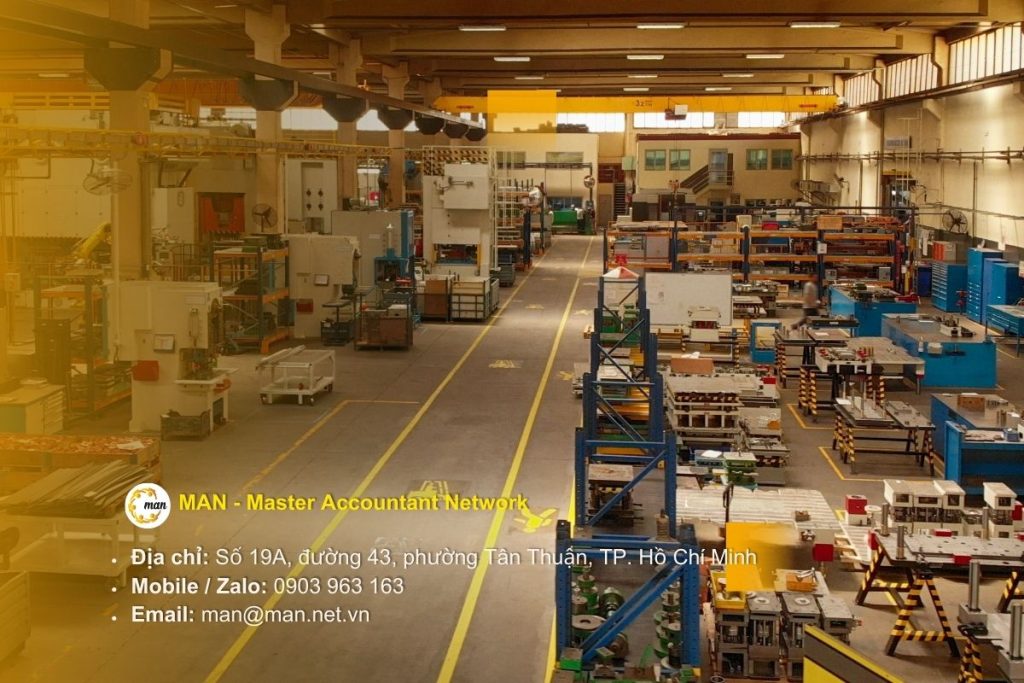
The accounting process in a manufacturing enterprise is not just a series of cost accounting operations, but also a tool for controlling costs, optimizing profits, and minimizing tax risks for the business. From the practical perspective of a Chief Accountant, this article comprehensively analyzes the manufacturing accounting process according to the new 2026 standards, from the legal basis, methods of cost collection and allocation, cost calculation, to common "pain points" and effective internal control solutions. This is an in-depth document for accountants, managers, and manufacturing enterprises seeking a systematic process that complies with the law and serves well for long-term financial management.
What is the accounting process for a manufacturing company?
The accounting process for a manufacturing enterprise encompasses all systematically organized accounting procedures aimed at recording, aggregating, and allocating production costs, calculating product costs, and reflecting the business results of a manufacturing enterprise in accordance with legal regulations and for internal management purposes.
In other words, this is the "financial backbone" that helps businesses know exactly how much it costs to produce a product, whether they make a profit or loss at each stage, thereby controlling costs and making effective operational decisions.
Characteristics of the accounting process in the manufacturing industry
This is clearly demonstrated by the broad scope of operations and the close linkage between accounting, inventory, and workshops, meaning that accounting work goes beyond simply recording expenses and must also track the entire product creation process, specifically:
- It involves many factors such as raw materials, labor, and general production costs;
- The accounting process is more complex than in other industries, requiring tracking of each stage of production;
- They frequently use specific cost allocation and pricing methods.
The unique characteristics of manufacturing operations, from long production cycles and large cost volumes to the simultaneous occurrence of multiple types of costs in the factory, have made manufacturing accounting the most complex area within the corporate accounting system. To control costs, ensure accurate data, and comply with legal regulations, businesses must establish a systematic and comprehensive manufacturing accounting process, from input to finished product.
See more: Accounting documents according to Circular 200/2014/TT-BTC
Accounting procedures for manufacturing businesses.
In manufacturing businesses, production accounting is the department responsible for accurately recording transactions and tracking the costs involved in producing a product. The entire accounting process typically revolves around three steps, specifically as follows:
Step 1: Gather the documents
Accountants are responsible for collecting, reviewing, and reconciling documents related to production activities, ensuring that accounting records are complete, accurate, and follow proper procedures. Specifically:
- Invoice documents: Must fully meet the requirements of legality, validity, and reasonableness, clearly showing the content of the transaction for the purchase and sale of goods or provision of services as prescribed by law.
- Bank documents: These include debit notes, payment orders, checks, and other non-cash payment documents, used to record and control financial transactions between businesses and credit institutions.
Step 2: Enter the documents into the ledger.
After gathering the documents, the accountant records them accurately in the accounting books, adhering to accounting principles:
- Analyzing the transaction: Accountants use the content of the documents to determine the correct economic nature of the transaction, and then select the appropriate debit and credit accounts according to current accounting regulations.
- Recording in the accounting system: Perform full accounting entries in the general journal and ledger, ensuring that entries are recorded in the correct chronological order and accurately reflect each transaction.
- Review and reconcile data: Conduct cross-checking between accounting records, original documents, and related reports to promptly detect discrepancies and ensure the accuracy and consistency of accounting data.
Step 3: Gather costs
The accountant compiles, categorizes, and allocates costs to calculate the cost of goods sold in the following order:
- Cost aggregation and classification: Accountants review and break down costs according to their constituent elements, such as direct material costs, direct labor costs, depreciation costs of fixed assets, and general manufacturing overheads.
- Determining product cost: Based on the accumulated costs, the accountant makes a reasonable allocation between direct and indirect costs to calculate the actual cost of each product or each production order.
- Performing the closing expense transfer: After completing the cost calculation, all production costs are transferred according to regulations to determine the business results for the accounting period.
Details of accounting procedures for manufacturing enterprises according to Circular 200/2014/TT-BTC
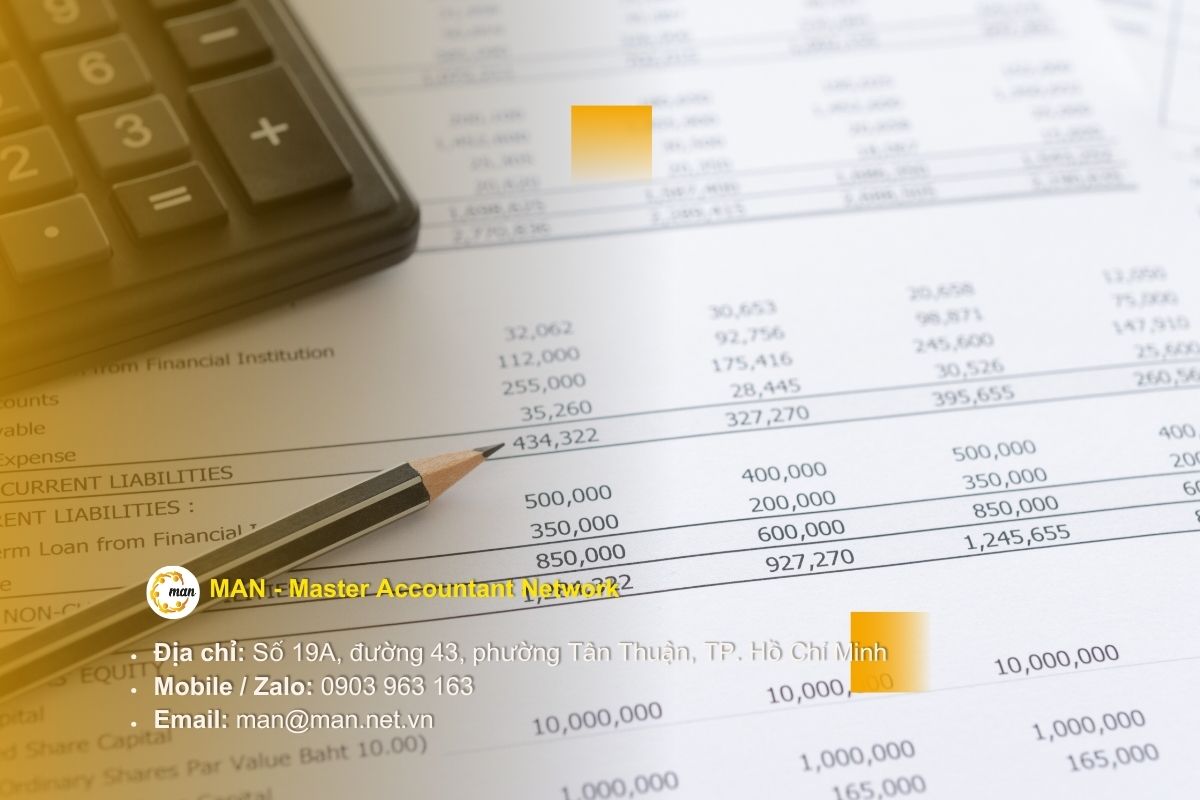
In general, production accounting according to Circular 200/2014/TT-BTC requires the accurate recording and reasonable allocation of costs incurred during the production process to ensure compliance with the law and provide accurate and timely financial data.
Cost accounting in the production process
In the accounting process of manufacturing businesses, a thorough understanding of each accounting transaction according to Circular 200 is fundamental to controlling costs, accurately calculating production costs, and ensuring legal compliance. The table below summarizes basic manufacturing accounting transactions, helping accountants easily track, apply them consistently, and minimize errors in the process of recording expenses.
| Operations | Debit Account | The account has |
| Export main and auxiliary raw materials and fuel for production. | TK 621 | TK 152 |
| Issue materials to the workshop manager. | TK 627 | TK 152 |
| Calculating wages for direct production workers. | TK 622 | Account 334 |
| Calculate the salary of the workshop manager. | TK 627 | Account 334 |
| Social insurance, health insurance, and union dues are deducted and included in expenses. | Account 622, Account 627 | Account 338 |
| Deductions for social insurance and health insurance from employees' salaries. | Account 334 | Account 338 |
| Export tools and equipment for immediate use in production. | TK 627 | Account 153 |
| Export of high-value tools and equipment, allocated over multiple periods. | TK 242 | Account 153 |
| Allocate tools and equipment to general production costs. | TK 627 | TK 242 |
| Depreciation of fixed assets at the workshop | TK 627 | TK 214 |
| Expenses for utilities, repairs, and entertaining guests. | TK 627 | Accounts 111, 112, 331 |
| Deduction of vacation pay | Account 622, 627 | Account 335 |
| Provision for major repair costs of fixed assets. | TK 627 | Account 335 |
All costs incurred during the production process must be collected and accurately reflected in each cost element (621, 622, 627) according to the nature of the transaction. Complete, timely, and accurate accounting not only helps businesses calculate product costs correctly but also serves as a crucial basis for cost control, management, and risk mitigation during audits and tax settlements.
Closing entries and cost calculation at the end of the period (perpetual accounting)
At the end of the accounting period, all costs incurred during the production process need to be collected, allocated, and transferred to determine the cost of goods sold according to its true economic nature. For businesses applying the perpetual inventory method, the journal entries for transferring raw material costs, labor costs, and general production costs play a crucial role in accurately reflecting work-in-process inventory costs and cost of goods sold. Below are common journal entries for transferring and calculating the cost of goods sold at the end of the period, according to Circular 200, that accounting professionals in manufacturing businesses need to understand.
| Case | Debit Account | The account has |
| Transfer of direct material costs | TK 154 | TK 621 |
| Transfer direct labor costs | TK 154 | TK 622 |
| Allocate all overhead costs when operating above normal capacity. | TK 154 | TK 627 |
| Allocate manufacturing overhead costs when operating below normal capacity. | Account 154, 632 | TK 627 |
The transfer of costs and allocation of cost at the end of the period must be carried out consistently according to the criteria selected at the beginning of the period (labor, machine hours, or main raw materials). For excess costs or fixed overhead costs that are not allocated, accounting must record them directly in the cost of goods sold (Account 632) to ensure that the product cost accurately reflects reality and complies with the regulations of Circular 200. This is a crucial step that determines the accuracy of the cost, profit, and the level of risk when tax authorities conduct audits and inspections.
Handling specific situations in the accounting process of manufacturing businesses.
In the accounting process of a manufacturing enterprise, in addition to the usual cost accounting transactions, accountants must also handle many specific situations such as defective products, outsourcing, trial production, or material discounts after use. Accurate accounting of these transactions is crucial for controlling costs and ensuring that accounting data accurately reflects the nature of production activities.
| Operations | Debit Account | The account has |
| Raw materials processed by external contractors are returned to the warehouse. | TK 152 | TK 154 |
| Defective products must be compensated. | Account 138, 334 | TK 154 |
| Costs exceed normal levels (for long-term manufacturing businesses) | Account 632 | TK 154 |
| Receive finished goods into inventory. | TK 155 | TK 154 |
| For internal use only. | Accounts 641, 642, 241 | TK 154 |
| Receive discounts and price reductions on raw materials already shipped. | Accounts 111, 112, 331 | TK 154, 133 |
Specific accounting transactions in manufacturing require separate tracking and accurate economic accounting to ensure that product costs truthfully reflect actual expenses. Accurate handling of excess expenses, defective products, trial production, or internal use not only helps businesses comply with accounting regulations but also reduces the risk of expenses being disallowed during audits and tax settlements.
Accounting for trial production products in the accounting process of a manufacturing enterprise.
In the accounting process of manufacturing businesses, trial production costs mainly arise during the investment phase, line testing, or technology refinement. Incorrect accounting of trial production costs can distort asset values, cost of goods sold, and business results. The table below summarizes common trial production accounting transactions according to Circular 200, helping accountants easily apply the regulations correctly and consistently.
| Case | Debit Account | The account has |
| Sell or recall the prototype product. | Accounts 111, 112, 131 | Account 154, 3331 |
| The cost of trial production exceeded the amount recovered. | Account 241 | TK 154 |
| The cost of trial production is less than the amount recovered. | TK 154 | Account 241 |
| The finished product is delivered directly to the customer. | Account 632 | TK 154 |
Accounting for trial production needs to be done separately, accurately reflecting the nature of costs and the return on investment for each case. Properly implementing this process in the accounting procedures of a manufacturing enterprise not only helps the business accurately control initial investment costs but also reduces the risk of cost discrepancies and disputes during tax settlement.
Accounting using the periodic inventory method.
At the beginning of the accounting period, work-in-process inventory costs are transferred to calculate the cost of goods sold for the new period.
Note:
- Debit Account 631 – Cost of Production
- Account 154 exists – Work-in-progress production and business costs.
At the end of the accounting period, the results of the physical inventory count are used to determine the cost of work-in-progress production and business.
Perform the expense transfer and record the following:
- Debit Account 154 – Work-in-progress production and business costs
- Account 631 – Production Costs
Difficulties in the accounting process of manufacturing businesses.

In practice, accountants in manufacturing businesses have to handle many complex tasks simultaneously, from tracking costs and managing documents to controlling inventory. These pressures require accountants to not only possess strong professional knowledge but also to effectively apply modern management tools to ensure accurate and timely data.
- Identifying and allocating production costs: Accurately identifying direct and indirect costs is fundamental to calculating product cost. Even a slight discrepancy in allocation can distort the cost, leading to risks of inaccurate financial reporting and flawed management decisions.
- Document management and control: Production activities generate continuous transactions such as purchasing raw materials, issuing inventory for production, paying workers' salaries, etc., leading to a rapid increase in the volume of documents. If documents are not standardized or controlled consistently, accounting will face many difficulties and potential risks during tax audits and inspections.
- Fluctuations in input material prices: Frequent changes in raw material prices according to market conditions make cost forecasting difficult. This directly impacts the determination of product cost and profit margin in each production period.
- Real-time cost monitoring and analysis: Production accountants need to monitor costs throughout the production process to promptly detect and adjust unreasonable expenses. However, this requirement can only be effectively met when the business possesses a synchronized, fast-updating, and accurate data management system.
- Inventory and Work-in-Process Management: Controlling raw material, semi-finished product, and work-in-process inventory requires a rigorous process to minimize waste or shortages in production. Inefficient inventory management can increase storage costs or disrupt production operations.
- Overall control of production costs: Production costs are simultaneously affected by labor productivity, machinery operating efficiency, and adherence to material consumption standards. To effectively control these costs, accounting needs to coordinate closely with relevant departments and possess the ability to proactively analyze and forecast costs.
Conclude
It is clear that the accounting process in manufacturing businesses goes beyond simply recording expenses or preparing financial statements; it plays a crucial role in cost control, evaluating production efficiency, and preventing tax risks. In the context of a constantly changing legal framework and increasing demands for transparency, a well-structured, up-to-date accounting process closely aligned with production realities is the foundation for stable operation and sustainable business development.
However, not all businesses have the resources to build and maintain a proper production accounting system, especially small and medium-sized enterprises. In such cases, the choice of business accounting services In-depth knowledge and understanding of specific production processes will help businesses ensure compliance with the law, optimize costs, and obtain reliable financial data for long-term management decisions.
A good accounting system not only "records the past" but also helps businesses see the present clearly and proactively plan for the future.
Contact MAN – Master Accountant Network for detailed advice and timely support. MAN looks forward to partnering with your business!
Contact information MAN – Master Accountant Network
- Address: No. 19A, Street 43, Tan Thuan Ward, Ho Chi Minh City
- Mobile/Zalo: 0903 963 163 – 0903 428 622
- E-mail: man@man.net.vn
Content production by: Mr. Le Hoang Tuyen – Founder & CEO MAN – Master Accountant Network, Vietnamese CPA Auditor with over 30 years of experience in Accounting, Auditing and Financial Consulting.
MAN Editorial Board – Master Accountant Network