
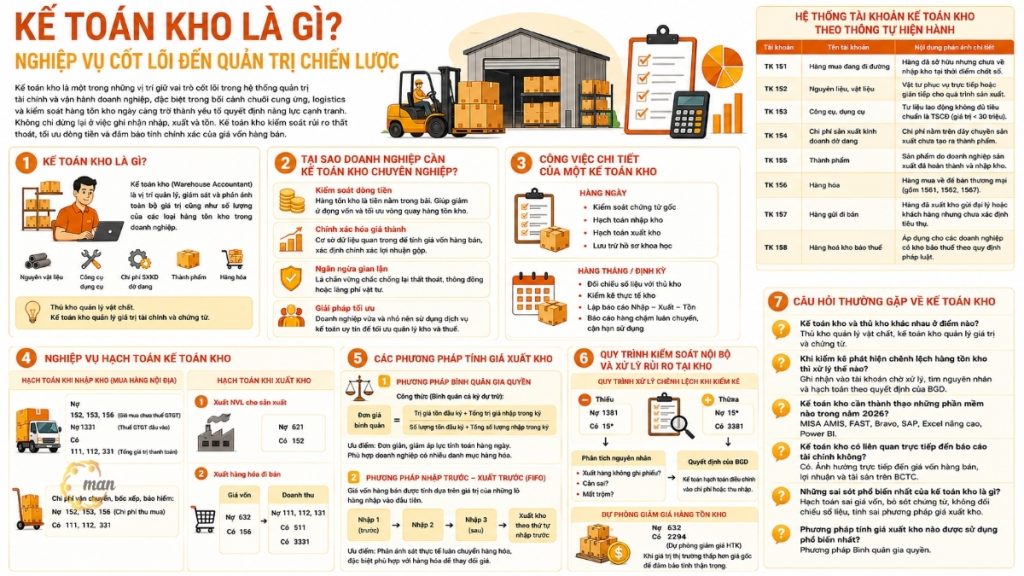
Inventory accounting is a core role in the financial management and operational systems of businesses, especially in the context where supply chains, logistics, and inventory control are increasingly becoming decisive factors in competitiveness. It goes beyond simply recording incoming, outgoing, and inventory levels. Inventory accountants control the risk of loss, optimize cash flow, and ensure the accuracy of the cost of goods sold. This article will provide a comprehensive guide covering definitions, job descriptions, accounting systems, accounting procedures, methods for calculating the cost of goods sold, and necessary skills, helping businesses and professionals master all aspects of inventory accounting according to the latest regulations of 2026.
What is inventory accounting?
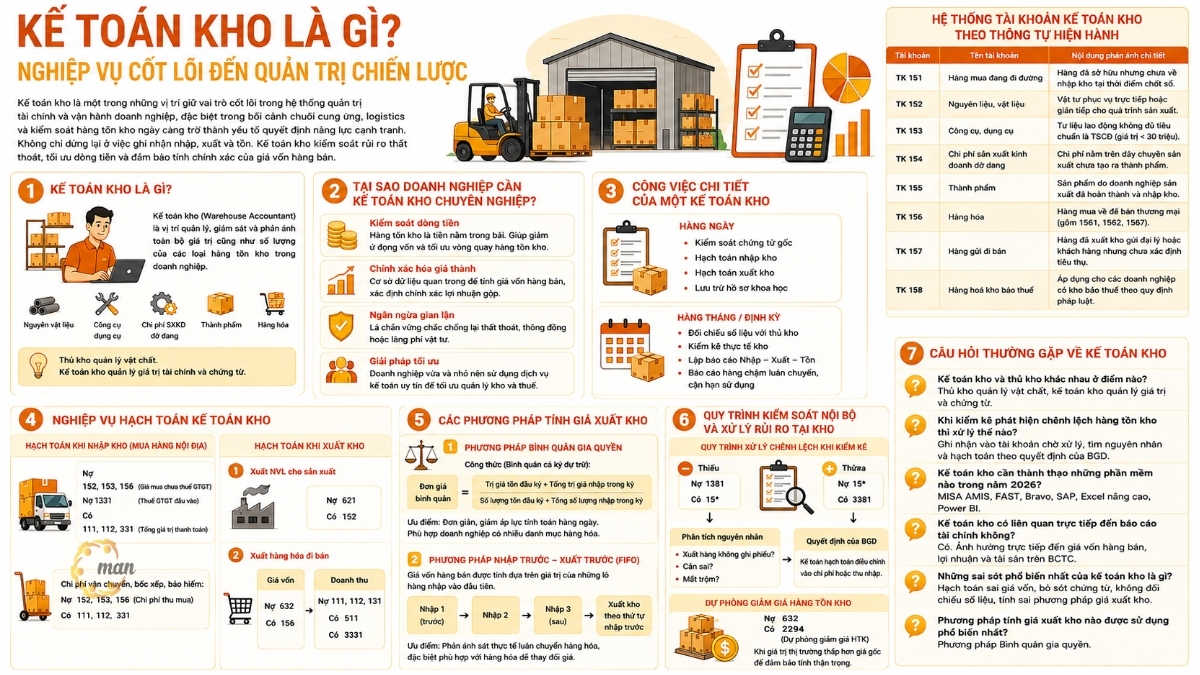
A warehouse accountant is responsible for managing, monitoring, and recording the entire value and quantity of inventory within a business. This inventory includes raw materials, tools and equipment, work-in-progress, finished goods, and commercial merchandise.
The biggest difference between a warehouse manager and a warehouse accountant lies in the nature of their management. While a warehouse manager focuses on the physical preservation (location, security, temperature), a warehouse accountant focuses on the legal validity of documentation and the financial value of the goods.
Why do businesses need a professional inventory accountant?
In the era of automation, the role of warehouse accountants is becoming more important than ever because:
- Cash flow control: Inventory is essentially money sitting idle. A good inventory accountant helps minimize capital stagnation and optimize inventory turnover.
- Accurate cost calculation: This is the most important data for calculating the cost of goods sold, thereby accurately determining the company's gross profit.
- Fraud prevention: Inventory accounting control systems are a strong shield against misappropriation, collusion, or waste of materials during the production process.
For small and medium-sized enterprises that have not yet built a complete human resources system in their own way, seeking the services of external providers is a viable option. accounting services Reputation is the optimal solution for improving warehouse management and tax documentation systems.
Detailed job description of an inventory accountant.

The work of an inventory accountant is divided into distinct time cycles to ensure continuity and prevent the omission of transactions.
Daily tasks:
- Control of original documents: Receiving import or export request forms, invoices, and quality inspection reports. Ensure that all transactions are validly documented before recording them in the ledger.
- Inventory accounting: Based on the purchase invoice or inventory order from the production department, record the increase in assets in the software.
- Inventory accounting: Based on the sales order or the order to issue raw materials for production, the inventory accountant must apply the correct method for calculating the cost of goods sold that the business has registered.
- Record keeping: Organize documents systematically (by time, by subject) to facilitate tax settlement and auditing later.
Tasks to be performed monthly and periodically:
- Data reconciliation: This is a very important task. The warehouse accountant must reconcile the balances in the software with the detailed ledger kept by the warehouse manager. Any discrepancy, even if it's just one unit, must be investigated to find the cause.
- Physical Inventory: Directly participate in periodic inventory checks (monthly/quarterly/annually). Prepare inventory reports and propose solutions if there are discrepancies (excess or shortage).
- Prepare comprehensive reports: Build inventory reports (Inflow, Outflow, and Stock). In particular, report on slow-moving or near-expired items so that Management can develop plans to reduce excess inventory.
Inventory accounting chart of accounts according to current Circular
To perform their job accurately, warehouse accounting personnel need to have a thorough understanding of the accounting system. Circular 200/2014/TT-BTC and Circular 133/2016/TT-BTC.
| Account | Account name | The content reflects the details. |
| TK 151 | The purchased goods are in transit. | Goods were in possession but had not yet been received into inventory at the time of closing the books. |
| TK 152 | Raw materials | Materials that directly or indirectly support the production process. |
| Account 153 | Tools and equipment | Labor resources that do not qualify as fixed assets (value < 30 million). |
| TK 154 | Work-in-progress production costs | The costs are incurred in the production line before any finished product is created. |
| TK 155 | finished product | The products manufactured by the company have been completed and stored in the warehouse. |
| Account 156 | Goods | Goods purchased for commercial resale (including 1561, 1562, 1567). |
| Account 157 | Goods sent for sale | Goods have been shipped from the warehouse to dealers or customers, but their consumption has not yet been determined. |
| Account 158 | Goods in bonded warehouses | This applies to businesses that have bonded warehouses as stipulated by law. |
Mastering the inventory accounting system not only helps warehouse accountants accurately record each transaction but also forms a crucial foundation for cost control, asset management, and transparent financial reporting. Each account reflects a different stage in the inventory lifecycle, from purchase, production, storage to consumption. Understanding the nature and correctly applying the accounts will help businesses minimize errors in tax settlement, while simultaneously improving inventory management efficiency and optimizing cash flow in production and business operations.
Inventory accounting procedures
Accurate accounting entries are a mandatory requirement. Below are the key journal entries that inventory accountants need to be aware of:
Accounting upon receiving goods into inventory (Domestic purchases)
When goods or materials are received into the warehouse, the accountant records the following:
- Debit accounts 152, 153, 156 (Purchase price excluding VAT)
- Debit Account 1331 (Input VAT that is deductible)
- Accounts 111, 112, and 331 (Total payment value)
Note: If transportation, loading, or insurance costs for purchased goods arise, the warehouse accountant must allocate them and add them to the cost of goods sold.
- Debit accounts 152, 153, 156 (Procurement expenses)
- There are accounts 111, 112, and 331.
Accounting when goods are withdrawn from inventory.
In the case of issuing raw materials for production:
- Debit Account 621 (Direct Material Costs)
- There is account 152 (Raw materials).
When goods are shipped for sale, two accounting entries must be made simultaneously to ensure the matching principle is followed.
Cost of goods sold entry:
- Debit Account 632 (Cost of Goods Sold)
- Account 156 (Goods)
Revenue entry:
- Debit accounts 111, 112, 131
- There is account 511 (Sales revenue).
- There is account 3331 (Output VAT).
In large businesses, this position is often closely supervised by higher levels of management to ensure transparency. For companies undergoing digital transformation or lacking senior management personnel, this option... hire chief accountant Experienced professionals will help businesses establish a scientific inventory control process from the outset, minimizing the risk of tax arrears due to errors in inventory documentation.
Methods for calculating the cost of goods sold.
The choice of pricing method directly impacts a business's profitability. Inventory accountants need to master the following formulas:
Weighted Average Method
This is the most common method used in accounting software today.
The formula for the average inventory over the entire period:
|
Average unit price = (Beginning inventory value + Total value of purchases during the period) / (Beginning inventory quantity + Total quantity purchased during the period) |
Advantage: Simple, reduces daily calculation burden. Suitable for businesses with many product categories.
First-In, First-Out (FIFO) method
The First In, First Out (FIFO) method is a stock management and asset valuation principle that assumes goods that enter inventory first will be shipped out first. Ending inventory will consist of the most recently received items.
The cost of goods sold is calculated based on the value of the initial shipments.
For example: Let's assume the company sells fashionable t-shirts and has the following transactions for the month:
- Beginning inventory: 100 products (Price: 120,000 VND/product)
- On May 8th, 2026, we received an additional shipment of 300 products (priced at 100,000 VND per product).
- 350 products were sold on May 15, 2026.
The calculation for 350 shirts sold is as follows:
- Take the first 100 products from the beginning inventory: 100 x 120,000 = 12,000,000 VND.
- Take another 250 products from the shipment on May 8th: 250 x 100,000 = 25,000,000 VND.
Total cost of goods sold = 12,000,000 + 25,000,000 = 37,000,000 VND
There are 50 remaining items from the May 8th batch, priced at 100,000 VND each.
Internal control and risk management procedures at the warehouse.
An excellent warehouse accountant is someone who is always one step ahead in risk prevention.
Procedure for handling discrepancies during inventory
When discrepancies are found between the accounting records and the actual figures, the accountant needs to take immediate action:
- If there is a shortage: Debit Account 1381 (Assets awaiting processing) / Credit Account 15*.
- If there is a surplus: Debit Account 15* / Credit Account 3381 (Surplus assets awaiting processing).
- Analyzing the cause: Was it due to the warehouse manager failing to record the shipment on the receipt? Was it due to incorrect weighing? Or was it due to theft? After the Board of Directors makes a decision, the accountant will then make the adjusting entry to the expense or income.
Provision for inventory devaluation
At the time of preparing the financial statements, if the market value of inventory is lower than its cost, the inventory accountant must create a provision to ensure prudence:
- Debit Account 632 (Cost of Goods Sold)
- There is account 2294 (Provision for inventory devaluation).
Frequently Asked Questions about Inventory Accounting
Warehouse accountants are responsible for managing documents and accounting for incoming, outgoing, and inventory. They reflect the financial value of goods in the accounting books. Meanwhile, the warehouse manager directly manages goods in the warehouse, including storage, arrangement, receiving and dispatching materials, and conducting physical inventory counts. These two positions must coordinate closely to ensure that the data matches the actual inventory and the system.
The warehouse accountant needs to prepare an inventory report, determine the cause, and temporarily record the discrepancy in a pending account such as Account 1381 (shortage) or Account 3381 (excess). Only after a decision is made by the Board of Directors can the difference be transferred to expenses, other income, or the compensation liability of the relevant individual.
In addition to advanced Excel skills, warehouse accountants need to be proficient in accounting and ERP software such as MISA, FAST, SAP, Oracle, or Bravo, depending on the size of the business. Furthermore, understanding barcodes, QR codes, RFID, and Power BI is a significant advantage in a modern warehouse management environment.
Yes. Data from inventory accounting directly impacts inventory levels, cost of goods sold, production costs, and business profits. If inventory figures are inaccurate, the entire financial statement, tax report, and business results can be severely affected.
Common errors include incorrect account entries, missing supporting documents, failure to reconcile data with warehouse managers, incorrect recording of the cost of goods sold, or delays in processing slow-moving inventory. These mistakes can lead to discrepancies in financial statements, incorrect cost of goods sold, and significant risks during tax settlement.
The most common method currently is the weighted average cost method because it is easy to apply in accounting software and suitable for businesses with many types of goods. In addition, the FIFO method is often used in the food, pharmaceutical, or goods with short shelf lives industries. What is the difference between an inventory accountant and a warehouse manager?
What should be done when an inventory check reveals discrepancies in stock?
What software programs will inventory accountants need to be proficient in by 2026?
Is inventory accounting directly related to financial reporting?
What are the most common mistakes made by inventory accountants?
Which method of calculating the cost of goods sold is most commonly used?
Conclude
Inventory accounting is not just about recording incoming, outgoing, and remaining stock; it's a crucial link in the entire financial management and operational system of a business. Mastering accounting practices, the chart of accounts, methods for calculating the cost of goods sold, and internal control procedures will help businesses minimize losses, optimize cash flow, and improve inventory efficiency. For professionals, this also provides a solid foundation for advancement to higher positions such as general accountant, cost accountant, or internal financial manager.
In the context of businesses increasingly focusing on transparency and operational efficiency in 2026, a professional inventory accounting system is a sustainable competitive advantage. If your business needs to review inventory processes, optimize accounting, or update to the latest accounting regulations, proactively consulting with experts is essential. accounting services company reputable, professional and experienced such as MAN – Master Accountant Network To achieve standardization, minimize tax, audit, and long-term governance risks, this is also the right time to invest in the right inventory accounting platform, because good inventory control means good control over business profits.
Contact MAN – Master Accountant Network For expert advice and support!
Contact information MAN – Master Accountant Network
- Address: No. 19A, Street 43, Tan Thuan Ward, Ho Chi Minh City
- Mobile/Zalo: 0903 963 163 – 0903 428 622
- Email: man@man.net.vn
Content production by: Mr. Le Hoang Tuyen – Founder & CEO of MAN – Master Accountant NetworkCPA Vietnam auditors with over 30 years of experience in accounting, auditing, and financial consulting.






