
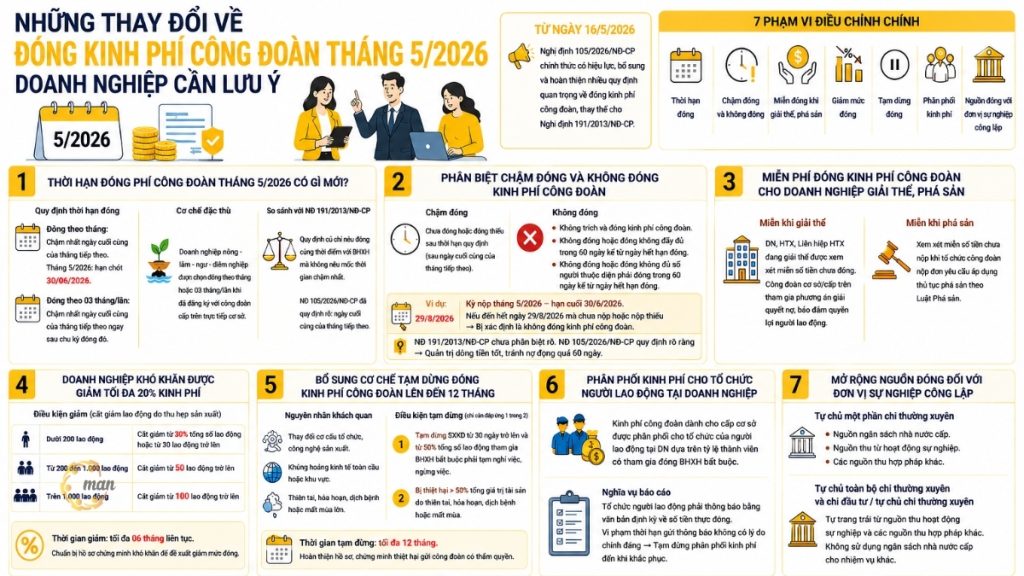
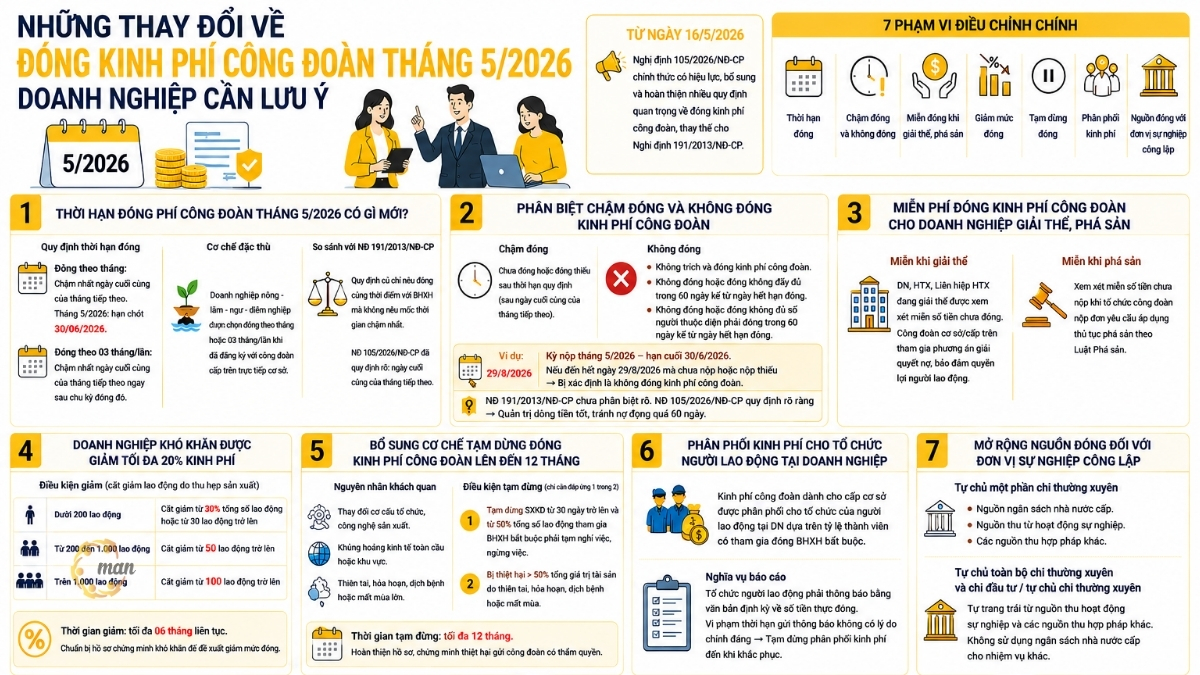
Entering the second quarter of 2026, the accounting community and business administrators are facing one of the biggest legal changes related to union financial obligations. Specifically, effective May 16, 2026, Decree 105/2026/ND-CP Officially effective, this new decree supplements and refines a series of groundbreaking regulations to replace outdated provisions in the previous Decree 191/2013/ND-CP.
For the Finance and Accounting department, understanding the new regulations regarding eligible contributors, payment deadlines, late payment penalties, and policies on exemptions, reductions, and temporary suspensions is crucial. To help your business proactively optimize cash flow and ensure maximum legal compliance, this article will provide a detailed analysis of the core changes to union fee payments for May 2026 that all employers must pay special attention to.
What's new regarding the deadline for paying union dues in May 2026?

The first and most direct change impacting the monthly accounting settlement process is the deadline for fulfilling payment obligations. Clearly defining this timeframe helps businesses avoid unnecessary legal risks associated with late payments.
The regulations specify the payment deadlines on a monthly and quarterly basis.
One of the notable new points in Article 4 of Decree 105/2026/ND-CP is that, for the first time, the legislature has specifically stipulated the deadline for paying trade union fees, instead of just stating it generally as before. Accordingly:
- For monthly payments: The deadline for payment is the last day of the following month. Therefore, the deadline for the company's union fee payment for May 2026 will be June 30, 2026.
- For payments made every three months: The deadline for payment is the last day of the month immediately following that payment cycle.
Special mechanisms for agricultural, forestry, fishery, and salt production enterprises.
To provide maximum support for industries dependent on seasonality, the new Decree maintains the spirit of facilitating businesses operating in agriculture, forestry, fisheries, and salt production. These units that pay wages according to the production and business cycle are still free to choose whether to pay monthly or quarterly, provided they register in advance with the directly superior trade union organization.
Comparison with the previous Decree 191/2013/ND-CP.
Decree 191/2013/ND-CP only vaguely stipulated that businesses pay trade union fees once a month at the same time as paying mandatory social insurance. The old regulation did not specify a deadline for fulfilling this obligation. This led to confusion for accountants when businesses faced temporary cash flow difficulties and wanted to postpone the payment without knowing whether they would be considered in violation. From the time the trade union fee for May 2026 is calculated according to Decree 105/2026, this period has been clearly defined by the last day of the following month.
Distinguishing between late payment and non-payment of trade union fees.
Clarifying the concepts of late payment and non-payment in Article 6 of Decree 105/2026/ND-CP is a major step forward in increasing transparency in administrative penalties for businesses. Although accountants often refer to it simply as the May 2026 union fee, it's crucial to understand that this is essentially a contribution from the employer to the 2% fund.
What constitutes late payment of union dues?
According to the latest guidelines, late payment is defined as a situation where a business has not paid or has paid but not in full the amount of trade union fees due after the deadline (i.e., after the last day of the following month for monthly payments). Accountants need to pay attention to this deadline to avoid prolonging the outstanding trade union fees for May 2026, preventing unforeseen legal risks.
Cases identified as not paying trade union fees.
More serious than the act of late payment, the new Decree clearly defines the cases considered as non-payment of trade union fees, including:
- The company completely failed to deduct and pay trade union fees as required by law.
- Businesses that fail to pay or pay only partially the amount due within 60 days from the payment deadline as stipulated.
- Businesses that fail to pay or pay insufficient amounts for the required number of employees within 60 days from the payment deadline as stipulated.
For example: For the May 2026 union fee payment, the deadline for monthly payment is June 30, 2026. If a business fails to pay or pays insufficient amounts by August 29, 2026, this will be considered a failure to pay union fees.
The importance of standardizing new legal definitions.
Previously, Decree 191/2013/ND-CP completely lacked specific regulations to distinguish between late payment and non-payment of trade union fees. From now on, risk management regarding outstanding trade union fees from May 2026 onwards has a very clear legal framework, requiring accounting departments to manage cash flow better and avoid outstanding debts exceeding 60 days.
Businesses that are dissolved or go bankrupt are exempt from paying union dues.

One of the most humane aspects of the new Decree is the addition of Chapter IV, which stipulates the exemption, reduction, and temporary suspension of trade union fees. This provides a crucial financial escape route for economic organizations on the verge of ceasing operations.
Conditions for exemption from contributions upon dissolution.
For businesses, cooperatives, and cooperative unions undergoing dissolution procedures, Article 11 of Decree 105 allows for consideration of exemption from unpaid trade union fees. To qualify for this mechanism, the grassroots trade union or a higher-level trade union must participate in the enterprise's debt settlement plan, ensuring that the rights of employees are harmonized and any outstanding trade union fees for May 2026 (if any) are settled completely according to the dissolution process.
Conditions for exemption from contributions in case of bankruptcy
In the case of a business facing bankruptcy, the consideration of waiving outstanding trade union fees will be triggered when the trade union files a request for bankruptcy proceedings as stipulated in the Bankruptcy Law. This is an important legal basis for tax authorities and trade unions to cooperate in debt restructuring and debt write-off for businesses that are no longer able to recover their cash flow.
Businesses facing difficulties can receive a maximum reduction of 20% in funding.

Besides the policy of exempting businesses from paying contributions if they cease operations, the State also issues practical support policies for businesses that are still operating but facing particular difficulties through a reduction in contribution rates.
Eligibility for reduced contribution rates is based on the size and percentage of workforce reductions.
To be considered for a reduction in the maximum trade union fee contribution under Decree 20% after the temporary suspension period has ended, businesses must demonstrate exceptional difficulties through the percentage of mandatory labor reductions due to production cuts. The level of difficulty is quantified as follows:
- For units with fewer than 200 employees: A reduction of 30 or more employees from the total workforce, or 30 or more employees from the total workforce, is required.
- For units with 200 to 1,000 employees: At least 50 employees must be laid off.
- For units with more than 1,000 employees: At least 100 employees must be laid off.
Timeframe for maximum contribution reduction under the new regulations: Accountants need to take note.
The maximum period for which a business is eligible for a reduced contribution rate is no more than 6 consecutive months. When calculating the May 2026 union fee, businesses should proactively compare their labor force data with the current figures to prepare a proposal for a reduced contribution rate if eligible. In cases where small and medium-sized enterprises (SMEs) face difficulties in management resources or lack senior personnel to perform this complex data verification task, a solution is... hire chief accountant External professionals would be the optimal choice to ensure the accuracy of records and protect the legal rights of the employer.
Adding a mechanism to temporarily suspend union fee payments for up to 12 months.
According to Article 13 of Decree 105/2026/ND-CP, employers may consider temporarily suspending trade union fee payments if they face difficulties due to the following objective reasons:
- Changes in organizational structure and production technology.
- Global or regional economic crises directly impact businesses.
- Natural disasters, fires, epidemics, or large-scale crop failures.
Specific conditions regarding the number of laid-off workers or property damage.
To prevent this policy from being exploited, the law sets out two very clear quantitative conditions. Businesses only need to satisfy one of the following two criteria to be able to apply for a temporary suspension of contributions:
- Production and business operations must be suspended for 30 days or more, and at least 50% of employees subject to mandatory social insurance must temporarily stop working or cease operations.
- Suffering severe damage exceeding 50% of the total value of the enterprise's assets due to natural disasters, fires, epidemics, or crop failures.
The maximum period for suspending contributions is up to 12 months. Accountants need to adhere closely to these quantitative standards to accurately complete the damage documentation submitted to the competent trade union for approval, in order to maximize the protection of the company's operating cash flow.
Funding allocation for employee organizations within enterprises.
Trade union fees collected at enterprises will no longer be automatically transferred entirely to the Vietnam General Confederation of Labor system as before. Instead, the workers' organization at the enterprise will be allocated a portion of the trade union funds for the grassroots level. The allocation ratio will be calculated fairly based on the percentage of members of that organization who participate in mandatory social insurance contributions at the unit.
Periodic reporting obligations of workers' organizations
Along with the right to receive financial benefits, the employee representative organization at the enterprise must periodically notify the enterprise in writing of the actual amount of union fees paid. If this organization violates the deadline for sending the notification without a valid and acceptable reason, the distribution of union fees may be suspended until the violation is rectified. This strict regulation helps to control the flow of union funds transparently, preventing loss or misuse.
Expanding funding sources for autonomous public service units.
The final reform targets the public administration sector, thoroughly addressing the obstacles arising from the process of socialization and financial autonomy in these units.
Funding sources for units that are partially self-sufficient in recurrent expenditures.
For public service units that partially self-finance their operating expenses, the trade union fee contributions will be flexibly drawn from:
- Funding is provided by the state budget as per regulations.
- Revenue from the unit's operational activities.
- Other legitimate sources of income as prescribed by law.
Funding is a requirement for units that are fully self-sufficient in both recurrent and investment expenditures.
For public service units that are fully self-sufficient in covering both recurrent and investment expenditures, or are self-sufficient in covering recurrent expenditures, the mandatory trade union fee must be entirely covered by the unit's own revenue from its operational activities and other legitimate sources of income. Under no circumstances should the unit use funds directly allocated from the state budget for other specific tasks when calculating trade union expenses.
If you don't have enough time to handle these complex administrative procedures yourself, delegating them to a service provider is a good option. accounting services Reputation will be the optimal solution to streamline processes, minimize legal risks, and help business owners focus on production and business operations most effectively.
Conclusion and recommendations for accountants when handling union fees.
To avoid legal troubles or missing out on legitimate cost-effective benefits, corporate accountants should immediately take the following steps regarding the union fee payment period.
- Review the employee list: Accurately compare the number of personnel participating in mandatory social insurance in May 2026 to correctly determine the payroll fund for trade union fee contributions (2%), in order to facilitate the correct payment of trade union fees for May 2026.
- Check payment cash flow: Ensure that the payment order for union dues for May 2026 is executed and completed no later than June 30, 2026 (if paid monthly).
- Proactively apply for preferential treatment: If your business is experiencing exceptional difficulties due to natural disasters, epidemics, or is undergoing large-scale workforce reductions, quickly compile the necessary data to submit an application for reduced or suspended contributions to the local labor union that directly manages your area.
Contact MAN – Master Accountant Network For free support and advice!
Contact information MAN – Master Accountant Network
- Address: No. 19A, Street 43, Tan Thuan Ward, Ho Chi Minh City
- Mobile/Zalo: 0903 963 163 – 0903 428 622
- Email: man@man.net.vn
Content production by: Mr. Le Hoang Tuyen – Founder & CEO of MAN – Master Accountant NetworkCPA Vietnam auditors with over 30 years of experience in accounting, auditing, and financial consulting..






