
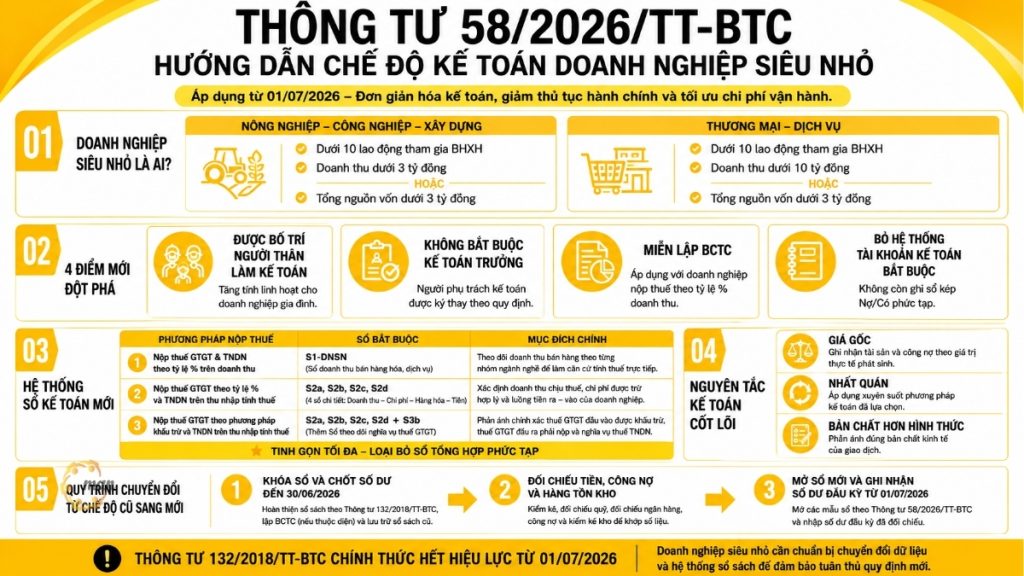
Circular 58/2026/TT-BTC Several important changes to the accounting regime for micro-enterprises have been officially implemented, creating favorable conditions for small businesses, household businesses, and individual entrepreneurs to reduce administrative burdens, optimize operating costs, and improve financial management efficiency. In this article, MAN – Master Accountant Network will provide a comprehensive update on the notable new points of the 2026 micro-enterprise accounting regime, from the scope of application, accounting book system, financial statement preparation regulations, to guidance on transitioning from the old regime according to Circular 132/2018/TT-BTC, helping businesses proactively comply with regulations and minimize tax and accounting risks during their operations.
What are micro-enterprises?
According to the regulations at Decree 80/2021/ND-CP The guidelines for the Law on Supporting Small and Medium-Sized Enterprises and Micro-Enterprises define economic organizations with extremely streamlined operations, specifically classified according to their field of activity based on the following quantitative criteria:
- In the fields of agriculture, forestry, fisheries, and industry and construction: The average number of employees participating in social insurance per year is less than 10 people, and the total revenue of the preceding year is less than 3 billion VND, or the total capital identified on the balance sheet of the preceding year is less than 3 billion VND.
- In the trade and service sector: The number of employees participating in social insurance is less than 10 people, and the total revenue of the preceding year is less than 10 billion VND, or the total capital identified on the balance sheet of the preceding year is less than 3 billion VND.
What is the accounting system for micro-enterprises?
The accounting regime for micro-enterprises is a system of legal regulations issued by the Ministry of Finance, specifically Circular 58/2026/TT-BTC, aimed at guiding micro-enterprises in carrying out accounting work, including:
- Accounting documents
- Accounting system
- Methods for recording financial data and preparing financial reports.
The core characteristic of the micro-enterprise accounting system is its radical simplification compared to the accounting systems of large or small and medium-sized enterprises. This system eliminates most cumbersome procedures and the complex dual-account system, making it easier for small businesses to manage their own accounting records at the lowest cost while still ensuring transparency before the tax authorities.
Overview of Circular 58/2026/TT-BTC and the latest accounting regulations for micro-enterprises.
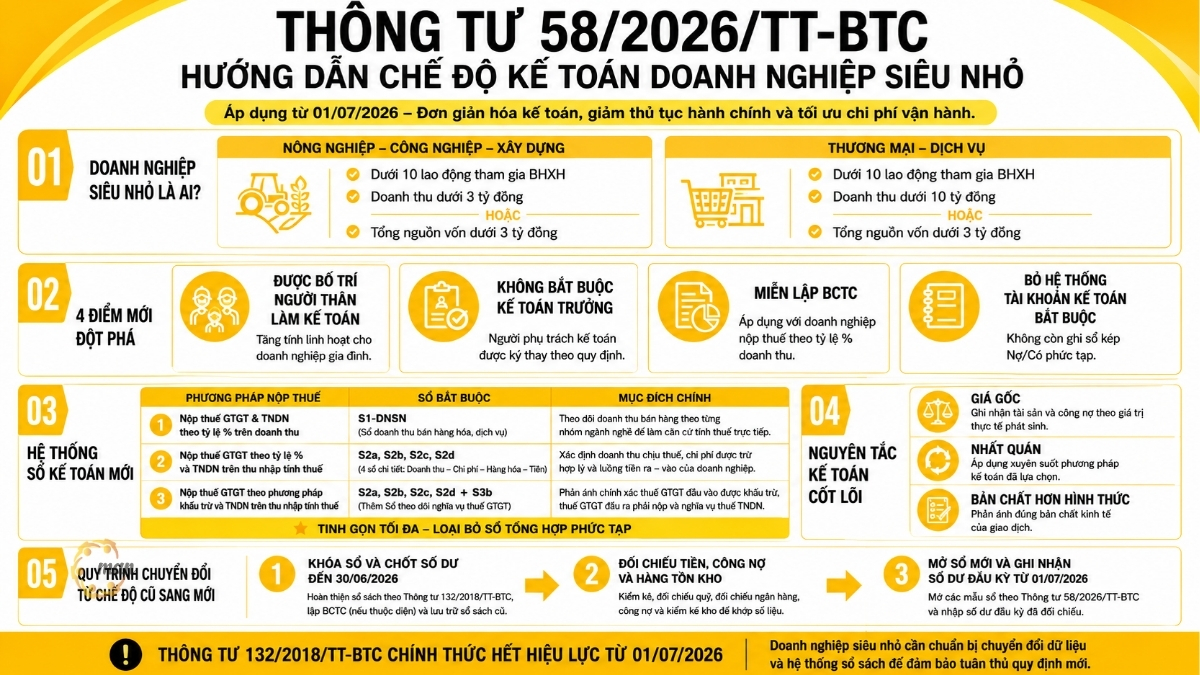
The introduction of Circular 58/2026/TT-BTC is seen as a "breath of fresh air," helping startups, single-member limited liability companies, and family businesses optimize their internal resources. The new regulations aim to simplify accounting documents, ledgers, and financial statement presentation forms to precisely match the extremely lean scale of these businesses.
The micro-enterprise accounting system applies to the following entities:
According to Article 2 of Circular 58/2026/TT-BTC, the following entities are subject to or permitted to choose to apply this accounting system:
- Micro-enterprises are established and operate in accordance with Vietnamese law and meet the quantitative criteria stated.
- Household businesses and individual business owners (New addition): This is a significant improvement in Circular 58/2026/TT-BTC. Now, household businesses and individual business owners who voluntarily wish to standardize their internal governance are fully allowed to proactively choose to apply the micro-enterprise accounting regime to record their financial data transparently, creating a foundation for upgrading to a business model in the future.
Identifying the right target group helps business owners proactively choose the most suitable accounting organization plan to minimize the risk of future tax audits.
In reality, not all micro-enterprises have the resources to set up their own dedicated accounting department. Therefore, many choose to use outsourced services. accounting services To receive support in establishing accounting systems, filing tax returns, and complying with the regulations of Circular 58/2026/TT-BTC right from the initial stages of operation.
The groundbreaking new features of the accounting regime for micro-enterprises according to Circular 58/2026/TT-BTC.

Compared to previous stringent regulations, the core spirit of the new Circular is to remove barriers and optimize costs. This shift is clearly demonstrated through the following four landmark changes, which directly impact the way personnel are organized, reporting obligations, and record-keeping methods of all entities when applying the micro-enterprise accounting system:
Micro-enterprises employ relatives as accountants.
Previously, due to the strict regulations of the 2015 Accounting Law, appointing blood relatives as accountants in businesses often faced complex legal obstacles, posing significant difficulties for family companies that prioritized absolute trust from family members.
Appointing a chief accountant is not mandatory.
In order to simplify the already streamlined organizational structure, Circular 58/2026/TT-BTC clearly stipulates that micro-enterprises are not required to report the appointment of the chief accountant.
In cases where a business only appoints an accounting officer to replace the chief accountant, this person will directly sign accounting documents, accounting books, and financial reports on behalf of the chief accountant. This flexible regulation is part of the new micro-enterprise accounting system, which completely eliminates the pressure to hire a chief accountant when the business's scale is still very small.
Businesses that pay taxes based on a percentage of revenue are exempt from preparing financial statements.
Clearly, this is the biggest advantage of the micro-enterprise accounting system, aiming to minimize the administrative burden at the end of the year. The core task focuses only on storing actual invoices and documents and completing a simple accounting system to facilitate periodic tax audits and settlements.
Completely eliminate the mandatory accounting system.
Now, micro-enterprises no longer need to perform double-entry bookkeeping (debit/credit) using complex accounting accounts. The accountant's primary responsibility is simply to record transactions directly in the detailed ledgers to track cash flow, revenue, expenses, and inventory. This simplification makes it easy for even those without in-depth accounting expertise to manage their business's bookkeeping.
Details of the accounting system for micro-enterprises under Circular 58/2026/TT-BTC

Depending on the method of Value Added Tax (VAT) and Corporate Income Tax (CIT) payment chosen by the enterprise, Circular 58/2026/TT-BTC categorizes the accounting system into separate groups to optimize the workload for accountants.
| Tax payment methods | Mandatory bookkeeping system | Main purpose |
| Case 1: Pay VAT and corporate income tax at a rate of 1% VAT to 3% VAT on revenue. | Sales Revenue Register for Goods and Services (Form S1-DNSN) | Track sales revenue by industry group to use as a basis for calculating direct taxes. |
| Case 2: Pay VAT at a rate of 1% to 3% and corporate income tax on taxable income. | Sales Revenue Register for Goods and Services (Form S2a-DNSN) | Accurately determine taxable revenue, deductible expenses, and the cash inflow and outflow of the business. |
| Detailed revenue and expense ledger (Form S2b-DNSN) | ||
| Detailed list of materials, tools, products, and goods (Form S2c-DNSN) | ||
| Cash Ledger (Form S2d-DNSN) | ||
| Case 3: Paying VAT using the deduction method and corporate income tax on taxable income. | All four types of ledgers in Case 2 (S2a, S2b, S2c, S2d) | Accurately reflect the amount of deductible input VAT, payable output VAT, and corporate income tax liability at the end of the year. |
| VAT Obligation Tracking Register (Form S3b-DNSN) |
Looking at the summary table above, the minimalist spirit of micro-enterprise accounting is clearly demonstrated, with the number of ledgers reduced to a minimum, completely eliminating the complex summary ledgers of double-entry accounting.
Guidelines on accounting methods for businesses paying taxes directly.
For micro-enterprises that pay taxes as a percentage of revenue, the accounting process is extremely streamlined:
- Accounting documents: Directly use sales invoices and other documents directly related to determining revenue from the sale of goods and services during the period. In addition, businesses can use a list of purchased goods and services without invoices to demonstrate cash outflow.
Instructions for recording in the Revenue Register (Form S1-DNSN):
- Columns A and B: Record the invoice number and date (month and year) of the sales document.
- Column C: Briefly describe the business transaction that generated revenue. Businesses can record details for each invoice or provide a total amount along with a periodic summary of invoices to minimize processing time.
- Column 1: Record the total actual revenue generated excluding VAT (or including VAT depending on the tax declaration method of the business).
Principles of accounting and financial reporting when applying the accounting regime for micro-enterprises.
Despite being simplified to the maximum extent, the operation of accounting systems for micro-enterprises must still strictly adhere to core financial principles to ensure transparency and protect the legitimate rights of businesses before tax authorities.
Fundamental accounting principles:
- Cost principle: The value of fixed assets, tools and equipment, and liabilities must be initially recorded at their actual cost at the time of purchase or transaction. Businesses are strictly prohibited from revaluing assets unless specifically stipulated by law.
- Consistency principle: The accounting policies, bookkeeping methods, and tax calculation methods chosen by the enterprise must be applied consistently throughout the entire fiscal year. If there are changes in the following year, the enterprise must clearly explain the reasons for the change.
- Substance over form: The preparation and presentation of accounting records and financial statements must accurately reflect the economic nature of the actual transactions that occur, rather than focusing solely on the form or name of the transaction.
For businesses that lack specialized accounting personnel or need to ensure the accuracy of year-end financial records, hire an accountant to prepare financial statements. This is a solution chosen by many organizations to minimize errors, meet tax authority requirements, and save on permanent staff recruitment costs.
Instructions for converting data from the old accounting system to the new micro-enterprise accounting system.
Do Circular 132/2018/TT-BTC With the new regulations officially expiring on July 1, 2026, micro-enterprises need to quickly prepare plans to migrate their balances and accounting data to avoid system disruptions.
Instructions for converting data from the old accounting system to the new micro-enterprise accounting system.
| Management object | Balance of old account according to Circular 132/2018 | Option for converting to the new register according to Circular 58/2026 |
| Cash and bank deposits | Debit balance of account 111
Outstanding balance of account 112 |
Transfer the entire balance to the Cash Details Ledger (Form S2d-DNSN) (Details by cash and demand deposits/current accounts at each bank). |
| Accounts payable | Outstanding balances in accounts 131 and 1318
Credit balances in accounts 1311, 3312, and 3318 |
Transfer the balance to the Accounts Payable Details Ledger (Form S4a-DNSN) (Details by customer or supplier). |
| Inventory | Debit balance of account 1521
Outstanding balance of account 1524 Outstanding balance of account 1526 |
Transfer the balance to the Detailed Inventory Register for Materials, Tools, Products, and Goods (Form S2c-DNSN) (Open details for each type of material, product, or goods). |
| VAT | Outstanding balance of account 1313
Credit balance in account 33131 |
Transfer the balance to the VAT Obligation Tracking Register (Form S3b-DNSN) (Record in the lines corresponding to input/output VAT). |
| Other types of taxes | Credit balance in account 33134 | Transfer the balance and the corresponding columns above. |
The conversion process is quick and efficient.
To ensure a smooth and error-free transition, businesses should follow this roadmap:
- Step 1 – Closing the books and finalizing the old accounting balances: Complete the recording of transactions arising up to June 30, 2026, in accordance with Circular 132/2018/TT-BTC. Prepare financial statements (if required) and archive the old accounting records.
- Step 2 – Verification: Conduct a physical inventory of cash funds, reconcile bank deposit balances, reconcile accounts receivable or payable with relevant parties, and conduct a physical inventory of the warehouse to ensure that the book balances completely match the actual balances before transferring the funds.
- Step 3 – Record the opening balance on the new ledger system: Open the ledger forms as prescribed by Circular 58/2026/TT-BTC and enter the opening balance as of July 1, 2026, based on the closing balance reconciled in Step 2.
Besides using accounting software, many micro-enterprises now also prioritize using... online accounting services To receive remote support in document recording, bookkeeping, tax filing, and timely updates on new regulations without maintaining a cumbersome in-house accounting system.
Frequently Asked Questions about Circular 58/2026/TT-BTC guiding the accounting regime for micro-enterprises
The micro-enterprise accounting regime applies to businesses that meet the criteria regarding labor, revenue, or capital as stipulated in Decree 80/2021/ND-CP. In addition, household businesses and individual business owners can also voluntarily choose to apply this regime to enhance transparency in financial management.
No. According to the new regulations, micro-enterprises are not required to appoint a chief accountant. Businesses can assign someone to be in charge of accounting to perform accounting tasks and sign documents, ledgers, and financial reports as required.
Depending on the tax payment method chosen by the business, some businesses that pay taxes as a percentage of revenue are exempt from preparing financial statements. However, businesses must still maintain complete records of invoices, documents, and accounting books to facilitate tax audits and inspections.
No. Circular 58/2026/TT-BTC has significantly simplified accounting practices by no longer requiring micro-enterprises to record transactions using the double-entry accounting system and accounting method as before. Which businesses are eligible to apply the micro-enterprise accounting regime?
Do micro-enterprises need to appoint a chief accountant?
Do micro-enterprises have to prepare year-end financial statements?
Is the accounting system for micro-enterprises mandatory to use the accounting chart of accounts?
Conclude
It is clear that Circular 58/2026/TT-BTC was issued not merely as a legal replacement, but also to facilitate micro-businesses and individual business households in Vietnam. By abolishing the complex accounting system, allowing the use of family members, and making financial reporting more flexible, the State has created optimal conditions for businesses to focus their resources on core production and business activities.
Understanding the nature and correctly applying micro-enterprise accounting principles is a solid foundation that helps your business safely control cash flow, optimize operating costs, and stand firm during periodic tax settlements. Proactively prepare a roadmap for balance conversion and standardize your accounting records today.
For any further questions, assistance, or advice, please contact us. Contact MAN – Master Accountant Network:
Contact information MAN – Master Accountant Network
- Address: No. 19A, Street 43, Tan Thuan Ward, Ho Chi Minh City
- Mobile/Zalo: 0903 963 163 – 0903 428 622
- Email: man@man.net.vn
Content production by: Mr. Le Hoang Tuyen – Founder & CEO of MAN – Master Accountant NetworkCPA Vietnam auditors with over 30 years of experience in accounting, auditing, and financial consulting.






