
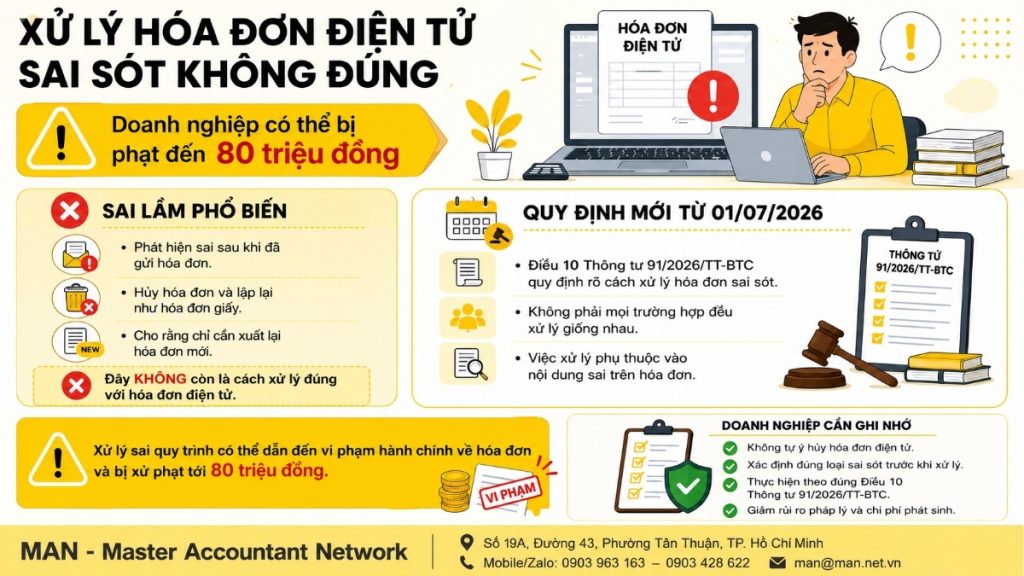
Discovering an error on an electronic invoice just after it's been sent to a customer is a familiar situation for any accountant. The problem is, many businesses still cling to the old habit: upon discovering an error, they simply cancel the invoice and create a new one from scratch, just like they did with paper invoices before. However, with electronic invoices, the data has already been transmitted to the tax authority's system, so deleting and redoing it is not as simple as that, and could even lead to administrative violations related to invoices.
From July 1st, 2026, the handling of erroneous electronic invoices has been clearly and detailedly regulated. Article 10 of Circular 91/2026/TT-BTCThe key point is that the handling method is not the same for every case, but depends on the specific content of the error on the invoice. This article will help accountants and business owners understand each specific case, avoiding incorrect procedures that lead to unnecessary costs and legal risks.
Why can't businesses unilaterally cancel erroneous electronic invoices?
Unlike paper invoices, which exist only between the seller and the buyer until they are declared, electronic invoices, once created (especially those with a tax authority code, or invoices without a code but whose data has been sent to the tax authority), become part of the data within the tax management system. In other words, the invoice is no longer an internal document between the two parties involved in the transaction, but has already been recorded by the tax authority.
Therefore, the act of arbitrarily canceling an electronic invoice and creating a completely new one to replace it without following the proper notification, adjustment, or replacement procedures carries the risk of being considered a violation of regulations on invoice creation and management. In fact, this remains one of the most common mistakes made by accountants.
Therefore, the first principle that every accountant needs to remember is:
When an electronic invoice is found to contain errors, the first step is not to cancel it, but to accurately identify the incorrect information, and only then choose the correct course of action.
Legal basis for handling erroneous electronic invoices from July 1, 2026.
The official basis for handling erroneous electronic invoices, effective from July 1, 2026, is Article 10 of Circular 91/2026/TT-BTC, which guides the implementation of the 2025 Tax Administration Law and Decree 254/2026/NĐ-CP on electronic invoices and electronic documents.
The core principle of this clause is that the handling of a case depends on the specific error, rather than applying a single formula to all situations. Specifically, the regulation divides the situations into two main groups, each with a different handling method. For easier understanding, a quick summary is provided in the table below:
| Type of error | How to handle it |
| Incorrect name, address, amount in words, or other details, but the tax identification number, amount on the invoice, tax rate, and tax amount are correct. | The seller notifies the buyer, without reissuing an invoice, and simultaneously notifies the tax authorities using Form 04/SS-HĐĐT. |
| Incorrect tax code, product name, product specifications or quality, amount, tax rate, or tax amount. | The seller has the option of issuing an adjustment invoice or a replacement invoice. |
Points to note: The new regulations clearly distinguish between formal errors (which do not affect tax obligations) and errors that directly affect tax declarations. This distinction helps businesses save considerable time in handling minor errors while ensuring stricter enforcement against errors that could potentially distort tax obligations.
Case 1: Incorrect invoices do not change tax obligations.
These are the most common types of errors accountants make in practice:
- The invoice may contain errors such as incorrect company name, address, amount written in words, or other details, but the most important information related to tax obligations remains accurate, including the tax identification number, the amount stated on the invoice, the tax rate, and the tax amount for the goods.
In this case, the business No need to issue a new invoice.The processing procedure consists of two steps:
- Notify the buyer. Regarding the error in the issued invoice, this is to inform both parties and prevent any confusion when comparing figures, making payments, or accounting for transactions.
- Notify the tax authorities. According to Form 04/SS-HĐĐT, this is to officially record that the invoice contains errors that do not affect tax obligations.
This approach helps businesses avoid unnecessary accounting tasks, the need to issue adjustment invoices, and supplementary declarations, while still ensuring transparency with both buyers and tax authorities.
Case 2: Incorrect invoices affect tax obligations.
Conversely, when an invoice contains errors that directly affect the amount of tax payable or deductible, specifically:
- Incorrect tax identification number, incorrect product name, goods not meeting specifications or quality standards, incorrect amount, incorrect tax rate, or incorrect tax amount will result in a different processing procedure. In this case, the seller... have the right to choose One of two options: issuing an adjustment invoice, or issuing a replacement invoice.
How to create an adjustment invoice
If the business chooses to make adjustments, the newly issued invoice must clearly state the details. "Adjust the invoice...", along with information identifying the original invoice (form number symbol, invoice symbol, invoice number, date of issue). This format is suitable when businesses want to retain the original invoice and only add the difference (increase or decrease) compared to the actual transaction.
How to create a replacement invoice
If an alternative form is chosen, the new invoice must clearly state the details. "A replacement for the bill..."This also includes information identifying the original invoice being replaced. This format is more suitable when the error is significant, causing the original invoice to no longer accurately reflect the nature of the transaction, and the business needs a completely new invoice to replace all the old content.
An important point that accountants need to know: Once an invoice has been processed using the adjustment or replacement method, if errors are subsequently discovered in the same invoice, subsequent processing must consistently follow the initially chosen method. Standardizing this approach helps avoid situations where an original invoice is simultaneously adjusted and replaced, making reconciliation and tax declaration difficult later on.
Common accounting mistakes when handling erroneous electronic invoices.
In practice, there are three common mistakes that put businesses at risk when handling erroneous invoices:
- Arbitrarily canceling an invoice and then issuing a completely new one. Instead of following the correct notification, adjustment, or replacement procedures as prescribed, this is the most serious error because it goes against the principles of electronic invoice data management.
- There is no clear distinction between errors that "affect tax obligations" and those that "do not affect tax obligations".This can lead to incorrect handling, such as issuing an adjustment invoice for an error that would have only required simple notification, or vice versa.
- Forgot to send notification Form 04/SS-HĐĐT Reporting to the tax authorities in cases where notification is mandatory results in errors not being fully recorded in the tax management system.
For businesses that do not have an in-house accounting team with sufficient experience to continuously update themselves on new regulations like these, using full accounting service This is a worthwhile solution that helps minimize errors in invoice creation and processing.
See more: Invoices must be issued in accordance with Decree 254/2026/ND-CP.
Note regarding the responsibility to verify buyer information when issuing invoices.

Besides processing invoices after errors have been discovered, there is a related aspect that businesses need to pay attention to right from the initial invoice issuance stage to minimize the need for adjustments or replacements later. According to Decree 254/2026/ND-CP:
The seller is responsible for reviewing the accuracy of the information provided by the buyer to determine whether the buyer is an end consumer or an organization or individual purchasing the goods for further production or business purposes.
In reality, many invoices are incorrectly issued right from the stage of identifying the buyer. For example, a customer who clearly purchases raw materials or semi-finished products to continue the production process cannot be considered the "end consumer." If the invoice incorrectly identifies this buyer, the business not only has to re-process it according to the adjustment or replacement procedure mentioned above, but also risks being penalized for administrative violations related to invoices.
For example: Phong Mao Company specializes in manufacturing and trading materials for the footwear industry, selling shoe insoles to customers. Essentially, shoe insoles are a semi-finished product: buyers can only use them after further processing to complete a pair of shoes, and cannot use them directly as a consumer product. Therefore, customers who buy shoe insoles from Phong Mao are certainly not end consumers, but rather a link in the next stage of the production chain.
In this case, Phong Mao's accounting and sales departments need to take note: the issued invoice The buyer's information should not be recorded as "consumer"., which requires the buyer to provide complete information (name, address, tax code or corresponding personal identification number) to be accurately reflected on the invoice.
If the invoice still states "sold to consumers" in this case, it will be considered incorrect regarding the buyer, not accurately reflecting the nature of the transaction, and the business will have to revert to issuing an adjusted or replacement invoice as described above. This example shows that correctly verifying the nature of the goods and the buyer's intended use from the outset is just as important as knowing how to handle invoices after errors have occurred.
Therefore, instead of focusing solely on correcting invoices after they've been made wrong, accountants and sales departments should proactively review and require buyers to provide complete information from the outset. This is especially important in transactions where the nature of the goods or services clearly indicates that the buyer is not the end consumer. This is the most effective preventative measure to minimize the number of invoices that need adjustment or replacement during operations.
Table of penalty rates for invoices in 2026

Proper handling of erroneous invoices not only helps businesses comply with regulations but also directly avoids administrative penalties related to invoices, which can amount to tens of millions of VND if violations are widespread. The new invoice penalty rates for 2026 are stipulated in Article 24 of Decree 125/2020/ND-CP, as amended and supplemented by... Articles 1 and 2 of Decree 310/2025/ND-CPSpecifically as follows:
Group 1: Violations of invoicing regulations when selling goods or providing services for business purposes and recognizing revenue:
| Violate | Created at the wrong time. | No invoice issued. |
| 01 number | 500,000 – 1,500,000 VND | 1,000,000 – 2,000,000 VND |
| 02 to under 10 numbers | 2,000,000 – 5,000,000 VND | 2,000,000 – 10,000,000 VND |
| 10 to under 20 numbers | 5.000.000 – 15.000.000 | 10,000,000 – 30,000,000 VND |
| 20 to under 50 numbers | 15,000,000 – 30,000,000 VND | 30,000,000 – 50,000,000 VND |
| 50 to under 100 numbers | 30,000,000 – 50,000,000 VND | 60,000,000 – 80,000,000 VND |
| Over 100 numbers | 50,000,000 – 70,000,000 VND | 60,000,000 – 80,000,000 VND |
Group 2: This applies to the following cases: goods and services used for promotional purposes, advertising, and samples; goods and services used for giving, gifting, exchanging, paying as compensation to employees, and internal consumption (excluding goods circulated internally to continue the production process); and goods exported in the form of loans, borrowings, or returns.
| Number of invoices in violation | Created at the wrong time. | No invoice issued. |
| 01 number | Warning | Warning |
| 02 to under 10 numbers | 500,000 – 1,500,000 VND | 1,000,000 – 2,000,000 VND |
| 10 to under 50 numbers | 2,000,000 – 5,000,000 VND | 2,000,000 – 10,000,000 VND |
| 50 to under 100 numbers | 5,000,000 – 15,000,000 VND | 10,000,000 – 30,000,000 VND |
| Over 100 numbers | 15,000,000 – 30,000,000 VND | 30,000,000 – 50,000,000 VND |
Important Note: The above penalties apply to organizations. For individuals, the penalty is half the penalty applied to organizations. Furthermore, if violations occur on the same day, only one penalty will be imposed, at the highest level within the corresponding penalty framework (based on Clause 5, Article 5 of Decree 125/2020/ND-CP).
This is also why businesses need to establish a rigorous invoice control process right from the creation stage, instead of waiting for widespread errors to occur before addressing them. Because then, not only will it take time to adjust or replace invoices, but the risk of penalties also increases significantly. This is also why businesses should hire accounting services We source our services from reputable and professional organizations like MAN – Master Accountant Network to ensure invoices are tightly controlled from the outset, avoiding unnecessary penalties.
Conclude
In summary, the core principle when handling erroneous electronic invoices is: businesses must accurately identify the incorrect content before choosing a course of action, instead of arbitrarily canceling the invoice and reissuing it from scratch. If the invoice only contains errors that do not affect tax obligations, notifying the buyer and submitting Form 04/SS-HĐĐT to the tax authority is sufficient. Conversely, if the error relates to the tax identification number, amount, tax rate, or tax amount, the business needs to consistently choose between issuing an adjustment invoice or a replacement invoice, in accordance with Article 10 of Circular 91/2026/TT-BTC.
Adhering to proper procedures not only helps businesses avoid the risks of administrative penalties but also ensures the validity of invoices when accounting for expenses and settling taxes.
If businesses are still unsure about applying regulations correctly to each real-world situation, partnering with a professional can be beneficial. accounting services company A reputable firm like MAN will significantly reduce legal risks and save processing time.
For any questions, assistance, or detailed advice, please contact us. Contact MAN – Master Accountant Network:
Contact information MAN – Master Accountant Network
- Address: No. 19A, Street 43, Tan Thuan Ward, Ho Chi Minh City
- Mobile/Zalo: 0903 963 163 – 0903 428 622
- E-mail: man@man.net.vn
- Google Business Profile: View MAN – Master Accountant Network's Google Business Profile
- LinkedIn Founder: View expert Le Hoang Tuyen's LinkedIn profile.
Responsible for production and professional content review by: Mr. Le Hoang Tuyen – Founder & CEO of MAN – Master Accountant NetworkHe is a CPA Vietnam auditor with over 30 years of in-depth experience in accounting, auditing, taxation, and corporate legal consulting.
Frequently Asked Questions about Handling Errors in Electronic Invoices
No. If the invoice is only incorrect in terms of name, address, amount in words, or some other details, while the tax identification number, amount on the invoice, tax rate, and tax amount are still correct, the seller only needs to notify the buyer of the error and send Form 04/SS-HĐĐT to the tax authority; a new invoice does not need to be issued.
This falls under the category of errors affecting tax obligations according to Article 10 of Circular 91/2026/TT-BTC. The seller can choose one of two options: issue an adjustment invoice or issue a replacement invoice, depending on the severity of the error and the actual transaction.
Form 04/SS-HĐĐT is a notification form used by sellers to send to the tax authorities in cases where invoice errors do not affect tax obligations.
For adjustment invoices, the seller declares them in the period in which the adjustment invoice is issued (i.e., the current period), and does not have to go back and declare them in the original period in which the incorrect invoice was issued. This is a notable difference compared to the old regulations, simplifying the process of declaring supplementary VAT for businesses.
Yes. This case falls under the category of incorrectly identifying the buyer. According to Decree 254/2026/ND-CP, the seller is responsible for verifying the accuracy of the buyer's information; if the nature of the transaction indicates that the buyer is not the end consumer, the invoice must fully reflect the buyer's information as required, and cannot be listed as a general consumer. Is it mandatory to issue a new invoice if the electronic invoice has an incorrect buyer name or address?
What procedures should be followed when an invoice contains an incorrect tax identification number for the buyer?
In what cases is Form 04/SS-HĐĐT used?
In which tax period should adjustment invoices be declared?
Is an invoice issued to a customer for the purchase of raw materials for further production but mistakenly recorded as a sale to a consumer considered an error?






