
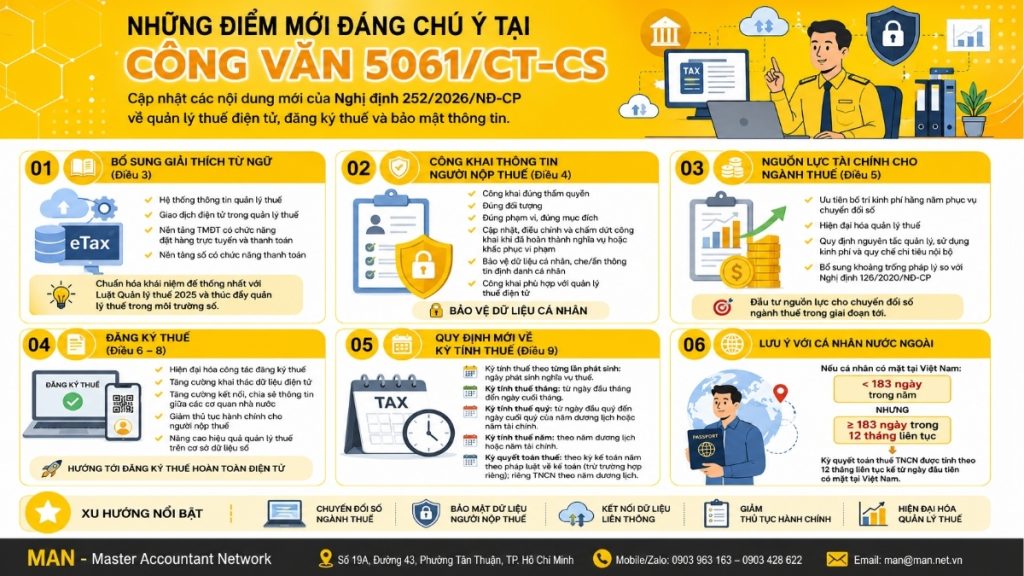
On July 22, 2026, the Tax Department officially issued the following: Official Document 5061/CT-CS, introducing all the new features of Decree 252/2026/ND-CPThe guiding document for the implementation of the Tax Administration Law has just come into effect. This is one of the documents that the accounting community, businesses, and taxpayers are paying special attention to at the moment, because it directly impacts a range of familiar operations: from tax registration and determining the tax period to the public disclosure of taxpayer information.
If you are a corporate accountant, chief accountant, or business owner looking to understand the specific changes in Circular 5061/CT-CS compared to the old regulations, this article will comprehensively and accurately summarize the key contents based on the original document, helping you to promptly grasp and proactively adjust your internal processes accordingly.
What is Official Document 5061/CT-CS? In what context was it issued?

Official Document 5061/CT-CS of 2026, issued by the Tax Department on July 22, 2026, primarily introduces and disseminates the new points of Decree 252/2026/ND-CP. This document provides professional guidance, helping tax authorities and taxpayers better understand the changes in tax management under the new regulations.
Regarding the legal basis, on June 30, 2026, the Government issued Decree 252/2026/ND-CP detailing certain provisions and measures for organizing and guiding the implementation of the Law on Tax Administration. This Decree officially came into effect on July 1, 2026, replacing the previous provisions in Decree 126/2020/ND-CP and related amending and supplementing decrees.
Structurally, Decree 252/2026/ND-CP is quite substantial, comprising 7 chapters and 76 articles, including:
- Chapter IGeneral Regulations (05 Articles)
- Chapter IITax administration functions, comprising 6 Sections (34 Articles)
- Chapter III: Declaration and payment of taxes and other fees for business activities on e-commerce platforms and other digital platforms, including 2 Sections (07 Articles)
- Chapter IVInternational cooperation on taxation; preferential treatment for taxpayers; application of technology, data and digital transformation in tax administration (10 Articles)
- Chapter V: Rights, obligations, duties, and powers of relevant parties in tax administration (8 Articles)
- Chapter VIEnforcement of administrative decisions on tax management (09 Articles)
- Chapter VII: Enforcement Clause (03 Articles)
Given the broad scope of the amendments, it is essential that Circular 5061/CT-CS summarizes the core new points, saving readers the trouble of reviewing all 76 articles of the Decree themselves.
Key new points in Official Document 5061/CT-CS

Additional definitions of terms are provided in Article 3 of Decree 252/2026/ND-CP.
One of the first points addressed in Official Letter 5061/CT-CS is the addition of explanations for several new terms in Article 3 of the Decree, including:
- Tax management information system;
- Electronic transactions in tax administration;
- An e-commerce platform, a digital platform with online ordering and payment functions;
- An e-commerce platform, a digital platform with payment functionality.
According to the official document, the addition of these terms aims to ensure consistency with the 2025 Tax Administration Law and relevant specialized legal regulations. This is a necessary standardization step in the context of tax administration activities becoming increasingly intertwined with the digital environment and e-commerce.
New points regarding the disclosure of taxpayer information are in Article 4.
This is a key point of interest for many businesses when reviewing Official Letter 5061/CT-CS, as it directly relates to the reputation and rights of taxpayers. Accordingly, Article 4 of Decree 252/2026/ND-CP introduces several new points as follows:
- Adding the principle of information disclosure. Taxpayers must ensure that disclosure is carried out by the correct authority, targeting the correct subjects, within the correct scope, and for the correct purpose as prescribed by law.
- Amend and supplement the mechanism for disclosing information. on the Tax Management Information System; and also adding regulations on updating, adjusting, and terminating public disclosure when taxpayers have fulfilled their obligations or rectified violations.
- Adding regulations to protect personal data. During the process of disclosing information, regulations stipulate the concealment or hiding of certain identifying information of individuals when making such disclosures in accordance with the law.
- Adding more forms of information disclosure. In line with the direction of electronic tax administration and the requirements for modernizing tax administration.
To better understand the underlying legal framework that Decree 252/2026/ND-CP specifies, one can refer to Article 7 of the 2025 Law on Tax Administration. According to this provision, tax authorities, tax officials (including former tax officials), agencies providing and exchanging taxpayer information, tax agents, and customs clearance agents are all responsible for maintaining the confidentiality of taxpayer information, except in cases where disclosure or public disclosure is permitted by law.
Specifically, the tax administration agency is Public disclosure of taxpayer information In cases of: tax evasion, evasion of other revenues; failure to pay taxes, other revenues, late payment penalties, and fines on time; tax arrears, other revenue debts, late payment penalties, and fines; violations of tax laws affecting the rights and obligations of other organizations and individuals to pay taxes; or failure to comply with the requirements of the tax authorities as prescribed.
To avoid falling into the situations mentioned above, many businesses have chosen to use tax accounting services With the help of specialized and experienced units like MAN – Master Accountant Network, we closely monitor tax obligations, ensure timely tax filing and payment.
In addition, the tax authorities are also permitted to... Providing taxpayer information Provided to investigative agencies, the Procuracy, the Court, inspection agencies, the State Audit Office, and other state management agencies upon written request to serve litigation, inspection, examination, and auditing activities; provided to other competent state agencies upon written request as prescribed by law; or provided to foreign tax authorities in accordance with international treaties and agreements on taxation to which Vietnam is a member or signatory.
New provisions regarding financial resources for the operation of tax administration agencies are found in Article 5.
Another notable new provision in Circular 5061/CT-CS is the regulation on financial resources for tax administration agencies. Accordingly, Decree 252/2026/ND-CP supplements regulations on prioritizing the allocation of annual funds for digital transformation and modernization of tax administration, while also stipulating the principles for managing and using funds and internal spending regulations.
This content was developed to concretize the 2025 Tax Administration Law, while also addressing a previous legal gap: Decree No. 126/2020/ND-CP lacked specific regulations on financial resources for tax administration agencies. The addition of this regulation demonstrates the clear direction of tax administration agencies in investing resources in the digital transformation of the tax sector in the coming period.
New points regarding tax registration in Articles 6, 7, and 8.
The regulations on tax registration in Decree 252/2026/ND-CP are designed to concretize the Law on Tax Administration No. 108/2025/QH15, focusing on the following contents: tax registration deadline, responsibilities of taxpayers, responsibilities of tax authorities, state agencies, organizations, and individuals involved in tax registration and the use of tax identification numbers.
Compared to Decree No. 126/2020/ND-CP and previous amending and supplementing decrees, Official Letter 5061/CT-CS clarifies that Decree 252/2026/ND-CP has been adjusted in the following direction:
- Modernizing the tax registration process;
- Enhance the utilization of electronic data;
- Strengthening connectivity and information sharing among government agencies;
- Reduce administrative procedures for taxpayers;
- Improving tax administration efficiency through digital databases.
This trend aligns with the national digital transformation strategy and helps businesses reduce the burden of paperwork when fulfilling their tax registration obligations.
New regulations on determining the tax period are stipulated in Article 9.
In addition to the above-mentioned contents, Official Letter 5061/CT-CS also addresses the regulations on tax periods in Article 9 of Decree 252/2026/ND-CP. Accordingly, the tax period includes the period for each transaction, monthly, quarterly, annually, or the tax settlement period, which are specifically determined as follows:
- Tax period based on each transaction.: Defined as the date on which the taxpayer incurs a tax liability.
- Monthly tax period: Defined from the first day to the last day of the month in the Gregorian calendar.
- Quarterly tax period: Defined from the first day of the quarter to the last day of the quarter in the calendar year or fiscal year.
- Tax period year: Determined according to the calendar year or fiscal year.
- Tax settlement period: Determined according to the accounting year as prescribed by accounting law (except for some specific cases as stipulated in point d.2, clause 2, Article 9); for personal income tax, the settlement period is determined according to the calendar year.
Notably, Decree 252/2026/ND-CP also clearly stipulates a special case: if, in a calendar year, an individual is present in Vietnam for less than 183 days, but the total number of days present in Vietnam in 12 consecutive months from the first day of arrival is 183 days or more, then the personal income tax settlement period for the first year is determined as 12 consecutive months from the first day of arrival in Vietnam. This is an important regulation for cases involving foreigners working in Vietnam or individuals whose residency period does not cover a full calendar year.
In such complex situations, the hire chief accountant Experienced professionals will help businesses determine the correct tax settlement period, avoiding errors when filing personal income tax returns for foreign employees.
Why should businesses and accountants pay special attention to Official Letter 5061/CT-CS?

As can be seen, Official Letter 5061/CT-CS is not merely an internal administrative document of the tax sector, but actually holds high reference value for the accounting and finance departments of businesses. The specific reasons include:
- Firstly, the new regulations on tax registration and tax periods directly affect the process of declaring and determining monthly, quarterly, and annual tax obligations for businesses as well as foreign workers and individuals with income in Vietnam.
- Secondly, regulations on taxpayer information disclosure require businesses to proactively review and fully comply with their tax obligations, avoiding situations where information is publicly disclosed, such as tax arrears or late payments, which can directly affect their reputation, relationships with partners, and banks.
- Thirdly, the trend of modernization and increased electronic data connectivity between government agencies requires businesses to standardize their internal accounting and tax data systems to ensure consistency and accuracy when tax authorities conduct data verification and exploitation.
What preparations do businesses need to make to comply with the spirit of Official Letter 5061/CT-CS?

Based on the above analysis, the accounting team and the company's management should proactively carry out the following tasks:
- Review the internal tax registration process.Compare this with the new regulations in Articles 6 to 8 of Decree 252/2026/ND-CP to ensure compliance with deadlines and related responsibilities.
- Re-determine the tax period This should be tailored to each type of tax obligation for businesses and employees, paying particular attention to specific cases regarding personal income tax for individuals residing in Vietnam for less than a full year.
- Actively fulfill all tax obligations fully and on time. To avoid falling under the category of information subject to public disclosure as stipulated in the new regulations in Article 4 of Decree 252/2026/ND-CP.
- Closely monitor subsequent guidance documents. The Department of Taxation and local tax offices are responsible for implementing Decree 252/2026/ND-CP, as this document has a broad scope and may be further specified by other circulars and guiding documents.
For businesses that lack the resources to keep up with and apply new regulations in a timely manner, consulting a professional is recommended. full accounting service This is the optimal solution to ensure that all tax registration, declaration, and tax period determination procedures are carried out in accordance with regulations without creating additional internal personnel burdens.
Conclude
To avoid compliance risks and make the most of the new regulations, businesses should proactively update themselves on the content of Circular 5061/CT-CS, compare it with their actual operations, and plan to adjust their internal accounting and tax processes as soon as possible. If your business needs in-depth advice, don't hesitate to contact us. contact Contact the accounting and tax team of MAN – Master Accountant Network for timely and accurate support.
Contact information MAN – Master Accountant Network
- Address: No. 19A, Street 43, Tan Thuan Ward, Ho Chi Minh City
- Mobile/Zalo: 0903 963 163 – 0903 428 622
- E-mail: man@man.net.vn
- Google Business Profile: View MAN – Master Accountant Network's Google Business Profile
- LinkedIn Founder: View expert Le Hoang Tuyen's LinkedIn profile.
Responsible for production and professional content review by: Mr. Le Hoang Tuyen – Founder & CEO of MAN – Master Accountant NetworkHe is a CPA Vietnam auditor with over 30 years of in-depth experience in accounting, auditing, taxation, and corporate legal consulting.
Frequently Asked Questions about Official Document 5061/CT-CS
Which agency issued Official Document 5061/CT-CS and when was it issued?
Official document 5061/CT-CS, issued by the Tax Department on July 22, 2026, introduces the new points of Decree 252/2026/ND-CP guiding the implementation of the Law on Tax Administration.
When does Decree 252/2026/ND-CP, introduced in Official Letter 5061/CT-CS, come into effect?
Decree 252/2026/ND-CP was issued by the Government on June 30, 2026, and officially came into effect on July 1, 2026, replacing the previous regulatory framework in Decree No. 126/2020/ND-CP and related amending and supplementing decrees.
What is the biggest difference between Decree 252/2026/ND-CP and Decree 126/2020/ND-CP?
According to Official Letter 5061/CT-CS, the biggest differences lie in three main areas: supplementing regulations on financial resources for tax administration agencies; tightening but simultaneously increasing transparency in the mechanism for disclosing taxpayer information, with additional regulations on protecting personal data; and modernizing tax registration by increasing the use of electronic data, inter-agency connectivity, and reducing administrative procedures.
Will businesses that owe taxes or are late in paying taxes have their information publicly disclosed under the new regulations?
Yes. According to Article 4 of Decree 252/2026/ND-CP and Article 7 of the 2025 Tax Administration Law, as referenced in Official Letter 5061/CT-CS, tax authorities are authorized to publicly disclose taxpayer information in the following cases: tax evasion, failure to pay taxes on time, tax arrears, late payment penalties, fines, violations of tax laws affecting the rights of other organizations or individuals, or failure to comply with requests from tax authorities.
How is the personal income tax settlement period calculated for foreign individuals who are present in Vietnam for less than 183 days in a calendar year?
According to Article 9 of Decree 252/2026/ND-CP, as mentioned in Official Letter 5061/CT-CS, if an individual is present in Vietnam for less than 183 days in a calendar year but is present for 183 days or more in 12 consecutive months from the first day of their presence in Vietnam, then the personal income tax settlement period for the first year is determined as those 12 consecutive months, instead of the usual calendar year.