
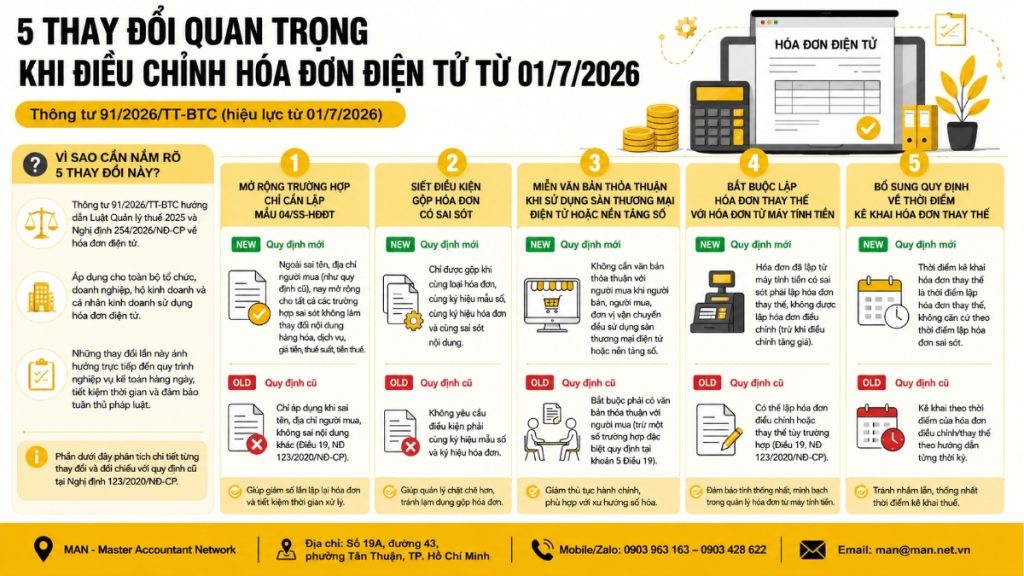
Five important changes regarding the adjustment of electronic invoices have just been specifically stipulated in... Circular 91/2026/TT-BTC (Effective from July 1, 2026), this will require corporate accountants to review their entire current process for handling erroneous invoices. Decree 123/2020/ND-CPFrom expanding the scope of cases requiring only Form 04/SS-HĐĐT, tightening the conditions for merging incorrect invoices, to waiving written agreements for transactions on e-commerce platforms and mandating the issuance of replacement invoices for invoices from cash registers, each change directly impacts daily operations. This article analyzes each new point in detail, comparing it with the old regulations, based on the latest updated legal grounds, helping accountants apply the correct procedures from the very first error correction.
Why is it important to understand these 5 key changes when adjusting electronic invoices in 2026?
Circular 91/2026/TT-BTC was issued to guide the implementation of the 2025 Tax Administration Law, and to specify its contents. Issuing invoices in accordance with Decree 254/2026/ND-CP Regarding electronic invoices and electronic documents, this document replaces the previous approach in Decree 123/2020/ND-CP, which had been in place for many years and had been amended once by Decree 70/2025/ND-CP.
In terms of scope, the new regulations directly impact economic organizations, businesses, other organizations, business households, and individual businesses currently using electronic invoices in their goods trading and service provision activities—that is, almost all business entities today.
It's noteworthy that these changes are not just technical in terms of document drafting, but actually affect the accounting department's business processes, from determining when a written record is sufficient without reissuing an invoice, to determining when a written agreement with the buyer is mandatory. Therefore, understanding and correctly applying these five important changes when adjusting electronic invoices will not only help businesses comply with the law but also significantly save time in handling errors in practice.
To make it easier to understand, the following section will analyze each change in detail, comparing it with the old regulations in Decree 123/2020/ND-CP.
Expand the scope to include only Form 04/SS-HĐĐT, eliminating the need to reissue the invoice.
According to Article 19 of Decree 123/2020/ND-CP (amended by Decree 70/2025/ND-CP), the case where the seller only needs to prepare Form No. 04/SS-HĐĐT to notify that the electronic invoice contains errors, without having to reissue the invoice, is limited to situations where the invoice is incorrect in terms of the buyer's name and address, while other contents on the invoice (tax code, amount, tax rate, tax amount, etc.) are still accurate.
Article 10 of Circular 91/2026/TT-BTC has significantly expanded the scope of application of this case. Specifically, in addition to errors in the buyer's name and address, the new regulation also adds cases where the invoice is incorrect in terms of the amount in words or other details, provided that it does not contain any of the following material errors:
- Tax identification number;
- The amount stated on the invoice;
- Tax rate;
- Taxes;
- Content of goods and services.
In other words, the scope of minor errors that only require a written record or notification, rather than the creation of an adjustment or replacement invoice, has been broadened compared to before. This is one of the five important changes when adjusting electronic invoices that accountants need to be aware of first, as it will help reduce the workload of re-issuing invoices in many practical situations that previously required more complex handling.
Accounting notes: When reviewing erroneous invoices, accountants need to carefully compare the incorrect content with the five key criteria mentioned above. If the error does not fall under these criteria, the business can apply a simpler procedure, simply preparing Form 04/SS-HĐĐT, instead of having to issue an adjustment or replacement invoice as before.
Clearly identify the cases where adjusting or replacing invoices are mandatory.
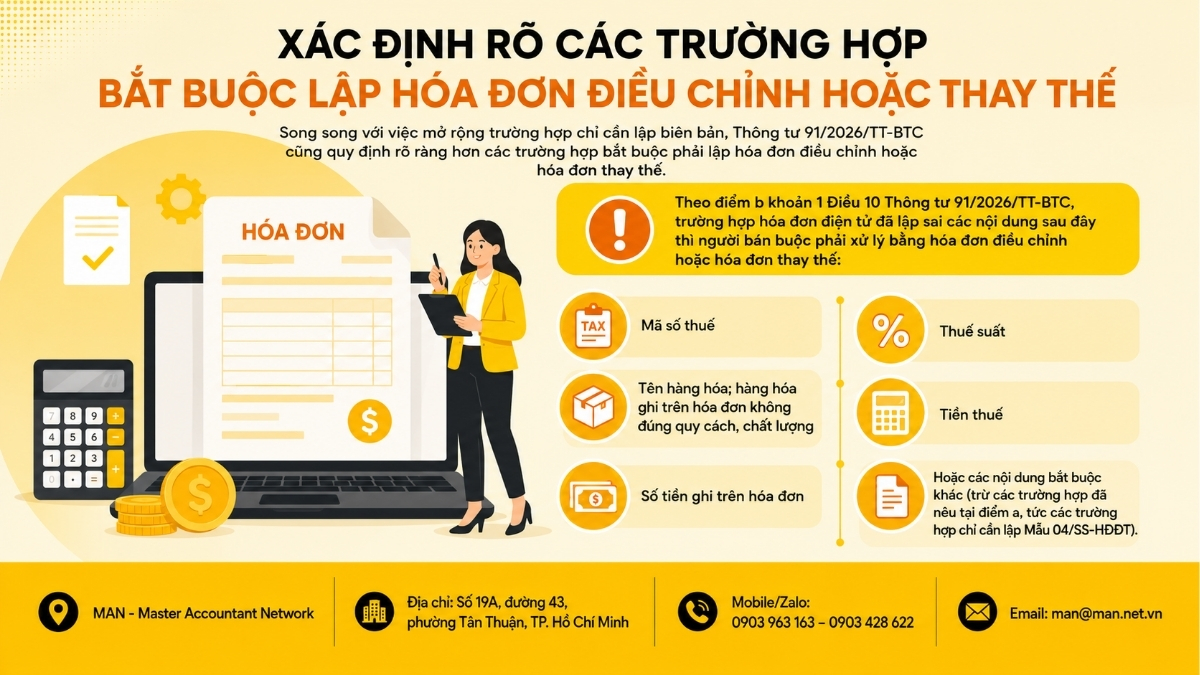
In parallel with expanding the cases where only a written record is required, Circular 91/2026/TT-BTC also clarifies the cases where it is mandatory to issue an adjustment invoice or a replacement invoice. According to point b, clause 1, Article 10 of Circular 91/2026/TT-BTC, if an electronic invoice has been issued with the following incorrect contents, the seller is required to process it with an adjustment invoice or a replacement invoice:
- Tax identification number;
- The product name; the goods listed on the invoice do not meet specifications or quality standards;
- The amount stated on the invoice;
- Tax rate;
- Taxes;
- Or other mandatory contents (except for the cases mentioned in point a, i.e., cases where only Form 04/SS-HĐĐT needs to be completed).
The option to choose between an adjustment invoice or a replacement invoice.
One point to note is that the seller has the right to choose between two options:
- Issue an adjusted invoice (keep the original invoice, only correct the incorrect part).
- Alternatively, issue a replacement invoice (cancel the original invoice and issue a new invoice to replace the entire invoice).
The choice of which option to use depends on the nature of the error and the internal management practices of each business.
Compared to Decree 123/2020/ND-CP, the essential content requiring adjustment/replacement invoicing hasn't changed much in essence, but the regulations in Circular 91/2026/TT-BTC are clearer and more logical when placed in direct relation to the exempted cases. This is why, when discussing the five important changes in adjusting electronic invoices, the first two changes should generally be read and applied concurrently.
Add a condition to combine multiple incorrect invoices into a single adjustment or replacement invoice.
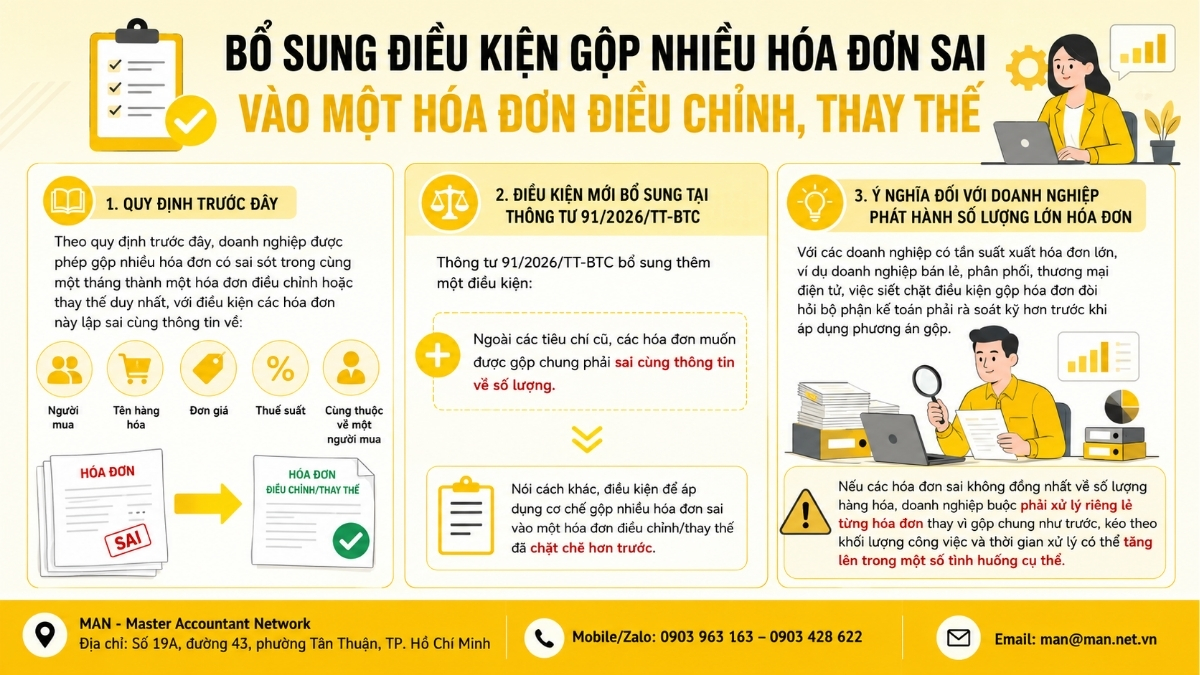
According to previous regulations, businesses were allowed to combine multiple invoices with errors in the same month into a single adjustment or replacement invoice, provided that these invoices contained the same incorrect information regarding: Buyer; Product name; Unit price; Tax rate, and all belonged to the same buyer.
New conditions added in Circular 91/2026/TT-BTC
Circular 91/2026/TT-BTC adds another condition: In addition to the old criteria, invoices intended to be merged must have the same incorrect information regarding the quantity. In other words, the conditions for applying the mechanism of merging multiple incorrect invoices into a single adjustment/replacement invoice have become stricter than before.
The significance for businesses that issue a large number of invoices.
For businesses with a high frequency of invoice issuance, such as retail, distribution, and e-commerce businesses, tightening the conditions for merging invoices requires accounting departments to conduct more thorough reviews before implementing the merging method. If the invoices contain discrepancies in the quantity of goods, businesses will be forced to process each invoice individually instead of merging them as before, potentially increasing the workload and processing time in certain situations.
A written agreement is not required in certain specific cases.
According to Article 10 of Circular 91/2026/TT-BTC, before adjusting or replacing incorrectly issued electronic invoices containing material information, the general principle remains:
- If the buyer is an economic organization, other organization, household business, or individual business: The seller and buyer must draw up a written agreement clearly stating the details of the error.
- If the buyer is an individual: The seller must notify the buyer, or make a public announcement on the seller's website (if available).
The seller is responsible for keeping a copy of this agreement at their premises and presenting it upon request by the tax authorities or other competent government agencies.
Three cases are exempt under the new regulations.
The major difference compared to Decree 123/2020/ND-CP, which did not clearly specify exemption cases, is that Circular 91/2026/TT-BTC has added three specific cases where the seller is not required to draw up a written agreement, including:
- This applies to transferring electronic invoice data via the Summary Table.
- This applies to the case of transferring detailed transaction information from the transaction details table.
- The buying and selling of goods on e-commerce platforms and other digital platforms.
This change has high practical applicability, especially for businesses operating in the e-commerce sector or those with a large volume of transactions that frequently require the transmission of invoice data in summary tables. Being exempt from preparing written agreements in these cases significantly reduces internal administrative procedures and is more suitable for the high volume and speed of transactions on digital platforms.
Specific regulations apply to invoices from cash registers and registered assets.
One of the limitations of Decree 123/2020/ND-CP is the lack of specific regulations for handling errors in electronic invoices generated from cash registers, as well as for transactions involving assets requiring registration of ownership or usage rights. This has caused considerable confusion for many retail businesses, especially those using cash registers with data transfer connections to the tax authorities, when dealing with incorrect invoices.
New requirements in Circular 91/2026/TT-BTC
Circular 91/2026/TT-BTC has added specific regulations:
For electronic invoices generated from cash registers and invoices related to assets that require registration, if an error is discovered, the seller must issue a replacement invoice.
The addition of this specific regulation helps fill a long-standing legal gap and creates uniformity in handling errors related to a particular group of invoices, which are linked to direct retail data and valuable assets requiring strict management in terms of ownership registration.
See more: New points in Circular 91/2026/ND-CP.
This table summarizes and compares 5 key changes when adjusting electronic invoices compared to the old regulations.
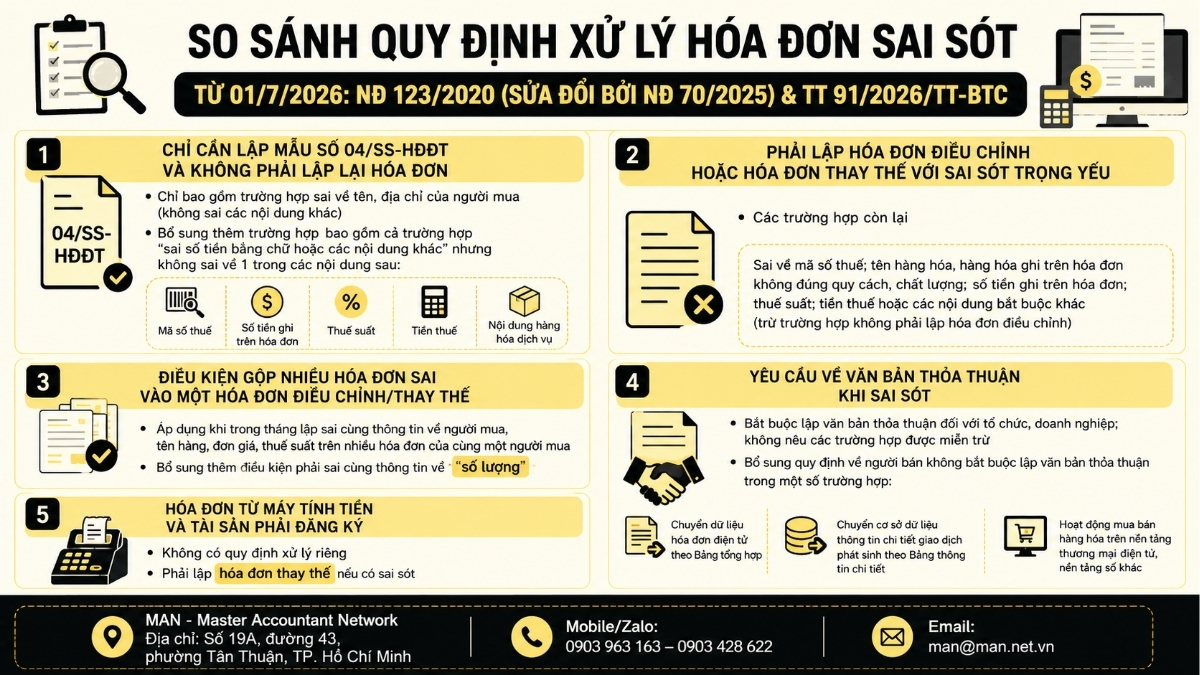
For easy comparison and quick reference, below is a summary table of all 5 important changes when adjusting electronic invoices according to Circular 91/2026/TT-BTC, compared in parallel with the corresponding regulations in Decree 123/2020/ND-CP (amended by Decree 70/2025/ND-CP).
| Criteria | Decree 123/2020 | Circular 91/2026 |
| In cases where only Form 04/SS-HĐĐT is required. | This only applies if the buyer's name or address is incorrect. | Adding cases where the amount of money is incorrect in words or other details, provided that the five key elements are not wrong. |
| Cases where issuing an adjustment or replacement invoice is mandatory. | Incorrect tax identification number, product name, amount, tax rate, tax amount, etc. | The regulations should be clearly defined and considered in relation to the cases that are exempt. |
| The condition for combining multiple invoices is incorrect. | Incorrect information regarding buyer, product name, unit price, and tax rate. | Add a condition that the error must be the same as the quantity information. |
| Request a written agreement. | Mandatory for organizations and businesses; no exemptions are given. | Three additional cases where a written agreement is not mandatory. |
| Receipts from cash registers are assets that require registration. | There are no specific regulations for handling this. | A replacement invoice must be issued if there are any errors. |
Overall, the five key changes in Circular 91/2026/TT-BTC regarding the adjustment of electronic invoices are selective adjustments, such as expanding the scope of application to cases of errors that do not affect tax obligations, while tightening control in areas prone to exploitation or lacking a basis for oversight. Therefore, businesses should not mechanically apply a single rule to all situations, but should compare each specific case with the comparison table above before deciding on an appropriate course of action.
Important notes regarding the application of regulations on electronic invoices from July 1, 2026.
With the aforementioned changes, businesses and accountants should proactively review their internal procedures for handling erroneous invoices, instead of continuing to mechanically apply old habits from Decree 123/2020/ND-CP. Several points require special attention:
- Update and classify errors according to the five key criteria stipulated in Circular 91/2026/TT-BTC, avoiding confusion between cases requiring only a written record and cases requiring the issuance of an adjusted or replacement invoice.
- Review the monthly process for merging incorrect invoices and add criteria for verifying quantities before merging.
- Clearly identify transactions that are exempt from written agreements to avoid unnecessary procedures.
- For businesses using cash registers with data connections to the tax authorities, it is important to note the mandatory principle of issuing replacement invoices when errors are discovered; the same adjustment methods as for regular invoices do not apply.
- Update your current electronic invoicing software to ensure compatibility with the new forms, especially Form No. 04/SS-HĐĐT, as its scope of application has been expanded.
In reality, not every business has enough staff to keep up with every change in regulations regarding electronic invoices. For businesses that do not have a dedicated accounting department or want to reduce the risk of errors, using full accounting service This is a worthwhile option, ensuring that the entire invoice and document processing procedure is carried out correctly according to regulations from the start.
In addition to provisions on correcting erroneous invoices, Circular 91/2026/TT-BTC (Article 11) also stipulates the conversion to electronic invoices with or without tax authority codes from July 1, 2026. Accordingly, taxpayers currently using electronic invoices without tax authority codes, if needed, can convert to electronic invoices with codes as prescribed in Article 6 of this Circular.
Key points to note: Taxpayers identified as high-risk taxpayers according to Circular 94/2026/TT-BTC and notified by the tax authority via Form No. 01/TB-KTT are required to switch to using electronic invoices with tax authority codes within 10 working days from the date of receiving the notification.
In cases where on-site consultation is required for specific situations, businesses can hire accounting services To receive support in handling the process correctly, minimizing risks and errors.
Conclude
Five key changes regarding the adjustment of electronic invoices under Circular 91/2026/TT-BTC, ranging from expanding the cases for creating Form 04/SS-HĐĐT, tightening conditions for merging incorrect invoices, adding cases exempt from written agreements, to a separate regulation mandating the creation of replacement invoices for invoices from cash registers, are all crucial aspects that accountants need to understand thoroughly to avoid incorrect processing, leading to unnecessary risks of retroactive tax collection or penalties.
Tax regulations and electronic invoices are still being refined through subsequent guidance documents, including Circular 94/2026/TT-BTC on high-risk tax criteria. Therefore, instead of waiting until errors occur to check, businesses should proactively review their internal processes now. If you need updates or further advice on regulations related to electronic invoices, please do not hesitate to contact us. Contact MAN – Master Accountant Network to receive timely assistance.
Contact information MAN – Master Accountant Network
- Address: No. 19A, Street 43, Tan Thuan Ward, Ho Chi Minh City
- Mobile/Zalo: 0903 963 163 – 0903 428 622
- E-mail: man@man.net.vn
- Google Business Profile: View MAN – Master Accountant Network's Google Business Profile
- LinkedIn Founder: View expert Le Hoang Tuyen's LinkedIn profile.
Responsible for production and professional content review by: Mr. Le Hoang Tuyen – Founder & CEO of MAN – Master Accountant NetworkHe is a CPA Vietnam auditor with over 30 years of in-depth experience in accounting, auditing, taxation, and corporate legal consulting.
Frequently Asked Questions about 5 Key Changes When Adjusting Electronic Invoices
In which cases is it sufficient to simply prepare Form 04/SS-HĐĐT and not to reissue the invoice?
This applies when the invoice contains errors in the buyer's name, address, or the amount written in words, as well as other details, provided that the tax identification number, the amount stated on the invoice, the tax rate, the tax amount, and the description of goods and services are correct.
When is it mandatory to create a written agreement when correcting an erroneous invoice?
When an incorrect invoice contains material information and the buyer is an economic organization, other organization, business household, or individual business, except for three cases exempted according to Circular 91/2026/TT-BTC.
What are the new regulations regarding handling incorrect receipts from cash registers?
According to Circular 91/2026/TT-BTC, invoices generated from cash registers and invoices related to assets must be registered, and if there are errors, a replacement invoice must be issued.
Is it permissible to combine multiple incorrect invoices into a single adjustment invoice?
Yes, but the invoices must meet the condition that they contain incorrect information about the buyer, product name, unit price, tax rate, and quantity (the quantity requirement is a new addition compared to the old regulations).
What should be done if an electronic invoice has an incorrect tax identification number for the buyer?
Incorrect tax identification numbers fall under the category of material errors as defined in Circular 91/2026/TT-BTC. Therefore, sellers are not allowed to simply use Form 04/SS-HĐĐT, but are required to issue an adjustment invoice or replacement invoice in accordance with the procedures outlined in Article 10 of the Circular.
Is it mandatory to create separate adjustment invoices for multiple incorrect invoices from the same customer?
While not mandatory, these invoices can only be combined into a single adjustment or replacement invoice if the incorrect invoices match in terms of buyer information, product name, unit price, tax rate, and quantity. This is a new addition in Circular 91/2026/TT-BTC compared to the old regulations. If these criteria are not met, businesses must still process each invoice separately.