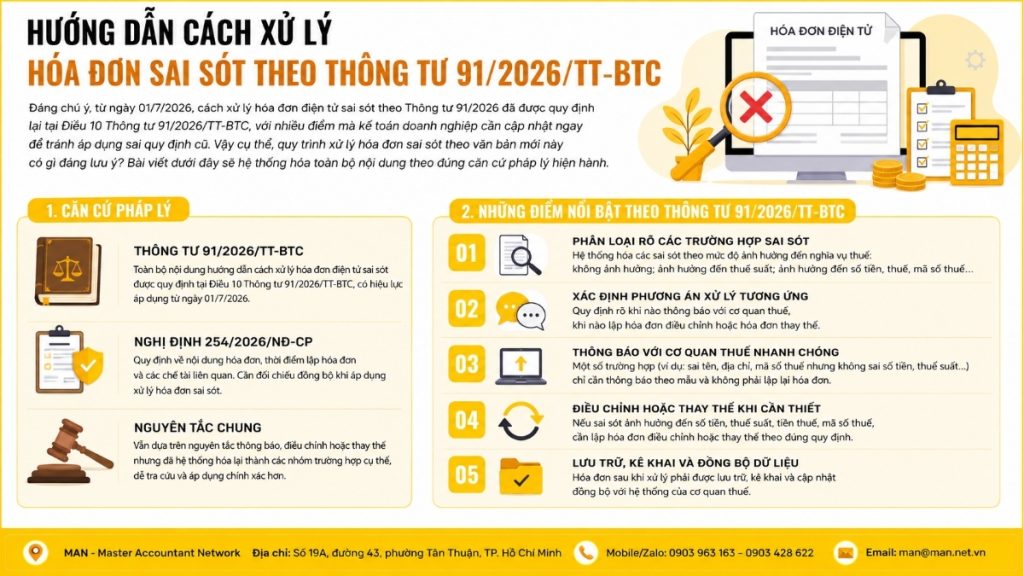
Notably, from July 1, 2026, the handling of erroneous electronic invoices as stipulated in Circular 91/2026 has been revised. Article 10 of Circular 91/2026/TT-BTCWith many points that corporate accountants need to update immediately to avoid misapplying old regulations, what are the specifics of the process for handling erroneous invoices according to this new document? This article will systematize all the content based on current legal grounds.
Legal basis for handling erroneous electronic invoices according to Circular 91/2026
The entire content of the instructions on how to handle erroneous electronic invoices according to Circular 91/2026 is stipulated in Article 10 of Circular 91/2026/TT-BTC, effective from July 1, 2026. This document provides detailed guidance on handling electronic invoices that have been issued but contain errors of varying degrees, from errors that do not affect tax obligations to errors regarding tax identification numbers, amounts, and tax rates.
In parallel, accountants also need to cross-check with Issuing invoices in accordance with Decree 254/2026/ND-CP The regulations specify the content of invoices, the time of invoice issuance, and related penalties to ensure consistent application and avoid situations where only a portion of the regulations is understood while other relevant aspects are overlooked.
Essentially, Circular 91/2026/TT-BTC does not change the philosophy for handling erroneous invoices (still based on the principle of notification, adjustment, or replacement), but it has systematized it into specific case groups, making it easier for accountants to look up and apply the regulations more accurately than previous regulations.
See more: New points in Circular 91/2026/TT-BTC.
Classification of cases of erroneous electronic invoices according to Circular 91/2026

This is the core of how to handle erroneous electronic invoices according to Circular 91/2026, divided into three main groups of cases based on the extent to which the error affects tax obligations.
The error is unrelated to the tax identification number, amount, tax rate, or goods.
The first case applies when the electronic invoice is incorrect in terms of name, address, amount in words, or other details, but not in terms of: tax identification number, amount written on the invoice, tax rate, tax amount, or goods listed on the invoice.
For this type of error, the seller does not need to reissue the invoice, but simply:
- Notify the buyer of any errors in the product description;
- Notify the tax authorities using Form No. 04/SS-HĐĐT.
This is the simplest processing procedure in the entire regulatory system, suitable for formal errors that do not alter the nature of the transaction or tax declaration obligations.
Errors regarding tax identification number, goods, amount, tax rate, and tax amount.
For more serious errors, including incorrect tax identification numbers; incorrect product names; goods not conforming to specifications or quality standards as stated on the invoice; incorrect amounts; incorrect tax rates, tax amounts, or other mandatory errors not falling under the category of incorrect tax identification numbers, amounts, or tax rates, the seller may choose one of two solutions:
- Option 1 – Correcting incorrectly issued invoicesElectronic invoices requiring adjustments must include a note clearly stating, "Adjustment for invoice Form No.… symbol… number… dated… month… year…".
- Option 2 – Replace the incorrectly issued invoice.The new replacement electronic invoice must include a note clearly stating, "Replaces invoice Form No. ... symbol ... number ... dated ... month ... year ...".
The choice between correction or replacement depends on the nature of the error and the agreement between the two parties, but once a form is chosen, the principle of consistency, which will be discussed later, should be noted.
Repeated errors on multiple invoices from the same buyer within the month.
The third specific case is when errors occur with the same buyer information, product name, unit price, quantity, and tax rate on multiple invoices from the same buyer in the same month. In this situation, the seller is allowed to:
- Create a single adjustment or replacement invoice for all incorrectly issued electronic invoices during that month;
- Attached is a list of incorrectly issued electronic invoices according to Form No. 01/BK-ĐCTT.
This regulation significantly reduces the workload for accountants in cases where transactions frequently occur with the same partner.
This regulation significantly reduces the workload for accountants in cases where transactions frequently occur with the same partner.
Handling electronic invoices in specific cases according to Circular 91/2026

In addition to the three basic types of errors mentioned above, the Circular also specifies how to handle erroneous electronic invoices according to Circular 91/2026 for some specific situations in business practice:
- Actual payment or settlement that changes the value or quantity: If the issued invoice is correct but a discrepancy arises during payment or settlement, the seller must issue a new electronic invoice for the difference, recording a negative number for a decrease and a positive number for an increase, reflecting the actual situation.
- Quantity-based and sales-based trade discounts: The discount amount is calculated and adjusted on the invoice of the last purchase or the next period; or an adjustment invoice is issued along with a list of invoices requiring adjustment.
- Returning goods: The seller issues an adjusted invoice when the buyer returns all or part of the goods. If the parties agree that the buyer issues the invoice upon return, the buyer will issue an electronic invoice to the seller.
- Goods are assets that require registration of ownership and use rights: If the property is registered in the buyer's name and the buyer is eligible to use electronic invoices, the buyer will issue a return invoice to the seller, ensuring compliance with relevant legal regulations.
- Insurance and deductions: When refunding, reducing premiums, or decreasing insurance brokerage commissions, the seller issues an adjustment invoice, clearly stating the amount and reason for the refund or reduction.
- Prepayment, payment services, telecommunications, natural gas: Each sector has its own way of handling things, from adjusting when real estate or construction transactions are canceled/terminated, to using data statements to create adjustment invoices for prepaid telecommunications services or exchange rate differences when selling natural gas.
- Electronic invoices from cash registers or sales of assets must be registered for ownership rights: The seller shall issue a replacement invoice for the incorrectly issued invoice, except in cases falling under the specific provisions of point c.2, clause 5, Article 10 of Circular 91/2026/TT-BTC.
- Aviation industry: Invoices for changes or refunds of air freight documents are considered adjustment invoices and do not require the inclusion of the phrase "Adjustment increase/decrease for invoice…". Air freight carriers are not permitted to issue their own invoices for refunds or changes to freight documents issued by agents.
Understanding each specific situation helps accountants avoid mechanically applying a single, general procedure to all types of transactions, which can lead to unnecessary secondary errors.
Procedure for handling erroneous electronic invoice data summary
Besides handling each individual invoice, Circular 91/2026 also clearly specifies the process for handling erroneous electronic invoices, which is a periodic report that many businesses must submit to the tax authorities:
- The summary of electronic invoice data has been submitted: The seller submits the adjustment or replacement information directly on the Data Summary Table for subsequent periods, without needing to send a notification using Form No. 04/SS-HĐĐT.
- The submitted summary table is incomplete or incorrect: The seller submits a supplementary summary of electronic invoice data, filling in all relevant information according to the applicable template.
- The transaction database is incomplete or contains incorrect information: The seller sends an additional Transaction Details Form.
- Tax authorities discovered an incorrectly issued electronic invoice: The tax authority will notify the seller using Form 01/TB-RSĐT; the seller is responsible for reviewing and making adjustments or replacements in accordance with regulations. If processed through notification (item 1), the system will automatically respond acknowledging receipt using Form 01/TB-SSĐT.
This process demonstrates the crucial role of proactive review by accountants; one should not wait until the tax authorities discover and send a notice before taking action, as this could lead to risks regarding filing deadlines and penalties.
For businesses that do not have an in-house accounting department with sufficient expertise to keep up with new regulations, hire accounting services Professional services from reputable organizations like MAN – Master Accountant Network will significantly reduce the risk of incorrect processing of electronic invoices.
Important notes when adjusting or replacing electronic invoices.
When applying the procedure for handling erroneous electronic invoices according to Circular 91/2026, accountants need to pay special attention to the following principles to avoid violating the process:
Principle of consistency in handling procedures
If the seller has already processed an incorrect invoice through adjustment or replacement, but subsequently discovers further errors on the same invoice, subsequent processing must follow the same procedure as the initial processing. This prevents a situation where an original invoice is both adjusted and replaced, making verification difficult.
Cases where only adjustment invoices can be issued.
If an electronic invoice is issued without an invoice form number, invoice symbol, or if the invoice number is incorrect, the seller is only allowed to issue an adjusted invoice; alternative options are not permitted.
Principles for declaring adjustment invoices
Regarding the value on the adjustment invoice, adjustments must be made by recording a positive number for increases and a negative number for decreases, reflecting the actual adjustment. The seller declares the adjustment in the period in which the adjustment invoice is issued, while the buyer declares it in the period in which the adjustment invoice is received; these two time points do not necessarily have to coincide.
Agreement document for adjusting or replacing invoices.
One easily overlooked aspect in the application of Circular 91/2026 regarding the handling of erroneous electronic invoices is the requirement for written agreement before adjusting or replacing invoices for the two groups of errors mentioned above:
- Buyers include economic organizations, other organizations, business households, and individual businesses: The seller and buyer must draw up a written agreement clearly stating the discrepancies; the seller is responsible for keeping this document at their unit and presenting it when requested by the tax authorities or other competent state agencies.
- The buyer is an individual: The seller must notify the buyer or make a public announcement on the seller's website (if any), while also retaining a copy of the agreement to present upon request.
However, a written agreement is not mandatory in all cases. The seller is exempt from this requirement in situations such as:
- Transfer electronic invoice data according to the Data Summary Table;
- Transfer the database containing detailed transaction information based on the Transaction Details Table;
- Or buy and sell goods on e-commerce platforms or other digital platforms.
Important notes regarding issuing electronic invoices to individuals and retail customers.

Mastering the handling of erroneous electronic invoices according to Circular 91/2026 will be more complete if accountants also update their knowledge of the regulations on invoice content and timing according to Decree 254/2026/ND-CP, as most errors arise right from the initial invoice creation stage.
Accordingly, invoices issued to individuals/individual customers need to clearly distinguish between three groups of customers:
- Individual business owners or household businesses (full name, address, and tax identification number must be provided);
- Individuals not engaged in business activities who require an invoice (should include full name, address, tax code/personal identification number);
- For individual customers who do not require an invoice, this group does not necessarily need to include the buyer's name, address, tax identification number, and digital signature; the entity name can be recorded as "Sold to Consumers".
Regarding the timing of invoice issuance, Article 9 of Decree 254/2026/ND-CP Regulations vary depending on the type:
- For goods, the time of transfer of ownership is the point at which payment is made, regardless of whether payment has been received or not;
- For services, this refers to the time when the service is completed or the time when payment is received in advance;
- For construction and installation activities, the time of acceptance and handover of completed work is the time of inspection and handover.
- In real estate business, the timing of invoice issuance depends on whether the ownership has been transferred or not.
Understanding these key timelines is the best way to prevent mistakes from the start, rather than having to make adjustments or replacements later.
Additionally, it is important to note the provision in Clause 5, Article 41 of Decree 254/2026/ND-CP regarding rewarding consumers who report acts of not issuing and delivering invoices:
The reward amount shall not exceed the administrative fine imposed for the violation, with a maximum of 10,000,000 VND per case.
This demonstrates that regulatory authorities are tightening compliance with invoicing regulations from both the seller's side and the consumer's oversight channel, further requiring businesses to handle erroneous invoices according to proper procedures and within the specified timeframe.
For businesses wishing to receive direct support in reviewing and processing erroneous electronic invoices and completing all tax declaration and reporting procedures in accordance with current regulations, please refer to the following: full accounting serviceThis solution helps businesses confidently comply with the law without worrying about updating to new regulations.
Conclude
As can be seen, the handling of erroneous electronic invoices according to Circular 91/2026 is structured to clearly classify errors based on their severity, accompanied by specific forms for each situation, from Form 04/SS-HĐĐT, Form 01/BK-ĐCTT to Form 01/TB-RSĐT, Form 01/TB-SSĐT. Mastering this process not only helps accountants correctly handle errors when they occur, but also serves as a basis for preventing administrative penalties related to invoices, ensuring accuracy in tax declaration and settlement for businesses.
If your business is still unsure about choosing between adjusting or replacing invoices, or how to properly format a written agreement, please Contact MAN – Master Accountant Network For assistance and advice on the latest invoicing and tax policies.
Contact information MAN – Master Accountant Network
- Address: No. 19A, Street 43, Tan Thuan Ward, Ho Chi Minh City
- Mobile/Zalo: 0903 963 163 – 0903 428 622
- E-mail: man@man.net.vn
- Google Business Profile: View MAN – Master Accountant Network's Google Business Profile
- LinkedIn Founder: View expert Le Hoang Tuyen's LinkedIn profile.
Responsible for production and professional content review by: Mr. Le Hoang Tuyen – Founder & CEO of MAN – Master Accountant NetworkHe is a CPA Vietnam auditor with over 30 years of in-depth experience in accounting, auditing, taxation, and corporate legal consulting.
Frequently Asked Questions about Handling Incorrect Invoices According to Circular 91/2026
Is it mandatory to cancel an electronic invoice if it contains errors?
No. Circular 91/2026/TT-BTC does not stipulate the cancellation of incorrectly issued electronic invoices. Depending on the severity of the error, the seller only needs to notify the buyer and the tax authority (for errors unrelated to the tax code, amount, or tax rate), or issue an adjusted or replacement invoice (for errors related to the tax code, amount, goods, or tax rate). The original invoice remains stored and is not deleted from the system.
Should you adjust or replace an electronic invoice when there are errors in the tax identification number, amount, or tax rate?
Circular 91/2026/TT-BTC allows sellers to choose one of two forms, without any mandatory order of priority. In practice, accountants usually choose to issue an adjustment invoice when only a part of the information needs to be corrected (e.g., adjusting the amount or tax rate), and choose to issue a replacement invoice when the original invoice contains too many errors and needs to be completely redone for clarity.
Can an electronic invoice be adjusted or replaced multiple times?
Yes, if errors are still discovered after adjustment or replacement. However, Circular 91/2026/TT-BTC clearly stipulates that subsequent processing must apply the same method used in the initial processing (if adjustments have been made, continue adjusting; if replacements have been made, continue replacing), in order to ensure consistency and ease of verification.
How to properly handle multiple erroneous invoices from the same customer within a month according to regulations?
If multiple invoices contain incorrect information regarding the buyer, product name, unit price, quantity, tax rate, and are issued within the same month, the seller may issue a single adjustment or replacement invoice for all the incorrect invoices, accompanied by a detailed list of invoices requiring processing under Form 01/BK-ĐCTT. This method reduces the workload compared to issuing each adjustment invoice separately.
Who is responsible for filing the adjustment declaration when an invoice is issued, the seller or the buyer?
Both parties must declare the adjustments, but in different periods: the seller declares in the period in which the adjustment invoice is issued, while the buyer declares in the period in which the adjustment invoice is received. Regarding value, upward adjustments must be recorded as positive numbers, and downward adjustments as negative numbers, reflecting the actual adjustments that occurred.