

Handling errors in financial reporting is a crucial task requiring businesses to understand accounting standard VAS 29, regulations on supplementary tax declarations, and procedures for legally adjusting data. Even a small error in financial statements can lead to the risk of tax arrears, administrative penalties, or directly affect the financial reputation of the business. In this article, MAN – Master Accountant Network This will provide detailed guidance on how to handle financial reporting errors at different times of detection, distinguish between retrospective and non-retrospective adjustments, and the process for preparing supplementary tax returns. Circular 80/2021/TT-BTC and control solutions to help businesses minimize accounting and tax risks in 2026.
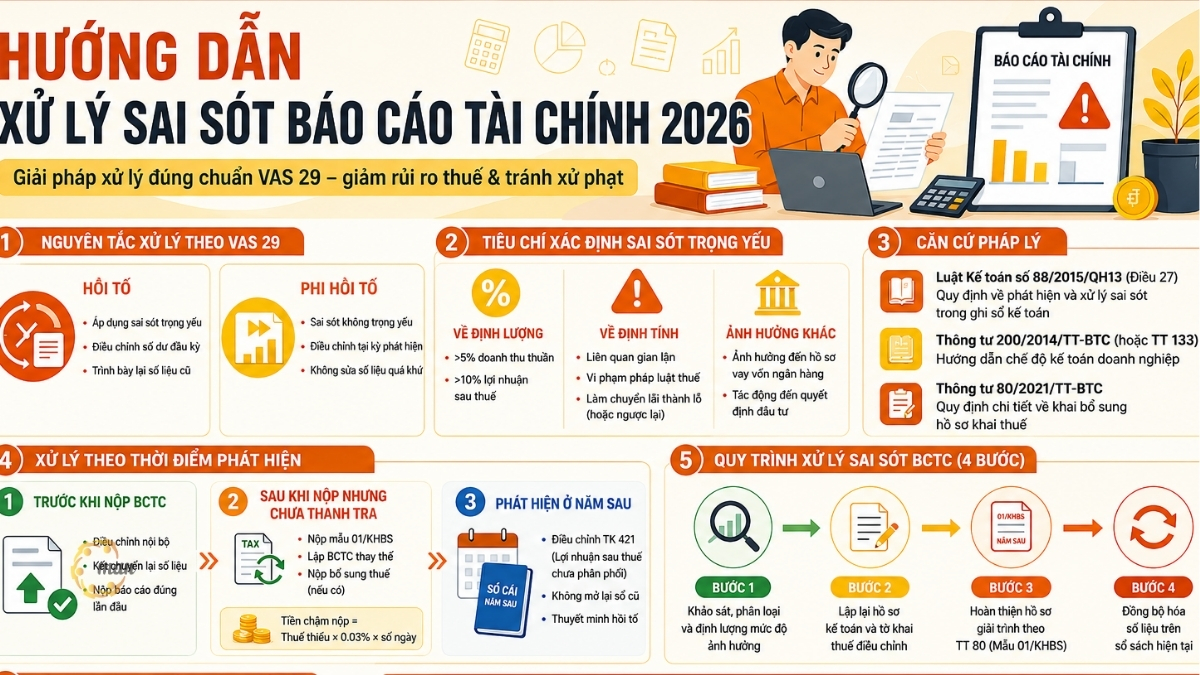
Principles for processing financial statements according to VAS 29
All accounting adjustments in Vietnam must be guided by Accounting Standard No. 29 (VAS 29). Changes in accounting policies, accounting estimates, and errors serve as the guiding principle. Mastering this principle helps accountants confidently explain their decisions to tax authorities and auditors, while also ensuring the consistency of historical data.
Distinguishing between Retrospective and Non-Retrospective Methods in Adjustments
VAS 29 classifies errors based on the time they occur and their impact, leading to two main handling methods:
Retrospective method
This method is applied when material errors related to previous accounting periods are discovered. Under this method, the business must make adjustments as if the error had never occurred.
Operation: Adjust the opening balances of asset, liability, and equity accounts (usually account 421 – Undistributed after-tax profit) for the current period. Simultaneously, restate comparative figures on the financial statements if necessary.
Non-Retrospective Method
This applies to non-material errors or changes in accounting estimates (e.g., changes in the depreciation period of fixed assets).
Operation: Record the impact of the adjustments on the business results of the period in which the error is discovered and any future periods (if any), but absolutely do not readjust past figures.
Criteria for determining the materiality of an error
This is the most important step in the process of handling financial reporting errors. An error is considered material if the omission or misrepresentation of that information could alter the economic decisions of the report's users.
In terms of quantity
Businesses often set a specific percentage threshold in their internal accounting policies. Typically:
- Errors affecting above 5% total net revenue or cost of goods sold.
- Errors affecting the after-tax profit of the reporting period (10%) are significant.
In terms of qualitative aspects
Even if the value is small, an error is still considered material if it relates to:
- Fraudulent or illegal tax practices.
- To change business results from profit to loss (or vice versa).
- This affects the likelihood of violating the terms of a bank loan.
Legal basis

To ensure authenticity and protect the business from legal risks, all operations must refer to:
- Accounting Law No. 88/2015/QH13 (Article 27): Clearly stipulates the detection and handling of errors in accounting records.
- Circular 200/2014/TT-BTC: Guidance on accounting regime for enterprises (or Circular 133 for small and medium-sized enterprises).
- Circular 80/2021/TT-BTC: Provides detailed regulations on supplementing tax declarations to legitimize corrections to the tax authorities.
In a constantly changing legal landscape, the best solution for businesses is to hire a highly qualified and experienced chief accountant to take ultimate control, ensuring all adjustment records comply with current regulations.
Guidance on handling errors in financial reporting depends on when they are discovered.

The timing of error detection plays a crucial role in determining the technical solutions and administrative procedures that accountants must follow. Accurately identifying the right time helps businesses optimize processes and minimize late payment penalties.
Detection before submitting financial statements to the Tax authorities.
Submit the report early, before the inspection decision is made, because the data has not yet been sent to the regulatory agency's system, and the business has not yet incurred any legal obligations related to that draft report. The accountant only needs to make internal correction entries.
- Use the negative numbering method (if the reciprocal relationship is incorrect) or make supplementary entries.
- Re-enter the revenue and expense accounts and re-determine the business results.
- Prepare a complete set of financial statements with accurate figures for initial submission.
- Keep records of the internal review to explain any discrepancies between drafts if requested by an auditor.
Discovered after financial statements were submitted but before an audit decision was made.
According to the Tax Administration Law No. 38/2019/QH14, businesses are encouraged to proactively detect and correct errors. Actively addressing errors in financial reporting during this period helps minimize the risk of penalties for incorrect declarations (penalties for underpaid taxes).
The supplementary application includes:
- The revised financial statements (Replacement version) have been updated.
- Supplementary Corporate Income Tax Return Form (Form 03/TNDN).
- The supplementary declaration explanation form (Form 01/KHBS) is the most important form for detailing the changes in indicators.
Financial responsibility: If an error results in an increase in the amount of tax payable, the business must immediately pay the difference in tax along with late payment penalties. The current formula for calculating late payment penalties is as follows:
| Late payment penalty = Amount underpaid x 0.03% x Number of days late |
Note: The number of days of late payment is calculated from the day following the tax payment deadline to the day the business pays the tax into the State budget.
Discovering errors from the previous year while preparing financial reports for the following year.
This case requires extremely strict retrospective adjustment techniques according to VAS 29. Accountants are not permitted to reopen closed and submitted books from the previous year for direct correction. Instead:
- The adjustment is recorded in the opening balance of the current year (Accounts 421, 214, 131, 331…).
- Re-present the figures in the "Previous Year" column on the Balance Sheet and Income Statement to ensure comparability.
- Prepare a detailed explanatory note to the financial statements regarding the nature of the adjustment item.
If the internal structure is not strong enough, finding a replacement is necessary. accounting outsourcing company Reputation is the best way to maintain transparency and stay up-to-date with the latest tax policies.
Procedure for handling errors in previously submitted financial statements.
To ensure the process runs smoothly, accountants should follow these steps:
Step 1: Survey, classify, and quantify the level of impact.
Accountants need to create a detailed list of errors found. Don't just look at the total number; analyze which indicators the error affects.
- Revenue: Incorrectly recorded or underrecorded revenue.
- Expenses: Expenses without valid invoices are disallowed during settlement, or expenses that were not accrued in advance.
- Assets or Liabilities: Exchange rate discrepancies at the end of the period or incorrect depreciation calculations as stipulated in Circular 45/2013/TT-BTC.
In cases where the accounting system is significantly and systematically inaccurate, businesses should consider using a third-party service. accounting record reconstruction services To ensure that the data is recovered accurately, for future accountability purposes.
Step 2: Recreate the accounting records and amended tax return.
After obtaining the reconciliation statement, proceed to prepare the correct set of financial statements. In the title or notes, clearly state: "This report replaces the financial statements submitted on… under transaction code…".
This helps tax officials update the correct data in the system, avoiding the situation where two reports exist simultaneously, causing misunderstandings during inspections.
Step 3: Complete the explanatory document according to Circular 80 (Form 01/KHBS)
In form 01/KHBS, transparency is crucial. Businesses need to provide clear explanations:
- Reasons: Misunderstanding of policies, software technical errors, or manual data entry errors.
- Content: List the old indicator code, the new indicator code, and the difference.
- Commitment: Affirming the integrity of the adjustment. A well-written explanation will help businesses minimize the risk of being summoned for in-person questioning by tax officials.
Step 4: Synchronize the data in the current accounting records.
The process of correcting errors in financial reporting is only truly complete when the figures in the accounting software match the supplementary documents submitted. Accountants must then make adjusting entries to the opening balances of the current fiscal year.
Ensure that adjustment documents are stored separately and signed by the Director for approval to facilitate future audits.
Here's a real-world example of how the MAN – Master Accountant Network team handles this:
In April 2025, Company X discovered that it had omitted input invoices worth VND 2 billion from 2024 due to an error in recording the period. This error artificially inflated the 2024 profit, leading to overpayment of corporate income tax but distorting the asset structure.
Handle: Since no additional tax liability arose, the company only needed to revise its financial statements and submit supplementary Form 03/TNDN. By submitting Form 01/KHBS with a clear explanation before the inspection decision, Company X avoided administrative penalties for misrepresenting financial statements under Decree 41/2018/NĐ-CP (the penalty could be up to 30 million VND).
Legal risks associated with delays in correcting errors in financial reporting.
Many businesses choose to remain silent when errors are discovered, hoping the tax authorities won't notice. However, with today's automated risk management systems, logical errors in financial statements are easily detected.
- Administrative penalties for accounting violations: According to Decree 41/2018/ND-CPThe act of preparing financial statements that do not conform to accounting documents or are inconsistent may be subject to a fine of VND 20,000,000 to VND 30,000,000.
- Tax penalties: According to Decree 125/2020/ND-CP, if errors leading to a shortfall in tax payable are discovered by the tax authorities during an inspection, the enterprise will be fined 20% of the shortfall amount, plus a late payment penalty of 0.03%/day.
- Non-financial consequences: Loss of credibility with investors. For listed companies, having to correct financial statements leads to a drop in stock price and loss of shareholder confidence.
Therefore, proactively addressing financial reporting errors as soon as they are discovered is the most effective risk management strategy.
Frequently Asked Questions about Handling Errors in Financial Reporting
Yes. If the error affects tax obligations, profits, assets, liabilities, or changes information already declared to the Tax authorities, the business is required to file a supplementary declaration as stipulated in Circular 80/2021/TT-BTC.
If errors from previous years are discovered, and the errors are material, the accountant must adjust the opening balances of the current year, prepare relevant financial statements, file supplementary tax returns, and clearly explain the cause and impact of the errors. Businesses are strictly prohibited from directly correcting the accounting records of a closed year.
Businesses may be penalized for preparing financial statements that are inaccurate compared to supporting documents, understating revenue or expenses, or understating taxes payable. Is it mandatory to submit supplementary reports if there are errors in the financial statements?
What should a company do if it discovers errors after submitting its financial statements for many years?
When can a business be penalized for errors in financial reporting?
Conclude
Handling financial reporting errors is a test of professionalism. Transparency and adherence to legal procedures not only protect businesses from audits but also build lasting brand value.
If your business is struggling with data review or needs in-depth legal advice, consult with us today. accounting services From MAN – Master Accountant Network. With a team of experienced professionals, we are committed to partnering with businesses to optimize their financial systems and minimize tax risks.
Contact MAN – Master Accountant Network for free support and advice!
Contact information MAN – Master Accountant Network
- Address: No. 19A, Street 43, Tan Thuan Ward, Ho Chi Minh City
- Mobile/Zalo: 0903 963 163 – 0903 428 622
- Email: man@man.net.vn
Content production by: Mr. Le Hoang Tuyen – Founder & CEO of MAN – Master Accountant NetworkCPA Vietnam auditors with over 30 years of experience in accounting, auditing, and financial consulting.






