
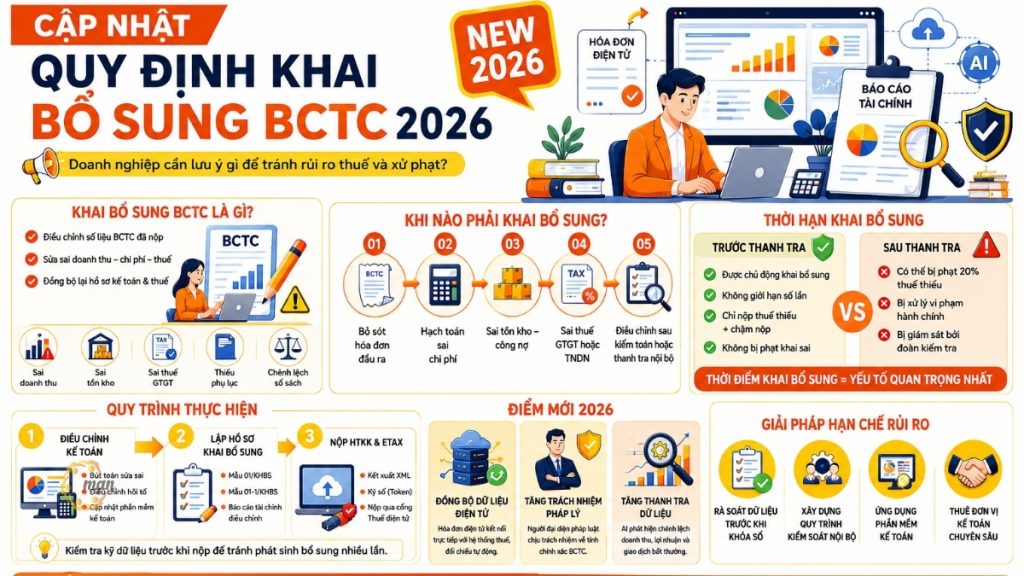
Regulations on supplementary financial statement filing are becoming a topic of particular interest to the business community in 2026 as regulatory agencies strengthen electronic data reconciliation between invoices, tax returns, and financial statements. Even a small error in revenue, expenses, liabilities, or taxes can force businesses to file supplementary reports, resubmit documents, and face the risk of administrative penalties.
In the context of increasingly stringent electronic tax management systems, correctly understanding the regulations for filing supplementary financial statements is crucial not only for businesses to ensure legal compliance but also to mitigate risks during tax audits and inspections. This article will provide a comprehensive update on the legal basis, implementation process, required documents, deadlines for filing supplementary statements, and important notes according to the latest regulations in 2026.
What are the regulations for filing supplementary financial statements?
According to the current Accounting Law and tax management regulations, the requirement to supplement financial statements is understood as the process by which a business adjusts, amends, or resubmits previously submitted financial statements when it discovers errors affecting the accuracy of financial data or tax obligations.
Supplementary declarations may be required in several situations, such as:
- Incorrect sales revenue.
- The report noted a lack of legitimate expenses.
- The accounting account was incorrectly entered.
- Incorrect inventory figures.
- Incorrect VAT or Corporate Income Tax.
- The financial statements are missing explanatory appendices.
- Discrepancies between accounting records and tax returns.
Many businesses often confuse:
- Adjusting internal accounting figures.
- Submit the financial statements.
- File supplementary tax returns.
In practice, the requirement to file supplementary financial statements often comes with the obligation to adjust tax records if errors change the amount of tax payable.
The purpose of the regulation on supplementing financial statements.
The issuance of regulations on supplementary financial statement filing aims to ensure:
- The accuracy and reliability of financial information.
- Transparency in business operations.
- Synchronize data between tax authorities, banks, and business registration agencies.
- Prevent tax fraud.
- Increase the accuracy of electronic accounting data systems.
Furthermore, proactively complying with regulations on supplementary financial statement filing significantly reduces the risk of being subject to tax arrears or penalties during audits.
Legal basis for requiring supplementary declaration of financial statements.

To properly and legally adjust financial data, businesses need to base their decisions on the following core legal regulations:
- Tax Administration Law No. 38/2019/QH14This is the supreme legal document governing all tax declaration, tax payment, and amendment of tax records in Vietnam. Specifically, Article 47 of this Law clearly stipulates the rights and responsibilities of taxpayers when they discover errors in their submitted tax declarations.
- Circular No. 80/2021/TT-BTCThis document provides detailed guidance on the implementation of certain provisions of the Law on Tax Administration. It serves as a technical "guideline," specifying the forms and methods for submitting supplementary documents through the General Department of Taxation's electronic portal.
- Vietnamese Accounting Standards (VAS 23 – Events Occurring After the End of the Accounting Period and IAS 8/VFRS): Guidance on how to treat material and immaterial errors in accounting records retrospectively or non-retrospectively.
Key new features for 2026: From 2026 onwards, the synchronized deployment of electronic invoices generated from cash registers, combined with the General Department of Taxation's AI-powered automatic reconciliation mechanism, has made discrepancies between Value Added Tax (VAT) declarations, Corporate Income Tax (CIT) settlements, and financial statements easier to detect. Therefore, understanding and accurately applying regulations on supplementary financial statement filing is a prerequisite for protecting businesses from unexpected inspections and audits.
Cases where supplementary financial statement submission is permitted and mandatory according to regulations.

Not all accounting errors are handled the same way. Businesses need to clearly distinguish which cases allow for adjustments and what the deadlines are for making them.
When does a business need to file a supplementary tax return?
According to current tax and accounting regulations, businesses must submit supplementary tax returns in the following cases:
- Discrepancies in revenue and expense figures: Discovery of omitted output or input invoices, incorrect accounting period recording, or unreasonable expense allocation leading to inaccurate business results.
- Errors in accounting account classification: Misclassification errors between assets and expenses (for example, classifying fixed assets as direct expenses instead of depreciation) may not immediately change corporate income tax obligations, but they distort the fundamental nature of the financial structure on the financial statements.
- Adjusting figures after an audit or internal inspection: When an independent auditing firm discovers material errors and requires the company to make adjustments before issuing or after submitting financial statements to the tax authorities.
Deadline for submitting supplementary financial statements.
The deadline is a decisive factor in whether a business will be penalized for late payment. The golden rule to remember is stipulated in Clause 1, Article 47 of Law No. 38 on Tax Administration:
Before the tax authorities announce a decision to conduct a tax audit or inspection at the company's premises.
Businesses are allowed to proactively submit supplementary financial statement declarations on any working day (without limit on the number of times). In this case, if additional tax is payable, the business only has to pay the outstanding tax and late payment penalty (calculated at a rate of 0.03%/day) and will not be penalized for incorrect declaration.
After the tax authorities have announced their decision to conduct a tax audit or inspection.
Businesses are still entitled to submit supplementary tax returns; however, the tax authorities will handle administrative tax violations (fines underpaid tax or tax evasion depending on the severity of the violation).
Additional data collected during this phase will typically be recorded and processed directly by the inspection team in the inspection report.
| Comparison criteria | Before the inspection decision was announced | Following the announcement of the inspection decision. |
| Right to self-determination | Completely proactive, free to correct mistakes. | Passive, subject to the supervision of the inspection team. |
| Penalties for false declarations | Only late payment penalties based on interest rate of 0.03%/day. | Fines range from 5,000,000 to 8,000,000 VND and even 20% on the amount of underdeclared tax. |
| Application form | Complete forms 01/KHBS, 01-1/KHBS and new financial statements. | Record this directly in the inspection report. |
As the comparison table above shows, the timing of filing supplementary tax returns plays a crucial role in minimizing legal risks and penalty costs for businesses. By proactively reviewing and complying with regulations on supplementary financial statement filing before the tax authorities announce an audit, businesses not only have the right to adjust their records but also have the opportunity to avoid penalties under Article 20% for incorrect tax declarations. Conversely, once the authorities have conducted an audit, the proactive option is almost lost, and businesses may face more severe penalties. Therefore, regularly reviewing accounting records, reconciling tax data, and proactively filing supplementary returns early are essential solutions to minimize financial and legal risks in 2026.
The procedure is carried out according to the regulations for filing supplementary financial statements.
The supplementary submission process requires absolute accuracy, from internal accounting to technical operations on the tax declaration support software (HTKK).
Step 1: Adjust accounting figures (Correcting entries)
Before submitting supplementary tax returns to the tax system, accountants must process the data directly in the company's accounting software (MISA, FAST, SAP, etc.):
- If an error from the previous year is discovered this year, make retrospective adjustments (if it is a material error) or non-retrospective adjustments in the current period (if it is an immaterial error) in accordance with the provisions of accounting standard VAS 29.
- Make additional adjusting entries, recording negatives or reversing entries depending on the nature of each account where the discrepancy arises.
Step 2: Prepare the supplementary declaration form in accordance with the regulations for supplementary financial statement declaration.
The complete dossier submitted to the tax authorities according to Circular 80/2021/TT-BTC must include:
- Supplementary Declaration Form (Form No. 01/KHBS): Reflects the difference between the data declared initially (or in the most recent supplement) and the data after adjustment.
- Explanation of supplementary and adjusted tax declarations (Form No. 01-1/KHBS): This is a crucial document clearly stating the reasons for adjusting the data, the adjusted item codes on the tax return, and the calculation of the additional/decreased tax amount along with the expected late payment penalty.
- The adjusted financial statements (Replacement): The new complete set of financial statements (including the Balance Sheet, Income Statement, Cash Flow Statement, and Notes to the Financial Statements) contains the correct revised figures.
Step 3: Submit the application through the HTKK system and the Electronic Tax Portal (Etax).
Accountants should follow these technical steps to ensure the records are error-free in formatting. Operations on the HTKK system:
- Open the HTKK software (make sure it's updated to the latest version in 2026).
- Select the item "Corporate Income Tax" -> Select "Annual Corporate Income Tax Settlement (03/TNDN)".
- Select the tax period to be adjusted, then tick the "Supplementary Tax Return" option.
- Re-enter the changed figures accurately. The HTKK system will automatically switch to Appendix 01/KHBS and 01-1/KHBS. The accountant should fill in the explanation in this appendix.
- Export the records as XML files.
Instructions on the Electronic Tax Portal (thuedientu.gdt.gov.vn)
- Log in using your company's digital signature (Token) account.
- Go to the "Tax Filing" section and then "Submit XML Tax Return".
- Upload the XML file just exported from HTKK to the system and digitally sign and submit the supplementary corporate income tax return.
- For replacement financial statements, you can submit them as an attached appendix or submit them directly in the "Search for declarations" section followed by "Submit appendix" depending on the management system of each local tax office.
The relationship between regulations on supplementary financial statement filing and related taxes.
Accountants often make the serious mistake of thinking that simply submitting financial statements is sufficient. In reality, the figures in financial statements are closely linked to a company's other tax obligations.
Impact on Corporate Income Tax Settlement
Financial statements are the basis for determining the pre-tax accounting profit (Indicator [A1] on form 03/TNDN). Therefore, any change in revenue or expenses on the financial statements will change taxable income.
- If the adjustment results in an increase in corporate income tax payable: The enterprise must proactively pay the additional tax amount along with late payment penalties calculated from the deadline for submitting the annual tax return to the actual payment date.
- If the adjustment results in a reduction of corporate income tax payable: This overpaid tax amount will be offset against the next tax period or a refund will be processed according to regulations.
Impact on Personal Income Tax (PIT) and Social Insurance (SI)
If the supplementary financial statement filing involves adjustments to employee salaries, wages, and bonuses:
- Businesses are required to resubmit the corresponding Personal Income Tax Final Settlement Declaration (Form 05/QTT-TNCN) for that year.
- Note the associated risks: Changes in payroll data may lead to cross-checking by the Social Insurance agency and a request for retroactive collection of mandatory social insurance contributions from the enterprise.
Impact on Value Added Tax (VAT)
If the error arises from omitting output invoices or incorrectly declaring input invoices, in addition to complying with the regulations on supplementary financial statement filing, the accountant must prepare a supplementary VAT declaration (Form 01/KHBS-GTGT) for the tax period in which the error occurred (corresponding month or quarter).
Advice from MAN – Master Accountant Network: When applying the regulations for submitting supplementary financial statements, accountants must always conduct a thorough review. Under no circumstances should the figures in the newly submitted supplementary financial statements differ from the figures in the Corporate Income Tax return currently stored in the tax authority's system.
Penalties for violating regulations on supplementing financial statements and ways to mitigate risks.

The current policy on handling administrative tax violations is extremely strict, but it also opens up opportunities for businesses to voluntarily "correct their mistakes."
Penalty framework according to Decree No. 125/2020/ND-CP
Decree 125/2020/ND-CP The regulations clearly specify the monetary penalties for late submission or incorrect filing of tax returns/financial statements:
- For late submission of financial statements (considered tax returns): The penalty can range from VND 2,000,000 to VND 25,000,000 depending on the number of days late. However, if the business proactively submits supplementary tax returns to correct errors before the deadline for final tax filing or before an inspection decision is issued, it will not be considered late submission of financial statements.
- The act of making false declarations resulting in an underpayment of taxes: Penalty understated or an overpayment of taxes compared to legal regulations.
- Tax evasion (if the tax authorities can prove intentional fraud): Penalty of 1 to 3 times the amount of tax evaded.
Measures to remedy and mitigate financial losses.
Instead of passively waiting for the results of inspections, businesses can proactively minimize financial losses and optimize their tax obligations:
- Proactive supplementary declaration: Point b, Clause 1, Article 9 of Decree 125/2020/ND-CP clearly states that taxpayers who voluntarily supplement their tax declarations and pay the full amount of outstanding tax and late payment penalties before the tax authority announces an inspection or audit decision will not be subject to administrative penalties for incorrect declarations.
Reference: Hire an accountant to prepare the financial statements.
New points in the regulations for filing supplementary financial statements in 2026.
From 2026 onwards, the tax and accounting management system will continue to be upgraded towards digitalization and enhanced automated data reconciliation. New changes in regulations for supplementary financial statement filing not only affect the filing and adjustment process but also increase the legal responsibility of businesses in ensuring the accuracy of their financial reports. Below are some important new points that corporate accountants need to pay special attention to in order to minimize risks when filing supplementary statements in the current period.
Electronic data synchronization
From 2026 onwards:
- Electronic invoice data is directly linked to the tax system.
- Financial statements are automatically reconciled.
- Discrepancies in revenue are detected more quickly.
This makes compliance with the regulations on filing supplementary financial statements a mandatory requirement for all businesses.
Increase the accountability of legal representatives.
Business representative:
- They are responsible for the accuracy of the financial statements.
- You are responsible for submitting supplementary declarations if any errors are discovered.
Increase data risk inspections.
Modern data analysis systems help to:
- Revenue discrepancies were detected.
- Compare the abnormal profit margins.
- Check for suspicious transactions.
Therefore, businesses need to proactively review their data regularly.
What can businesses do to minimize the need for supplementary filings?
In reality, most cases requiring supplementary financial statement filing stem from businesses failing to properly control their accounting data, invoices, and tax obligations from the outset. Instead of addressing errors after filing, businesses should proactively develop robust financial and accounting management processes to minimize the risk of financial statement adjustments and potential tax audits and penalties.
Establish internal control procedures.
Businesses should:
- Regularly check the documents.
- Clear division of accounting responsibilities.
- Regularly reconcile accounts payable and receivable.
Review data before closing the books.
Before preparing financial statements, you need to:
- Check the revenue.
- Check the invoice.
- Compare inventory levels.
- Review of VAT.
Accounting software applications
Modern software helps to:
- Automatic error alerts.
- Synchronize invoice data.
- Reduce the risk of manual errors.
Hire a specialized accounting firm.
For businesses with complex data, the use of accounting services Or professional auditing will help:
- Minimize material errors.
- Ensure compliance with regulations regarding the submission of supplementary financial statements.
- Reduce the risk of tax penalties.
Frequently Asked Questions about Regulations for Filing Supplementary Financial Statements
Not every case will result in a penalty. If the business proactively detects errors, submits supplementary declarations to the inspector, and there are no signs of fraud, penalties may apply.
Yes. According to the regulations on supplementary financial statement filing, businesses are allowed to file supplementary statements multiple times if new errors are discovered before the tax authorities announce a tax audit decision.
If the error is not material, does not affect tax obligations, and does not distort the nature of the financial statements.
Typically, after an inspection concludes, businesses no longer have the right to independently submit supplementary declarations; instead, all adjustments must be made according to the tax authority's conclusions. Will I be penalized for resubmitting my financial statements?
Is it possible to submit supplementary declarations multiple times?
Do minor errors require supplementary declarations?
After a tax audit, is it possible to file a supplementary tax return?
Conclusion and recommendations
In the context of increasingly stringent regulations on electronic data and enhanced automated inspections, correctly understanding and fully implementing regulations on supplementary financial statement filing is a mandatory requirement for all businesses. Even a small error in revenue, expenses, or tax obligations can lead to back taxes, penalties, and damage to a company's financial reputation.
Therefore, businesses need to:
- Proactively review accounting records periodically.
- Compare tax data regularly.
- Standardize accounting records.
- Submit supplementary declarations promptly upon discovering errors.
In cases involving complex data or significant tax risks, businesses should consult with relevant authorities. accounting record reconstruction services from experienced units to ensure proper handling in accordance with regulations.
Contact MAN – Master Accountant Network For free support and advice!
Contact information MAN – Master Accountant Network
- Address: No. 19A, Street 43, Tan Thuan Ward, Ho Chi Minh City
- Mobile/Zalo: 0903 963 163 – 0903 428 622
- Email: man@man.net.vn
Content production by: Mr. Le Hoang Tuyen – Founder & CEO of MAN – Master Accountant NetworkCPA Vietnam auditors with over 30 years of experience in accounting, auditing, and financial consulting.






