
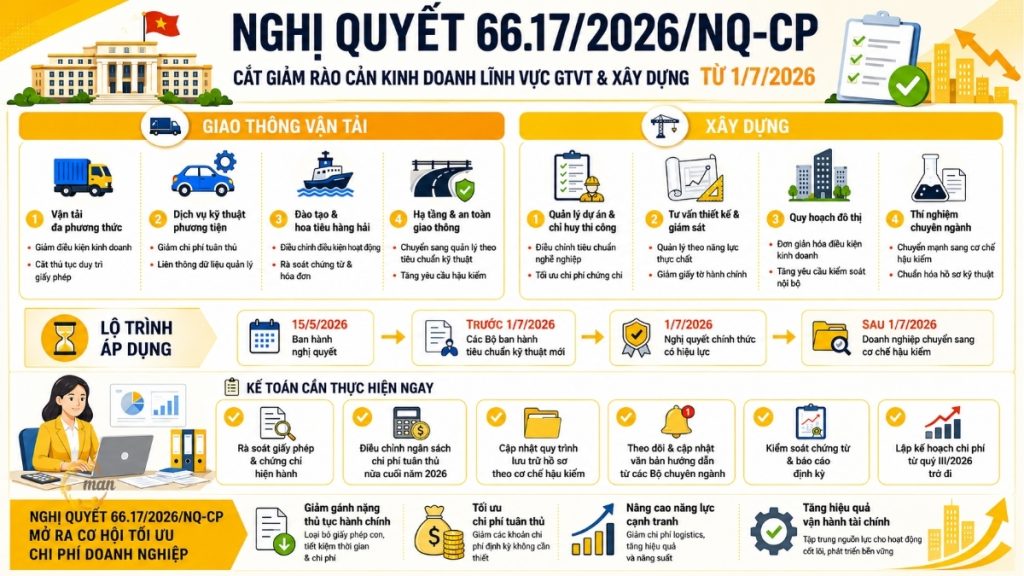
In business operations, the accounting department is not only responsible for recording and accounting data but also for closely monitoring legal changes that directly impact costs, documentation, and compliance obligations. This is especially true in the transportation and construction sectors, which are subject to numerous business regulations. Any adjustments from government agencies need to be identified and addressed promptly from a financial perspective.
On May 15, 2026, the Government officially issued... Resolution 66.17/2026/NQ-CP Regarding the reduction and simplification of business conditions in the transportation and construction sectors, effective from July 1, 2026, this is an important legal document that accountants in businesses in these two sectors need to understand before the resolution officially comes into effect.
What is Resolution 66.17/2026/NQ-CP? What is the context of its creation?
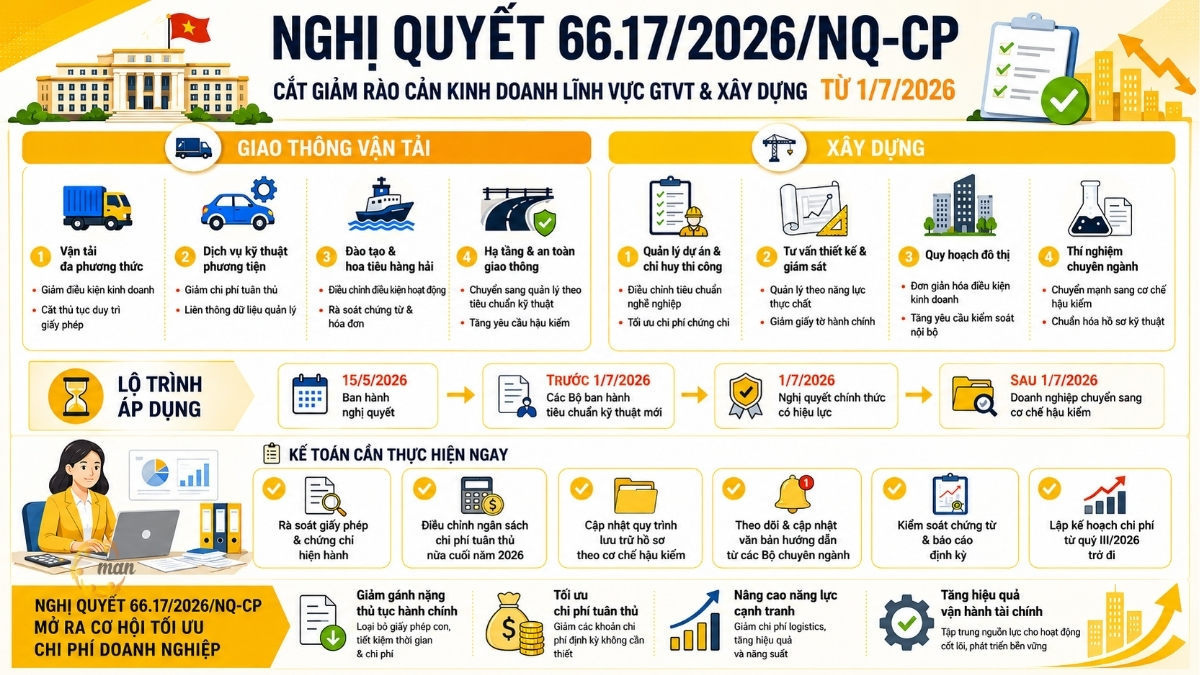
Resolution 66.17/2026/NQ-CP, signed by Deputy Prime Minister Pham Thi Thanh Tra on May 15, 2026, is part of the government's ongoing business environment reform program. The resolution focuses on establishing a new management mindset, resolutely eliminating unnecessary requirements and shifting strongly from pre-inspection to post-inspection based on a rigorous system of technical standards and regulations.
The shift from a pre-audit to a post-audit mechanism has significant practical implications for corporate accounting. In the traditional pre-audit model, businesses must complete all licensing procedures, incurring fees, legal consulting costs, and waiting costs before being allowed to operate. The shift to post-audit means a significant change in the compliance cost structure: some recurring expenses may disappear, while new requirements emerge regarding the maintenance of capability records and regular reporting to regulatory authorities.
This is why Resolution 66.17/2026/NQ-CP is not simply legal news, but essential input data for financial planning and cost control in the second half of 2026.
Key changes in the transportation sector according to Resolution 66.17/2026/NQ-CP

The transportation sector accounts for a large proportion of the list of cuts and amendments this time. Accordingly, four main business sectors are included in the review and simplification of business conditions.
Multimodal transport
Businesses operating in the road, rail, and air transport sectors will have their business conditions adjusted to reduce administrative procedures. Accountants responsible for this sector need to immediately review the list of fees and charges currently being accounted for periodically related to maintaining transport business licenses to determine which are still valid and which will no longer be incurred after July 1, 2026.
Vehicle technical services
The production, assembly, import of automobiles, and vehicle inspection are among the areas included in the review and reduction of administrative procedures. For businesses importing or distributing vehicles, minimizing business conditions in this group directly impacts compliance costs before goods are put into circulation on the market. This cost is often accounted for in the cost of goods sold or business management expenses.
Furthermore, promoting data linkage between regulatory agencies also helps to reduce the number of businesses having to file duplicate declarations. In this context, businesses operating in the vehicle technical services sector should consider this approach. full accounting service To standardize records, control documentation, avoid risks from new regulations that have not yet been adapted to, and reduce internal operational pressure when policies are constantly changing.
Training, testing, and maritime pilotage
Training and testing for automobile drivers, and training for seafarers and maritime pilots are also subject to regulation. Service providers in this field need to review their documentation, service invoices, and fees to ensure they comply with the new regulations when operating conditions change.
Infrastructure and traffic safety
Airport operations, railway infrastructure, and traffic safety audits will be managed under a system of technical standards instead of administrative conditions as before. This transition requires accountants to closely monitor the issuance of new standards by relevant ministries, as new technical standards may entail requirements for periodic reporting or certification testing, generating costs that need to be budgeted and accounted for in due course.
Reducing business regulations in these sectors not only helps businesses streamline administrative procedures and eliminate unnecessary permits, but also contributes to creating a level playing field, thereby reducing logistics costs and enhancing the competitiveness of the economy.
From an accounting perspective, this is a positive sign as reduced compliance costs mean the potential for improved operating profit margins.
How has the construction sector changed according to Resolution 66.17/2026/NQ-CP?

Alongside transportation, the construction sector is also undergoing extensive regulation. The government is focusing on standardizing highly specialized professions, especially consulting and engineering activities. The goal is to manage construction quality based on actual competence rather than formal administrative requirements.
Project management and construction supervision
Project management and site management will be adjusted according to substantive professional standards. This is a point that accountants at contracting units need to pay attention to: the cost of maintaining professional certifications for project management personnel, which is accounted for as personnel costs or general project costs, may change after the new standards are issued.
Design consulting and construction supervision
Construction surveys; design, design review; and construction supervision consulting are the technical consulting service groups included in the review list. The management method is shifting to being based on actual competency standards instead of control through administrative paperwork.
For construction accounting departments, this is also an opportunity to optimize document archiving processes and synchronize data for auditing, inspection, or settlement purposes. This is especially true for small and medium-sized enterprises (SMEs). hire accounting services To ensure compliance and mitigate risks arising during project operation.
For accounting departments at consulting firms, this is a good time to review the categories of professional practice maintenance expenses, professional association membership fees, and recurring training investments to ensure proper classification and accounting.
Urban planning and specialized experiments
Urban and rural planning, as well as specialized construction testing services, are also among those whose requirements are being simplified. For construction laboratories and planning consulting units, the shift to a post-audit mechanism requires the establishment of a more rigorous internal control record system—a requirement that accounting departments need to coordinate with the technical and legal departments for synchronized implementation.
The management approach will shift to a system based on professional standards and technical regulations. This requires consulting firms and contractors to improve their substantive capabilities, while also creating more favorable conditions for economic entities to participate in the construction market. From a financial perspective, the pressure to improve substantive capabilities means that investments in personnel training, equipment, and quality management systems need to be fully and accurately reflected in the capital budget and operating expenses.
Implementation roadmap and accounting deadlines to be recorded.

This is the part that the accounting department needs to monitor most closely, as it directly affects the timing of cost recognition and allocation.
The government has instructed the Ministers of the relevant ministries to urgently issue replacement technical standards and regulations before July 1, 2026. This means that between now and the end of June 2026, detailed guidance documents from the Ministry of Transport and the Ministry of Construction will be issued sequentially. Each document may entail changes to accounting conditions, the legal basis of documents, and reporting requirements.
The drafting and promulgation process must ensure openness and transparency, preventing the emergence of new business conditions in any form, while also preventing vested interests and corruption. This provides accountants with confidence in the stability of the legal framework during the transitional period.
The most important accounting aspect is the transitional clause:
- For businesses that are already operating, the licenses that have been issued remain valid until their expiration date, ensuring stability and continuity in production and business operations.
Note: The accounting department does not need to adjust the accounting for license renewal expenses in the current period, but needs to create a clear plan for each license. Record the expiration date specifically to avoid the risk of unnecessary renewals (wasting budget) or overlooking valid, mandatory licenses.
Impact on the business and immediate accounting actions needed.
The core spirit of Resolution 66.17/2026/NQ-CP is to reduce administrative burdens and create a more substantive operating environment for businesses. From the perspective of internal financial control, this is the opportune time for the accounting department to proactively implement these measures:
Review and categorize the current list of licenses and certificates.
Compile a complete list of all licenses and professional certifications that the business currently holds. Compare each item with the industry groups regulated by the resolution to classify them:
- Which items will definitely no longer be required after July 1, 2026?
- Which items are awaiting specific guidance from the circular?
- Which provisions remain mandatory under current regulations?
The review results will serve as the basis for adjusting compliance cost estimates and planning documentation for the next period.
Adjusting the compliance cost estimate for the second half of 2026.
After the review results are available, the budget for July to December 2026 will be updated for the following items:
- Licensing fees and professional certificate maintenance fees.
- Legal consulting fees related to administrative procedures.
These figures need to be accurately reflected in the third and fourth quarter financial reports, avoiding budget overruns that could lead to discrepancies in year-on-year comparisons.
Update the record-keeping process to a post-audit mechanism.
The post-licensing mechanism focuses on businesses demonstrating their capabilities and compliance themselves, rather than waiting for government agencies to grant licenses. From an accounting perspective, this requires building or updating an internal record-keeping system including:
- Documents demonstrating technical competence.
- Professional liability insurance contract.
- Periodic inspection report.
All necessary documentation can be presented immediately. This is also a requirement that internal and independent auditors will increasingly focus on checking in future assessments.
Monitor and update guidance documents from relevant ministries.
Since the entire replacement technical standard must be issued before July 1, 2026, accountants need to establish a schedule for monitoring additional information in the coming period. Each newly issued circular may entail adjustments to the accounting basis, the list of valid documents, or the cost calculation basis; any updated information needs to be updated immediately and communicated promptly to relevant departments.
For businesses that do not yet have a dedicated finance team, hire chief accountant It is a solution that helps control the documentation system, review compliance, and advise on financial strategies that are appropriate to the new legal changes.
Resolution 66.17/2026/NQ-CP opens up opportunities for cost optimization.

The significant reduction of business conditions in the transportation and construction sectors, as stipulated in Resolution 66.17/2026/NQ-CP, demonstrates the Government's determination to build a proactive state, supporting businesses and creating momentum for breakthrough development in the new phase.
For accounting and finance departments, the strategic message from this resolution is an opportunity to comprehensively review the company's compliance cost model. Legal compliance costs include fees, consulting fees, and personnel costs for handling procedures. Capital is a significant hidden cost in the operating structure of transportation and construction businesses. As the government reduces administrative requirements, businesses that quickly identify and adjust their compliance budgets will have a cost advantage over their competitors.
This is the time for the chief accountant or CFO to propose to management a comprehensive assessment of cost-saving opportunities from legal reforms, and to plan investments in post-audit documentation systems, as this will be a mandatory compliance requirement in the new operational phase.
Conclude
Resolution 66.17/2026/NQ-CP is considered a significant step forward in the process of reforming the business environment in 2026. Reducing business barriers, simplifying administrative procedures, and promoting digital transformation will not only help businesses reduce operating costs but also improve internal governance efficiency.
For the accounting department, proactively updating on changes from Resolution 66.17/2026/NQ-CP will play a crucial role in controlling records, optimizing documentation processes, and mitigating legal risks in the new phase.
For any detailed questions regarding the Resolution, businesses are kindly requested to contact MAN – Master Accountant Network for timely advice and support.
Source: Nhan Dan Newspaper
Contact information MAN – Master Accountant Network
- Address: No. 19A, Street 43, Tan Thuan Ward, Ho Chi Minh City
- Mobile/Zalo: 0903 963 163 – 0903 428 622
- Email: man@man.net.vn
Content production by: Mr. Le Hoang Tuyen – Founder and CEO of MAN – Master Accountant NetworkCPA Vietnam auditors with over 30 years of experience in accounting, auditing, and financial consulting.






