
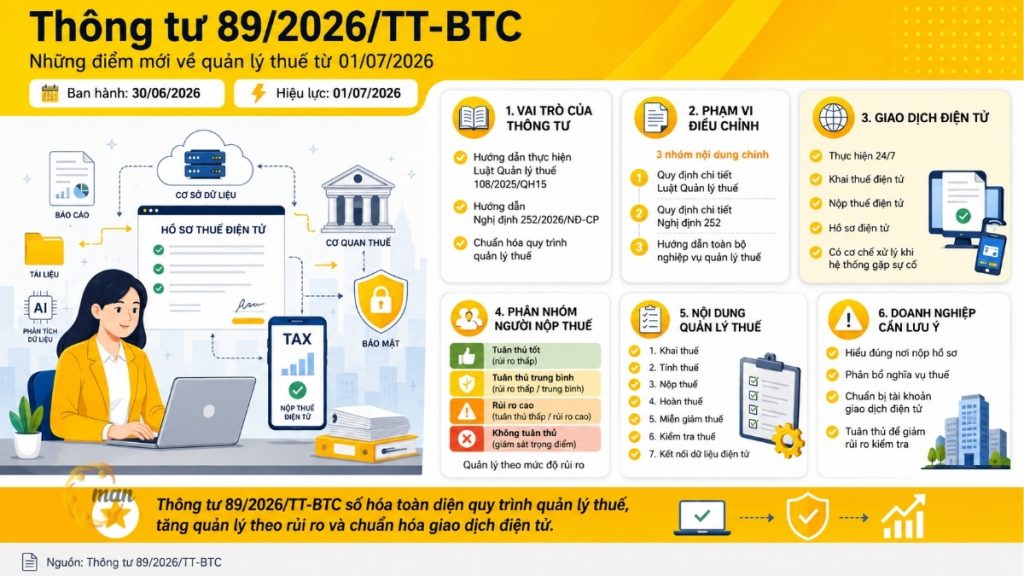
On June 30, 2026, the Ministry of Finance officially issued Circular 89/2026/TT-BTC, which officially came into effect on July 1, 2026, signed by Deputy Minister Cao Anh Tuan. This is a document that any accountant, business owner, or individual with tax obligations needs to understand, as it directly clarifies two fundamental legal documents issued earlier: Law on Tax Administration No. 108/2025/QH15 and Decree 252/2026/ND-CP.
To put it simply, if the Law on Tax Administration and Decree 252/2026/ND-CP are the foundation that sets out the major principles, then Circular 89/2026/TT-BTC This includes implementation guidelines, from determining the tax period and where to file tax returns, to conducting electronic transactions with the tax authorities. In this context, early updating and correctly understanding the spirit of Circular 89/2026/TT-BTC will help taxpayers avoid numerous compliance risks during the current tax policy transition period.
This article will help you understand the overall content of Circular 89/2026/TT-BTC, from its scope of application and subjects covered to key regulations on electronic transactions and tax declaration, calculation, and allocation.
What are the regulations stipulated in Circular 89/2026/TT-BTC?
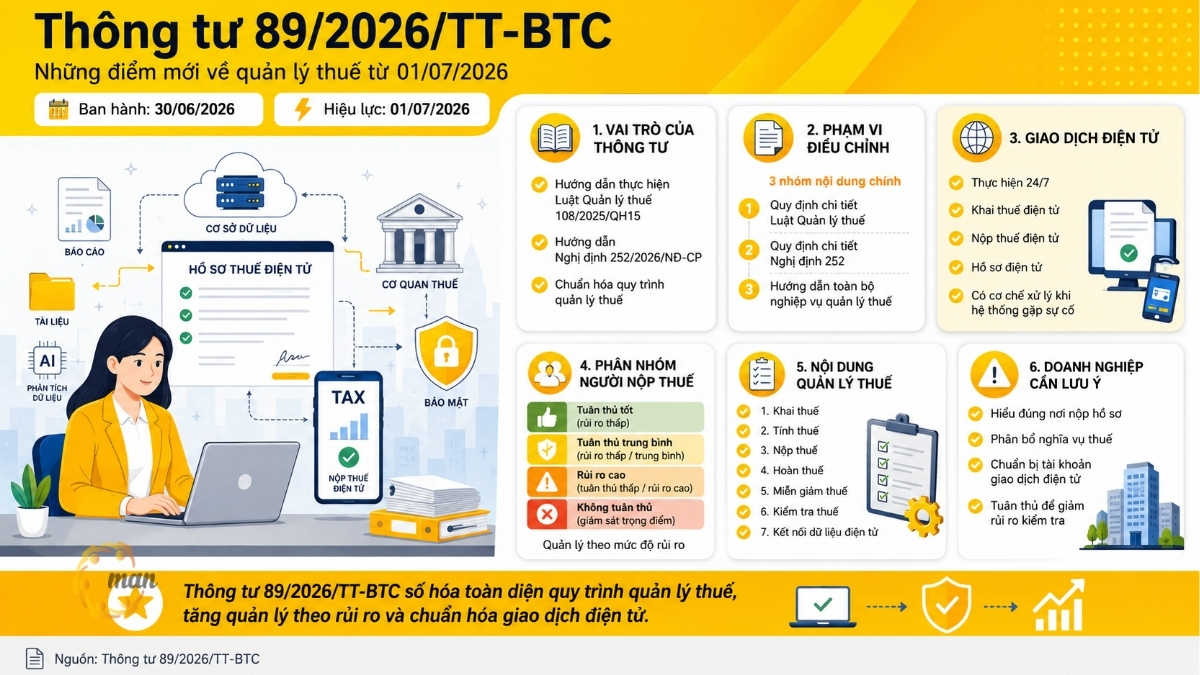
According to Article 1 of the document, the scope of Circular 89/2026/TT-BTC is divided into three main groups of contents.
Group 1The Circular provides detailed regulations on several articles, clauses, and points assigned in the Law on Tax Administration, including the contents of Clause 3, Article 3; Clause 9, Article 12; Clause 9, Article 14; Clause 5, Article 15; Clause 7, Article 16; Clause 7, Article 18; Clause 6, Article 19; Clause 6, Article 20; Clause 5, Article 21; Clause 7, Article 22; Clause 3, Article 37; Point b, Clause 2, Article 38; and Clause 4, Article 52. These are all provisions directly related to tax declaration, tax payment, tax exemptions and reductions, and handling of violations – tax accounting operations that must be performed regularly.
Second groupThe Circular provides detailed regulations for a series of provisions assigned in Decree 252/2026/ND-CP, spanning from Clause 10 of Article 12 to Point b, Clause 2 of Article 65, and also issues sample notification documents to serve tax management and the implementation of tax administrative procedures as stipulated in Point b, Clause 2 of Article 58 of Decree 252/2026/ND-CP. Standardizing these forms helps both tax authorities and taxpayers have a unified basis for carrying out administrative procedures, limiting the situation where each locality applies a different template.
Third groupAnd, which is also the largest section, the Circular details seven core operational content groups in tax management:
- Electronic transactions in tax administration;
- Filing tax returns and other income declarations; calculating taxes and other income; allocating taxes and other income;
- Paying taxes and other fees; extending tax payment deadlines, late payment penalties, and fines; processing tax payments, late payment penalties, and fines;
- Tax refund procedures;
- Tax exemption, tax reduction; installment payment of tax debt; freezing of tax debt; cancellation of tax debt;
- Tax audits; inspection and monitoring of the implementation of laws on taxes, fees, and charges;
- Connecting and exchanging information and data between tax authorities and competent state management agencies, organizations, and individuals in receiving and resolving tax administrative procedures electronically.
As can be seen, Circular 89/2026/TT-BTC covers almost the entire lifecycle of a tax obligation, from declaration, calculation, and payment to refunds, exemptions, reductions, or inspections and penalties.
Scope of application of Circular 89/2026/TT-BTC
According to Article 2 of Circular 89/2026/TT-BTC, it applies to two groups of subjects:
- Taxpayers and tax authorities as stipulated in Article 2 of the Law on Tax Administration and Article 2 of Decree 252/2026/ND-CP;
- State agencies, organizations, and other relevant individuals as defined in Clause 4, Article 2 of the Law on Tax Administration.
In other words, the scope of impact of this document is not limited to businesses and tax authorities, but also extends to third parties involved in the data supply chain and services related to tax administration, such as payment service providers and T-VAN service providers.
Several important concepts are explained in Circular 89/2026/TT-BTC.

Article 3 of Circular 89/2026/TT-BTC is dedicated to explaining a series of terms that accountants need to understand thoroughly, as they will govern how to determine where to file and where to pay taxes in the following chapters:
- Tax liability allocationThis refers to the process by which taxpayers declare their taxes to the tax authority directly managing their tax affairs or the tax authority managing the revenue collection, and simultaneously determine the amount of tax payable for each province that receives state budget revenue.
- The tax authority is in charge of direct management.: This refers to the tax authority listed on the Tax Registration Certificate, Tax Identification Number Notice, or Notice of Assignment of Tax Authority, including specific cases for individuals with income from salaries and wages, or individuals receiving inheritance or gifts of securities or capital contributions.
- The tax authority responsible for the area receives the allocation. and The tax authorities manage state budget revenue.These two concepts clearly distinguish the roles between the place that receives tax returns and the place that receives budget revenue but does not directly manage taxpayers.
- Subordinate unitThis includes branches and representative offices.
- Electronic transaction code and Electronic trading accountThese are the technical elements serving electronic tax transactions, in which the electronic transaction account includes an electronic identification account as defined by law on electronic identification and authentication, and an electronic tax transaction account.
Understanding these concepts correctly is not simply a matter of terminology; it directly determines where a business files its tax returns and which provincial budget it pays taxes to, especially for businesses with multiple branches and subsidiaries in different provinces.
A notable new point in Circular 89/2026/TT-BTC regarding the classification of taxpayers.

Another notable aspect of Circular 89/2026/TT-BTC lies in Article 4 – which regulates the classification of taxpayers in tax administration. Accordingly, tax authorities will classify taxpayers based on criteria such as geographical location, scale of operations (revenue, budget contributions, capital, assets, labor), business sectors (including e-commerce and cross-border transactions), and especially the level of tax compliance, compliance history, and tax risk.
Based on data analysis, the tax authorities will rank taxpayers into four levels corresponding to four different management methods:
- Good compliance, low risk.: is given preferential treatment in tax administration.
- Average compliance, low or medium risk: Implemented compliance support programs, public awareness campaigns, guidance, and training.
- Low compliance or high risk: Subject to warning, monitoring, and surveillance measures; if compliance is both low and risk is high, then enhanced management measures, including inspection, supervision, and enforcement, will be applied.
- Non-compliancePlaced under重点 tax monitoring.
This grouping mechanism shows that the tax management orientation under Circular 89/2026/TT-BTC is shifting strongly towards a data-driven risk management model, instead of applying a uniform process to all taxpayers. For businesses with a good compliance history, this is good news as they will benefit from a more flexible mechanism; conversely, for businesses showing signs of risk, the level of supervision will be significantly stricter.
Electronic transactions in tax administration according to Circular 89/2026/TT-BTC

Chapter II of Circular 89/2026/TT-BTC (from Article 7 to Article 16) focuses on regulations regarding electronic transactions in tax administration – content that most clearly reflects the spirit of digitalization that this document aims for.
Content and principles of electronic tax transactions
According to Article 7, electronic tax transactions include:
- Transactions between taxpayers and tax authorities (tax declaration, tax payment, receiving notifications, tax audits);
- Transactions between tax authorities and other state management agencies are conducted through a streamlined, one-stop mechanism.
- Providing and exchanging information with relevant organizations and individuals;
- And transactions are conducted through a T-VAN service provider.
Article 8 stipulates the conditions for taxpayers to conduct electronic tax transactions, including: having an electronic tax transaction account (an electronically identified account or an account issued by the Tax Management Information System), having internet access, and having an electronic signature as prescribed. Electronic information systems serving electronic tax transactions include the National Public Service Portal, the Tax Management Information System, the systems of T-VAN service providers, and, specifically for electronic tax payments, other online public service systems or electronic payment services.
Electronic confirmation and transaction processing time.
According to Article 10, the verification of the signatory on electronic documents and records is carried out using electronic signatures (public digital signatures, specialized digital signatures for official use) or electronic transaction authentication codes, biometric verification, and other electronic means as instructed by the information system administrator.
A very important point to note in Article 11 of Circular 89/2026/TT-BTC is that taxpayers can conduct electronic tax transactions 24 hours a day and 7 days a week, including holidays and Tet (Lunar New Year). The confirmation of electronic tax filing is the date the Tax Management Information System receives a complete and valid application. Regarding the response time, the tax authority must notify whether the application has been accepted or not within 1 working day from the date the system records the submission; for tax refund, tax exemption, tax reduction, or request to cancel a tax refund application, this time is 3 working days.
Troubleshooting technical issues during electronic transactions.
Article 12 of Circular 89/2026/TT-BTC specifies in considerable detail the responsibilities for handling incident situations:
- If the taxpayer's technical infrastructure system experiences a problem that cannot be resolved by the deadline for filing and paying taxes, the taxpayer may submit a paper application at the one-stop service center, via postal service, or pay taxes directly at the payment service provider or the State Treasury.
- If the payment service provider's or payment intermediary's system experiences a problem, that organization is responsible for notifying and assisting taxpayers.
- If the Tax Management Information System experiences a malfunction on the very last day of the tax filing deadline, the Tax Department must notify the taxpayer promptly, and the taxpayer may submit their tax return on the next working day, which will still be considered within the deadline.
This mechanism shows that Circular 89/2026/TT-BTC not only promotes electronic transactions but also builds a safe zone to protect taxpayers' rights when the system malfunctions, a point that accountants should understand to avoid being mistakenly charged late payment penalties in situations of force majeure due to technical issues.
T-VAN service provider
Articles 15 and 16 stipulate the conditions and procedures for registration, changes, and disconnection for organizations providing value-added services for electronic transactions in tax administration (T-VAN). These organizations must have a technical system that ensures stable operation 24/7, a minimum of 3 years of experience in information technology, financial capacity to handle risks and compensate for damages, and a suitable technical staff. This is an important regulation for businesses providing tax declaration services or accounting software integrated with electronic tax declaration.
Regulations on tax declaration, tax calculation, and tax allocation according to Circular 89/2026/TT-BTC
Chapter III (Articles 17 to 24) is the most technically demanding part of Circular 89/2026/TT-BTC, detailing the methods for declaring, calculating, and allocating each type of tax.
General principles
According to Article 17, taxpayers must file tax returns for each type of tax, in accordance with the tax calculation method and tax period. The tax return includes the tax return form, appendices (if any), and supporting documents and materials used to determine tax obligations. An important principle is that the allocation of tax payable to provinces receiving state budget revenue must not exceed the total tax payable as stated in the taxpayer's tax return.
Value Added Tax Declaration
Article 19 stipulates that the monthly VAT calculation period is the general principle, except for two exceptions:
| Declaration form | Terms and conditions apply |
| Filing on a quarterly basis | Revenue from the sale of goods and provision of services in the preceding year was 50 billion VND or less, or the taxpayer is a new business operator. |
| Monthly filing | Revenue in the preceding year exceeded 50 billion VND. |
| Declare on a case-by-case basis. | This applies to certain specific cases: exemption from filing tax returns under Article 11 of Decree 252/2026/ND-CP, filing using the direct method with infrequent transactions, requesting electronic invoices for each transaction, and construction activities with a project value of VND 1 billion or more… |
Furthermore, Article 19 also specifies in detail how to allocate the VAT payable to each province for specific activities such as:
- Computerized lottery business: Based on the percentage of actual ticket sales revenue in each province;
- Construction activities: Based on a ratio of 1% on revenue excluding VAT in each province;
- Real estate transfer: Similar to the 1% ratio;
- The operation of production facilities and hydroelectric power plants is located across multiple provinces: Based on the proportion of investment value, as well as postpaid telecommunications services.
Specifically for basic construction projects using state budget funds, Article 19 also stipulates a special deduction mechanism:
The State Treasury will directly deduct 1% from the revenue excluding VAT of completed work when paying capital to contractors, except for certain exceptions such as capital advances, project management costs, works under 1 billion VND, or consulting, surveying, design, insurance, and accounting activities.
Excise tax declaration
According to Article 20, excise tax is, in principle, declared on a monthly basis, except for two cases where it is declared on a transaction-by-transaction basis:
- Exported goods that have not paid excise tax at the production stage but are subsequently sold domestically;
- And means of transport (airplanes, helicopters, gliders, yachts, cars, etc.).
Initially exempt from excise tax, the land use purpose was later changed to subject to excise tax.
Filing corporate income tax returns
Article 21 stipulates that corporate income tax is, in principle, a tax payable quarterly and settled annually. However, there are many cases where declarations must be made each time a transaction occurs, including:
- Corporate income tax is not regularly applied using the percentage-based method on revenue.
- Corporate income tax from real estate transfers; corporate income tax from the sale and auction of secured assets subject to withholding, declaration, and payment on behalf of others;
- Corporate income tax on capital transfers by foreign enterprises; corporate income tax on the sale of the entire single-member limited liability company in the form of capital transfers associated with real estate;
- And corporate income tax from the distribution of dividends to investment organizations by securities investment funds.
Corporate income tax settlement is carried out at the end of the fiscal year (including cases of temporary suspension of operations for less than a full year), or at the time of dissolution, bankruptcy, cessation of operations, termination of contracts, privatization of state-owned enterprises, or when the enterprise is divided, merged, or consolidated.
Why do businesses and accountants need to update to Circular 89/2026/TT-BTC immediately?
With such a detailed set of regulations, it's clear that Circular 89/2026/TT-BTC is not merely a formality but directly impacts the daily accounting and tax operations of businesses. Here are some practical risks if businesses don't keep up-to-date with this document:
- Incorrectly determining the VAT tax period (month/quarter) leads to late filing of documents, resulting in late payment penalties or administrative fines.
- Filing tax returns with the wrong tax authority, especially for businesses with branches, subsidiaries, or investment projects in multiple provinces.
- Omitting the obligation to allocate tax payments to provinces that receive state budget revenue leads to discrepancies in the final settlement figures.
- Failure to utilize the technical troubleshooting mechanism when electronic transactions encounter problems results in unnecessary losses in terms of application deadlines.
In the context of constantly changing regulations and highly technical procedures, many businesses, especially small and medium-sized enterprises, lack a sufficiently strong accounting department, making the choice to use a professional accounting service a viable option. full accounting service or tax accounting services We source our services from reputable and professional organizations like MAN – Master Accountant Network to ensure that all changes from Circular 89/2026/TT-BTC are updated and applied accurately from the outset, instead of having to constantly retrain internal processes. This is also the reason for our solution. hire an external accountant It is becoming increasingly popular, helping businesses reduce compliance risks while optimizing operating costs.
Conclusions and recommendations on the application of Circular 89/2026/TT-BTC
In summary, Circular 89/2026/TT-BTC plays a crucial role as a guiding document for implementation, revolving around three pillars:
- Specifically, to concretize the provisions assigned in the Law on Tax Administration No. 108/2025/QH15 and Decree 252/2026/ND-CP;
- Standardize the system of forms and templates used for tax administrative procedures;
- And strongly promote electronic transactions and the exchange of information between tax authorities and other state management agencies.
As the person directly responsible for filing and paying taxes for the business, the accountant should proactively perform the following tasks:
- Review the internal tax declaration process, comparing it with the tax period and applicable conditions stipulated in Circular 89/2026/TT-BTC, especially for VAT and corporate income tax.
- Check the status of your electronic tax transaction registration, digital signature, and electronic transaction account to ensure there are no interruptions when carrying out tax administrative procedures.
- For businesses with subsidiaries, business locations, or investment projects in multiple provinces, it is necessary to carefully compare the regulations on tax liability allocation to avoid errors in determining the tax authority directly responsible for management and the tax authority receiving the allocation.
- Closely monitor any supplementary guidance documents (if any) during the implementation of Circular 89/2026/TT-BTC, as this document has a broad scope and high technical and operational content.
If businesses do not have sufficient resources to update and implement the new regulations of Circular 89/2026/TT-BTC on their own, they can refer to the list. Reputable accounting firm in Ho Chi Minh City Choosing a partner with sufficient expertise will be a practical step, helping businesses comply with tax laws while confidently focusing on their core business activities.
For any questions or assistance, please contact your company. Contact MAN – Master Accountant Network:
Contact information MAN – Master Accountant Network
- Address: No. 19A, Street 43, Tan Thuan Ward, Ho Chi Minh City
- Mobile/Zalo: 0903 963 163 – 0903 428 622
- E-mail: man@man.net.vn
- Google Business Profile: View MAN – Master Accountant Network's Google Business Profile
- LinkedIn Founder: View expert Le Hoang Tuyen's LinkedIn profile.
Responsible for production and professional content review by: Mr. Le Hoang Tuyen – Founder & CEO of MAN – Master Accountant NetworkHe is a CPA Vietnam auditor with over 30 years of in-depth experience in accounting, auditing, taxation, and corporate legal consulting.
Frequently Asked Questions about Circular 89/2026/ND-CP
According to Article 2, the applicable subjects include: taxpayers and tax authorities as stipulated in Article 2 of the Law on Tax Administration and Article 2 of Decree 252/2026/ND-CP; along with other relevant state agencies, organizations, and individuals as specified in Clause 4, Article 2 of the Law on Tax Administration, including payment service providers and T-VAN service providers participating in electronic tax transactions.
According to Article 19, businesses subject to monthly VAT declaration but with total revenue from the sale of goods and services in the preceding year of 50 billion VND or less may choose to declare VAT quarterly. Newly established businesses may also choose to declare quarterly; after 12 months of operation, the business will determine whether to continue declaring monthly or quarterly based on its actual revenue in the preceding year.
No. Once a choice is made, taxpayers must file taxes monthly or quarterly consistently throughout the calendar year. If they wish to switch from monthly to quarterly filing, they must submit a written request to change the tax period (Form No. 01/ĐK-TĐKTT) to the directly managing tax authority no later than January 31st of the year in which the change takes effect.
According to Article 12 of Circular 89/2026/TT-BTC, the Tax Department is responsible for promptly notifying taxpayers of the time of the incident and the time when the system resumes operation. Taxpayers may submit tax returns and electronic payment documents on the next working day immediately following the system's return to operation, and submissions made during this period will still be considered timely.
According to Article 11, the tax authority must notify the receipt or rejection of electronic tax returns no later than one working day from the date the system records the submission. For tax refund, tax exemption, tax reduction, or cancellation requests, the notification deadline is no later than three working days. Which entities are covered by Circular 89/2026/TT-BTC?
What revenue level does a business need to have to file VAT returns quarterly according to Circular 89/2026/TT-BTC?
Can the option to file VAT returns quarterly be changed at will?
What happens if the tax management information system malfunctions on the last day of the filing deadline?
How long does the tax authority have to notify the public that they have received an electronic tax return?