
For accountants, every time the electronic invoice policy changes, it's necessary to review the entire invoice creation and issuance process of the business – from the time of creation, the applicable subjects, to the registration procedures. A single mistake in invoice creation time can lead to administrative penalties for invoice violations, and even affect the declaration and deduction of value-added tax. Therefore, any new guidance from the tax authorities needs to be updated promptly and accurately.
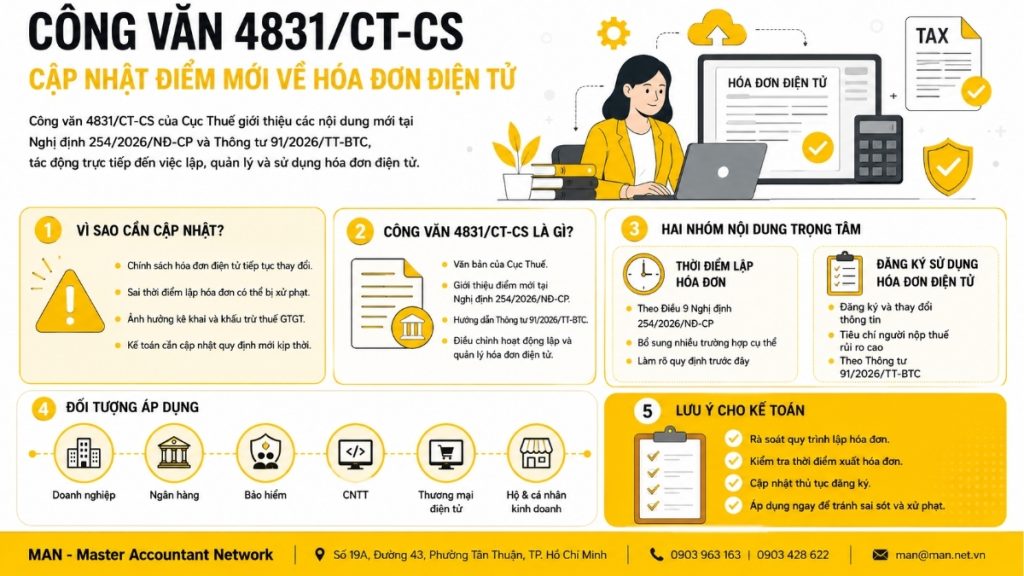
Official Document 4831/CT-CS This is a document issued by the Tax Department to introduce new and noteworthy content at Decree No. 254/2026/ND-CP and Circular No. 91/2026/TT-BTCThese two important legal documents directly regulate the creation, management, and use of electronic invoices. This article will systematize the entire core content of Official Letter 4831/CT-CS, helping accountants in businesses, household businesses, and individual businesses quickly, fully, and accurately grasp the latest regulations.
What is Official Document 4831/CT-CS and in what context was it issued?
Official Letter 4831/CT-CS, issued by the Tax Department, aims to introduce and disseminate some new content in Decree No. 254/2026/ND-CP and Circular No. 91/2026/TT-BTC. These two documents directly impact the process of creating electronic invoices, as well as the procedures for registering and changing registration information for the use of electronic invoices by economic organizations, other organizations, business households, and individual businesses.
The content mentioned in Official Letter 4831/CT-CS covers two major groups of issues:
- The first group relates to time of invoicing According to Article 9 of Decree No. 254/2026/ND-CP, which includes many specific cases that have been added and clarified compared to previous regulations.
- The second group is related to Registering and changing registration information for using electronic invoices. and Criteria for identifying high-risk taxpayers According to Circular No. 91/2026/TT-BTC.
With a wide range of applications, from insurance companies, banks, IT companies, and e-commerce businesses to small-scale household businesses, this document has high practical significance and should be studied and applied immediately by accountants in these entities to avoid errors in invoice preparation.
The new points in Decree 254/2026/ND-CP are outlined in Official Letter 4831/CT-CS.

The first part of Official Letter 4831/CT-CS focuses on the amendments and additions to Article 9 of Decree No. 254/2026/ND-CP regarding the timing of invoice issuance. This is also the content that many accountants are most interested in because it directly relates to daily transactions.
Adding regulations regarding the timing of invoice issuance when collecting deposits.
According to the guidance in Official Letter 4831/CT-CS, Decree No. 254/2026/ND-CP has added regulations regarding the collection of deposits as stipulated in the Civil Code to ensure the performance of service contracts. Accordingly, for this deposit amount intended to guarantee contract performance, the seller... No invoice required.This regulation helps to clearly distinguish between the deposit required to secure the contract and the advance payment for services, which is a point of confusion in the accounting practices of many service businesses.
The group of services that were billed late by 7 days
Another important point mentioned in Official Letter 4831/CT-CS is the addition of a time limit for issuing invoices for certain services that occur frequently and require time for data reconciliation between parties. According to point a, clause 4, Article 9, the following service groups are permitted to be invoiced no later than 7 days from the time of occurrence:
- Maritime pilotage services;
- Advertising services on online news websites;
- Digital technology services, digital platforms, information technology services (including payment intermediary services used on telecommunications and information technology platforms, except as otherwise stipulated in point b of this clause);
- Cryptocurrency services, services supporting trading on carbon exchanges, insurance services;
- Security services;
- Passenger transport services using taxis, contract vehicles, and two-wheeled motorcycles must utilize transport connection support software in accordance with road transport laws, applicable when providing services to corporate or organizational clients.
These are industries characterized by continuous and large-scale transactions, requiring time to consolidate and reconcile data between systems before issuing official invoices. The clarification of this list in Circular 4831/CT-CS helps businesses in the aforementioned sectors be more proactive in their invoicing process, avoiding being considered late or violating regulations regarding the timing of invoice issuance.
Data-related products and services with a billing period of no more than 2 months.
In addition to the aforementioned service group, Circular 4831/CT-CS also introduces a separate regulation in point b, clause 4, Article 9, regarding data-related products and services. Due to the specific nature requiring more complex data reconciliation, the invoice issuance time for this group is permitted to be no later than 2 months from the month the transaction occurs.
Specific regulations for co-insurance contracts
Another notable new point mentioned in Official Letter 4831/CT-CS is the supplementary regulation at point o, clause 4, Article 9, regarding co-insurance contracts, a form in which multiple insurance companies participate in insuring the same subject. Specifically:
- When collecting insurance premiums, each co-insurance company issues an invoice to the customer corresponding to the portion of the premium they receive.
- In cases where the parties authorize a business to collect insurance premiums on their behalf, the collecting business will issue an invoice to the customer for the entire contract value; at the same time, the business requesting collection will issue an invoice to the collecting business corresponding to the portion of the insurance premium they are entitled to according to the agreement.
- For expenses related to the purchase of goods and services to compensate or pay costs under co-insurance contracts, if an insurance company is authorized to make the payment, it will issue an invoice when it recovers the funds from the insurance companies that requested the payment.
This regulation helps to definitively resolve the difficulties that many insurance companies have encountered in practice, as the previous mechanism of collecting and disbursing payments between co-insurers lacked specific guidelines on invoicing.
Notable new feature: Transaction details table
One of the points emphasized in Official Letter 4831/CT-CS is the supplementary regulation at point r, clause 4, Article 9, regarding the preparation of detailed transaction information tables, applicable to certain services provided directly to individual consumers, including:
- Banking services, payment intermediary services, credit information services;
- Securities trading, cryptocurrency trading, and support services for trading on carbon exchanges;
- Insurance business, money transfer services via e-wallets;
- Power outage and restoration service;
- E-commerce services; postal and transportation services directly supporting e-commerce activities;
- Public passenger transport services by tram and bus; passenger transport business by taxi, contract vehicles, and two-wheeled motorcycles;
- Parking services, movie screenings, and other services are available.
The conditions for applying this method are that the business must have a software system to manage each transaction in detail, with cash collection data stored on the system for each transaction. Once these conditions are met, the business's detailed transaction information database will be transferred to the tax authority using the Transaction Details Information Table, form 01/TTGD in Appendix III issued with Circular No. 91/2026/TT-BTC.
This includes selling goods or providing services during nighttime working hours.
Furthermore, Circular 4831/CT-CS also introduces supplementary regulations applicable to cases where sellers do not have automated invoicing software but have transactions involving the sale of goods or provision of services during nighttime working hours as stipulated by the Labor Code. In this case, the invoice issuance time can be postponed to the latest, on the next working day, instead of being required to be issued immediately at night as previously stipulated – an adjustment that aligns with the operational realities of many 24/7 business models.
See more: Issuing invoices according to Decree 254/2026/ND-CP.
New points in Circular 91/2026/TT-BTC as guided by Official Letter 4831/CT-CS

In addition to the contents of Decree No. 254/2026/ND-CP, Official Letter 4831/CT-CS also introduces several important new points in Circular No. 91/2026/TT-BTC, focusing on the procedures for registering to use electronic invoices and risk management criteria.
Registering and changing registration details for using electronic invoices.
According to Official Letter 4831/CT-CS, Circular No. 91/2026/TT-BTC has amended the regulations regarding changes to registered information for using electronic invoices. Specifically, except for cases of discontinuing or temporarily suspending the use of electronic invoices, other cases of information changes will require biometric authentication.
According to the new regulations, economic organizations, other organizations, business households, and individual businesses must update their information using Form No. 01/ĐKTĐ-HĐĐT in Appendix III issued with Circular No. 91/2026/TT-BTC, through the Tax Management Information System or through an electronic invoice service provider.
Official document 4831/CT-CS also compares this regulation with Decree No. 70/2025/ND-CP – according to which, in cases where taxpayers change information for using electronic invoices due to changes in information about the legal representative, business household representative, individual business owner, contributing member, or owner, the procedures shall be carried out according to the separate regulations in Clause 1a, Article 6.
In addition, another noteworthy adjustment mentioned in Official Letter 4831/CT-CS is that Extend the deadline for providing explanations, additional information, and documents. from 2 days onwards 3 working daysThis applies in cases where the tax authority issues a notice requesting taxpayers to provide explanations or supplementary documents related to the registration for using electronic invoices. Extending the deadline by one working day provides more favorable conditions for businesses and household businesses to prepare complete documents, avoiding penalties for not responding within the previous deadline.
Criteria for identifying high-risk taxpayers in the registration process for using electronic invoices.
The final point introduced in the Official Letter concerns the amendment of the criteria for identifying high-risk taxpayers in Article 7 of Circular No. 91/2026/TT-BTC. Specifically, criterion No. 3 is amended to state: taxpayers who register their head office address. There is no specific address according to administrative boundaries.or register at apartment, will be considered high-risk.
However, this regulation also specifies the exceptions:
This does not apply to apartments or portions of apartment buildings permitted for commercial use under the law, and there are exceptions for individual businesses.
This is a point that accountants and business owners need to pay special attention to when registering or reviewing their head office address, in order to avoid being placed under high-risk management, leading to closer supervision during the use of electronic invoices.
For businesses with limited internal accounting capabilities, keeping up-to-date with regulations such as Circular 4831/CT-CS can become a significant burden. In this case, using full accounting service This solution helps businesses feel confident about the accuracy and timeliness of applying the new electronic invoicing policy, while minimizing risks related to invoice creation timing and registration procedures.
What should corporate accountants take note of from Official Letter 4831/CT-CS?
Based on the information provided in Official Letter 4831/CT-CS, accountants in businesses, household businesses, and individual businesses should proactively carry out the following tasks:
- Review the invoicing process for each specific industry group, especially those with specific invoicing time regulations such as data reconciliation services, insurance services, and technology-based passenger transport services.
- Review the existing electronic invoicing software system to determine if the unit falls under the category of entities required to prepare a Transaction Details Table according to mẫu số 01/TTGD (Form No. 01/TTGD), and then plan for a suitable system upgrade.
- Prepare the necessary documents and procedures for biometric authentication when changes to your electronic invoice registration information arise, and note that the deadline for submitting the new explanation is 3 working days.
- Verify the registered head office address, especially for businesses located in apartment buildings, to compare it with the newly revised high-risk criteria.
- In all specific cases, accountants should directly refer to the full text of Official Letter 4831/CT-CS along with Decree No. 254/2026/ND-CP and Circular No. 91/2026/TT-BTC for the most accurate basis, avoiding misapplication due to incomplete understanding of the regulatory context.
For newly established businesses or those without a dedicated accounting department, this form of hire accounting services With specialized and experienced units like MAN – Master Accountant Network, we are the optimal choice to ensure that all changes from Circular 4831/CT-CS and related documents are updated and applied within the stipulated timeframe.
Conclude
Official document 4831/CT-CS has systematized three important groups of content:
- The timing of invoice issuance varies depending on specific circumstances as stipulated in Decree No. 254/2026/ND-CP;
- Regulations regarding registration and changes to information for using electronic invoices;
- And the criteria for identifying high-risk taxpayers are specified in Circular No. 91/2026/TT-BTC.
These are all contents that directly impact the daily operation of creating and managing electronic invoices for businesses, household businesses, and individual business owners.
Understanding and correctly applying the regulations introduced in Official Letter 4831/CT-CS not only helps businesses comply with tax laws but also minimizes the risk of penalties due to errors in invoice timing or registration procedures.
If your business needs more specific advice on how to apply this to individual real-world situations, please don't hesitate to contact us. Contact MAN – Master Accountant Network to get support.
Contact information MAN – Master Accountant Network
- Address: No. 19A, Street 43, Tan Thuan Ward, Ho Chi Minh City
- Mobile/Zalo: 0903 963 163 – 0903 428 622
- E-mail: man@man.net.vn
- Google Business Profile: View MAN – Master Accountant Network's Google Business Profile
- LinkedIn Founder: View expert Le Hoang Tuyen's LinkedIn profile.
Responsible for production and professional content review by: Mr. Le Hoang Tuyen – Founder & CEO of MAN – Master Accountant NetworkHe is a CPA Vietnam auditor with over 30 years of in-depth experience in accounting, auditing, taxation, and corporate legal consulting.
Frequently Asked Questions about Official Document 4831/CT-CS
Which businesses are required to prepare a Transaction Details Table as instructed in Official Letter 4831/CT-CS?
These are businesses that provide services directly to individual consumers in sectors such as banking, payment intermediaries, insurance, securities, e-commerce, passenger transportation, etc., and have software systems that manage each transaction in detail.
Is biometric authentication mandatory when changing registration information for electronic invoicing?
According to the content of Official Letter 4831/CT-CS, except for cases of discontinuing or temporarily suspending the use of electronic invoices, all other cases of changes to registration information must be verified using biometric authentication.
What is the deadline for providing explanations and additional information as requested by the tax authorities?
According to the guidelines in Official Letter 4831/CT-CS, this deadline has been adjusted upwards from 2 days to 3 working days.






