
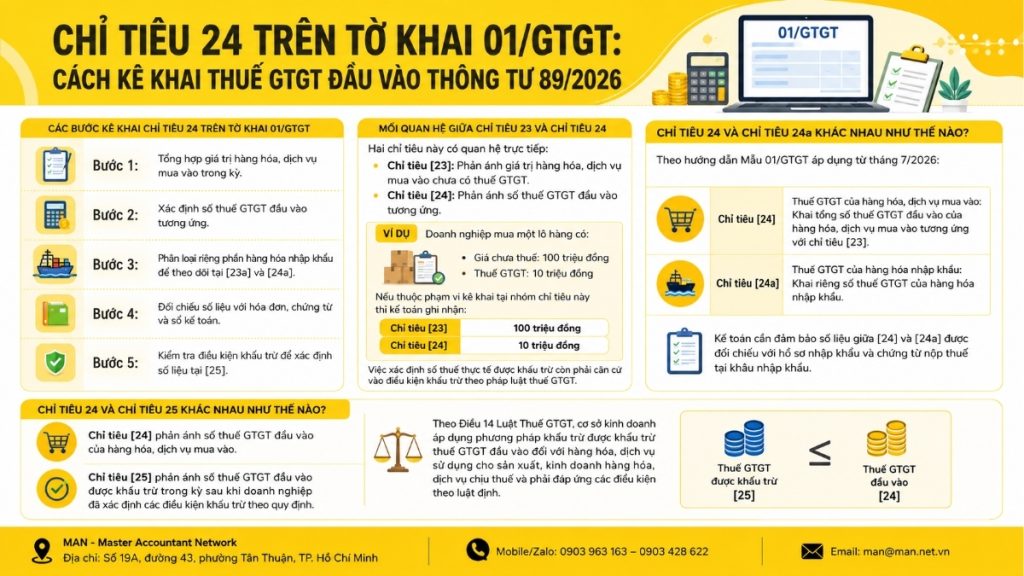
Item 24 on the 01/GTGT declaration form is used to reflect the total input VAT of goods and services purchased in the period corresponding to the purchase value declared in item [23]. From the tax period of July 2026, businesses shall implement according to Form 01/GTGT issued with Circular 89/2026/TT-BTC.
However, item [24] is not synonymous with the amount of deductible VAT. Accountants need to clearly distinguish item [24] from [24a] and [25], and check the conditions for deduction according to the VAT Law and Decree 181/2025/ND-CP before determining the amount of deductible tax.
This article provides detailed guidance on item 24 on form 01/GTGT, how to determine the figures, the relationship with related items, practical examples, and common accounting errors encountered during the VAT declaration process in 2026.
What does item 24 on form 01/GTGT mean?
According to the instructions for Form 01/GTGT applied from July 1, 2026, item [24] is named "VAT of purchased goods and services" and is used to declare the total input VAT of purchased goods and services corresponding to the value declared in item [23].
Simply put, it can be understood as follows:
- Indicator [23]: Value of goods and services purchased excluding VAT.
- Indicator [24]: Input VAT corresponding to goods and services purchased at indicator [23].
The data in item [24] is the basis for the accountant to further determine the input VAT that is eligible for deduction in item [25].
What tax item is reflected in item 24 on form 01/GTGT?
Professionally, accountants need to compile the input VAT generated from goods and services purchased during the period based on legitimate invoices, supporting documents, and related tax payment documents.
For imported goods, the new declaration form has item [24a] to separately declare the VAT amount of imported goods. Item [24a] is a part of the total input VAT reflected in [24].
Therefore, when preparing the tax return, accountants should not only look at the tax amount eligible for deduction but should fully compare the purchase data before determining the indicator [25].
Is item 24 the amount of deductible VAT?
No. This is the most common mistake when filing VAT returns.
They can be distinguished as follows:
| Target | Content | Nature |
| [23] | Value of goods and services purchased | Purchase price excluding VAT |
| [23a] | Value of imported goods | The import value is declared separately. |
| [24] | Value Added Tax (VAT) on purchased goods and services. | Total input VAT corresponding to [23] |
| [24a] | Value Added Tax (VAT) on imported goods | The VAT portion of imported goods is declared separately. |
| [25] | VAT is deductible this period. | The portion of input tax that meets the deduction requirements. |
Form 01/GTGT, as per Circular 89/2026/TT-BTC, continues to illustrate the relationship between the group of indicators for purchase value, input VAT, and deductible VAT.
Therefore, you should not take the machine numbers at [24] to record to [25] without checking the deduction conditions.
For businesses that do not have a dedicated tax accounting department or want better control over their tax filing records, using full accounting service With expertise from specialized units like MAN – Master Accountant Network, businesses can reduce operational pressure and mitigate risks in fulfilling their tax obligations.
How to fill in item 24 on form 01/GTGT
To declare item 24 on form 01/GTGT, the accountant should follow these steps:
- Step 1: Summarize the value of goods and services purchased during the period.
- Step 2: Determine the corresponding input VAT amount.
- Step 3: Separately classify the imported goods for tracking at [23a] and [24a].
- Step 4: Compare the figures with invoices, supporting documents, and accounting records.
- Step 5: Check the deduction conditions to determine the figures at [25].
The relationship between indicator 23 and indicator 24
These two indicators are directly related:
- Indicator [23]: Reflects the value of goods and services purchased excluding VAT.
- Indicator [24]: Reflects the corresponding input VAT amount.
For example: The business purchased a shipment containing:
- Price excluding tax: 100 million VND;
- VAT: 10 million VND.
If it falls within the scope of this group of indicators, the accountant should record it as follows:
- Target [23]: 100 million VND;
- Target [24]: 10 million VND.
Determining the actual amount of tax to be deducted must also be based on the deduction conditions under VAT law.
What is the difference between indicator 24 and indicator 24a?
According to the guidelines for Form 01/GTGT applicable from July 2026:
- Indicator [24] – VAT of purchased goods and services: Declare the total input VAT of purchased goods and services corresponding to indicator [23].
- Indicator [24a] – VAT of imported goods: Declare separately the VAT of imported goods.
Therefore, accountants need to ensure that the figures between [24] and [24a] are reconciled with import records and tax payment documents at the import stage.
How do indicator 24 and indicator 25 differ?
These are two indicators that are fundamentally different in nature.
Indicator [24] It reflects the input VAT amount on purchased goods and services.
Meanwhile, indicator [25] This reflects the amount of input VAT that is deductible in the period after the business has determined the deduction conditions as prescribed by regulations.
According to Article 14 of the Value Added Tax Law, businesses applying the deduction method are entitled to deduct input VAT on goods and services used in the production and business of taxable goods and services, provided they meet the conditions stipulated by law.
Therefore:
|
VAT deductible [25] ≤ Input VAT [24] |
In cases where the declared figures are correct and there is an amount of input tax that is not eligible for deduction.
Conditions for VAT at item 24 to be deductible
After determining item 24 on the 01/GTGT declaration form, the accountant needs to check which VAT portion meets the conditions to include in item [25].
Article 14 of the Value Added Tax Law The regulations stipulate the principles and conditions for deducting input VAT. Decree 181/2025/ND-CP provides detailed guidance on deductions, invoices, documents, and non-cash payments.
There are legitimate invoices and documents.
One of the basic requirements is that businesses must have VAT invoices for the purchase of goods and services, or VAT payment documents at the import stage, or VAT payment documents on behalf of the foreign party as prescribed.
Decree 181/2025/ND-CP Article 25 specifies regulations regarding invoices and tax payment documents used for input VAT deduction.
Therefore, before determining the tax amount at [24] to be transferred to [25], the accountant needs to check:
- The invoice contains all the required information.
- Is the invoice legal and valid?
- The content of goods and services is consistent with actual business operations;
- Tax payment documents for imported goods;
- Documents proving tax obligations in cases where taxes are paid on behalf of a foreign party.
There are non-cash payment documents as required.
According to Article 26 of Decree 181/2025/ND-CP, businesses must have non-cash payment documents for purchased goods and services, including imported goods, with a value of VND 5 million or more including VAT, except for specific cases as stipulated.
This is a point that accountants need to pay special attention to when reviewing input VAT records for 2026. They should not only check invoices but also payment documents.
Goods and services used for taxable activities
According to Article 14 of the Value Added Tax Law, input VAT on goods and services used for the production and business of goods and services subject to VAT is deductible as prescribed. If goods and services are used simultaneously for both taxable and non-taxable activities, the deduction must be determined according to the corresponding regulations.
Therefore, accountants need to classify the purpose of the purchase before determining the amount of tax to be deducted.
Determining deductible input VAT requires accountants to simultaneously compare invoices, supporting documents, intended use, and payment terms. If businesses are still unclear on how to handle each specific case, they can refer to the following resources. accounting consulting services to receive support in reviewing and processing appropriate business operations.
Example of how to fill in item 24 on form 01/GTGT.
Let's assume that in August 2026, Company A applies the VAT deduction method and incurs the following:
Operation 1: Purchase office supplies for business operations:
- Price excluding tax: 20,000,000 VND;
- VAT 10%: 2,000,000 VND;
- There is a valid invoice;
- Meets the deduction requirements.
Operation 2: Purchases of equipment for operational purposes are not eligible for deductions:
- Price excluding tax: 10,000,000 VND;
- VAT 10%: 1,000,000 VND;
- This portion of the tax is not eligible for deduction.
How to determine the data
Indicator [23]:
|
20,000,000 + 10,000,000 = 30,000,000 VND |
Indicator [24]:
|
2,000,000 + 1,000,000 = 3,000,000 VND |
Criterion [25]: Only calculate the tax portion that is eligible for deduction, which is VND 2,000,000.
Thus, the above example shows:
- Indicator [24] reflects 3 million VND input VAT;
- Indicator [25] only reflects 2 million VND of deductible VAT.
The key point is that accountants should not equate input VAT incurred with deductible VAT.
Cases requiring special attention when declaring item 24

Imported goods
For imported goods, accountants need to separately track the value and VAT at indicators [23a] and [24a]. The reconciliation should be done with customs documents and tax payment documents at the import stage.
Goods and services used for both taxable and non-taxable activities.
If input goods and services are used simultaneously for both taxable and non-taxable activities, the business must determine the deductible input VAT portion in accordance with Article 14 of the Value Added Tax Law.
This is one of the reasons why the figures at [24] and [25] may not be the same.
Goods and services purchased on deferred payment or installment plans.
For goods and services purchased on deferred payment or installment plans of 5 million VND or more, Decree 181/2025/ND-CP has specific regulations regarding non-cash payment documents.
If the payment due date according to the contract has not yet arrived, the business can still make deductions under the stipulated conditions; however, if, upon the payment due date, there is no non-cash payment document as required, the business must declare and adjust the deductible input VAT accordingly.
Therefore, accountants need to track the timing of payments as well as the timing of invoice receipts.
Input VAT of the investment project
Businesses involved in investment activities need to differentiate between VAT tax returns for production and business activities and those for investment projects.
Input VAT amounts included in the investment project dossier should not be automatically included in the 01/GTGT declaration form if those amounts are required to be declared using the form specifically for investment projects.
Handling errors related to item 24 on form 01/GTGT.
During the tax declaration process, businesses may discover omitted input invoices or incorrect VAT declarations.
Article 14 of the Value Added Tax Law stipulates the principles for handling cases where errors or omissions are discovered in the declared and deducted input VAT amounts.
Case 1: Input invoices were omitted.
Accountants need to determine:
- Which period does the invoice belong to?
- What is the amount of input VAT?
- How do these additions change the amount of tax payable or the amount of tax that can be deducted?
- Has the tax authority announced its decision to conduct an audit or inspection yet?
A single formula should not be used to handle all cases of omitted invoices. The method of filing supplementary declarations should be based on the impact of the error on tax obligations.
Case 2: Errors that increase the amount of tax payable or decrease the amount of tax refundable.
According to Clause 1, Article 14 of the Value Added Tax Law, in cases of incorrect or incomplete declarations that increase the amount of tax payable or decrease the amount of tax refundable, taxpayers must file supplementary declarations in the period in which the error occurred, as prescribed, and must fulfill any related financial obligations.
Case 3: Errors that reduce the amount of tax payable or change the amount of tax that can be deducted.
If the error only reduces the amount of tax payable or increases/decreases the amount of deductible VAT carried forward to the next period, the handling method shall be in accordance with the provisions of Article 14 of the VAT Law.
Therefore, before filing a supplementary return, accountants should accurately determine the nature and impact of the error.
5 common mistakes when filling out item 24 on form 01/GTGT.
Below are 5 common and frequently encountered errors when declaring input VAT at item [24] on the declaration form:
- Confusing indicator [24] with [indicator 25]: It should be noted that indicator [24] is input VAT, while indicator [25] is deductible VAT. Accountants need to check the deduction conditions before determining [25].
- Do not compare indicator [24] with indicator [23]: The data in indicator [24] must correspond to the value of goods and services purchased in [23]. If indicators [23] and [24] are not compared with the summary table of input invoices, the risk of error when preparing the declaration will be high.
- Omitted item [24]: For businesses with import activities, it is necessary to check separately the VAT on imported goods at [24a].
- Checking only the invoice without checking the payment: For goods and services purchased worth 5 million VND or more, including VAT, the condition regarding non-cash payment documents must be checked according to Article 26 of Decree 181/2025/ND-CP.
- Failure to track deferred payment purchases: Businesses may be eligible for deductions before the payment due date, but will need to make adjustments if, by the due date, they do not meet the requirements for non-cash payment documentation.
For businesses with a large volume of invoices, numerous purchase transactions, or those lacking specialized tax accounting personnel, independently tracking all invoices, supporting documents, and deduction conditions can present significant risks. In such cases, businesses may consider alternative solutions. outsource accounting services To assist with accounting, tax filing, and record keeping.
Checklist for item 24 before submitting VAT declaration form 01/GTGT.
Accountants can use the following checklist:
- All purchase invoices and supporting documents for the period have been reconciled.
- The purchase value has been compared at [23].
- Input VAT amount has been determined at [24].
- Check the VAT amount of imported goods separately at [24a], if any.
- The invoices and tax payment documents have been reviewed and found to be legitimate.
- We have checked the non-cash payment conditions for purchases of 5 million VND or more, including VAT.
- Goods and services used for taxable and non-taxable activities have been classified.
- The deductible tax portion has been correctly identified at [25].
- We have checked for deferred payment options, installment plans, and payment terms.
- Investment project expenses have been reviewed to avoid incorrect declaration forms.
Conclude
Indicator 24 on the 01/GTGT declaration form is an important indicator to reflect the input VAT of goods and services purchased during the period. However, accountants need to remember that the VAT at [24] is not automatically deductible at [25].
In particular, the requirements regarding invoices, supporting documents, and cashless payments need to be carefully checked. Article 26 of Decree 181/2025/ND-CP currently stipulates a threshold of 5 million VND, including VAT, for requirements regarding cashless payment documents, instead of simply meaning "invoices of 5 million VND or more must be transferred via bank."
Contact MAN – Master Accountant Network For free support and advice!
Contact information MAN – Master Accountant Network
- Address: No. 19A, Street 43, Tan Thuan Ward, Ho Chi Minh City
- Mobile/Zalo: 0903 963 163 – 0903 428 622
- E-mail: man@man.net.vn
- Google Business Profile: View MAN – Master Accountant Network's Google Business Profile
- LinkedIn Founder: View expert Le Hoang Tuyen's LinkedIn profile.
Responsible for production and professional content review by: Mr. Le Hoang Tuyen – Founder & CEO of MAN – Master Accountant NetworkHe is a CPA Vietnam auditor with over 30 years of in-depth experience in accounting, auditing, taxation, and corporate legal consulting.
Frequently Asked Questions about item 24 on form 01/GTGT
What does item 24 on form 01/GTGT mean?
Indicator 24 on the 01/GTGT declaration form is the indicator used to declare the total input VAT of purchased goods and services corresponding to the purchase value in indicator [23].
Is item 24 the deductible VAT?
No. Indicator [24] reflects input VAT of purchased goods and services; indicator [25] reflects the amount of input VAT deductible in the period after determining the conditions for deduction.
What is the difference between indicator 24 and 24a?
Indicator [24] reflects the total input VAT of purchased goods and services; indicator [24a] is used to separately declare the VAT portion of imported goods.
Do invoices exceeding 5 million VND require bank transfer to be eligible for tax deduction?
According to Article 26 of Decree 181/2025/ND-CP, goods and services purchased with a value of VND 5 million or more, including VAT, must be paid using non-cash methods, except for specific cases as stipulated.
Which form 01/GTGT will be used from July 2026 onwards?
Form 01/GTGT, as per Circular 89/2026/TT-BTC, is applicable for tax periods from July 2026 onwards.






