
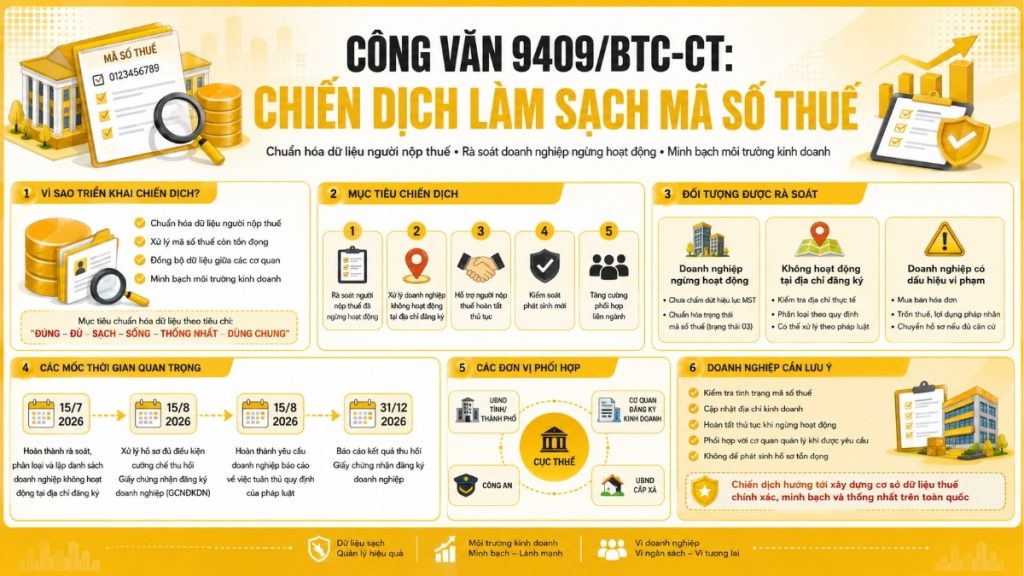
Official Document 9409/BTC-CT This is a document from the Ministry of Finance regarding the coordinated implementation of the "Cleaning Tax Identification Numbers – Removing Bottlenecks in Business" campaign, aimed at reviewing and standardizing taxpayer data, and handling cases of businesses and household businesses that have ceased operations but have not yet terminated their tax identification numbers or are no longer operating at their registered addresses. The document also clearly assigns responsibilities to tax authorities, business registration agencies, the police, and local authorities in the implementation of the campaign. This article will comprehensively analyze Circular 9409/BTC-CT, closely following the document's content to help businesses, household businesses, and accountants understand the campaign's objectives, the target groups to be reviewed, important timelines, and key points to note during implementation.
In what context was Official Document 9409/BTC-CT issued?
The issuance of Official Letter 9409/BTC-CT stems from the need to further improve the quality of the taxpayer database and enhance the effectiveness of coordination in management among state agencies. Prior to launching the campaign, the Ministry of Finance had implemented numerous solutions to support taxpayers in the process of business registration, tax registration, tax declaration, tax payment, and fulfilling their obligations to the state budget.
Regarding the standardization of business registration data for enterprises, cooperatives, and household businesses, the Ministry of Finance also issued Official Letter No. 8131/BTC-DNTN dated June 16, 2026, requesting the People's Committees of provinces and cities to direct business registration agencies to coordinate with tax authorities to review, clean, and standardize data according to the goal of "accurate - complete - clean - active - unified - shared use".
However, according to the Ministry of Finance's assessment in Official Letter 9409/BTC-CT, the management practices still have many shortcomings that need to be addressed comprehensively nationwide.
The current situation shows that there are still many outstanding issues regarding taxpayer data.
According to Official Letter 9409/BTC-CT, the cumulative number of businesses, organizations, household businesses, and individual businesses that have ceased operations but have not yet completed the procedures for terminating their tax identification numbers remains high. In addition, the authorities have also noted many cases where taxpayers are no longer operating at their registered addresses.
These issues directly affect the quality of tax management data and make it difficult to monitor the operational status of taxpayers. At the same time, the existence of unresolved tax identification numbers increases the backlog of files, impacting the management work of state agencies as well as the procedures carried out by taxpayers.
According to Official Letter 9409/BTC-CT, the focus on reviewing and handling these cases also aims to support taxpayers who are willing to comply with the law in completing the procedures for dissolution, cessation of operations, or resumption of business operations in accordance with current regulations.
Furthermore, the Ministry of Finance also determined that standardizing data will contribute to a more transparent business environment and prevent the misuse of legal entities, tax identification numbers, and invoices to commit illegal acts.
The objective of Official Letter 9409/BTC-CT
To address the aforementioned issues, Circular 9409/BTC-CT states that the Ministry of Finance has directed the Tax Department to implement the campaign nationwide.
According to the official document, the campaign is being implemented with the following main objectives:
- Focus on reviewing, standardizing, and addressing cases of taxpayers who have ceased operations but have not yet completed the procedures for terminating their tax identification numbers.
- Review and address cases of taxpayers who are not operating at their registered address.
- Assisting taxpayers who are willing to comply with and complete all procedures as required by law.
- Closely monitor any new cases that arise.
- Improve the effectiveness of inter-agency coordination in taxpayer management.
As can be seen, the objectives stated in the Official Letter are all aimed at improving the quality of the taxpayer database and enhancing the effectiveness of state management. At the same time, the implementation of the Campaign is also expected to contribute to building a transparent and healthy business environment and create more favorable conditions for businesses, household businesses, and individual business owners to fully comply with legal procedures.
Which groups are being targeted for review?

To implement the Campaign, Circular 9409/BTC-CT clearly identifies the target groups that need to be focused on for review and processing. Accurately identifying the target groups helps tax authorities and related agencies implement the campaign uniformly nationwide.
The business has ceased operations but its tax identification number has not yet been terminated.
According to Official Letter 9409/BTC-CT, one of the key target groups is businesses, household businesses, and individual business owners who have ceased operations but have not yet completed the procedures for terminating their tax identification numbers.
For this group, the official document requests relevant agencies to coordinate in reviewing and standardizing information on business registration, tax registration, legal status, and tax identification number status to assist taxpayers in completing the procedures as prescribed.
During the campaign implementation, the document also mentioned cases of taxpayers with tax code status 03, a group that requires coordinated processing to ensure data consistency between systems.
The business is not operating at its registered address.
Another group of entities identified in the Official Letter are businesses that are no longer operating at their registered address.
According to the official document, provincial business registration agencies, in coordination with tax authorities and other relevant agencies, will review, classify, and handle these cases in accordance with the authority, procedures, and regulations stipulated in the law on business registration, the law on tax administration, and other relevant regulations.
At the same time, the official document requests the business registration agency to coordinate with the tax authority to update and compile a list of businesses that are not operating at their registered addresses in order to handle violations and revoke business registration certificates in accordance with regulations for cases subject to processing.
Regarding the coordination of data standardization, Circular 9409/BTC-CT also mentions taxpayers with tax code status 06, which includes cases where businesses are not operating at their registered address.
The business shows signs of using its legal entity to violate the law.
In addition to the cases mentioned above, Official Letter 9409/BTC-CT also requires increased scrutiny of businesses showing signs of violating the law.
Specifically, in the case of a business that is not operating at its registered address but shows signs of:
- Buying and selling invoices;
- Tax evasion;
- Exploiting legal entities;
- Exploiting tax identification numbers and invoices to violate the law;
The tax authority is responsible for leading the risk assessment, inspection, handling of violations, or transferring reports and files recommending prosecution to the police when there is sufficient evidence, as prescribed by law.
If both the conditions for revoking the business registration certificate are met under the tax administration law or the business registration law, the tax authority shall coordinate with the provincial business registration authority to carry out the action within their jurisdiction.
Official document 9409/BTC-CT stipulates the procedures for reviewing businesses that are not operating at their registered address.

For businesses that are no longer operating at their registered address, the Official Letter requests the People's Committees of provinces and cities to direct the Department of Finance, the Management Board of the High-Tech Park (for localities where such parks are established), and the provincial-level business registration agency to coordinate with the provincial/city Tax Department and the local Tax Department to conduct a review and take appropriate action.
What tasks does the business registration agency have to perform?
According to Official Letter 9409/BTC-CT, provincial-level business registration agencies are responsible for coordinating with tax authorities and other relevant agencies to:
- Review businesses that are not operating at their registered address.
- Classify the cases according to the provisions of the law.
- The matter must be handled in accordance with the proper authority, procedures, and regulations.
- Update information and create a list of businesses that are not operating at their registered address.
- Implement procedures for handling violations and revoking business registration certificates in accordance with regulations for cases subject to processing.
This assignment aims to ensure that business registration data and tax management data are updated consistently, facilitating the management and handling of arising cases.
The deadline for completion is before July 15, 2026.
To ensure the progress of the Campaign, Official Letter 9409/BTC-CT requires that the task of reviewing businesses that are not operating at their registered addresses be completed before July 15, 2026.
This is the timeline for reviewing, classifying, and compiling a list of businesses that are not operating at their registered addresses, as a basis for implementing further processing steps in accordance with the law.
Cases subject to review for revocation of business registration certificates.

Besides reviewing and standardizing taxpayer data, Circular 9409/BTC-CT also requires competent authorities to coordinate in handling cases that meet the conditions for revoking business registration certificates according to the law on tax administration and the law on business registration. This aims to ensure that the handling is carried out correctly, according to the proper procedures, and on the basis of coordination between the tax authorities and the business registration authorities.
This applies to businesses that are not operating at their registered address, have long-standing tax debts, and are uncooperative.
According to Official Letter 9409/BTC-CT, in cases where a business is not operating at its registered address, has long-standing tax debts, is uncooperative, and meets the conditions for applying coercive measures to revoke its Business Registration Certificate as prescribed by tax management law, the tax authority is responsible for:
- Prepare the necessary documents as required.
- Submit a request to the provincial business registration authority to revoke the business registration certificate within their jurisdiction.
After receiving the request from the tax authority, the provincial business registration agency will revoke the Business Registration Certificate and update the legal status to "Revoked due to tax management enforcement" as prescribed.
According to Official Letter 9409/BTC-CT, this task must be completed before August 15, 2026.
It should be noted that the document does not stipulate that all businesses with tax debts will have their business registration certificates revoked. Revocation will only be carried out when the business simultaneously meets the conditions stipulated by tax management laws for the application of coercive measures.
In cases where businesses fail to submit reports as required by the business registration authority.
In addition to cases requested by the tax authorities, Circular 9409/BTC-CT also addresses cases where provincial-level business registration agencies require enterprises to report on their compliance with legal regulations.
If a business fails to submit the report, the provincial business registration authority will revoke the business registration certificate in accordance with regulations.
The official document also emphasized that the revocation must be carried out in accordance with the procedures stipulated in Clauses 3 and 4 of Article 69 of Government Decree No. 168/2025/ND-CP on business registration.
Regarding this task, Official Letter 9409/BTC-CT requires:
- Complete the process of requesting businesses to submit reports by August 15, 2026.
- Report on the results of revoking the Business Registration Certificate before December 31, 2026.
In cases where business registration documents are forged or personal information is used illegally.
Another noteworthy point in Official Letter 9409/BTC-CT concerns the handling of cases where there is evidence to suggest that business registration documents are forged or that personal information is being used illegally.
According to the official document, when there is evidence to determine that a business registration application is forged, or that personal information has been stolen or used illegally to establish a business, the provincial business registration authority is responsible for coordinating with the police, tax authorities, and other relevant agencies to verify and handle the matter.
If a competent authority issues a document confirming that the business registration application is fraudulent, the business registration authority shall revoke the business registration certificate in accordance with regulations.
At the same time, Official Letter 9409/BTC-CT requires coordination with tax authorities to separate the legitimate rights and interests of individuals whose identities are being impersonated from the obligations and violations of legal entities, organizations, or individuals using the forged information. This regulation contributes to protecting the legitimate rights and interests of those whose personal information is being exploited during the business establishment process.
What information does Official Document 9409/BTC-CT request verification of?

To facilitate the review and standardization of taxpayer data, Circular 9409/BTC-CT requires relevant agencies to coordinate in verifying several important groups of information.
Verify business address
According to Official Letter 9409/BTC-CT, the actual business address is one of the contents that needs to be reviewed to determine whether the business is still operating at the registered address. The verification results serve as the basis for the management agency to classify and handle cases according to regulations.
Verify actual operational status
In addition to the business address, Official Letter 9409/BTC-CT also requires verification of the actual operating status of businesses, household businesses, and individual businesses. This verification helps the management agency accurately assess the taxpayer's status to take further processing steps.
Verify residency information and legal representative.
According to the official document, the People's Committee at the commune level and the commune-level police will coordinate to verify the residence information and contact information of the legal representative, business owner, household business owner, or individual business owner when necessary to serve management purposes.
Handling data inconsistencies
Besides verifying factual information, Official Letter 9409/BTC-CT also requires business registration agencies and tax authorities to coordinate in handling inconsistencies between the business registration system and the tax management system; and to promptly address inter-system transaction errors, difficulties in dissolution procedures, cessation of operations, restoration of legal status, or revocation of business registration certificates as prescribed.
Key dates in Official Document 9409/BTC-CT
During the campaign's implementation, the official document stipulated several deadlines for agencies and units to complete their assigned tasks. Understanding these deadlines helps businesses and accountants track the progress of implementation at the local level.
| Timeline | Content |
| Before June 15, 2026 | Complete the review, classification, and listing of businesses that are not operating at their registered addresses. |
| Before August 15, 2026 | Complete the documentation and processing of cases eligible for compulsory revocation of business registration certificates as requested by the tax authorities. |
| Before August 15, 2026 | Complete the process of requiring businesses to report on their compliance with legal regulations in cases falling under the jurisdiction of the business registration authority. |
| Before December 31, 2026 | Report on the results of revoking the Business Registration Certificate as assigned. |
What should businesses keep in mind when complying with the Official Letter?
Although Circular 9409/BTC-CT primarily assigns tasks to state agencies in organizing and implementing the Campaign, businesses should still proactively review their legal status and tax identification number to minimize potential problems during the review process by relevant authorities.
Some key points for businesses and accountants to note include:
- Proactively check the operational status of your tax identification number and business registration information.
- Ensure that the business operates at the registered address or completes the necessary procedures for changing information as required by regulations.
- Cooperate with tax authorities when requested to verify information or provide guidance on completing procedures.
- If the business has ceased operations, procedures for dissolution or termination of the tax identification number must be carried out in accordance with the law.
- Personal information, digital signatures, and bank accounts must not be lent, rented, or sold for the purpose of establishing or operating businesses or household businesses.
- Promptly report to the competent authorities if you discover that your personal information has been falsified or misused to establish a business illegally.
In cases where a business does not have a dedicated accounting department or needs assistance reviewing records, books, and tax obligations before dealing with authorities, the use of full accounting service This can help standardize accounting data, ensuring that tax declarations and obligations are fulfilled in accordance with current regulations.
Conclude
Official Document 9409/BTC-CT is a document from the Ministry of Finance regarding the coordination of the "Cleaning up Tax Identification Numbers - Removing Bottlenecks in Business" campaign, aiming to standardize taxpayer data, address outstanding tax identification number cases, and enhance coordination among state management agencies.
For businesses and accountants, monitoring the content of Official Letter 9409/BTC-CT, proactively reviewing the legal status of the business, and coordinating with competent authorities when requested will help limit potential risks and ensure the fulfillment of obligations in accordance with the law.
Besides keeping track of new legal documents such as Official Document 9409/BTC-CTBusinesses should also choose a consulting firm with expertise and practical experience to partner with in accounting and tax matters. If you are looking for a suitable partner, you can refer to the list below. reputable accounting firm in Ho Chi Minh City to have more basis for evaluation and selection.
Contact MAN – Master Accountant Network For free support and advice!
Contact information MAN – Master Accountant Network
- Address: No. 19A, Street 43, Tan Thuan Ward, Ho Chi Minh City
- Mobile/Zalo: 0903 963 163 – 0903 428 622
- E-mail: man@man.net.vn
- Google Business Profile: View MAN – Master Accountant Network's Google Business Profile
- LinkedIn Founder: View expert Le Hoang Tuyen's LinkedIn profile.
Responsible for production and professional content review by: Mr. Le Hoang Tuyen – Founder & CEO of MAN – Master Accountant NetworkHe is a CPA Vietnam auditor with over 30 years of in-depth experience in accounting, auditing, taxation, and corporate legal consulting.






