Since Decree 254/2026/ND-CP Officially in effect, regulations regarding the timing of invoicing for electronic game businesses have been specified more clearly, providing businesses with a solid legal basis for implementation. This article will systematize all current legal regulations, analyze each application case in detail, and provide specific practical guidance to help accounting departments in businesses understand and comply correctly.
What are the regulations regarding the timing of invoicing for electronic gaming businesses that offer prizes?
Based on point q, clause 4, Article 9 of Decree 254/2026/ND-CP, this is the fundamental regulation for determining the time of issuing invoices for electronic games with prizes and casino business activities.
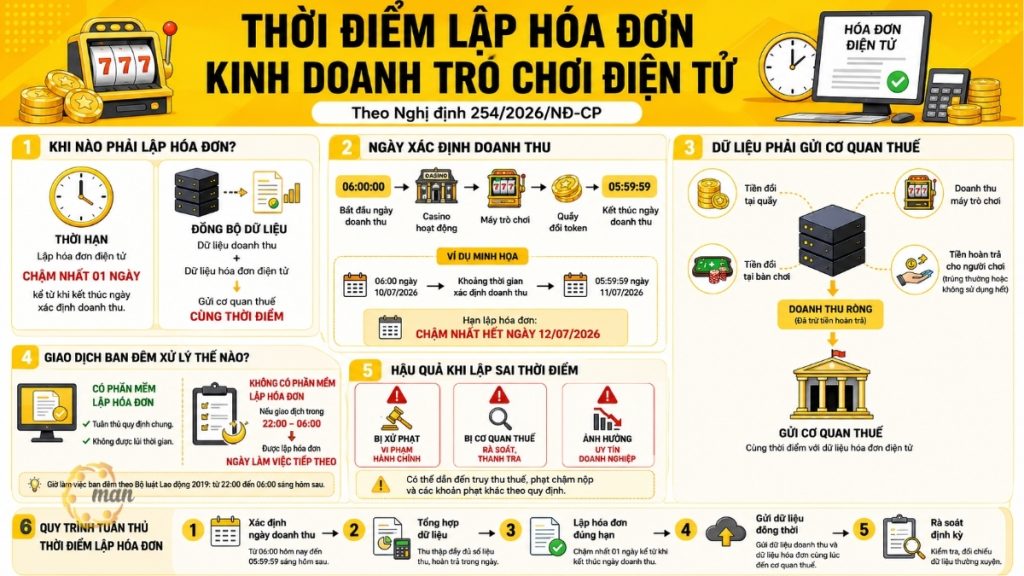
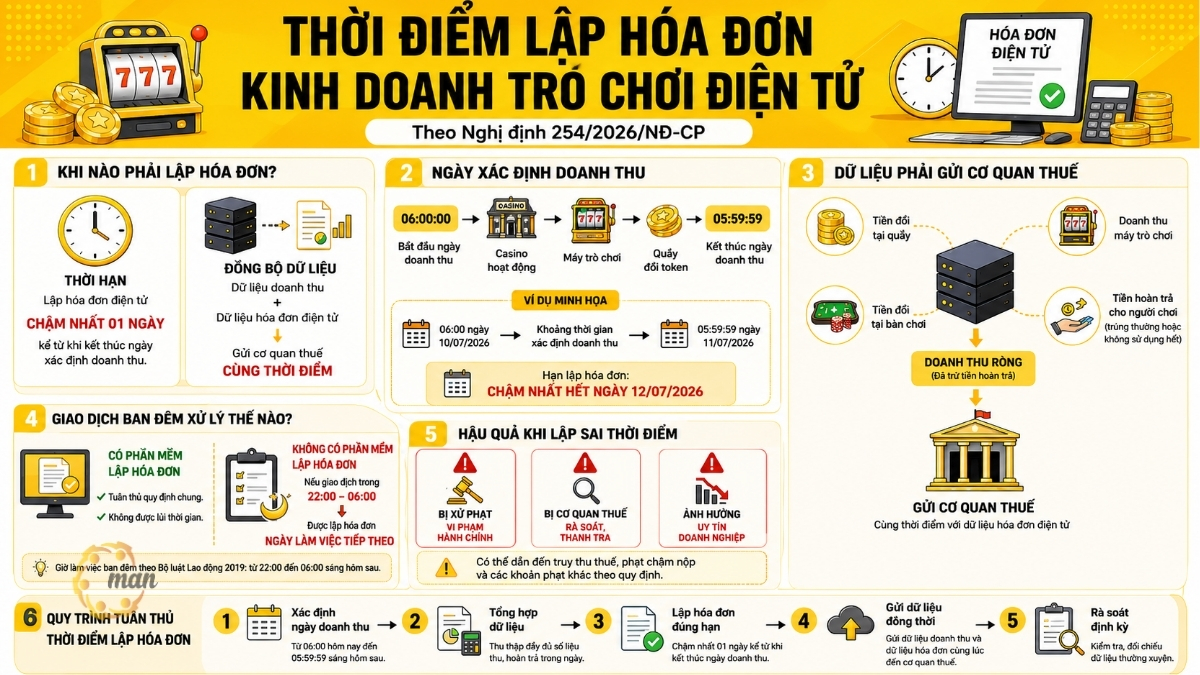
Accordingly, for casino and electronic gaming businesses, the electronic invoice must be issued no later than one day after the revenue determination date. Simultaneously, casino and electronic gaming businesses must transfer data recording the collected funds, including the amount received from exchanging conventional currency for players at the counter or at the gaming table, and the amount collected from electronic gaming machines, after deducting the amount returned to players (due to winnings or unused funds). This data must be prepared according to the form prescribed by the Minister of Finance and sent to the tax authority at the same time as the electronic invoice data transfer.
Thus, the regulations regarding the timing of invoicing for electronic gaming businesses with prizes can be summarized into two parallel requirements:
- Deadline requirement: Electronic invoices must be issued no later than one day after the end of the revenue determination date.
- Data synchronization requirement: Businesses must transfer net revenue data (after deducting payments to players) to the tax authorities at the same time as transferring electronic invoice data.
Furthermore, the Decree also includes an open provision: if specialized laws stipulate otherwise regarding the timing of invoice issuance for electronic game businesses, then those specialized laws shall prevail. This is a point businesses should note and compare with specific legal documents of the casino and electronic game industry (if any) before implementation.
Revenue recognition date in the business of electronic games with prizes.

One of the key concepts for accurately determining the timing of invoicing for video game businesses is the revenue recognition date. According to Decree 254/2026/ND-CP, the revenue recognition date is the period from 06:00:00 AM to 05:59:59 AM the following day.
In other words, a day's revenue in the casino and electronic gaming industry does not coincide with the standard calendar day (00:00 – 23:59), but is calculated according to the industry's specific operating cycle, starting at 6:00 AM today and ending at 5:59:59 AM tomorrow.
To better illustrate this, accountants can refer to the following example:
Let's assume the revenue recognition date starts at 06:00:00 on July 10, 2026, and ends at 05:59:59 on July 11, 2026. Then, all transactions occurring within this timeframe will be aggregated into one revenue day. Based on the end date of the revenue recognition date (05:59:59 on July 11, 2026), the business has a maximum of one day to issue electronic invoices, i.e., no later than the end of July 12, 2026. Understanding the principle of calculating the revenue recognition date is the first and most important step in correctly determining the timing of issuing invoices for electronic game businesses, avoiding delays or data discrepancies.
What revenue data needs to be submitted to the Tax Authority?
In addition to meeting deadlines, businesses must also ensure the completeness and accuracy of the accompanying data. According to regulations, the data recording the amount of money collected includes:
- The money collected is from exchanging conventional currency for players at the counter.
- The money collected is from exchanging conventional currency for players at the gaming table.
- The amount of money collected at electronic gaming machines with prizes.
The total amount will be reduced by the amount refunded to the player, arising from two cases: the player winning a prize or the player not using all of the exchanged currency. The remaining difference will be the basis for determining revenue and generating an electronic invoice.
The overarching principle here is that the transfer of revenue data to the tax authorities must occur simultaneously with the transfer of electronic invoice data. This is a point businesses need to pay special attention to when developing internal processes, avoiding the separation of these two data streams, which could lead to discrepancies with regulations regarding the timing of invoice issuance for electronic game businesses.
For transactions that occur at night, what is the appropriate time to issue invoices for electronic game business?
A unique characteristic of the casino and electronic gambling industry is that it operates throughout the day and night. Therefore, Decree 254/2026/ND-CP also includes specific regulations for transactions occurring during nighttime working hours.
According to Clause 5, Article 9 of Decree 254/2026/ND-CP, if the seller does not have automatic invoicing software but a transaction involving the sale of goods or provision of services occurs during nighttime working hours as stipulated by the Labor Code, the invoice must be issued no later than the next working day.
Regarding the concept of night work hours, Article 106 of the 2019 Labor Code The regulations stipulate that nighttime working hours are from 10 PM to 6 AM the following day. Therefore, comparing these two regulations, it can be determined that: If a transaction occurs between 10 PM and 6 AM the following day, and the business does not have automated invoicing software, then the latest time to issue an invoice for electronic game business in this case is the next working day, instead of issuing it immediately at night.
However, it should be noted that the regulation stating that invoices must be issued no later than the next working day only applies to sellers who do not have automated invoicing software. For businesses that have already equipped themselves with automated invoicing software, or other cases not covered by Clause 5 of Article 9, the time of invoice issuance must still comply with the general regulations in Clauses 1 and 2 of Article 9 of Decree 254/2026/ND-CP.
See more: Issuing invoices in accordance with Decree 254/2026/ND-CP
Distinguishing between cases with and without automated invoicing software.
To avoid confusion during application, business accountants need to clearly distinguish between the following two cases:
- Businesses with automated invoicing software: Subject to the general regulations in Clauses 1 and 2 of Article 9 of Decree 254/2026/ND-CP, they are not entitled to the extension to the next working day, even if the transaction occurs at night.
- For businesses without automated invoicing software: If a transaction occurs during nighttime working hours (10:00 PM – 6:00 AM the following morning), the deadline for invoicing is the next working day, as stipulated in Clause 5, Article 9 of Decree 254/2026/ND-CP.
Clearly distinguishing between these two cases helps businesses avoid misapplying regulations and ensures compliance with the correct timing for invoicing electronic game services during all operating hours.
Why do businesses need to know when to issue invoices for video game sales?
Issuing invoices at the wrong time is not simply a technical error in accounting, but also carries significant legal and financial consequences for businesses. For regulated business sectors such as casinos and electronic games with prizes, adhering to the correct invoice issuance timeframe is paramount, as these industries are subject to strict supervision by state management agencies and tax authorities.
Notably, delays or non-compliance with invoicing regulations can indirectly lead to businesses being classified as high-risk in tax management. According to Article 7 of Circular 91/2026/TT-BTC, which stipulates five criteria for identifying high-risk taxpayers in electronic invoice registration, effective from July 1, 2026, these criteria include:
- Taxpayers whose owners or legal representatives, business household representatives, individual business owners, or private enterprise owners are simultaneously the owners or legal representatives, business household representatives, individual business owners, or private enterprise owners, and who have been found by competent state management agencies to have committed fraud or invoice trading based on the tax authority's database.
- Taxpayers whose owners or legal representatives, business representatives, individual business owners, or private enterprise owners are on the list of those with suspicious transactions as stipulated in the Law on Prevention and Combatting Money Laundering 2022.
- Taxpayers who register their head office address without a specific address within administrative boundaries, or at an apartment building (excluding apartments or portions of apartment buildings permitted for business purposes according to legal regulations), except in the case of individual businesses.
- Taxpayers whose legal representative or owner is also the legal representative or owner of the taxpayer whose tax identification number is inactive but has not completed the procedures for terminating the tax identification number, or is inactive at the registered address, or has committed violations regarding taxes, invoices, and documents as stipulated in Circular 94/2026/TT-BTC.
- Taxpayers with other risk indicators are identified by the tax authorities in accordance with Circular 94/2026/TT-BTC, and the taxpayers are notified to provide explanations.
Although the above criteria focus primarily on ownership, legal representation, registered address, and violation history, broadly speaking, frequent violations regarding the timing of invoices and supporting documents are also indicators that may be considered and scrutinized by tax authorities during risk management according to Circular 94/2026/TT-BTC. Therefore, strictly adhering to the timing of invoices not only helps businesses fulfill their legal obligations but also contributes to building a transparent tax compliance record, reducing the risk of being placed under special supervision.
Consequences of issuing invoices at the wrong time.

In fact, failure to comply with the correct invoicing schedule for video game businesses can lead to several consequences for the business:
- Subject to administrative penalties for violations in the field of invoices and documents according to tax laws.
- Being scrutinized and having revenue data and invoices compared by the tax authorities affects the process of filing and settling periodic tax returns.
- This affects the reputation and transparency of businesses in sectors with conditional business licenses that are subject to strict supervision.
Therefore, the accounting and finance departments at casino and electronic gaming businesses need to establish strict internal control procedures to ensure that all transactions are recorded and invoiced at the correct time, in accordance with regulations.
Solution hire accounting services Professionalism is a worthwhile option to consider, helping to minimize the risk of errors in invoicing and tax filing.
Guidelines for businesses operating video games to comply with invoicing regulations.
To ensure full compliance with deadlines, businesses can refer to the following suggested process:
- Accurately determine the revenue recognition date within the timeframe from 06:00:00 to 05:59:59 the following day, as a basis for calculating the invoice issuance deadline.
- Compile complete revenue and expenditure data, including the amount of money exchanged for conventional currency at the counter and at the gaming tables, the amount of money collected at electronic gaming machines with prizes, and the amount of money returned to players.
- Electronic invoices must be issued no later than one day after the revenue determination date.
- Synchronize the transfer of revenue data to the tax authorities according to the form prescribed by the Ministry of Finance, at the same time as the transfer of electronic invoice data.
- For transactions occurring during nighttime working hours (10:00 PM – 6:00 AM the following morning) where the business does not have automated invoicing software: proactively generate invoices no later than the next working day to avoid exceeding the stipulated deadline.
- Regularly review tax records and data to compare them against high-risk criteria as stipulated in Circular 91/2026/TT-BTC, promptly detecting and addressing any irregularities.
Implementing these steps fully and sequentially will help businesses minimize risks related to invoice timing, while also creating a solid foundation for internal financial and accounting management.
Conclude
As can be seen, the timing for issuing invoices for electronic game businesses, according to Decree 254/2026/ND-CP, is quite detailed, revolving around two main timeframes:
- No later than one day from the end of the revenue determination period for casino operations and electronic games with prizes in general;
- And no later than the next business day for transactions occurring during nighttime hours when the business does not have automated invoicing software.
To fully comply with these regulations, businesses operating electronic gaming with prizes should proactively review their internal accounting and invoicing processes, consider investing in automated electronic invoicing software to optimize compliance with the timing of electronic gaming business invoices, and regularly update new guidance documents from the Ministry of Finance and tax authorities to avoid falling into high-risk criteria according to Circular 91/2026/TT-BTC.
If businesses encounter difficulties in the practical application process, they should consult this information. full accounting service We rely on specialized and experienced units like MAN – Master Accountant Network to ensure that invoicing is done accurately and on time, in accordance with current legal regulations.
Businesses can refer to the list. Top 10 reputable accounting firms in Ho Chi Minh City To select a suitable partner, support in building compliance procedures for timely invoicing of video game businesses, as well as related accounting and tax operations.
Contact MAN – Master Accountant Network For free support and advice!
Contact information MAN – Master Accountant Network
- Address: No. 19A, Street 43, Tan Thuan Ward, Ho Chi Minh City
- Mobile/Zalo: 0903 963 163 – 0903 428 622
- E-mail: man@man.net.vn
- Google Business Profile: View MAN – Master Accountant Network's Google Business Profile
- LinkedIn Founder: View expert Le Hoang Tuyen's LinkedIn profile.
Responsible for production and professional content review by: Mr. Le Hoang Tuyen – Founder & CEO of MAN – Master Accountant NetworkHe is a CPA Vietnam auditor with over 30 years of in-depth experience in accounting, auditing, taxation, and corporate legal consulting.
Frequently Asked Questions about When to Invoice for Video Game Businesses
According to point q, clause 4, Article 9 of Decree 254/2026/ND-CP, the latest time to issue an electronic invoice is 01 day from the end of the revenue determination date.
The revenue recognition period is the time from 06:00:00 AM to 05:59:59 AM the following day, as stipulated in Decree 254/2026/ND-CP.
If the seller does not have automated invoicing software and the transaction occurs during nighttime working hours (10:00 PM - 6:00 AM the following morning, according to the 2019 Labor Code), the latest time for invoicing is the next working day.
No. The regulation allowing the deadline to be postponed to the next working day only applies to sellers who do not have automatic invoicing software when transactions occur at night; other cases follow the general provisions in Clauses 1 and 2 of Article 9 of Decree 254/2026/ND-CP. What is the latest time to issue invoices for electronic gaming businesses that offer prizes?
How is the revenue recognition date calculated in the business of electronic games with prizes?
What is the time limit for issuing invoices for transactions that occur at night?
Can businesses with automated invoicing software apply for a deferral of the billing deadline to the next business day?