
Circular 152/2025/TT-BTC, issued on December 31, 2025, provides accounting guidance for household businesses and individual business owners, marking a major turning point in standardizing financial management for these sectors. Circular 152/2025/TT-BTC officially takes effect on January 1, 2026, replacing Circular 88/2021/TT-BTC.
If you are a business owner, self-employed individual, or accounting service provider, understanding Circular 152/2025/TT-BTC is mandatory to ensure legal compliance and optimize tax management.
Applicable subjects and scope of regulation
Circular 152/2025/TT-BTC stipulates the accounting record keeping and archiving of accounting documents for:
- Household businesses: This includes all households that are currently operating or newly established according to regulations.
- Self-employed individuals: Individuals who generate revenue from manufacturing or providing services.
So, From January 1st, 2026, all business households and individual business owners must keep accounting records in accordance with the regulations of Circular 152/2025/TT-BTC.
New points regarding the organization of accounting work.
Circular 152/2025/TT-BTC provides maximum flexibility for business owners:
- The person directly responsible for accounting: The representative of the household business or individual business owner can keep the accounting records themselves.
- Family members: Allows parents, spouses, children, and siblings to work as accountants for household businesses and individual businesses (previously there were more restrictions on their independence).
- Additional duties: Warehouse manager, cashier, or asset buyer/seller may also perform accounting duties.
- Hiring services: Homeowners have the right to hire professional accounting service providers to perform the tasks.
Accounting books and accounting record keeping
Based on regulations regarding the form of accounting record keeping and management, the law also sets specific requirements for accounting books and the storage of accounting documents for household businesses and individual businesses to ensure transparency and the ability to check and compare when necessary.
- Household businesses and individual business owners have the right to proactively choose the form of accounting record storage. Accordingly, documents such as invoices, accounting vouchers, accounting books, etc., can be stored in electronic or paper form, depending on the conditions and management methods of each entity.
- The minimum retention period for accounting documents for household businesses and individual business owners is 5 years. Specifically for invoices, storage must comply with the time limits stipulated by current tax laws.
- In addition to the accounting ledger templates guided by the Circular, household businesses and individual business owners are allowed to open additional accounting ledgers or adjust the forms to suit their actual operations. These supplementary or revised accounting ledgers must still contain all the required information, such as: ledger name, date of creation, full name and signature of the representative of the household business or individual business owner, and seal (if any).
- In cases where household businesses and individual businesses use electronic invoices and are assisted by the tax authority's tax management system in determining tax obligations (including VAT, personal income tax, and other taxes if applicable) along with a notification of the tax payable, taxpayers shall record and track this information in accounting ledgers as guided in the Circular to facilitate the verification and control of the tax payable as notified by the tax authority.
Household businesses and individual business owners are exempt from Value Added Tax (VAT) and Personal Income Tax (PIT).
Based on general regulations regarding accounting and tax obligations, the following content clarifies the cases in which household businesses and individual businesses are exempt from value-added tax and personal income tax.
In the case of household businesses and individual businesses that are not subject to value-added tax, they are not required to pay personal income tax.
In the case of household businesses or individual businesses that are exempt from value-added tax (VAT) and personal income tax (PIT), specifically:
- Applicable to: Household businesses and individual business owners with annual revenue under 500 million VND.
- Accounting records used: Sales revenue register for goods and services (Form S1a-HKD).
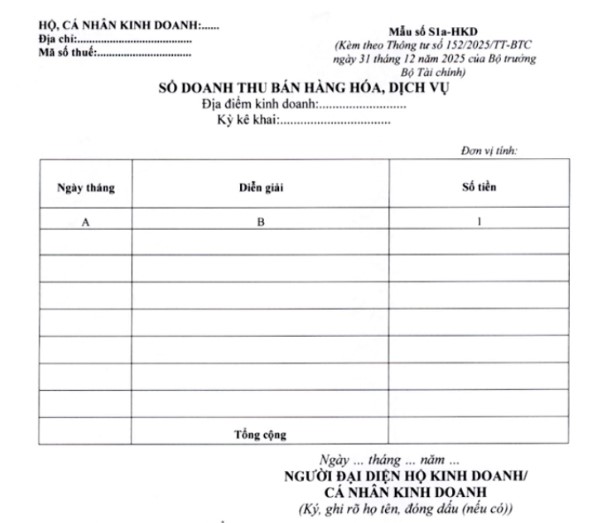
This register is established to track and fully reflect revenue generated from the sale of goods and provision of services. The data recorded in the register serves as the basis for competent authorities to determine whether a business household or individual business is subject to Value Added Tax (VAT) and Personal Income Tax (PIT) obligations according to tax laws.
In the case of household businesses and individual business owners who declare their revenue in accordance with regulations, this ledger also serves as an internal management tool, helping to track, compare, and reconcile declared revenue figures with information managed by the tax authorities, thereby ensuring transparency and accuracy in fulfilling tax obligations.
Bookkeeping method:
- Column A: Clearly state the date of entry.
- Column B: Record and describe revenue generated from the sale of goods and provision of services. For household businesses and individual businesses, recording can be done for each specific transaction as it occurs or aggregated and recorded periodically, in accordance with the revenue management and tracking method.
- The "Amount" column: Record the total amount of money earned from selling goods or services.
Household businesses and individual business owners are subject to Value Added Tax (VAT) and Personal Income Tax (PIT).
Household businesses and individual business owners subject to VAT and personal income tax apply the tax calculation method based on a percentage of revenue (%), depending on the scale of their operations.
In the case of household businesses and individual business owners, VAT and personal income tax are paid as a percentage (%) of revenue.
For household businesses and individual business owners who pay VAT and personal income tax at a percentage rate (1% VAT 3% personal income tax) on revenue, the law clearly stipulates the scope of application as well as the accounting records and documents that need to be implemented accordingly. Specifically, as follows:
- Target group: Household businesses and individual entrepreneurs with annual revenue ranging from 500 million to 3 billion VND.
- Accounting documents: Invoices and other documents that identify revenue.
- Accounting books used: Sales revenue book for goods and services (Form S2a-HKD).
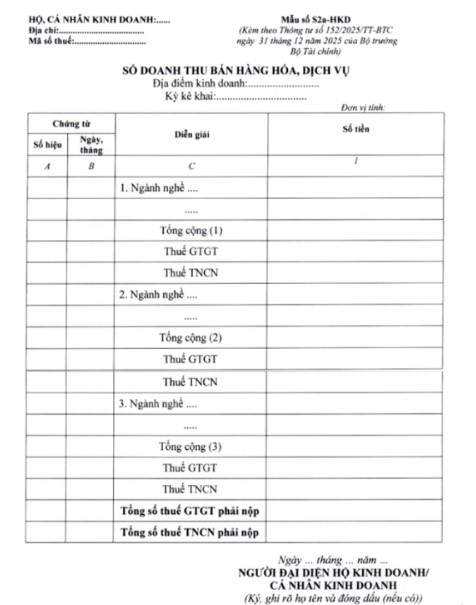
This ledger is used to track and record revenue from the sale of goods and provision of services, categorized by business sectors with the same VAT rate (%) or the same personal income tax rate.
In cases where a household business or individual business operates in multiple sectors, separate accounting records can be maintained for each sector, ensuring the same VAT rate (%) or personal income tax rate, thereby guaranteeing accurate and transparent management of revenue and tax obligations.
When the tax authorities provide data on the amount of VAT and personal income tax payable, business households and individual business owners use this ledger as a basis for monitoring, checking, and comparing the actual tax payable with the information provided by the tax authorities.
Bookkeeping method:
- Columns A and B: Clearly state the document number and date.
- Column C: This column details revenue generated from the sale of goods and provision of services for each business sector with the same VAT rate (%) or the same tax rate applied when determining personal income tax, in order to ensure accurate and consistent tax declaration and calculation in accordance with regulations.
- Column 1: Records sales revenue from goods and services by industry to serve as the basis for applying the same % rate for VAT calculation or the same personal income tax rate. From the determined revenue, business households and individual businesses calculate the VAT and personal income tax payable for each industry group. The last row shows the total VAT and personal income tax payable.
In the case of household businesses and individual business owners, VAT is paid at a rate of 1% of total revenue and personal income tax is paid on taxable income.
In the case of household businesses and individual business owners applying the VAT payment method at a rate of 1% of VAT and 3% of personal income tax on revenue, correctly identifying the eligible entities and preparing valid accounting documents are key factors in minimizing the risk of tax assessment or retroactive collection during tax audits.
- Applicable to: Household businesses and individual entrepreneurs with annual revenue from 500 million to 3 billion VND.Choose the method of paying personal income tax on taxable income for business households with revenue exceeding 3 billion VND.
- Accounting documents: Invoices, purchase lists (in cases where the seller does not have a VAT invoice or sales invoice), and other documents used as a basis for determining revenue and taxable income.
Accounting system
Household businesses and individual business owners use accounting books according to the following mẫu (template):
| Accounting ledger name | Sample symbols | Purpose |
| Sales revenue register for goods and services | Form S2b-HKD | Track revenue to calculate VAT and personal income tax. |
| Revenue ledger | Form S2c-HKD | Determine taxable income for personal income tax purposes. |
| Detailed register of materials, tools, products, and goods. | Form S2d-HKD | Managing inventory, including incoming, outgoing, and stock levels. |
| Cash register | Form S2e-HKD | Track cash flow and bank deposits. |
Detailed instructions on how to record entries and calculation formulas.
Circular 152/2025/TT-BTC stipulates specific formulas to ensure consistency in determining the value of goods and taxes.
Pricing methods
Household businesses and individual business owners are responsible for establishing and maintaining detailed records of materials, tools, products, and goods to fully manage inventory inflows, outflows, and stock levels.
Formula for calculating the cost of goods sold:
|
Cost of goods sold = (Value of beginning inventory + Value of goods purchased during the period) / (Quantity of beginning inventory + Quantity of goods purchased during the period) |
Formula for determining monetary value:
- Inventory Receipt: Total Receipt Amount = Quantity Receipt x Purchase Price per Unit.
- Inventory withdrawal: Amount withdrawn = Quantity withdrawn x Unit price withdrawn.
- Inventory: Ending inventory value = Beginning inventory value + Value of purchases during the period – Value of sales during the period.
Activities subject to other taxes (Business Registration Certificate S3-HKD)
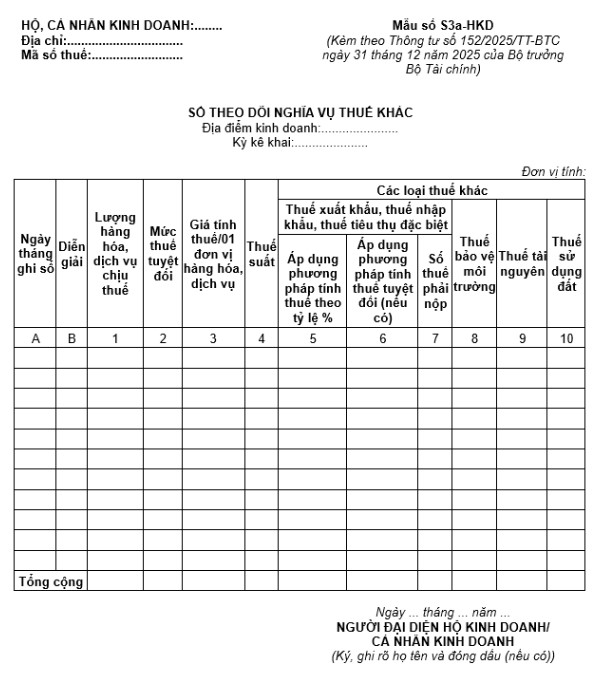
For household businesses and individual business owners whose activities are subject to taxes other than VAT and personal income tax, such as export tax, import tax, special consumption tax, resource tax, environmental protection tax, or land use tax, taxpayers must open and maintain a corresponding tax obligation tracking ledger as prescribed.
Bookkeeping method:
- Column A: Record the date of entry.
- Column B: Record a description of the transaction that occurred.
- Column 1: Record the quantity of goods and services subject to tax.
- Column 2: Record the absolute tax rate as stipulated by law regarding export tax, import tax, special consumption tax, and environmental protection tax.
- Column 3: Taxable price/01 unit of goods or services, in accordance with tax laws.
- Column 4: Record the tax rates as prescribed by law for export tax, import tax, special consumption tax, resource tax, and land use tax.
- Column 5: Export tax, import tax, and special consumption tax are calculated using the % ratio (Column 5 = Column 1 x Column 3 x Column 4).
- Column 6: Calculate export tax, import tax, and special consumption tax using the absolute tax calculation method (Column 6 = Column 1 x Column 2).
- Column 7: Calculate the export tax, import tax, and special consumption tax payable (Column 7 = Column 5 + Column 6).
- Column 8: Calculate the environmental protection tax payable (Column 8 = Column 1 x Column 2).
- Column 9: Calculate the resource tax payable (Column 9 = Column 1 x Column 3 x Column 4).
- Column 10: Calculate the land use tax payable (Column 10 = Column 1 x Column 3 x Column 4).
Conclusion and recommendations
The accounting system guided by Circular 152/2025/TT-BTC is highly detailed, requiring those implementing it to closely control the classification of revenue and expenses and accurately determine the cost of goods sold. While self-management may help businesses reduce initial costs, a lack of experience and in-depth knowledge significantly increases the risk of data discrepancies, leading to potential tax assessments or penalties from tax authorities for incorrect declarations or late payments.
In cases where household businesses or individual entrepreneurs are not fully familiar with the new accounting procedures or encounter difficulties in applying electronic accounting ledger templates, seeking support from a professional unit is a safe and effective solution.
MAN – Master Accountant Network currently offers comprehensive support services such as:
- Providing consulting services for establishing and standardizing accounting systems in accordance with the latest regulations.
- Assisting with the preparation and payment of periodic taxes, ensuring accurate data that reflects actual business operations;
- Answering and resolving issues related to invoices, documents, and post-audit tax work.
With the support of MAN – an experienced accounting, auditing, and tax service provider – business owners can confidently focus on developing their core business activities while ensuring that their accounting and tax records are always complete, transparent, and ready to work with regulatory authorities when needed.
Contact information MAN – Master Accountant Network
- Address: No. 19A, Street 43, Tan Thuan Ward, Ho Chi Minh City
- Mobile/Zalo: 0903 963 163 – 0903 428 622
- E-mail: man@man.net.vn
Content production by: Mr. Le Hoang Tuyen – Founder & CEO MAN – Master Accountant Network, Vietnamese CPA Auditor with over 30 years of experience in Accounting, Auditing and Financial Consulting.
MAN Editorial Board – Master Accountant Network






