
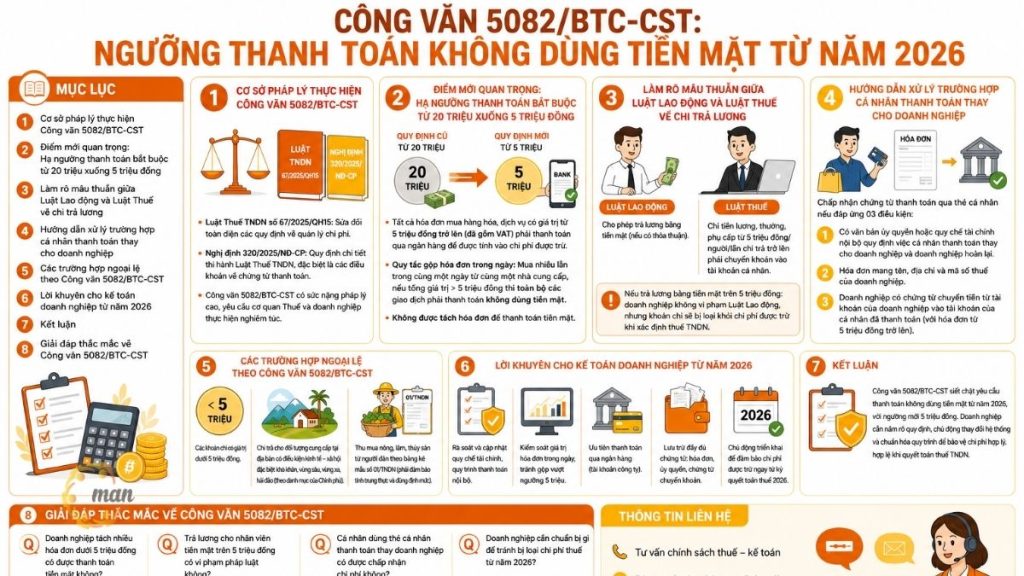
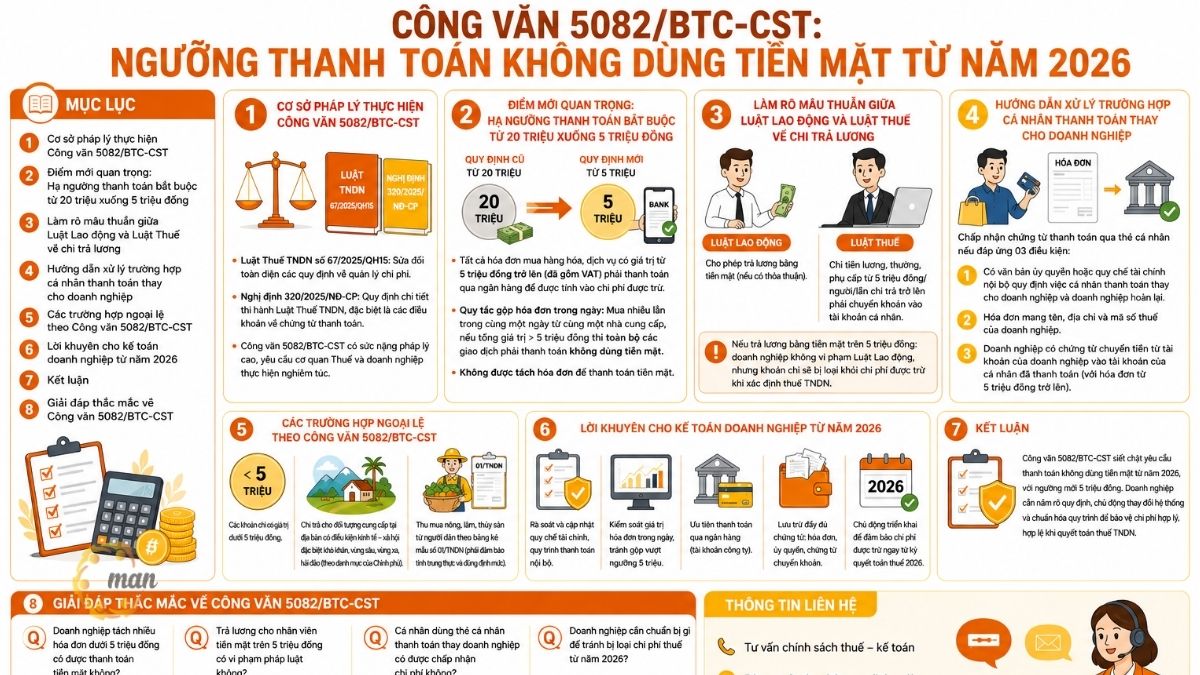
From 2026, the conditions for non-cash payments to be considered deductible expenses when determining corporate income tax have changed significantly. Official Document 5082/BTC-CST The Ministry of Finance issued Circular 5082/BTC-CST. The most notable point is the drastic reduction in the mandatory transfer threshold from 20 million to 5 million VND, leading to a series of risks related to tax costs, salaries, reimbursements, and internal payments if businesses fail to adapt. This article will analyze in detail the content of Circular 5082/BTC-CST, the exceptions, and provide guidance for businesses to implement the regulations correctly starting from the 2026 tax year.
Legal basis for implementing Official Letter 5082/BTC-CST

The guidance contained in Official Letter 5082/BTC-CST is based on consistency with important legal documents:
- Corporate Income Tax Law No. 67/2025/QH15: Comprehensive amendments to regulations on expense management.
- Decree 320/2025/ND-CP: Provides detailed regulations for the implementation of the Corporate Income Tax Law, especially the provisions on payment documents.
The direct reference to provisions from the Law and Decree gives Circular 5082/BTC-CST high legal weight, requiring local tax authorities and businesses to comply strictly.
Key new development: Lowering the mandatory payment threshold from 20 million to 5 million VND.

The landmark change highlighted in Official Letter 5082/BTC-CST is the adjustment of the threshold for invoice value that must be paid using non-cash methods.
- New regulation: All invoices for goods and services with a value of 5 million VND or more (including VAT) must be paid through a bank to be considered deductible expenses.
- Rules for Consolidating Invoices in a Single Day: According to the guidelines in the official document, if a business makes multiple purchases on the same day from the same supplier, and the total value of these purchases exceeds 5 million VND, then all transactions must be paid using non-cash methods.
This is a point that accountants need to pay special attention to when controlling small expenses, avoiding the practice of splitting invoices to pay in cash, as tax authorities can easily detect this through centralized electronic invoice data.
Clarifying the conflict between the Labor Law and the Tax Law regarding wage payments in Official Letter 5082/BTC-CST
Many businesses are confused because the Labor Code allows for cash salary payments, but tax laws are strict about documentation requirements. Circular 5082/BTC-CST has clarified this:
- Regarding corporate obligations: Paying wages in cash does not violate labor laws (if agreed upon).
- Regarding the conditions for deductible expenses: For payments of salaries, bonuses, and allowances to individual employees with a value of 5 million VND/person/payment or more, the enterprise must transfer the funds to the individual's bank account.
If payments exceeding 5 million VND are made in cash, the business still fulfills its obligations to the employee, but this expense will be excluded from deductible expenses when determining corporate income tax.
Instructions for handling cases where individuals make payments on behalf of businesses.
To alleviate difficulties for employees on business trips or making urgent purchases, Circular 5082/BTC-CST allows acceptance of payment documents via personal cards if 3 conditions are met:
- There is a written authorization or internal financial regulation stipulating that an individual makes payments on behalf of the business, and then the business reimburses the individual.
- Invoices for goods and services must bear the name, address, and tax identification number of the business.
- Businesses must have documentation showing the transfer of funds from their business account to the individual's account that made the payment for invoices of 5 million VND or more.
Exceptions as per Official Letter 5082/BTC-CST
Despite stricter regulations, the Ministry of Finance still stipulates cases where non-cash payment documentation is not mandatory:
- Expenses that are under 5 million VND.
- Payments are made to beneficiaries in areas with particularly difficult socio-economic conditions, remote areas, and islands (according to the Government's list).
- In the case of purchasing agricultural, forestry, and aquatic products from the people according to the list form No. 01/TNDN (must ensure honesty and adherence to the prescribed limits).
Advice for business accountants from 2026
Based on the guidance in Official Letter 5082/BTC-CST, corporate accountants need to urgently:
- Review payment procedures: Immediately adjust the advance payment and cash settlement limits to below 5 million VND in all internal regulations.
- Request 100% requires employees to open bank accounts: To facilitate the synchronized payment of salaries, bonuses, and reimbursement of business trip expenses.
- Closely monitor supplier tax identification numbers: Avoid the risk of unknowingly consolidating invoices on the same day.
To ensure accuracy in handling complex documents, invoices, and accounting records, businesses should consider using... full accounting service The aim is to standardize the accounting system right from the beginning of the fiscal year.
Conclude
Circular 5082/BTC-CST is not merely a technical guidance document, but also a signal that the tax authorities are stepping up control over the flow of money and electronic invoice data towards greater transparency from 2026. With the mandatory payment threshold lowered to 5 million VND, businesses need to quickly update their financial regulations, standardize payment processes, and avoid the risk of having their tax expenses disallowed. Proactive early compliance will help businesses reduce settlement pressure, limit tax arrears, and maximize the protection of their legitimate tax rights in the new phase.
Contact MAN – Master Accountant Network for free support and advice!
Contact information MAN – Master Accountant Network
- Address: No. 19A, Street 43, Tan Thuan Ward, Ho Chi Minh City
- Mobile/Zalo: 0903 963 163 – 0903 428 622
- Email: man@man.net.vn
Content production by: Mr. Le Hoang Tuyen – Founder & CEO MAN – Master Accountant Network, Vietnamese CPA Auditor with over 30 years of experience in Accounting, Auditing and Financial Consulting.
Answers to frequently asked questions regarding Official Letter 5082/BTC-CST
No. If a business makes multiple purchases on the same day from the same supplier, and the total value exceeds 5 million VND, all transactions must be paid through a bank. The tax authorities will cross-check the electronic invoice data to verify any instances of invoice splitting.
Businesses can still pay salaries in cash if there is an agreement with employees in accordance with the Labor Code. However, salary, bonus, or allowance payments of 5 million VND/person/payment or more, if paid in cash, will not be deductible expenses when calculating corporate income tax.
Yes, if the following conditions are met: There is an internal regulation or authorization document; the invoice contains complete business information; and the business has proof of bank transfer for reimbursement to the individual for transactions of 5 million VND or more.
Businesses should review their entire internal payment process, reduce cash disbursement limits, require employees to use bank accounts, and tightly control electronic invoice data to avoid the risk of expenses being disallowed during tax settlement. Can a business split multiple invoices under 5 million VND be paid in cash?
Is it against the law to pay employees more than 5 million VND in cash?
Can an individual using a personal card to pay on behalf of a business be considered a valid expense?
What preparations do businesses need to make to avoid having their tax expenses disallowed starting in 2026?






