
From July 1st, 2026, the Vietnamese business community officially enters a new phase as the amended Tax Administration Law comes into effect. In the context of comprehensive digitalization, supplementing tax declaration documents has become one of the hottest topics due to fundamental changes in deadlines for benefits and accompanying penalties.
Corporate accountants need to stay updated and understand the regulations regarding deadlines for supplementary tax filings. This not only helps businesses avoid heavy administrative penalties but also demonstrates professional compliance. This article will provide the most comprehensive, in-depth, and detailed overview for the corporate accounting community.
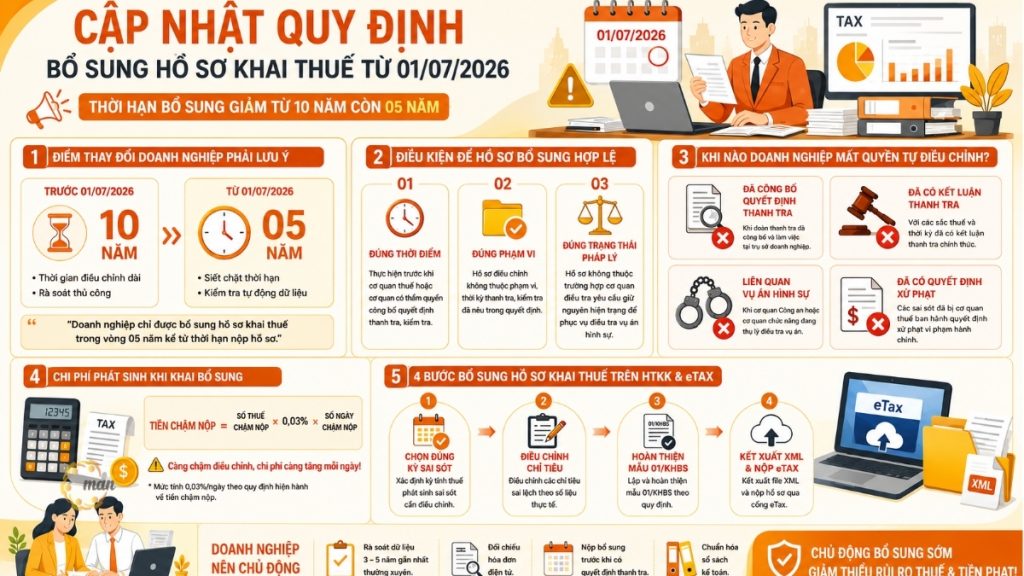
The deadline for supplementing tax returns from July 1, 2026: Shortened from 10 years to 5 years.
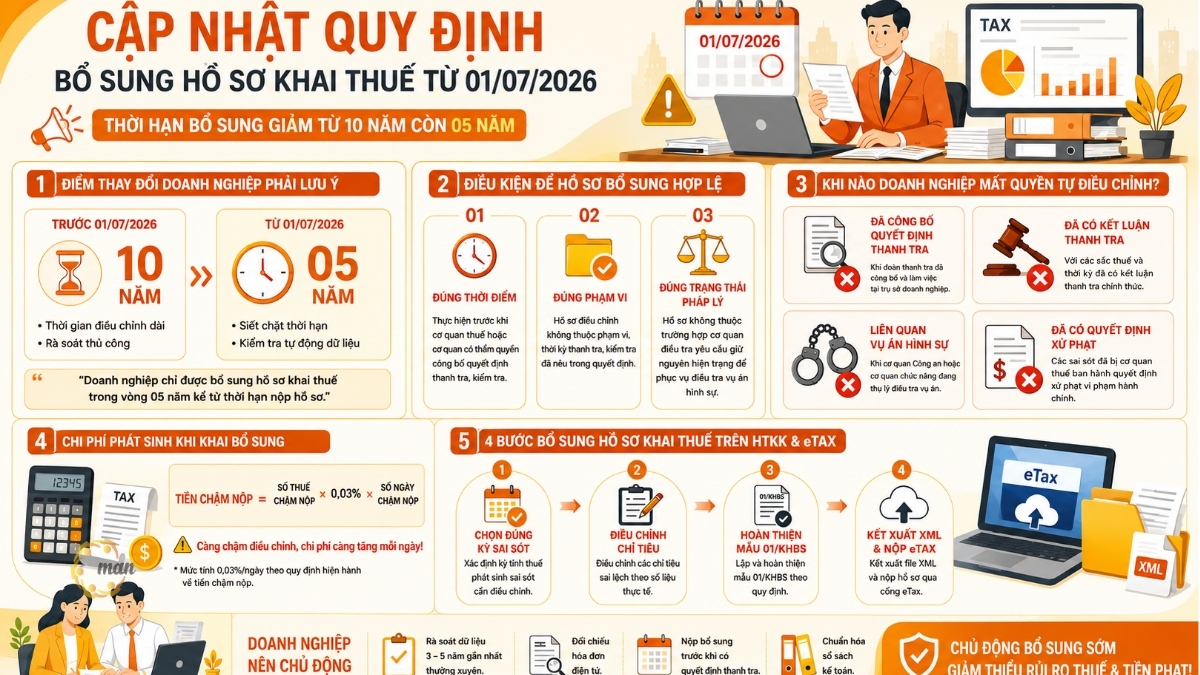
The most important change that every business and accountant needs to understand is as follows: Law on Tax Administration 2019 Currently, the deadline for supplementing tax returns is 10 years, which is the period for making corrections and adjustments. However, from July 1, 2026, this right has been significantly tightened to match the speed of the tax authorities' automated audits.
As stipulated in Clause 5, Article 12 of the amended Law on Tax Administration.
Specifically, if a taxpayer discovers errors or omissions in their tax return or other payments already submitted to the tax authorities, they are only allowed to supplement the tax return within a period of 5 years. This period is calculated from the date the deadline for submitting the tax return for the tax period in question has expired.
Reducing the timeframe from 10 years to 5 years places enormous pressure on businesses' data storage and review systems. Therefore, accounting operations must be error-free. This requires businesses to have a more stringent internal control process than ever before.
Conditions for the submission of supplementary tax return documents to be legally accepted.
For tax return amendments to be legally valid and recognized by the tax authorities as proactive adjustments, businesses must meet three prerequisites:
- Timing: This must be done before the tax authorities or competent agencies announce a decision to conduct an inspection or audit.
- Scope of documents: The amended documents must not fall within the scope or period of inspection or audit as clearly stated in the decision.
- Legal status: The file does not fall under the category where the investigating agency requires it to be kept in its current state to facilitate the investigation of criminal cases.
Special cases for supplementing tax return documents after an audit.
A new, extremely humane yet challenging aspect of the 2026 amended Law is the mechanism for accountability when errors related to the audited period are discovered. Point d, Clause 5, Article 12 stipulates a separate roadmap for this case.
If a taxpayer discovers errors related to the scope of the audit that result in an increase in the amount of tax payable or a decrease in the amount of tax exempted, reduced, or refunded, the business is still allowed to supplement the tax return in the form of an Explanatory Document.
The process for handling these explanatory documents is as follows:
- The company's accountant proactively submits explanations of errors to the tax authorities.
- The tax authorities are responsible for reviewing the reasonableness of the explanatory documents.
- If approved, the tax authority issues an official notice allowing the adjustment.
Note: Although adjustments are permitted, in this case, the taxpayer will still be processed according to regulations as if the tax authorities had discovered the violations through an inspection. This aims to ensure fairness and prevent the exploitation of loopholes to evade financial responsibility after an inspection has concluded.
When are businesses not allowed to submit additional tax return documents?
In 2026, regulations will clearly define the red line at which the self-regulation rights of businesses are completely suspended. Businesses will absolutely not be allowed to supplement tax return documents in the following four common situations:
- The records are within the scope of inspection at the headquarters: Once the inspection team has announced its decision and begun its on-site work, any subsequent adjustments to the inspection content will not be considered voluntary.
- The official inspection report has concluded: For the taxes and periods for which the official report has been issued, the business no longer has the right to arbitrarily change the data on the system.
- Regarding criminal cases: This applies when the police or other relevant authorities are investigating a case directly related to that tax file.
- Administrative sanctions have been imposed: The errors have been formalized by a legally binding administrative decision from the tax authority.
Will I be penalized for submitting additional tax returns?
The biggest question for accountants is often about the costs incurred. The 2026 tax policy continues to encourage self-discipline but is also extremely strict about procrastination.
Cases where administrative penalties are waived.
Businesses will not be subject to administrative penalties if they proactively supplement their tax return documents before authorities announce a decision to conduct an inspection at their headquarters. However, this exemption must be accompanied by three mandatory actions:
- Pay the full amount of outstanding taxes to the state budget.
- Pay all late payment penalties incurred in real time.
- Complete all necessary transparent explanations before being discovered through the tax authorities' investigative measures.
How to calculate late payment penalties when submitting supplementary tax return documents.
Delaying the adjustment will cause the business's costs to increase daily. The formula for calculating late payment penalties is as follows:
|
Late payment penalty = Amount of tax overdue x 0.03% x Number of days overdue |
In this context: The number of days of late payment is calculated from the day following the final tax payment deadline until the actual payment date.
See details: Penalties for late filing of tax returns.
Required documents for supplementing an accurate tax return.
To ensure a smooth and successful tax return submission process on the electronic system, the accounting department needs to prepare a complete set of legal documents. Below is a summary of the necessary documents for submitting tax returns.
| File | Status | Purpose of use |
| Supplementary declaration form | Obligatory | Update the data correctly according to the period in which the error occurred. |
| Explanation Form 01/KHBS | Obligatory | Explain the difference, the increase or decrease in figures. |
| Detailed explanation file | Obligatory | Clearly and specifically state the actual causes of the errors (objective or subjective). |
| Books, invoices, and supporting documents. | Depending on the circumstances | Use this as a basis for comparing new data when required. |
| Proof of payment of outstanding debt (if any) | Obligatory | Confirmation of fulfillment of additional financial obligations. |
The supplementary tax return documents must be prepared thoroughly, with consistent and synchronized data between declared figures, accounting documents, and actual financial obligations. The omission of any documents, especially explanations or supplementary supporting documents, can lead to the tax authorities requesting further clarification or prolonging the processing time. Therefore, businesses should carefully review their documents before submission to ensure a smooth and compliant tax return submission process and minimize potential risks.
Instructions for supplementing tax return documents on the HTKK and eTax systems.
In 2026, with the comprehensive synchronization of electronic invoice data, adding tax declaration records to the HTKK software and eTax portal has become more intuitive but requires absolute accuracy.
Step 1: Identify and select the correct tax period in which the error occurred.
This is a crucial step. The accountant must select the correct filing period in which the error occurred, and then select the "Supplementary Filing" option. Under no circumstances should adjustments be filed in the current period for errors from previous years.
Step 2: Adjust for discrepancies in actual performance indicators.
The system will display the most recently filed figures. The company's accountant will enter the correct figures into the corresponding fields. When supplementing the tax return, the system will automatically recalculate the tax difference and estimate the late payment penalty.
Step 3: Complete form 01/KHBS
Accountants need to explain in detail the reasons for the error: whether it was due to a mistake in the invoice, incorrect tax rate application, or missing supporting documents, etc. Transparency and honesty at this stage help minimize the chances of being summoned by the tax authorities for a direct explanation.
Step 4: Generate XML and submit via eTax
Export the tax return in standard XML format, use the company's digital signature to submit it to the General Department of Taxation's system. After submission, immediately pay any additional tax (if applicable) so that the system stops calculating late payment penalties immediately.
Submit supplementary tax returns for each specific type of tax.

Each type of tax has its own specific characteristics that accountants need to be aware of when making adjustments:
Supplementing Value Added Tax (VAT) declaration documents
This is the most common case, usually involving the omission of outgoing invoices or the confusion of invalid incoming invoices. If supplementing the tax return results in an increase in the amount of deductible VAT carried forward to the next period, the accountant needs to ensure that this figure is accurately updated in the current period's tax return.
Supplementing Corporate Income Tax (CIT) return documents
Corporate income tax errors often stem from the incomplete accounting of expenses without supporting invoices or discrepancies in revenue between accounting and tax records. These types of violations can easily lead to significant back taxes and late payment penalties if not addressed proactively.
Supplementing Personal Income Tax (PIT) return documents
This often involves incorrect tax identification numbers for employees, missing information on dependents, or miscalculations of personal deductions. Early correction helps ensure employee rights and the company's reputation.
Common mistakes corporate accountants often make when filing tax returns.
During the consultation and support process, MAN – Master Accountant Network We have identified and pointed out four common mistakes that render tax return filings ineffective or counterproductive:
- Internal accounting adjustments only: Accountants make adjustments on the software but forget to submit the documents to the tax authorities. When internal data and tax data differ, the business will be placed on a high-risk list. At this point, the business should proactively seek advice. accounting record reconstruction services to clean up and standardize the entire data system.
- Incorrect adjustment period: Instead of returning to the exact time the error occurred, the accountant adjusted it to the current period. This disrupts the logical flow of tax data across multiple years.
- Forgetting to pay late payment penalties: Only submitting the tax return without paying the outstanding tax and late payment interest will result in the system continuing to hold the debt and calculating the penalty daily.
- The "wait until an audit is called" mentality: This is the most dangerous mistake. With automated management technology in 2026, tax authorities can easily detect discrepancies. Waiting until an audit decision is made before supplementing tax returns will result in extremely high penalties.
Effective strategies for reviewing and supplementing tax returns.

With the term shortened to 5 years, businesses need a proactive review strategy to protect themselves:
- Prioritize key areas: Focus on reviewing records from the last 3-5 years. Pay particular attention to periods with significant revenue fluctuations or unusually low profit margins.
- Verify payment documents: Ensure that all purchase invoices exceeding 20 million VND have valid non-cash payment documentation. If any are missing, proactively supplement the tax return to have the expenses disallowed immediately.
- Electronic invoice reconciliation: Regularly use data from the General Department of Taxation's portal to reconcile with accounting records, avoiding the omission of output invoices or the duplication of input invoices in declarations.
To ensure absolute safety, many businesses have proactively sought out such services. accounting services Reputable and experienced firms like MAN – Master Accountant Network are available to conduct periodic health checks before tax audits begin.
Frequently Asked Questions When Filing Tax Returns
Yes. Currently, almost the entire process, from preparing supplementary declarations and explanation forms (01/KHBS) to submitting declarations and imposing late payment penalties, is done online via the eTax portal (100%).
If a business proactively detects errors and submits supplementary tax return documents before the tax authorities announce an inspection or audit decision, it will generally not be subject to administrative penalties. However, the business must still pay the full amount of outstanding taxes and any late payment interest as stipulated by law.
Businesses are not permitted to make adjustments on their own if the file is already under inspection at their headquarters, has received an official inspection conclusion, has been subject to administrative penalties, or is involved in a criminal investigation. In these cases, adjustments can only be made at the request or instruction of the competent authority.
According to tax management principles, businesses must refer back to the tax period in which the error occurred to supplement their tax return. Making adjustments directly to the current period can distort the declared data between years and lead to risks when the tax authorities cross-check the data on the electronic system.
Yes. Taxpayers are still entitled to file multiple supplementary tax returns for a tax period if they continue to discover new errors, as long as there is no decision to conduct an on-site audit. Is it possible to submit tax returns online?
Will I be penalized for submitting additional tax returns before an audit?
When are businesses not allowed to submit additional tax return documents?
Should businesses correct errors in the current period or the period in which the error occurred?
Is it possible to file supplementary tax returns multiple times?
Conclude
The new regulation requiring the submission of tax return documents from July 1, 2026, sends a clear message from the government about tightening management and demanding high accuracy from businesses. The five-year period is sufficient for businesses to professionalize, but also short enough to penalize those that are negligent in their accounting practices.
Proactively identifying and supplementing tax returns and fulfilling financial obligations is the best way to save on penalties and build a sustainable financial foundation. Don't let small past mistakes become a huge financial burden in the future. Start the process of checking and supplementing your tax returns today!
For any questions or further information, please contact your company. Contact MAN – Master Accountant Network For free support and advice!
Contact information MAN – Master Accountant Network
- Address: No. 19A, Street 43, Tan Thuan Ward, Ho Chi Minh City
- Mobile/Zalo: 0903 963 163 – 0903 428 622
- Email: man@man.net.vn
Content production by: Mr. Le Hoang Tuyen – Founder & CEO of MAN – Master Accountant NetworkCPA Vietnam auditors with over 30 years of experience in accounting, auditing, and financial consulting.






