
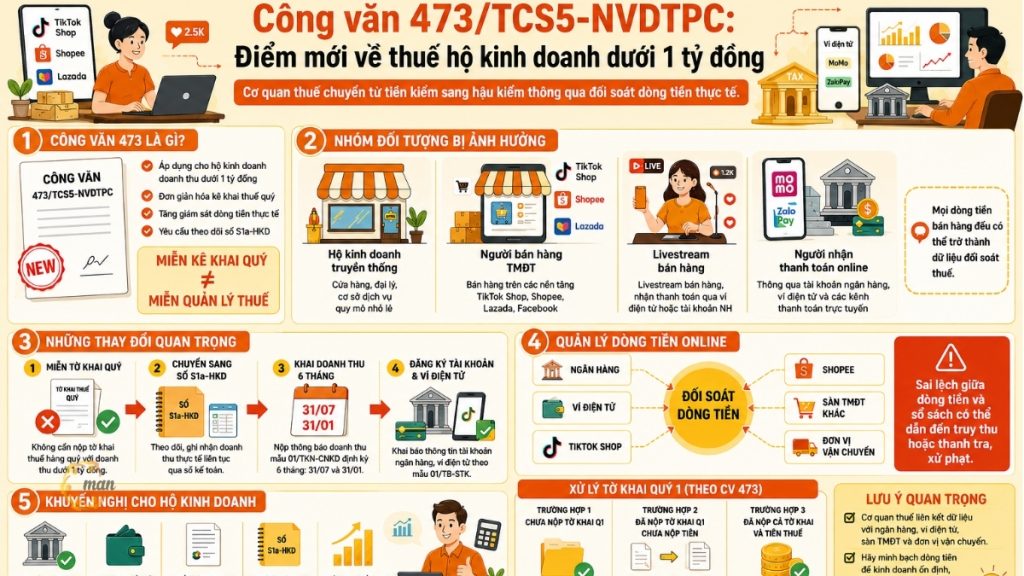
The emergence of Official Document 473/TCS5-NVDTPC The tax regulations issued by the five provincial tax authorities of Dong Thap are attracting significant attention from the business community. This is especially true for individual business owners, online sellers, and small shop owners who are directly affected by this new tax management mechanism. The document not only provides procedural guidance but also reflects a major shift in the method of monitoring actual revenue by the tax authorities.
Scope of application of Official Letter 473/TCS5-NVDTPC
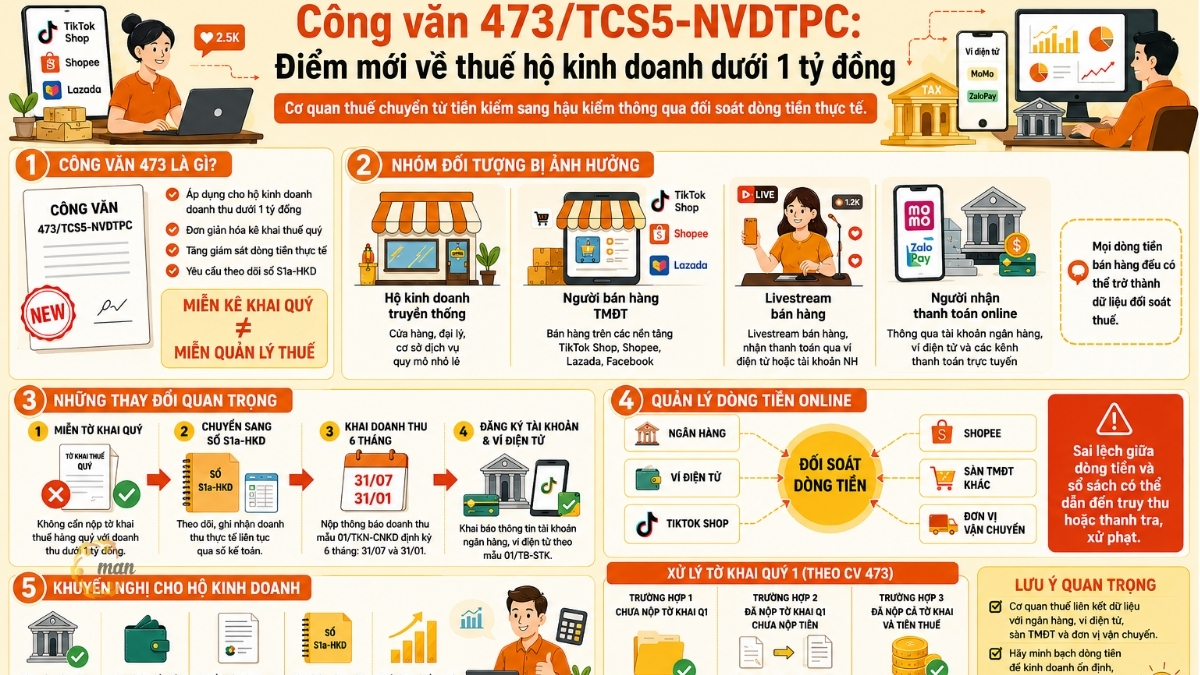
To specify the new regulations at Decree 141/2026/ND-CP and Decree 68/2026/ND-CPCircular 473/TCS5-NVDTPC focuses on guiding accounting procedures and tax declaration obligations for entities with annual revenue of less than 1 billion VND.
The groups directly affected include:
- Traditional household businesses: Small-scale shops, agencies, and service establishments.
- E-commerce: Sellers on platforms such as TikTok Shop, Shopee, Lazada, and Facebook.
- Digital business: Individuals conduct live-streamed sales and receive payments via e-wallets or bank accounts.
The essence of Official Letter 473/TCS5-NVDTPC is not to completely exempt tax obligations, but rather to simplify quarterly administrative procedures and shift the focus of supervision to verifying actual cash flow and revenue generated.
| Core content | Details of the regulations are provided in the Official Letter. |
| Document code | Official Document 473/TCS5-NVDTPC |
| Applicable threshold | Revenue reached a level of less than 1 billion VND. |
| Administrative reform | Exempt from filing quarterly tax returns. |
| Monitoring obligation | Record actual revenue through accounting records. |
| Required number | Model S1a-HKD (replacing the old model S2a-HKD) |
| Revenue notification template | Form No. 01/TKN-CNKD |
| Account declaration form | Form No. 01/TB-STK |
In summary, the systemic changes in Circular 473/TCS5-NVDTPC show that the tax authorities are shifting their management method from pre-audit (requiring continuous tax declaration submission) to post-audit (reconciling actual revenue through cash flow and accounting records). This change requires individual business owners not to be complacent, but to proactively standardize their financial tracking processes and sales data storage to ensure legal transparency before the management authorities. At this point, proactiveness is crucial. hire accounting services Professionalism will be the optimal solution to help homeowners streamline processes and focus on business development.
Changes to declaration and record-keeping obligations according to Official Letter 473/TCS5-NVDTPC

One of the biggest changes stipulated in Circular 473/TCS5-NVDTPC is that business households with revenue of less than 1 billion VND will be exempt from submitting quarterly tax returns. However, this simplification of procedures comes with stricter requirements for self-monitoring of accounting records.
Convert the revenue tracking log template.
Instead of using form S2a-HKD as before, business households must switch to using form S1a-HKD to continuously record actual cash flow. The S1a-HKD ledger is an important legal basis that helps tax authorities determine:
- Does the household business maintain a revenue limit of less than 1 billion VND?
- The time when the obligation to file a tax return officially arises.
- The basis for offsetting or refunding overpaid taxes.
Regulations on the deadline for submitting revenue reports.
Although exempt from quarterly declarations, businesses are still obligated to submit revenue reports using form 01/TKN-CNKD periodically every six months. Circular 473/TCS5-NVDTPC specifies the following timelines:
- Announcement of revenue for the first six months of the year: Deadline is July 31st of the same year.
- Report on revenue for the last six months of the year: Deadline is January 31st of the following year.
Note: For newly established businesses or those starting operations mid-year, the business owner must submit revenue reports twice as required by regulations.
Instructions for processing tax returns and payments for Quarter 1 according to Official Letter 473/TCS5-NVDTPC
Because the document was issued after many households had already completed the provisional calculation procedure at the beginning of the year, Circular 473/TCS5-NVDTPC provided transitional solutions for three specific cases:
Case 1: The Q1 tax return has not been submitted.
Household heads do not need to submit the Q1 tax return. Instead, they should urgently submit the bank account and e-wallet information declaration form 01/TB-STK.
- Documents required: Tax identification number, bank account number, e-wallet used for transactions, and a fully completed Form 01/TB-STK.
Case 2: The Q1 tax return has been submitted but the tax has not yet been paid.
To standardize data in accordance with the spirit of Official Letter 473/TCS5-NVDTPC, business households can choose one of two solutions:
- Option 1: Submit supplementary declaration form No. 01/CNKD to adjust the generated revenue indicator to zero.
- Option 2: Draft and send a written request to cancel the previously submitted tax return to the directly managing tax authority.
Please note the accompanying obligations: After completing the adjustment of the declaration form, the household head must still submit the account notification form 01/TB-STK.
Case 3: Both the tax return and the tax payment have been submitted to the government.
If the actual total revenue at the end of the fiscal year remains below 1 billion VND, the tax paid in Quarter 1 is considered overpaid. The business household is entitled to:
- Prepare the tax refund application in accordance with the law.
- Alternatively, you can offset your tax obligations against subsequent periods.
Regulations on managing online cash flow in Official Letter 473/TCS5-NVDTPC
The boom in the digital economy demands that tax management methods adapt quickly. Circular 473/TCS5-NVDTPC clearly demonstrates modern management thinking by focusing on tightly controlling online payment channels.
- Revenue from bank transfers: All bank transfer transactions that are essentially payments for goods or services are included in actual revenue for tax purposes.
- Transactions via e-wallets: E-wallet accounts (such as Momo, Zalopay, ShopeePay) used for sales activities must register their information using form 01/TB-STK submitted to the tax authorities.
- Cross-checking data: Tax authorities are currently strengthening data linkages with commercial banks, payment intermediaries, major e-commerce platforms, and shipping and delivery companies. Inconsistencies between actual cash flow through accounts and data recorded in the S1a-HKD ledger pose a significant risk, potentially leading to audits, tax arrears, or penalties for household businesses.
Reference: Online accounting services.
Practical recommendations for household businesses from Official Letter 473/TCS5-NVDTPC
To proactively adapt to the legal changes from Circular 473/TCS5-NVDTPC and minimize future legal risks, business households need to immediately take the following steps:
- Review the transaction account system: Clearly list and categorize bank accounts and personal e-wallets that generate sales revenue to accurately complete Form 01/TB-STK.
- Standardize input and output documents: Store invoices, shipping receipts, and order data from e-commerce platforms in a systematic manner. This documentation serves as proof of legal origin when tax authorities conduct verification.
- Update the accounting system: Regular conversion and recording using the S1a-HKD ledger format is essential for real-time cash flow control. In cases where the business household's old data system is inaccurate, inconsistent, or does not match the actual cash flow, the use of this new system is recommended. accounting record reconstruction services Professionals are needed to clean up data and standardize information before regulatory agencies conduct inspections.
- Proactive revenue monitoring: If actual revenue for the year exceeds 1 billion VND at any point, the business household must proactively switch to the accounting regime according to Circular 152/2025/TT-BTC and fulfill its tax declaration obligations immediately in that quarter without waiting until the end of the fiscal year.
Answers to questions regarding Official Letter 473/TCS5-NVDTPC
To help businesses resolve difficulties during the application process, here is a compilation of expert answers from a legal perspective:
According to the spirit of Official Letter 473/TCS5-NVDTPC, business households are only required to declare bank accounts and e-wallets that directly generate cash flow from transactions involving the purchase and sale of goods and services, using Form 01/TB-STK. However, to protect your rights and minimize the risk of having to explain, you need to absolutely separate personal cash flow from business cash flow. If the tax authorities conduct a post-audit and discover commercial cash flow into undeclared accounts, the business household will face the risk of being accused of revenue concealment and facing severe penalties.
For business households operating for less than 12 months in a fiscal year, the revenue threshold for determining eligibility is still based on actual revenue generated during the actual operating period, without converting it to an equivalent annual revenue. If the total actual revenue from establishment to December 31st of that year is less than 1 billion VND, the business household is fully subject to the regulations of the Official Letter and is exempt from submitting quarterly tax returns.
This is a crucial point that can easily lead to administrative errors. Once the actual cumulative revenue exceeds 1 billion VND, the business household is no longer subject to the provisions of the Circular. The household owner must immediately switch from the simplified accounting method (form S1a-HKD) to the full accounting method stipulated in Circular 152 and submit the tax return and fulfill tax obligations in the quarter in which the threshold is exceeded, without waiting until the end of the fiscal year. I have multiple personal bank accounts, but I only use one for online sales. Do I need to declare all of them?
If a business is newly established in the middle of the year, how is the revenue threshold determined?
What should be done when applying the S1a-HKD ledger but the cumulative revenue suddenly exceeds 11 billion VND in the middle of the quarter?
Conclusion: Proactively adapt to modern tax management trends.
Circular 473/TCS5-NVDTPC is not simply a routine operational guidance document, but a significant turning point, reshaping the way tax management is conducted in the digital economy era. The abolition of the quarterly tax return requirement for business households with revenue of 1 billion VND or less presents a tremendous opportunity for administrative reform, helping online shop owners and individuals reduce paperwork burdens.
However, "simplification" does not mean "loosening the reins." Along with the exemption from pre-audit obligations comes a tightening of post-audit procedures, demanding maximum transparency from actual cash flow to the taxpayer's accounting records. Proactively updating the S1a-HKD form, declaring bank accounts, and strictly controlling revenue thresholds in accordance with Circular 473/TCS5-NVDTPC is not only a solution to avoid legal risks and penalties, but also a necessary preparation for business households to confidently operate sustainably and professionally in the future.
Contact MAN – Master Accountant Network For free support and advice!
Contact information MAN – Master Accountant Network
- Address: No. 19A, Street 43, Tan Thuan Ward, Ho Chi Minh City
- Mobile/Zalo: 0903 963 163 – 0903 428 622
- Email: man@man.net.vn
Content production by: Mr. Le Hoang Tuyen – Founder and CEO of MAN – Master Accountant NetworkCPA Vietnam auditors with over 30 years of experience in accounting, auditing, and financial consulting.






