In business operations, determining the correct timing for issuing invoices for goods and services is not merely an accounting procedure, but also a crucial legal basis for determining the obligation to declare and pay value-added tax (VAT) and corporate income tax (CIT). In reality, many businesses, even those with dedicated accounting departments, still struggle with this, issuing invoices late or at the wrong time, leading to the risk of tax authorities assessing revenue, collecting back taxes, and imposing administrative penalties.
Since Decree 70/2025/ND-CP Amendments and additions to several articles of Decree 123/2020/ND-CP, which are in effect, have made several notable adjustments regarding the timing of invoice issuance, especially for specific sectors such as real estate, construction, telecommunications, banking, insurance, healthcare, and petroleum. This article will systematize all current regulations, helping accountants and business owners understand and apply them accurately in each practical situation.
Why is it important to determine the correct time to issue invoices for goods and services?

Invoices are original documents, serving as the basis for recording revenue, declaring taxes, and accounting entries. Incorrectly determining the time of issuing invoices for goods and services can lead to a series of negative consequences:
- Incorrect VAT and corporate income tax declarations for the wrong tax period can lead to late or underpayment of taxes.
- Being subject to administrative penalties by the tax authorities for invoice violations according to current regulations, and even having taxable revenue assessed in cases of serious violations.
- This affects the reconciliation of accounts payable and revenue recognition between parties in commercial transactions.
The entire content regarding the timing of invoice issuance is currently regulated in Article 9 of Decree 123/2020/ND-CP, which has been amended and supplemented by Decree 70/2025/ND-CP. This is the main legal basis that accountants need to adhere to when handling transactions.
When is it necessary to issue invoices for goods and services?
According to Clause 1, Article 4 of Decree 123/2020/ND-CP (amended and supplemented by Decree 70/2025/ND-CP), when selling goods or providing services, the seller is responsible for issuing an invoice to the buyer. This regulation applies to cases that are often overlooked in practice, including:
- Goods and services used for promotional purposes, advertising, and samples.
- Goods and services intended for giving, gifting, or exchanging.
- Goods and services used as payment in lieu of wages for workers.
- Goods and services for internal consumption (excluding those transferred internally to continue the production process).
- Goods are exported in the form of loans, borrowings, or repayments.
In addition, other invoicing cases are specifically regulated in Article 19 of Decree 123/2020/ND-CP. The invoice content must ensure that all items according to Article 10 are included, and if the business uses electronic invoices, it is mandatory to comply with the standard data format of the tax authority as stipulated in Article 12 of Decree 123/2020/ND-CP.
As can be seen, the scope of mandatory invoicing is very broad, covering almost all transactions arising in business operations – including those that do not generate direct cash flow.
The time of issuing invoices for goods and services is governed by general regulations.
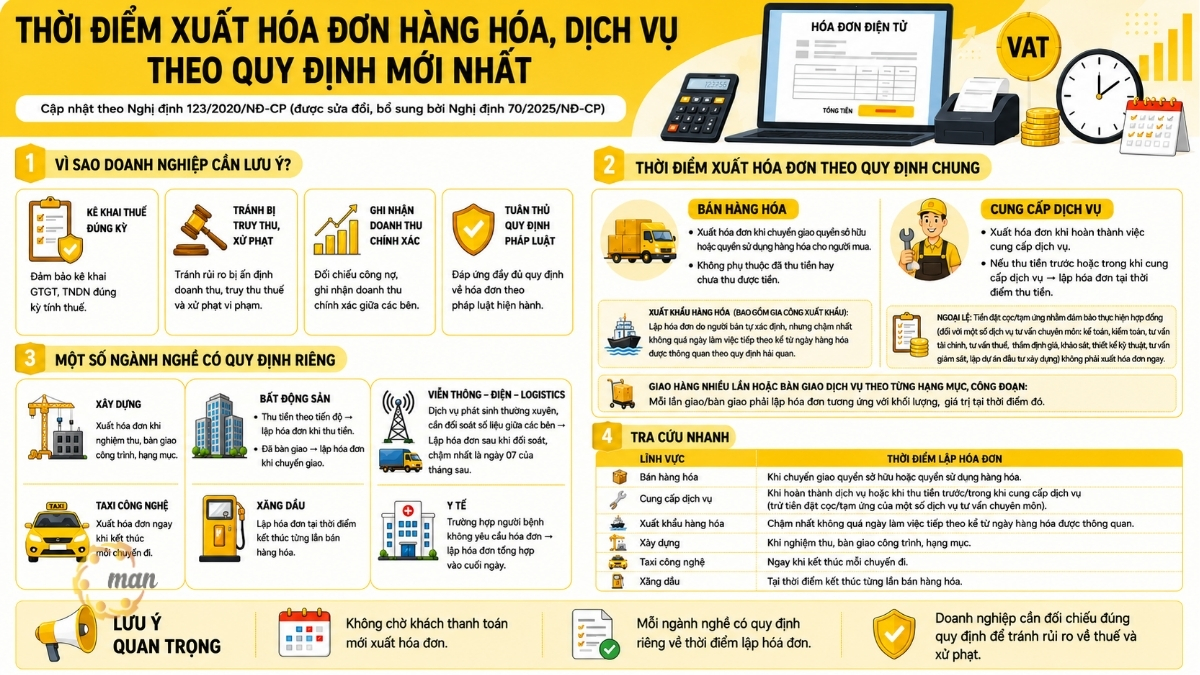
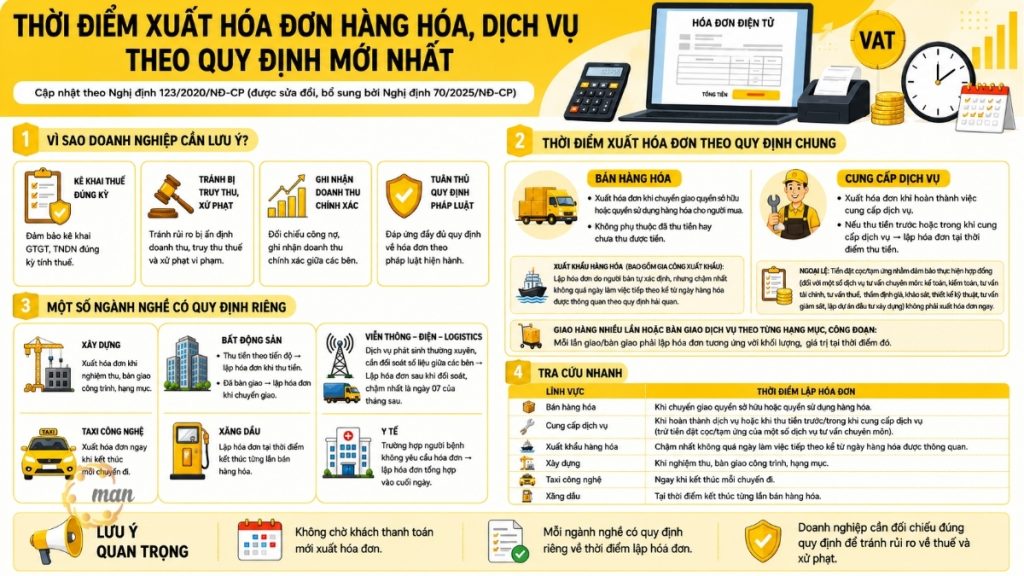
Based on Clauses 1 and 2 of Article 9 of Decree 123/2020/ND-CP (amended and supplemented by Decree 70/2025/ND-CP), the general regulations on the timing of invoice issuance are divided into two groups: sales of goods and provision of services.
The timing of issuing invoices when selling goods.
For the sale of goods (including the sale and transfer of public assets and the sale of national reserves), the time of invoice issuance is the time of transfer of ownership or the right to use the goods to the buyer, regardless of whether payment has been received or not.
This is an important principle that many accountants often misunderstand: invoices are not issued at the time of payment, but at the time of transfer of ownership/use of goods. Even if the customer has not yet paid, the business must still issue an invoice if the goods have been delivered.
Specifically for export activities (including processing for export), the time of issuing the electronic commercial invoice, electronic value-added tax invoice, or electronic sales invoice is determined by the seller, but no later than the next working day from the date the goods are cleared through customs as stipulated by customs law.
Time of invoice issuance when providing services
For the provision of services (including services provided to foreign organizations and individuals), the time of invoice issuance is the time when the service is completed, regardless of whether payment has been received or not.
However, there is an important exception: if the service provider collects payment before or during the provision of services, then the time of invoice is the time of payment. An exception to this is deposits or advances intended to guarantee contract performance for services such as accounting, auditing, financial consulting, tax consulting, valuation, surveying, engineering design, supervision consulting, and construction investment project planning; these amounts are not required to be invoiced immediately upon receipt of the deposit.
Another point to pay special attention to: in cases of multiple deliveries or service handover in stages, each delivery or handover must be invoiced separately for the quantity and value of goods or services delivered at that time; these invoices cannot be combined and left until the entire contract is completed.
Timing of invoice issuance for goods and services in specific cases

Besides the general principles, Clause 4, Article 9 of Decree 123/2020/ND-CP (amended and supplemented by Decree 70/2025/ND-CP) stipulates specific regulations for a number of sectors with unique characteristics regarding transaction frequency, reconciliation procedures, or revenue recognition cycles. This is a section that accountants in these specialized sectors need to pay particular attention to.
The service group needs to reconcile data periodically.
For cases involving the sale of goods or provision of services in large quantities and occurring frequently, time is needed to reconcile data between the business and its customers/partners, including:
- Services that directly support air transport;
- Supplying aviation fuel, providing electricity;
- Rail and water transport support services
- Television services, television advertising, e-commerce, postal and delivery services, telecommunications, logistics, and information technology sold on a periodic basis.
- Banking services (excluding lending activities), international money transfers, securities, and computerized lottery;
- Tolls are collected for the use of roads.
The time of invoice issuance is the time when data reconciliation between the parties is completed, but no later than the 7th day of the month following the month in which the service was rendered, or no later than 7 days from the end of the agreed period (the agreed period is determined by mutual agreement between the parties).
Specifically for telecommunications and information technology services that generate connection fees between service businesses, the invoice date is the date of completion of the service fee data reconciliation, no later than two months from the month in which the connection fee is incurred. In cases where prepaid cards are sold or connection fees are collected and the customer does not request an invoice or provide information, the service business may issue a single VAT invoice at the end of the day or periodically during the month to record total revenue.
Construction and Real Estate Sector
For construction and installation activities, the time of invoice issuance is the time of acceptance and handover of the completed project, project item, or construction and installation volume, regardless of whether payment has been received or not.
For businesses involved in real estate development, infrastructure construction, and building houses for sale or transfer, the timing of invoice issuance is distinguished in two cases:
- If ownership or usage rights have not yet been transferred but payments are collected according to the project progress or payment schedule specified in the contract: the invoice date is the date of payment collection or as agreed upon in the contract.
- If ownership or usage rights have been transferred: the invoice date is the date of transfer, regardless of whether payment has been received or not.
Other specialized industry groups
In addition to the two groups above, the Decree also stipulates separate invoice issuance times for many other specific fields, specifically:
- Air freight services via websites and e-commerce systems: the time of invoice issuance follows international practice, no later than 5 days from the date the air freight service document is issued on the system.
- Crude oil, condensate, and refined petroleum products: the time of invoicing is the time when the buyer and seller determine the official selling price.
- Natural gas, associated gas, and coal gas via pipeline: the time of invoicing is the time when the volume of gas delivered in the month is determined, no later than the last day of the deadline for declaring and paying taxes for the month in which the tax liability arises.
- Electricity sales by power generation companies on the electricity market: based on the time of reconciliation of payment data between relevant units, no later than the last day of the deadline for tax declaration and payment.
- Retail sale of petroleum products at stores: the time of invoice issuance is the time when the sale of petroleum products is completed for each sale; the seller must keep complete records of invoices for reference when requested by competent authorities.
- Air freight and insurance through agents: the invoice date is the date of completion of data reconciliation between the parties, no later than the 10th day of the month following the month in which the transaction occurred.
- Lending activities of credit institutions: interest is collected according to the terms of the credit contract; if interest is not collected by the due date and the credit institution monitors it off-balance sheet, the invoice is issued at the time the interest is actually collected; if interest is paid early, the invoice is issued at the time the interest is collected early.
- Taxi passenger transport businesses using fare calculation software can generate electronic invoices at the end of each trip and simultaneously transfer invoice data to the tax authorities.
- Healthcare facilities with management software: if the customer does not request an invoice, at the end of the day the facility compiles and generates an electronic invoice for medical services incurred during the day; for social insurance agencies, the invoice is issued at the time of settlement of medical examination and treatment costs.
- Electronic toll collection without stopping: the invoice date is the day the vehicle passes through the toll station; in cases where customers use the service multiple times in a month, periodic invoices can be issued, no later than the last day of the month in which the service is used.
- Insurance business: the time of invoice issuance is the time of recognition of insurance revenue according to insurance business law.
- For traditional lottery ticket businesses and instant lottery businesses: after collecting unsold tickets, no later than before the next draw, the business must issue one electronic VAT invoice with a tax authority code to each agent.
- For casino and electronic gaming businesses: electronic invoices must be issued no later than one day after the end of the revenue determination date (from 0:00 to 23:59 on the same day), and revenue data must be transferred to the tax authority using the prescribed form.
See more: Invoices must be issued in accordance with Decree 254/2026/ND-CP.
Summary table of invoice issuance times for goods and services by sector
For ease of reference and quick application in practice, below is a summary table of the invoice issuance times for goods and services by the sectors and industries presented above. Accountants can use this table as a quick reference tool; however, when applying it to specific cases, it is still necessary to carefully read the detailed content and corresponding legal basis to ensure compliance with regulations. .
| Field | Invoice date |
| Selling goods | The time of transfer of ownership or use of goods |
| Exporting goods | No later than the next working day from the date of customs clearance. |
| Providing services | The time of completion of service provision, or the time of payment collection if payment is collected in advance. |
| Services requiring reconciliation (telecommunications, electricity, aviation, banking, etc.) | The reconciliation process must be completed no later than the 7th of the following month. |
| Telecommunications and IT connection fees | No later than 2 months from the month the charge was incurred. |
| Construction and installation | Time of acceptance and handover |
| Real estate (not yet transferred) | Payment due date according to contract schedule |
| Real estate (already transferred) | Time of transfer of ownership or use |
| Electronic flight tickets | No later than 5 days from the date of issuance of the document. |
| Crude oil | Time of determining the official selling price |
| Natural gas via pipeline | No later than the last day of the tax filing period. |
| Electricity sales (power generation company) | No later than the last day of the tax filing period. |
| Retail sale of petroleum products | The end time of each sale |
| Air freight, insurance through agents | No later than the 10th of next month |
| Credit lending | According to the interest collection schedule in the contract. |
| Technology-based taxi | The time the trip ends |
| Medical examination and treatment | At the end of the day (unless requested by the customer) or when settling health insurance claims. |
| Non-stop road toll collection | The day the vehicle passes the toll station or at the end of the month. |
| Insurance business | Time of insurance revenue recognition |
| Traditional lottery | Before the next draw takes place. |
| Casino, games with prizes | No later than one day from the end of the revenue determination date. |
As can be seen, each field and industry has its own specific characteristics regarding the timing of invoice issuance. Therefore, businesses operating in the aforementioned specialized fields need to pay special attention to correctly comparing the regulations applicable to their industry, avoiding confusion between general principles and specific regulations, in order to minimize tax risks during operation.
Some important points to note for issuing invoices on time.

To ensure compliance with regulations regarding the timing of issuing invoices for goods and services, accountants and businesses should note the following points:
- Review internal sales and service delivery processes to clearly identify the point of ownership transfer, service completion date, or payment collection date for each type of transaction.
- For specific industries (construction, real estate, telecommunications, insurance, healthcare, transportation, etc.), careful comparison with the specific regulations in Clause 4, Article 9 of Decree 123/2020/ND-CP is necessary to avoid misapplying the general principles.
- Update your electronic invoicing software and sales/service management software to ensure you can issue invoices within the stipulated timeframe.
- Regularly train and update accounting staff on the changes in Decree 70/2025/ND-CP compared to previous regulations, avoiding the application of outdated practices.
In fact, for small and medium-sized enterprises that do not have a sufficiently strong accounting department to continuously update changes in invoice issuance timing, the solution is... hire accounting services Choosing a professional and experienced firm like MAN – Master Accountant Network significantly reduces the risk of errors. In particular, using full accounting service This will give businesses greater peace of mind in issuing invoices on time and in accordance with regulations for each type of transaction, while also saving time and operating costs for their internal accounting department.
Conclude
Understanding and correctly applying regulations regarding the timing of issuing invoices for goods and services not only helps businesses comply with tax laws but also minimizes the risk of penalties and tax arrears during tax audits and inspections. With the changes in Decree 70/2025/ND-CP, especially the detailed regulations for specific industry groups, accountants need to proactively update their knowledge regularly to accurately apply them to each transaction arising within their businesses.
If you have any further questions about when to issue an invoice for a specific case at your business, please leave your question below or contact Contact MAN – Master Accountant Network's accounting consulting team for timely and accurate support in accordance with current regulations.
If your business is looking for a long-term partner, you can refer to the following list. Reputable accounting firm in Ho Chi Minh City to choose a partner that suits the scale and industry of your business.
Contact information MAN – Master Accountant Network
- Address: No. 19A, Street 43, Tan Thuan Ward, Ho Chi Minh City
- Mobile/Zalo: 0903 963 163 – 0903 428 622
- E-mail: man@man.net.vn
- Google Business Profile: View MAN – Master Accountant Network's Google Business Profile
- LinkedIn Founder: View expert Le Hoang Tuyen's LinkedIn profile.
Responsible for production and professional content review by: Mr. Le Hoang Tuyen – Founder & CEO of MAN – Master Accountant NetworkHe is a CPA Vietnam auditor with over 30 years of in-depth experience in accounting, auditing, taxation, and corporate legal consulting.
Frequently Asked Questions about the timing of issuing invoices for goods and services.
No. According to the general principle in Article 9 of Decree 123/2020/ND-CP, the time of issuing an invoice for the sale of goods is the time of transferring ownership or use of the goods, while for services it is the time of completion of the service provision, regardless of whether payment has been received or not. Businesses must still issue invoices even if the customer has not yet paid.
In principle, if the service provider collects payment before or during the provision of services, the invoice date is the date of payment. However, for deposits or advances to guarantee contract performance for accounting, auditing, financial consulting, tax consulting, valuation, surveying, engineering design, supervision consulting, and construction investment project planning services, it is not mandatory to issue an invoice at the time of receiving the deposit.
Yes. Issuing invoices at the wrong time is a violation of invoicing regulations and may result in administrative penalties. It also affects the declaration and determination of VAT and corporate income tax obligations in the correct tax period.
No. Decree 123/2020/ND-CP clearly stipulates that in cases of multiple deliveries or handover of individual items or service stages, an invoice must be issued for each delivery or handover, corresponding to the quantity and value delivered at that time.
Businesses should review their internal sales/service provision processes, compare them with the regulations applicable to their industry, and may also consider using professional accounting services to receive advice and stay updated on changes in Decree 70/2025/ND-CP. Is it mandatory to wait for customer payment before issuing invoices for goods and services?
Do I need to issue an invoice immediately after receiving a deposit?
Will there be a penalty for issuing invoices late?
If delivery or service is made in multiple installments, can a single invoice be issued at the end of the contract?
What should small businesses, which don't have a dedicated accounting department, do to avoid errors in invoice timing?