
Issuing invoices when transferring assets is a problem that confuses many accountants when a parent company transfers assets to a dependent branch. Article 7 of Decree 254/2026/ND-CPFrom July 1st, 2026, assets transferred between the parent company and its subsidiary (or between subsidiary accounting units) are not subject to the requirement of issuing electronic invoices. This article will help you clearly distinguish which cases are exempt, which cases still require invoices, the necessary invoice content according to Article 10 of Decree 254/2026/ND-CP, as well as the risk of tax assessment under the 2025 Tax Administration Law if the nature of the transaction is mishandled.
How should an invoice be issued when transferring assets?

Before answering the question of whether the parent company is required to issue an invoice when transferring assets to a dependent accounting branch, accountants need to understand the true nature of the "asset transfer" activity within a business organization.
Internal asset transfers involve the transfer of fixed assets, goods, tools, and equipment between units within the same business entity. For example, this could be between a parent company and a subsidiary, or between subsidiary branches themselves. A key characteristic of this type of transfer is that the assets remain under the ownership of the same legal entity; no purchase or sale transaction occurs, and there are no independent buyers or sellers in the true economic sense.
This is quite different from asset transfer or sale transactions between two independent legal entities, where there is a real transfer of ownership and revenue is generated, thus requiring the issuance of invoices according to general regulations. Clearly distinguishing between these two cases is the prerequisite for accurately determining the obligation to issue invoices when transferring assets of a business.
Is it necessary to issue an invoice when transferring assets to a dependent accounting branch?

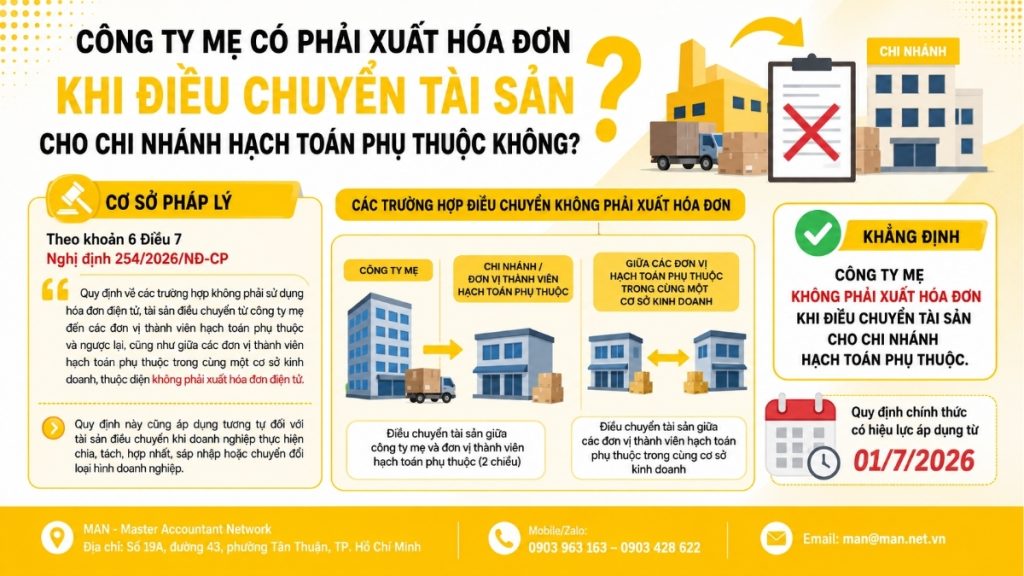
This is the most common practical question faced by accountants in businesses with a parent company-branch model. According to Clause 6, Article 7 of Decree 254/2026/ND-CP, which stipulates cases where electronic invoices are not required, assets transferred from the parent company to dependent accounting units and vice versa, as well as between dependent accounting units within the same business establishment, are exempt from the requirement to issue electronic invoices. This regulation also applies similarly to assets transferred when a business undergoes division, separation, merger, acquisition, or conversion of its business type.
Therefore, it can be affirmed that: The parent company is not required to issue an invoice when transferring assets to a dependent accounting branch.This regulation officially takes effect from July 1, 2026. This provides a clear legal basis, allowing accountants to confidently handle internal asset transfers without needing to issue electronic invoices. Instead, they can use internal documents such as handover records and asset transfer decisions as the basis for accounting.
Other cases where electronic invoices are not required when transferring or disposing of assets.
Besides the case of transferring assets between the parent company and its subsidiary, Decree 254/2026/ND-CP also lists several other cases where electronic invoices are not required, which accountants need to be aware of to avoid incorrect processing:
- Organizations and individuals engaged in business activities contribute assets as capital to economic organizations.
- Assets are transferred when a business undergoes division, separation, merger, acquisition, or conversion of its business type.
- Machinery and equipment are fixed assets, tools, and implements used for processing goods, which are loaned by the lender free of charge and without transfer of ownership.
- Household businesses and individual business owners are required to prepare a list of purchased goods and services in accordance with the law on corporate income tax, except in cases where they have registered to use electronic invoices.
Understanding all these cases helps businesses not only correctly handle invoicing when transferring assets between parent companies and branches, but also accurately apply them to situations of business restructuring or capital contribution arising in practice.
Why is it necessary to clearly distinguish between cases where an invoice is required and those where it is not required when transferring assets?

Accurately determining the nature of a transaction before deciding whether or not to issue an invoice when transferring assets is crucial for a company's accounting and tax practices, for two main reasons:
- The firstIf a business issues invoices unnecessarily (for example, transferring assets internally between the parent company and a dependent branch), it can lead to unnecessary value-added tax liabilities and cause discrepancies in the recording of revenue and expenses on financial statements, affecting the accuracy of accounting data throughout the system.
- MondayIf a business omits its obligation to issue invoices when a transaction is essentially a transfer or sale of assets between independent legal entities, but mistakenly considers it an internal transfer, the business may face the risk of being deemed by the tax authorities to have made incomplete or dishonest declarations. According to Article 24 of the 2025 Tax Administration Law, this is one of the grounds for the tax authorities to assess the tax liability of the taxpayer.
Therefore, the role of accountants in reviewing and accurately determining the economic nature of each asset transfer transaction before deciding whether or not to issue an invoice is crucial in helping businesses comply with tax laws and minimize risks during future audits and inspections.
In what cases is it still necessary to issue an electronic invoice when transferring assets?
Although Decree 254/2026/ND-CP clearly stipulates the cases where invoices are not required when transferring assets internally, businesses need to pay special attention to the boundaries of application to avoid confusion.
Specifically, the regulation exempting the issuance of invoices only applies to assets transferred within the same business entity, i.e., between the parent company and its subsidiary, or between subsidiary accounting units themselves.
In cases where assets are transferred between two independent legal entities (for example, between a parent company and a subsidiary with independent accounting, or between companies within the same group but without dependent accounting relationships), or transactions involving a transfer of ownership accompanied by payment, electronic invoices are still required according to general regulations.
Therefore, before processing any asset transfer transactions, businesses need to carefully review the accounting model of the asset recipient, whether it is a dependent or independent accounting system, in order to apply the correct regulations and avoid confusion between two cases with completely different legal natures.
Content required on an electronic invoice when the obligation to issue an invoice arises.
In cases where asset transfer transactions are not exempt and the business is required to issue an invoice upon asset transfer, the electronic invoice must contain all the information specified in Clause 1, Article 10 of Decree 254/2026/ND-CP, including:
- Invoice name, invoice symbol, invoice form number symbol, and invoice number;
- Name, address, and tax identification number of the seller;
- Name, address, tax identification number or budget-related unit code, or personal identification number of the buyer;
- Name, unit of measurement, quantity, unit price of goods and services; total amount excluding value-added tax, value-added tax rate, total value-added tax amount for each tax rate, total value-added tax amount, and total payment amount including value-added tax;
- The seller's signature and the buyer's signature are required, noting that electronic invoices do not necessarily need the buyer's digital signature unless otherwise agreed upon by both parties;
- The invoice date is displayed in the format of the Gregorian calendar day, month, and year;
- The time of digital signature on the electronic invoice;
- Tax authority code, for electronic invoices that have a tax authority code;
- Other related items include fees and charges belonging to the state budget, trade discounts, and promotions (if any).
Having a firm grasp of these mandatory requirements helps accountants proactively prepare accurate and complete invoices even when it becomes necessary. Issue invoices when transferring assets.This will prevent errors that could lead to invalid invoices.
See more: Invoices must be issued in accordance with Decree 254/2026/ND-CP.
The consequences of mishandling asset transfers include the risk of tax assessment.
One point that businesses need to pay particular attention to is that mishandling asset transfer transactions, whether by issuing unnecessary invoices or omitting the obligation to issue invoices, can lead to the risk of being assessed taxably by the tax authorities.
According to Article 24 of the 2025 Law on Tax Administration:
The tax authorities have the right to determine the amount of tax payable or to determine each element and basis for calculating the tax in many cases, including: businesses failing to reflect or reflecting incomplete, untruthful, or inaccurate data in their accounting records to determine tax obligations; using documents that do not accurately reflect the nature or value of the transaction in order to reduce tax obligations; or conducting transactions that do not reflect the true economic nature in order to reduce tax obligations.
This is also why many businesses should consider it. hire chief accountant services This allows someone to directly assess the nature of each transaction and control tax risks before the documents are submitted to the tax authorities.
Practical experience helps accountants handle asset transfers correctly.
To minimize risks and ensure compliance with invoicing regulations when transferring assets, corporate accountants can refer to the following handling experiences:
- Establish clear internal procedures.Before transferring assets, it is necessary to accurately determine whether the receiving entity is a dependent accounting unit, based on its business registration and accounting system registered with the tax authorities. For businesses with multiple branches, establishing this process will be much easier if a specialized unit is involved from the beginning. full accounting service With the help of specialized and experienced units like MAN – Master Accountant Network, the entire accounting and documentation process across the system will be standardized.
- Keep complete records of replacement documents.Even without issuing invoices, businesses still need to prepare and store complete asset handover records and internal asset transfer decisions with signatures and seals of all relevant parties, as a basis for accounting and explanation when necessary.
- Regularly update legal regulations.Legal documents regarding invoices and supporting documents are frequently amended and supplemented. Accountants need to proactively update the content of Decree 254/2026/ND-CP and related guiding documents to avoid applying regulations that are no longer in effect.
- Conduct periodic reviews of internal transactions.Especially for businesses with multiple branches, it is necessary to periodically review asset transfer transactions to ensure consistency in the handling of invoices and documents across the entire system.
Conclusion: What should businesses keep in mind when issuing invoices for asset transfers?
Based on the above analysis, three key points that accountants and businesses need to remember regarding invoicing when transferring assets can be summarized as follows:
- Assets transferred between the parent company and its subsidiary, or between subsidiary accounting units within the same business entity, are not subject to the requirement of issuing electronic invoices, as stipulated in Decree 254/2026/ND-CP, effective from July 1, 2026.
- In cases where transactions are required to be invoiced (transfer of assets between independent legal entities, involving a transfer of ownership and generating transaction value), the electronic invoice issued must ensure that it contains all the information specified in Clause 1, Article 10 of Decree 254/2026/ND-CP.
- Misidentifying the nature of a transaction, whether through over-invoicing or under-invoicing, carries the risk of being subject to tax assessment by the tax authorities under Article 24 of the 2025 Tax Administration Law.
Has your company reviewed its internal asset transfer process in accordance with the latest regulations on invoicing during asset transfers? If you still have questions about distinguishing between cases where invoices are required or not, as well as how to properly create electronic invoices, please contact us. Contact MAN – Master Accountant Network To receive specific advice and support tailored to your business's particular situation.
Contact information MAN – Master Accountant Network
- Address: No. 19A, Street 43, Tan Thuan Ward, Ho Chi Minh City
- Mobile/Zalo: 0903 963 163 – 0903 428 622
- E-mail: man@man.net.vn
- Google Business Profile: View MAN – Master Accountant Network's Google Business Profile
- LinkedIn Founder: View expert Le Hoang Tuyen's LinkedIn profile.
Responsible for production and professional content review by: Mr. Le Hoang Tuyen – Founder & CEO of MAN – Master Accountant NetworkHe is a CPA Vietnam auditor with over 30 years of in-depth experience in accounting, auditing, taxation, and corporate legal consulting.
Frequently Asked Questions about Invoicing When Transferring Assets
Is it necessary to issue an invoice when transferring assets between two dependent accounting branches of the same company?
No. The provisions in Article 7 of Decree 254/2026/ND-CP apply to the transfer of assets between dependent accounting units within the same business entity, not just the parent company-branch relationship.
When transferring assets to a subsidiary company with independent accounting, is it necessary to issue an invoice?
Yes. The regulation exempting the transfer of invoices only applies to assets transferred within a single business entity. If the recipient is an independent legal entity and the transaction involves a transfer of ownership, an electronic invoice must still be issued according to general regulations.
If no invoice is issued, what documents can be used to record the transfer of assets internally?
Businesses use asset handover records and internal asset transfer decisions, complete with signatures and confirmations from all relevant parties, as the basis for accounting entries, instead of electronic invoices.
Is it necessary to issue invoices when transferring assets during mergers, consolidations, or changes in business type?
No. According to Clause 6, Article 7 of Decree 254/2026/ND-CP, assets transferred during division, separation, merger, acquisition, or conversion of business type also fall under the category of cases where electronic invoices are not required.
Is it necessary to issue an invoice when contributing assets as capital to another company?
No. This is one of the cases listed in Article 7 of Decree 254/2026/ND-CP: contributing assets of business organizations and individuals to economic organizations that are not required to issue electronic invoices.






