
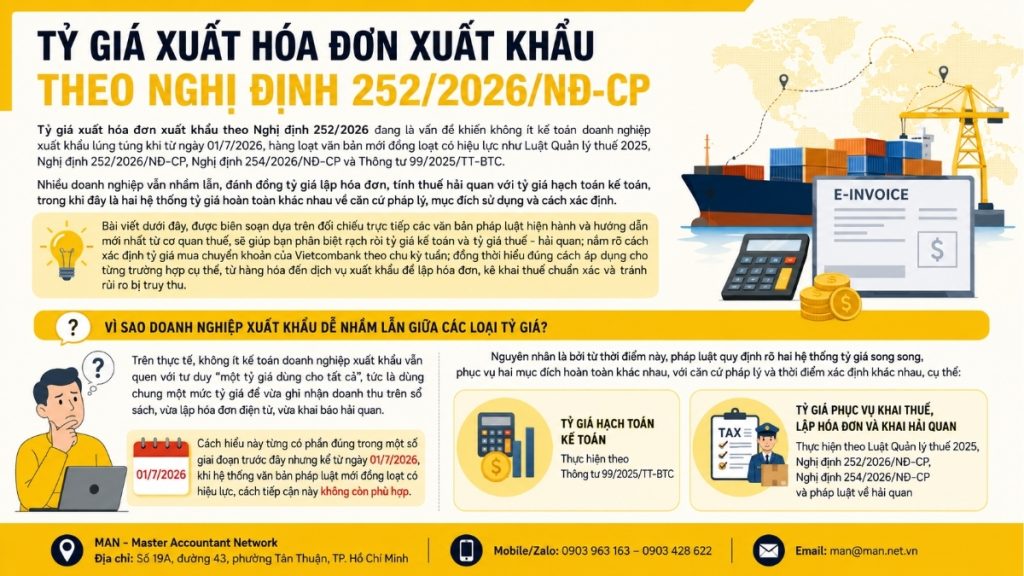
The exchange rate for export invoices under Decree 252/2026 is causing considerable confusion for many accountants in export businesses, especially since a series of new regulations, such as the 2025 Tax Administration Law, will come into effect on July 1, 2026. Decree 252/2026/ND-CP, Decree 254/2026/ND-CP and Circular 99/2025/TT-BTCMany businesses still mistakenly equate the exchange rate used for invoicing and customs tax calculation with the exchange rate used for accounting, even though these are two completely different exchange rate systems in terms of legal basis, purpose of use, and determination method. This article, compiled based on a direct comparison of current legal documents and the latest guidance from tax authorities, will help you clearly distinguish between accounting exchange rates and tax/customs exchange rates; understand how to determine Vietcombank's weekly transfer purchase exchange rate; and correctly apply it to specific cases, from exported goods to services, to ensure accurate invoicing, tax declaration, and avoid the risk of retroactive tax collection.
Why do export businesses often get confused between different exchange rates?
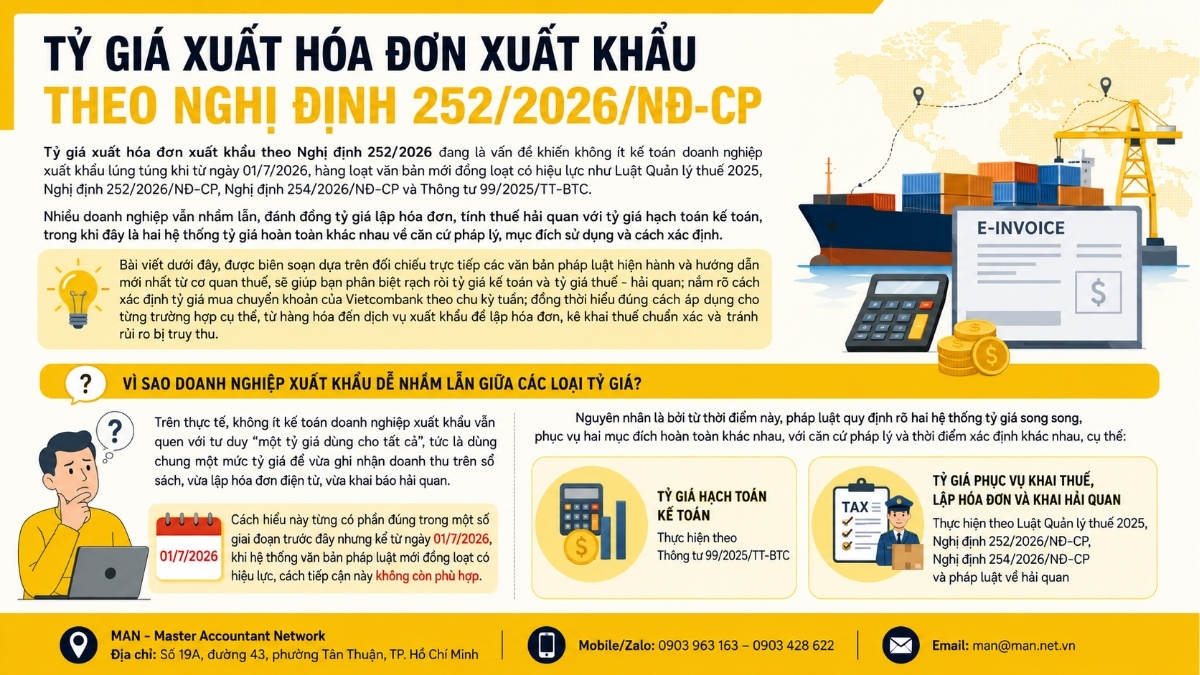
In reality, many accountants in export businesses are still accustomed to the "one exchange rate for all" mindset, meaning using a single exchange rate for recording revenue in the books, creating electronic invoices, and declaring customs. This understanding was partly correct in some previous periods, but since July 1, 2026, when the new legal framework comes into effect, this approach is no longer appropriate.
The reason is that from this point onwards, the law clearly stipulates two parallel exchange rate systems, serving two completely different purposes, with different legal bases and determination times, specifically:
- Accounting exchange rate, implemented in accordance with Circular 99/2025/TT-BTC.
- Exchange rates used for tax declaration, invoicing, and customs clearance., implemented in accordance with the Law on Tax Administration 2025, Decree 252/2026/ND-CP, Decree 254/2026/ND-CP and customs laws.
What is the difference between the exchange rate used for accounting and the exchange rate used for tax and customs purposes?
To make it easier to understand, the differences between these two types of exchange rates can be summarized in the following table:
| Criteria | Accounting exchange rate | Exchange rates for tax declaration, invoicing, and customs purposes. |
| Legal basis | Circular 99/2025/TT-BTC | Law on Tax Administration 2025; Decree 252/2026/ND-CP; Decree 254/2026/ND-CP; customs law |
| Purpose of use | Recording revenue, expenses, and liabilities for accounting purposes. | Electronic invoicing, determining exchange rates for tax calculation, tax declaration, customs declaration. |
| Scope of application | Business accounting | Taxes and customs |
Because of this clear distinction, exporting businesses need to pay special attention to the following: The exchange rate used for accounting purposes is not necessarily the same as the exchange rate used for export invoices or customs declarations. The following section of this article will delve into the legal basis and specific methods for determining the exchange rate for export invoices according to Decree 252.
The legal basis for determining the exchange rate for export invoices is Decree 252/2026.
For exported goods, Clause 6, Article 12 of the 2025 Law on Tax Administration clearly stipulates:
The exchange rate used for calculating taxes on exported and imported goods is determined according to the regulations of customs law.
This regulation is further affirmed in Article 1 of Decree 252/2026/ND-CP, according to which the exchange rate for calculating taxes on exported and imported goods continues to be implemented according to the provisions of customs law. Thus, it can be seen that Decree 252/2026/ND-CP does not establish a completely new mechanism for determining the exchange rate, but directly refers to the current customs legal system.
In parallel, Decree 254/2026/ND-CP stipulates:
When issuing electronic invoices in foreign currency, businesses must show the exchange rate between the foreign currency and the Vietnamese Dong in accordance with the Law on Tax Administration and its implementing regulations.
This is the direct legal basis for determining the exchange rate for export invoices under Decree 252 on electronic invoices.
It is important to emphasize: This exchange rate is used for tax and customs declaration purposes and is shown on invoices; it is completely different from the accounting exchange rate that businesses use to record revenue and expenses in their books.
See more: Issuing invoices according to Decree 254/2026/ND-CP
How to determine the exchange rate for export invoices according to Decree 252 in practice.
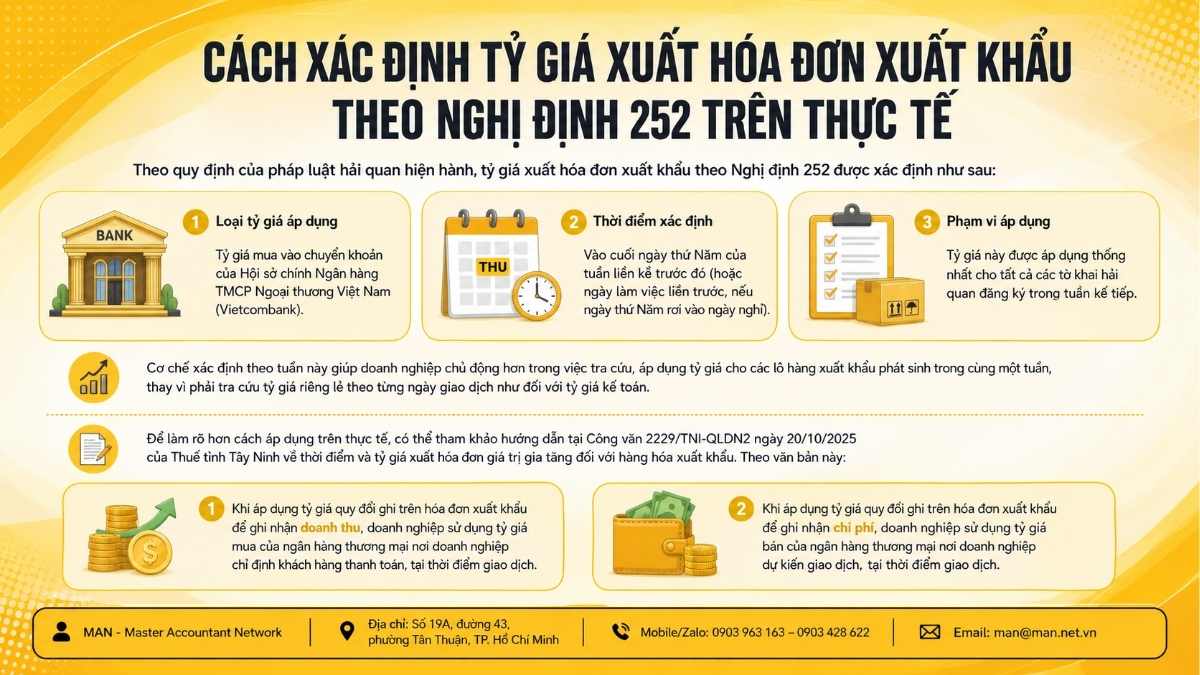
According to current customs regulations, the exchange rate for export invoices under Decree 252 is determined as follows:
- Applicable exchange rate: the buying rate for bank transfers of the Head Office of Vietnam Foreign Trade Commercial Bank (Vietcombank).
- The time of determination: at the end of Thursday of the immediately preceding week (or the preceding working day, if Thursday falls on a holiday).
- Scope of application: This exchange rate will be applied uniformly to all customs declarations registered in the following week.
This weekly exchange rate determination mechanism allows businesses to be more proactive in looking up and applying exchange rates for export shipments arising within the same week, instead of having to look up individual rates for each trading day as with accounting rates.
To further clarify the practical application, please refer to the guidance in Official Letter 2229/TNI-QLDN2 dated October 20, 2025, from the Tay Ninh Provincial Tax Department regarding the timing and exchange rates for issuing value-added tax invoices for exported goods. According to this document:
- When applying the exchange rate stated on the export invoice to record revenue, businesses use the buying rate of the commercial bank where the business designates the customer to make payment, at the time of the transaction.
- When applying the exchange rate stated on the export invoice to record expenses, businesses use the selling rate of the commercial bank where they intend to conduct the transaction, at the time of the transaction.
An example illustrating how to apply the export invoice exchange rate.
To illustrate, suppose an exporting company generates an export shipment and registers its customs declaration on Tuesday of any given week in the month. In this case, the company needs to look up the buying exchange rate for bank transfers published by Vietcombank's head office at the end of Thursday of the preceding week. This is the exchange rate used for export invoices according to Decree 252, applied uniformly to all declarations registered during the week containing that Tuesday, including its appearance on electronic invoices and export tax declarations.
This method helps avoid the situation of checking a different exchange rate each day when declaring customs, while also ensuring consistency between the data on electronic invoices and customs declarations within the same period.
Note regarding export services
An important point for businesses to distinguish is that the regulations in Decree 252/2026/ND-CP regarding references to customs law only apply to exported goods. For exported services, Decree 252/2026/ND-CP currently does not contain any similar provisions for references to customs law.
According to tax authority guidelines, for export services, businesses determine the exchange rate according to tax laws (customs exchange rates, as applied to goods, do not apply). Therefore, before issuing electronic invoices, businesses need to clearly determine whether their transaction is an export of goods or an export of services, and then compare it with the relevant regulations on invoices, taxes, and customs to avoid confusion between the two types of transactions.
Distinguishing between the exchange rate used for export invoices under Decree 252 and the exchange rate used for accounting under Circular 99.
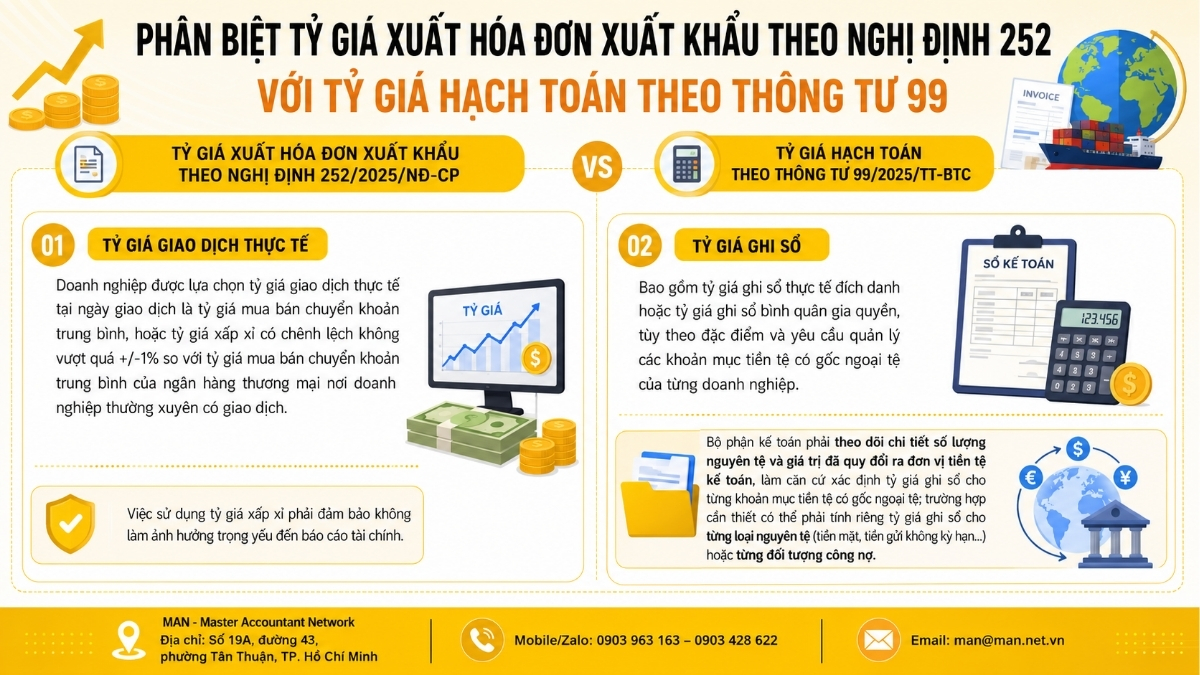
In parallel with the exchange rate used for tax and customs purposes as stipulated in Decree 252, businesses must also determine the accounting exchange rate according to Circular 99/2025/TT-BTC, the official document replacing Circular 200/2014/TT-BTC in guiding the accounting regime for businesses.
According to Circular 99/2025/TT-BTC, the conversion of foreign currency in accounting must be based on the actual transaction exchange rate or the book exchange rate, depending on each economic transaction, specifically including two types:
- First, the actual exchange rate. Businesses may choose the actual exchange rate on the transaction date as the average transfer buying and selling rate, or an approximate rate with a difference not exceeding +/- 1% compared to the average transfer buying and selling rate of the commercial bank where the business regularly conducts transactions. The use of an approximate exchange rate must ensure that it does not materially affect the financial statements.
- Secondly, the book exchange rate.This includes either the actual specific book exchange rate or the weighted average book exchange rate, depending on the characteristics and management requirements of each enterprise's foreign currency-denominated monetary items. The accounting department must meticulously track the quantity of the original currency and its converted value into the accounting currency unit, as a basis for determining the book exchange rate for each foreign currency-denominated monetary item; if necessary, the book exchange rate may need to be calculated separately for each type of original currency (cash, demand deposits, etc.) or each type of liability.
Compared to the old regulations in Circular 200/2014/TT-BTC, which stipulated that the exchange rate for export invoices was determined as the actual transaction rate at the time of the transaction, specifically the buying rate of the commercial bank where the enterprise designated the customer for payment, Circular 99/2025/TT-BTC has expanded the option to include an approximate exchange rate, making accounting more convenient for businesses while still ensuring accuracy.
The differences can be summarized in the following table:
| Content | Accounting exchange rate | Exchange rates for tax declaration, invoicing, and customs purposes. |
| Legal basis | Circular 99/2025/TT-BTC | Law on Tax Administration 2025; Decree 252/2026/ND-CP; Decree 254/2026/ND-CP; customs law |
| Purpose of use | Recording revenue, expenses, liabilities, and accounting entries. | Electronic invoicing, determining exchange rates for tax purposes, tax declaration, and customs declaration. |
| How to determine | The average buying and selling exchange rate for transfers, or the approximate exchange rate of +/- 1% of the commercial bank where the business regularly conducts transactions. | The buying exchange rate for bank transfers at Vietcombank's head office is in accordance with customs regulations. |
| Scope of application | Business accounting | Taxes and customs |
Looking at the comparison table above, it can be seen that the exchange rate for export invoices according to Decree 252 and the exchange rate for accounting purposes according to Circular 99/2025/TT-BTC, although both related to export activities, serve two independent purposes and cannot be substituted for each other. If a business mistakenly uses the accounting exchange rate to prepare invoices or customs declarations (or vice versa), the data on electronic invoices, customs declarations, and accounting records will not match, potentially leading to the risk of being required to explain, adjust, or collect back taxes from tax and customs authorities. Therefore, clearly separating these two types of exchange rates from the initial stage of establishing internal procedures is a prerequisite for export businesses to comply with current legal regulations.
What should businesses keep in mind when applying the export invoice exchange rate according to Decree 252?
To ensure compliance with regulations and minimize tax and accounting risks when applying the export invoice exchange rate according to Decree 252, businesses should note the following points:
- The exchange rate used for accounting purposes is not consistent with the exchange rate used for customs tax purposes. These are two types of exchange rates with completely different purposes and legal bases; using them incorrectly can lead to discrepancies between figures on invoices, customs declarations, and accounting records.
- Follow the exchange rates published weekly by Vietcombank. Since the customs tax exchange rate is determined weekly (based on the closing rate on the preceding Thursday), businesses need to proactively update it to apply the correct rate to customs declarations registered during the corresponding week.
- Review internal processes and accounting software, including electronic invoicing. Businesses should check whether their software system supports separating two parallel exchange rate systems (accounting exchange rate and tax/customs exchange rate) to avoid the software defaulting to using a single exchange rate for all purposes. For businesses lacking personnel with sufficient expertise to continuously update new regulations, alternative solutions may be considered. hire chief accountant services We rely on reputable and experienced organizations like MAN – Master Accountant Network to ensure that exchange rates, invoicing, and tax declarations always comply with current regulations.
- Clearly distinguish between export transactions of goods and services. Before determining the exchange rate for invoicing, it is important to note that the regulations regarding exchange rates for these two types of transactions are currently different.
- Refer to the guidelines of the tax and customs authorities directly in charge. Guidance documents from local tax authorities (such as Official Letter 2229/TNI-QLDN2, Official Letter 349/VLO-QLDN3, Official Letter 1064/CTQNG-TTHT) are for reference only and do not replace legal regulations; businesses should proactively contact the relevant management agency when unclear situations arise.
Reference: Full accounting service
Conclude
From July 1st, 2026, export businesses need to remember that two exchange rate systems exist simultaneously, serving two different purposes:
- Exchange rates for accounting purposes as per Circular 99/2025/TT-BTC
- The export exchange rate under Decree 252, applicable for invoicing, tax declaration, and customs clearance, is based on the transfer buying rate of Vietcombank's head office as stipulated by customs law.
Accurately identifying and clearly distinguishing each type of exchange rate not only helps businesses create electronic invoices, file taxes, and declare customs accurately, but also significantly reduces the risk of tax adjustments and retroactive collection during subsequent inspections and audits.
Contact MAN – Master Accountant Network For timely advice and support!
Contact information MAN – Master Accountant Network
- Address: No. 19A, Street 43, Tan Thuan Ward, Ho Chi Minh City
- Mobile/Zalo: 0903 963 163 – 0903 428 622
- E-mail: man@man.net.vn
- Google Business Profile: View MAN – Master Accountant Network's Google Business Profile
- LinkedIn Founder: View expert Le Hoang Tuyen's LinkedIn profile.
Responsible for production and professional content review by: Mr. Le Hoang Tuyen – Founder & CEO of MAN – Master Accountant NetworkHe is a CPA Vietnam auditor with over 30 years of in-depth experience in accounting, auditing, taxation, and corporate legal consulting.
Frequently Asked Questions about Export Invoice Exchange Rates under Decree 252
From July 1st, 2026, which exchange rate will businesses apply when issuing electronic invoices for exported goods?
Businesses apply the buying rate for bank transfers set by Vietcombank's head office, determined according to customs regulations and updated weekly.
Are export services subject to the same exchange rates as goods, as those mandated by customs law?
No. Decree 252/2026/ND-CP currently does not refer to regulations on exchange rates for export services in customs law; businesses comply with tax laws.
When is the exchange rate used for calculating customs duties updated?
The exchange rate is determined at the end of Thursday of the preceding week (or the preceding working day if Thursday is a holiday) and is applied uniformly to customs declarations registered in the following week.
Does the exchange rate for export invoices under Decree 252 also apply to import goods?
Yes. Unlike the accounting exchange rate (which depends on the commercial bank where the business regularly transacts), the customs tax exchange rate is the buying rate for transfers at Vietcombank's head office, applied uniformly to all customs declarations throughout the week, regardless of whether the business has direct transactions with Vietcombank or not.
What are the consequences of using the wrong exchange rate on export invoices?
Incorrect exchange rate application, for example using the accounting exchange rate to prepare invoices or customs declarations instead of the tax exchange rate stipulated by customs law, can lead to inconsistencies in data on electronic invoices, customs declarations, and accounting records. This can result in the risk of being required to explain, adjust declared taxes, or face back taxes from tax and customs authorities.






