
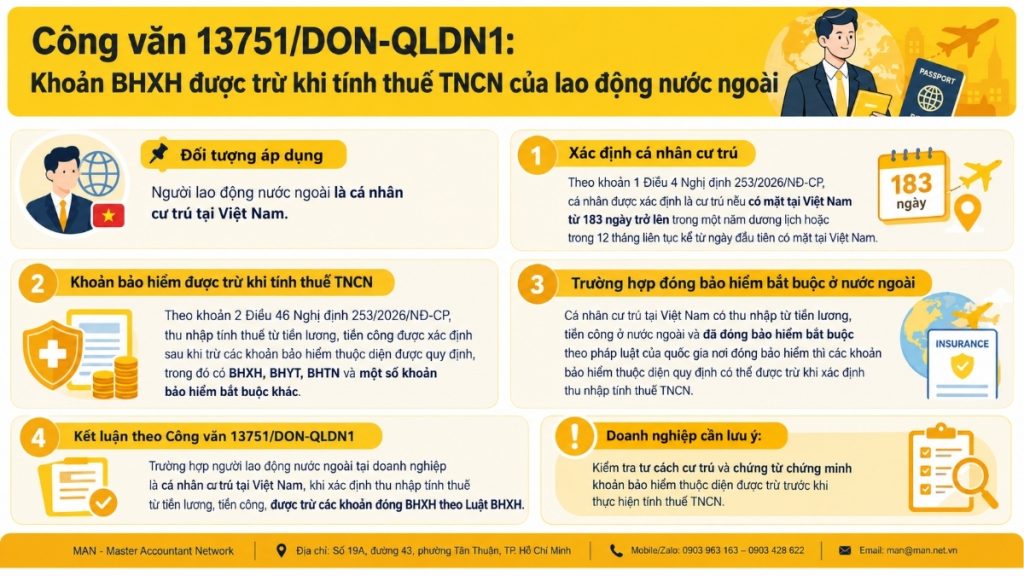
Official Letter 13751/DON-QLDN1 is a response from the tax authority clarifying a common issue faced by many businesses employing foreign workers when settling personal income tax (PIT): whether social insurance contributions for foreign workers can be deducted when determining taxable income from salaries and wages, and under what principle this deduction applies. Decree 253/2026/ND-CP Officially effective from the 2026 tax year. This article summarizes all the legal basis and practical application of the new regulations. Official document 13751/DON-QLDN1This helps payroll accountants process payments correctly from the start, avoiding the disallowance of expenses or the underestimation of employee benefits.
Why is Official Document 13751/DON-QLDN1 receiving special attention from payroll accountants?
From July 1st, 2026, Decree 253/2026/ND-CP on personal income tax officially takes effect and applies to income from salaries and wages of resident individuals starting from the 2026 tax year. This change in the legal framework has caused considerable confusion for many businesses employing foreign workers in determining which social insurance contributions of foreign workers can be deducted before calculating personal income tax, and how to handle cases where workers continue to pay mandatory social insurance abroad while working in Vietnam.
Official document 13751/DON-QLDN1 of 2026 directly answers this question. This is not a new legal document but rather guidance on application, based on existing regulations. Tax Administration Law 2025 Although it is based on Decree 253/2026/ND-CP, it has great practical value because it accurately addresses common situations faced by FDI enterprises, representative offices, and businesses employing foreign experts.
For payroll accountants, a thorough understanding of Circular 13751/DON-QLDN1 offers two specific benefits: accurately calculating taxable personal income from the payment period, avoiding retroactive adjustments during annual tax settlement; and providing a solid basis for explaining to tax authorities when foreign workers' payroll records are reviewed.
The legal basis cited in Official Letter 13751/DON-QLDN1

The entire guidance in Official Letter 13751/DON-QLDN1 is based on three groups of legal grounds: the authority of the tax agency to provide guidance, the conditions for determining individual residency, and regulations on deductible items when calculating taxable personal income.
Article 38 of the 2025 Tax Administration Law: Basis for tax authorities to issue guidelines.
Official document 13751/DON-QLDN1 is primarily based on the duties of the tax administration agency as stipulated in Article 38 of the 2025 Tax Administration Law, which clearly states that the tax authority has the following duties:
Disseminating, publicizing, guiding, and explaining tax laws to taxpayers; publicly disclosing tax administrative procedures, voluntary compliance incentive programs, and preferential treatment at provincial and commune-level public administrative service centers, on the Tax Management Information System, and through mass media.
This is why Official Letter 13751/DON-QLDN1 is valuable as an official channel for clarification from the tax authorities. Although it is not a legal document, businesses should still consider it as a consistent basis for application when handling similar cases.
Personal residency requirements as stipulated in Clause 1, Article 4 of Decree 253/2026/ND-CP.
The first key point of Official Letter 13751/DON-QLDN1 is to determine whether foreign workers fall under the category of "resident individuals," because only resident individuals are eligible for the deduction of social insurance contributions as guided in this official letter. Clause 1, Article 4 of Decree 253/2026/ND-CP stipulates:
Being present in Vietnam for 183 days or more within a calendar year or within 12 consecutive months from the first day of arrival in Vietnam. For individuals entering and exiting the country, the day of arrival is counted as one day, the day of departure is counted as one day, and if entry and exit occur on the same day, it is counted as one day of residence.
The arrival and departure dates are determined based on the certification of the immigration authorities on the passport, travel document, or other documents related to the individual's purpose of entry and exit. For foreign workers who frequently travel between Vietnam and their host country, payroll accountants need to carefully compare their entry and exit schedules to determine their residency status before applying any deductions as per Circular 13751/DON-QLDN1.
Insurance premiums are deductible according to Clause 2, Article 46 of Decree 253/2026/ND-CP.
After determining the individual's residency status, Official Letter 13751/DON-QLDN1 refers to Clause 2, Article 46 of Decree 253/2026/ND-CP to determine taxable income from salaries and wages. Accordingly, taxable income equals the total taxable income stipulated in Article 8 of the Decree minus the following amounts:
Social insurance contributions, health insurance contributions, unemployment insurance contributions, professional liability insurance contributions for certain industries and professions that are required to participate in mandatory insurance, voluntary social insurance contributions according to the Social Insurance Law, voluntary health insurance contributions according to the Health Insurance Law, supplementary retirement insurance contributions according to the Social Insurance Law, voluntary retirement insurance purchases, and life insurance.
Thus, the scope of deductible expenses according to Official Letter 13751/DON-QLDN1 is quite broad, including both mandatory insurance and some types of voluntary insurance, as long as they are of the correct type listed in the above clause. This is the list that payroll accountants need to cross-check line by line when separating deductions on the payroll of foreign workers.
Cases where mandatory insurance is paid abroad.
The most important point clarified by Official Letter 13751/DON-QLDN1 is the specific case of foreign workers: individuals residing in Vietnam but earning income from salaries and wages abroad and having participated in mandatory insurance contributions as prescribed by the country where the insurance is paid. Decree 253/2026/ND-CP clearly stipulates:
In the case of individuals residing in Vietnam who earn income from salaries and wages abroad and have participated in mandatory insurance contributions as prescribed by the country where they pay these contributions, such as social insurance, health insurance, unemployment insurance, and professional liability insurance for certain occupations, these insurance premiums may be deducted from taxable income when determining taxable income from salaries and wages.
This is precisely the point that Circular 13751/DON-QLDN1 definitively resolves for businesses: even if the mandatory insurance contribution is not paid according to Vietnam's Social Insurance Law but according to foreign law, employees are still allowed to deduct this mandatory insurance fee when determining their taxable personal income in Vietnam, provided they can prove its "mandatory" nature according to the regulations of the country where the contribution is made.
Conclusion of the Official Letter and how businesses should apply it.
Based on the above, Official Letter 13751/DON-QLDN1 directly concludes: in the case of foreign employees at the company who are resident individuals as stipulated in Clause 1, Article 4 of Decree 253/2026/ND-CP, when determining taxable income for salaries and wages, taxpayers are allowed to deduct social insurance contributions according to the Social Insurance Law 2024. This serves as a guideline for businesses to apply uniformly to all salary records of foreign employees in 2026.
Procedure for determining deductible social insurance contributions for foreign workers.
To properly implement the spirit of Official Letter 13751/DON-QLDN1, payroll accountants should follow these four steps:
- Determine your residency status: Compare the entry and exit schedule with the 183-day condition in Clause 1, Article 4 of Decree 253/2026/ND-CP.
- Identify the type of insurance you are currently paying: Clearly categorize the contributions as either mandatory social insurance, health insurance, and unemployment insurance under the 2024 Social Insurance Law, or mandatory insurance contributions under foreign laws.
- Gather supporting documents: For insurance policies paid overseas, documentation proving their mandatory nature as required by the regulations of that country and the actual amount paid during the period is required.
- Deduct it directly from taxable income: Applying the formula in Clause 2, Article 46 of Decree 253/2026/ND-CP, deduct the eligible insurance amount from the total taxable income before calculating the personal income tax payable.
For example: Mr. B is a foreign expert working at a foreign direct investment (FDI) enterprise, present in Vietnam for 220 days in 2026, thus qualifying him as a resident. Mr. B continues to pay mandatory social insurance contributions according to the laws of his home country at a rate equivalent to 40 million VND/year, and also receives income from his salary in Vietnam.
According to the guidance in Official Letter 13751/DON-QLDN1, the 40 million VND in mandatory insurance contributions that Mr. B paid abroad can be deducted from taxable income when determining personal income tax in Vietnam, provided that the enterprise retains complete documentation proving the mandatory nature of these contributions as required by the regulations of that country.
Time of application and notes on effective date.
According to Clause 1, Article 69 of Decree 253/2026/ND-CP, this Decree takes effect from July 1, 2026. However, regulations related to income from business activities and salaries/wages of resident individuals will apply immediately from the 2026 tax year. This means that the guidance in the Official Letter will apply throughout the entire 2026 tax year, not just from the date the document takes effect.
Businesses employing foreign workers need to review all personal income tax deduction periods from the beginning of 2026 to ensure that social insurance contributions are deducted in accordance with the spirit of the Official Letter, avoiding situations where taxes were withheld from employees in periods prior to the issuance of this document.
Reference: How to determine the salary used for calculating social insurance contributions for foreign workers.
Common mistakes when applying official documents.
Firstly, the residency requirement is overlooked. Some businesses apply social insurance deductions for foreign workers without clearly verifying whether the individual meets the residency requirements as stipulated in Clause 1, Article 4 of Decree 253/2026/ND-CP.
Secondly, a lack of documentation proving mandatory overseas insurance. This is the most common mistake when applying the Official Letter, where businesses directly deduct the insurance amount without providing documentation proving that the contribution is mandatory under the laws of the host country.
Third, there is confusion between mandatory and voluntary insurance. Not all insurance premiums paid by foreign workers abroad are deductible; only those mandatory as stipulated by the country are subject to deductions.
Fourth, the regulations have not been updated in a timely manner since the beginning of the 2026 tax period. Due to the retroactive application of the regulations from the 2026 tax period, businesses that are slow to update the Official Letter may have to readjust previous deduction periods.
What should businesses do to ensure compliance with regulations?

With the volume of tax laws constantly changing in 2026, from the 2025 Tax Administration Law, the 2025 Personal Income Tax Law, to Decree 253/2026/ND-CP and guiding documents such as Official Letter 13751/DON-QLDN1, continuously updating and accurately applying them to each foreign worker's file requires continuous professional resources.
If a business does not have an accounting department with sufficient expertise in personal income tax for foreign workers, the solution is... full accounting service With expertise from specialized units like MAN – Master Accountant Network, we ensure that all deductions and declarations adhere to the latest guidelines.
For more complex cases, such as foreign workers with income from multiple countries, or businesses needing to review deduction periods before this document is issued, the team will... accounting consulting services MAN's services can assist in cross-referencing specific records, avoiding the risk of being subject to back taxes during tax audits.
For FDI businesses or representative offices with a large number of foreign employees but wanting to optimize the operating costs of their internal accounting department, the following solution is recommended: outsource accounting services This option helps to keep up-to-date with all changes in personal income tax policies without maintaining a large internal team.
Conclude
Official document 13751/DON-QLDN1 addresses a common and practical issue faced by businesses employing foreign workers: mandatory social insurance contributions paid by employees abroad can still be deducted when determining taxable personal income in Vietnam, provided that the employee is a resident individual according to Decree 253/2026/ND-CP and has complete documentation proving the mandatory nature of the contribution.
Three key points to remember when applying this:
- The correct residency status must be determined before any deductions can be considered;
- The list of deductible insurance items adheres closely to Clause 2, Article 46 of Decree 253/2026/ND-CP;
- And the regulation, which will apply throughout the 2026 tax year, requires businesses to review all deduction periods prior to the issuance of the document.
Contact MAN – Master Accountant Network For timely advice and support!
Contact information MAN – Master Accountant Network
- Address: No. 19A, Street 43, Tan Thuan Ward, Ho Chi Minh City
- Mobile/Zalo: 0903 963 163 – 0903 428 622
- E-mail: man@man.net.vn
- Google Business Profile: View MAN – Master Accountant Network's Google Business Profile
- LinkedIn Founder: View expert Le Hoang Tuyen's LinkedIn profile.
Responsible for production and professional content review by: Mr. Le Hoang Tuyen – Founder & CEO of MAN – Master Accountant NetworkHe is a CPA Vietnam auditor with over 30 years of in-depth experience in accounting, auditing, taxation, and corporate legal consulting.
Frequently Asked Questions about Official Document 13751/DON-QLDN1
Which entities are covered by Official Document 13751/DON-QLDN1?
Official document 13751/DON-QLDN1 applies to foreign workers who are individuals residing in Vietnam according to Clause 1, Article 4 of Decree 253/2026/ND-CP, and who have income from salaries and wages and contribute to social insurance.
Are social insurance contributions paid abroad deductible when calculating personal income tax in Vietnam?
Yes, if it is mandatory insurance as required by the country where the individual is registered, including social insurance, health insurance, unemployment insurance, mandatory professional liability insurance, and there is supporting documentation.
Can individuals who do not meet the residency requirements be subject to the deduction as stipulated in the Official Letter?
No. The deduction of social insurance contributions as guided in Official Letter 13751/DON-QLDN1 only applies when the foreign worker is determined to be a resident individual according to Clause 1, Article 4 of Decree 253/2026/ND-CP.
From what date do Official Document 13751/DON-QLDN1 and Decree 253/2026/ND-CP come into effect?
Decree 253/2026/ND-CP takes effect from July 1, 2026, except for the regulations on income from salaries and wages of resident individuals, which apply from the tax year 2026; Official Letter 13751/DON-QLDN1 provides guidance on application in accordance with this scope of effect.
Are life insurance and voluntary retirement insurance policies eligible for tax deductions?
Yes, voluntary retirement insurance contributions and life insurance contributions are also deductible under Clause 2, Article 46 of Decree 253/2026/ND-CP, as referenced in Official Letter 13751/DON-QLDN1.