Recording buyer information correctly on electronic invoices is a mandatory requirement that all accountants and business owners need to be aware of from July 1, 2026, when Decree 254/2026/ND-CP Officially in effect. This article systematizes all regulations in Section 4 of the Appendix to Decree 254/2026/ND-CP, along with practical guidance from tax authorities, helping you clearly distinguish how to record the name, address, and tax code for business customers and how to handle cases where the buyer is an individual consumer, even if the customer does not provide this information. In particular, the article clarifies the legal consequences of incorrect or incomplete buyer information: the invoice may lose its value for accounting purposes and tax settlement. This is fundamental, up-to-date knowledge that helps businesses and individuals create invoices correctly, avoiding risks during tax audits and inspections.
Legal basis for recording buyer information on electronic invoices.
Regulations regarding the recording of buyer information on electronic invoices are now specified in Section 4 of the Appendix issued with Decree 254/2026/ND-CP. This Appendix provides detailed guidance on how to record the name, address, tax code or budget-related unit code, or personal identification number of the buyer on the invoice. This document will be applied uniformly from July 1, 2026, replacing previous guidelines, so accountants need to update immediately to avoid issuing invoices according to the old regulations that are no longer in effect.
Section 4 of the Appendix divides buyer information into two main groups based on the buyer's status: business entities and individual consumers. Each group has different information requirements, and this is the most important aspect for accountants to clearly differentiate when preparing daily invoices.
Besides Decree 254/2026/ND-CP, the Dong Nai City Tax Department has also issued specific guidance on how to record buyer information on electronic invoices with tax authority codes on the Ministry of Finance's electronic portal. According to this guidance, when a company issues an invoice for the sale of goods or provision of services to a consumer, the invoice must show the buyer's name, address, and personal identification number.
If the consumer does not provide this information, the invoice must clearly state "Sold to consumer" in accordance with the provisions of point b, clause 4, Appendix to Decree 254/2026/ND-CP.
See more: Invoices must be issued in accordance with Decree 254/2026/ND-CP.
Two groups of people are involved when recording buyer information on electronic invoices.
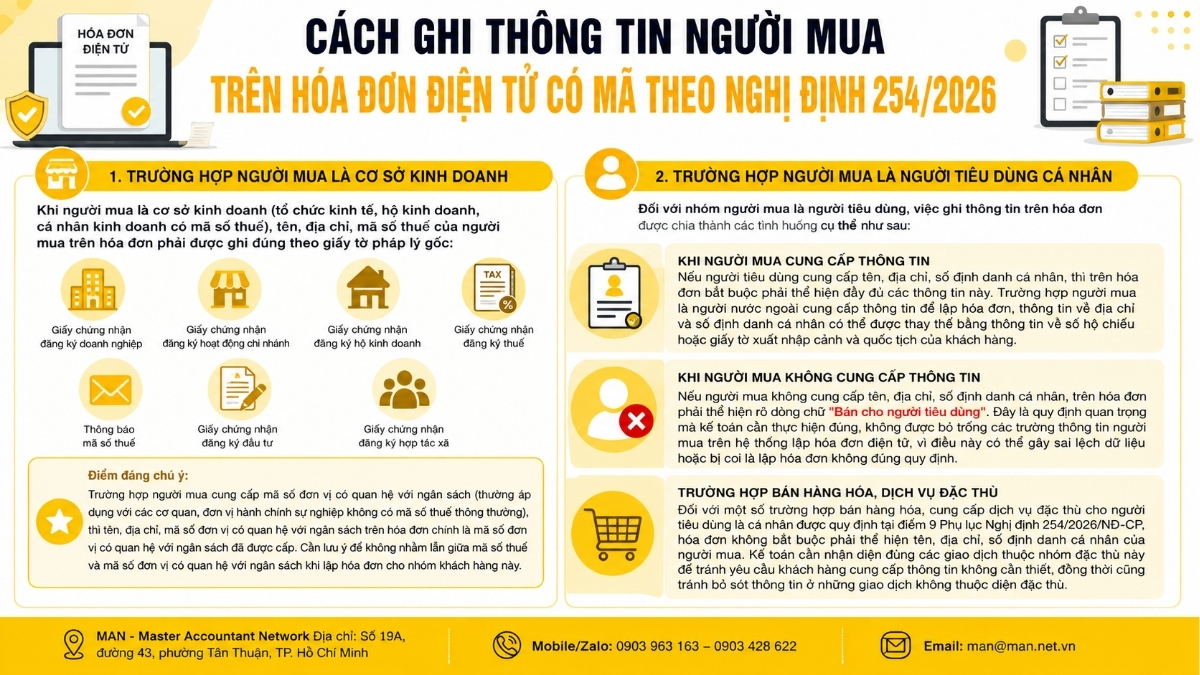
To accurately record buyer information on electronic invoices, accountants need to clearly identify which of the following two groups the buyer belongs to: business establishments or individual consumers. Each group has its own specific information recording guidelines.
In the case where the buyer is a business entity.
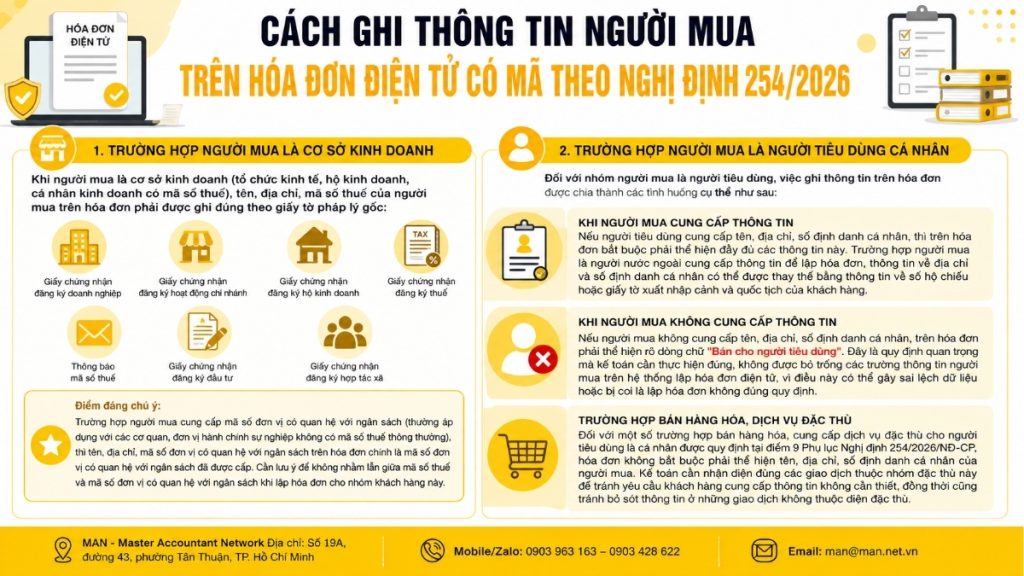
When the buyer is a business entity, including economic organizations, household businesses, and individual businesses with a tax identification number, the name, address, and tax identification number of the buyer shown on the invoice must be recorded exactly as in the original legal documents, specifically:
- Business registration certificate;
- Certificate of registration of branch operations;
- Business registration certificate;
- Tax registration certificate;
- Tax identification number notification;
- Investment registration certificate;
- Certificate of registration of the cooperative.
Key points to note: If the buyer provides a budget-related entity code (usually applicable to administrative and public service agencies and units without a regular tax code), then the name, address, and budget-related entity code shown on the invoice are the same budget-related entity codes that have been assigned. This is an important point for accountants to note to avoid confusion between tax codes and budget-related entity codes when issuing invoices to this group of customers.
Regarding abbreviation rules, if the buyer's name or address is too long, the seller is allowed to abbreviate certain common nouns, for example:
| Full word | Acronym |
| Ward | P |
| City | City |
| Vietnam | Vietnam |
| Share | CP |
| Limited liability | Ltd. |
| Industrial zone | industrial park |
| Manufacture | SX |
| Branch | CN |
However, abbreviations must adhere to the mandatory principle that the invoice must still fully display the house number, street name, ward, commune, special zone, province, and city to accurately identify the business name and address, and must also match the business registration and tax registration information of that business. In other words, abbreviations are only intended to shorten the wording and must not compromise the ability to accurately identify the buyer.
In the case where the buyer is an individual consumer
For the group of buyers who are consumers, recording buyer information on electronic invoices is divided into the following specific situations:
- When the buyer provides the following information: If the consumer provides their name, address, and personal identification number, this information must be fully displayed on the invoice. If the buyer is a foreigner providing information for invoice generation, the address and personal identification number may be replaced with their passport number or entry/exit document and nationality.
- When the buyer does not provide the information: If the buyer does not provide their name, address, or personal identification number, the invoice must clearly state "Sold to Consumer". This is an important regulation that accountants must adhere to; leaving the buyer information fields blank on the electronic invoicing system can lead to data discrepancies or be considered as issuing invoices that do not comply with regulations.
- Cases involving the sale of specific goods or services: For certain specific cases of selling goods or providing services to individual consumers as stipulated in Point 9 of the Appendix to Decree 254/2026/ND-CP, invoices are not required to show the name, address, and personal identification number of the buyer. Accountants need to correctly identify transactions belonging to this specific group to avoid requesting unnecessary information from customers, while also avoiding omitting information in transactions that do not fall under this specific category.
Legal consequences for incorrect or incomplete buyer information on electronic invoices.
The invoice is not valid for expense accounting or tax settlement.
This is a consequence that accountants need to pay special attention to: invoices without buyer information, or invoices issued to consumers (i.e., only stating "Sold to consumers" without a specific name, address, tax code, or personal identification number), are invalid for economic organizations, agencies, other organizations, business households, and individual businesses to use for accounting purposes or tax settlement according to tax laws.
In other words, if the buyer is a business or household business that needs an invoice to include as a legitimate expense when calculating corporate income tax, or to claim value-added tax deductions, then that invoice must contain complete buyer information as required by regulations, and cannot simply state "Sold to consumer".
Risks for the purchasing business.
The responsibility for accurately recording buyer information on electronic invoices rests not only with the seller but also directly impacts the buyer's rights. If a business purchases goods or services but fails to proactively provide the seller's name, address, and tax identification number when issuing the invoice, the received invoice will be invalid for accounting purposes or tax settlement later. This is why corporate accountants need to proactively remind and coordinate with the purchasing department to ensure that buyer information is always provided fully and accurately at the time of the transaction.
For businesses that do not have a dedicated accounting department to closely monitor this process, use full accounting service From reputable and professional units like MAN – Master Accountant Network, this solution helps to systematically review and compare input invoice information, minimizing the risk of expenses being disallowed during tax settlement.
Important notes when recording buyer information on electronic invoices.

Compare the information with the original legal documents.
A key principle when recording buyer information on electronic invoices is that all information (name, address, tax identification number) must exactly match the buyer's original legal documents such as business registration certificates, household business registration certificates, investment registration certificates, cooperative registration certificates, or tax identification number notifications. Even a small discrepancy (such as an incorrect branch address or incorrect abbreviation of the business type) can render the invoice invalid during tax audits and verifications.
Apply abbreviation rules correctly.
Abbreviations of common nouns should only be used when the buyer's name or address is excessively long, and the invoice must always fully display the house number, street name, ward, commune, special zone, province, and city.
Handling situations where individual customers do not provide information.
In retail transactions, especially at stores, supermarkets, and restaurants, it's common for individual customers to fail to provide their name, address, or personal identification number. In such cases, accountants need to ensure that the automated or manual electronic invoicing system correctly fills in the phrase "Sold to Consumer" in the buyer information field, instead of leaving it completely blank.
Identify the specific trading group correctly.
Not all sales transactions to individuals are required to include the full name, address, and personal identification number. For specific cases of selling goods or providing services as listed in point 9 of the Appendix to Decree 254/2026/ND-CP, this requirement is waived.
| Target buyers | Information that needs to be included on the invoice. | Legal basis |
| Businesses with tax identification numbers. | Name, address, and tax identification number as per original registration documents. | Point a, Clause 4, Appendix to Decree 254/2026 |
| Unit with budget relationship code | Name, address, and budget relationship unit code | Point a, Clause 4, Appendix to Decree 254/2026 |
| Consumers provide information. | Name, address, personal identification number (or passport/nationality number if foreign national) | Point b, Clause 4, Appendix to Decree 254/2026 |
| Consumers did not provide information. | Clearly state "For sale to consumers" | Point b, Clause 4, Appendix to Decree 254/2026 |
| Transactions specific to individuals | It is not mandatory to include name, address, or personal identification number. | Point 9 of the Appendix to Decree 254/2026 |
Regardless of the buyer's group, the overarching principle is that the information on the invoice must accurately reflect the nature of the transaction and the buyer's legal documentation at the time the invoice is issued.
Conclude
Recording buyer information on electronic invoices may seem like a simple task, but it directly affects the legal validity of the invoice in accounting for expenses and tax settlement. Understanding the regulations in Decree 254/2026/ND-CP and specific guidelines from the tax authorities will help accountants, business owners, and individual business owners be more proactive in invoice preparation, minimizing the risk of expense disallowance or penalties for violations during tax audits.
If your business is in the process of transitioning or updating its electronic invoicing process to comply with new regulations, but you have limited accounting staff, the solution is... hire an external accountant This will help businesses stay up-to-date with regulations such as Decree 254/2026/ND-CP without needing to invest in internal personnel.
Contact MAN – Master Accountant Network For expert advice and support.
Contact information MAN – Master Accountant Network
- Address: No. 19A, Street 43, Tan Thuan Ward, Ho Chi Minh City
- Mobile/Zalo: 0903 963 163 – 0903 428 622
- E-mail: man@man.net.vn
- Google Business Profile: View MAN – Master Accountant Network's Google Business Profile
- LinkedIn Founder: View expert Le Hoang Tuyen's LinkedIn profile.
Responsible for production and professional content review by: Mr. Le Hoang Tuyen – Founder & CEO of MAN – Master Accountant NetworkHe is a CPA Vietnam auditor with over 30 years of in-depth experience in accounting, auditing, taxation, and corporate legal consulting.
Frequently Asked Questions about including buyer information on electronic invoices
Can invoices without buyer information be used to record expenses?
No. According to regulations, invoices without buyer information, or invoices that only state "Sold to Consumer," are not valid for use by economic organizations, agencies, other organizations, business households, or individual businesses for accounting purposes or tax settlement. Therefore, if the buyer needs an invoice to include as a legitimate expense, they must proactively provide the full name, address, tax code, or personal identification number when making the purchase.
How should invoices be issued to individual retail customers who do not provide their personal identification number?
In cases where the buyer is a consumer but does not provide their name, address, or personal identification number, the accountant must clearly state "Sold to consumer" on the invoice, in accordance with the provisions of point b, clause 4, Appendix to Decree 254/2026/ND-CP, and the buyer's information field must not be left blank.
How does a budget-related unit code differ from a regular tax code?
These are two different types of codes. For businesses with a tax identification number, the invoice will show the name, address, and tax identification number as stated in the tax registration/business registration certificate. However, when the buyer provides a budget-related entity code, the information shown on the invoice will be the assigned budget-related entity code, not the tax identification number.
How should the information be recorded on the invoice if the buyer is a foreigner?
If the buyer is a foreigner providing information for invoicing, the address and personal identification number may be replaced with the customer's passport number or entry/exit document of the same nationality, instead of the usual address and personal identification number.
In which cases is it not necessary to include the buyer's name, address, and personal identification number?
For certain transactions involving the sale of goods or provision of services specifically to individual consumers, as stipulated in point 9 of the Appendix to Decree 254/2026/ND-CP, invoices are not required to show the name, address, and personal identification number of the buyer.