Signing invoices later than the invoice creation date is not an uncommon situation in the practice of issuing electronic invoices, and from July 1, 2026, this issue has been clearly regulated. Decree 254/2026/ND-CPAccordingly, businesses are allowed to digitally sign invoices later than the invoice date, but must complete the digital signing and submit the code (or transfer the data to the tax authority) to the tax authority no later than the next working day. Notably, sellers still declare taxes based on the invoice date, while buyers declare taxes based on the date they receive the valid invoice. This is a crucial difference that accountants need to understand to avoid errors in tax declaration and settlement. This article provides a detailed analysis of the legal basis, specific timelines, and practical considerations to help businesses correctly apply the regulations from the moment the Decree takes effect.
Regulations on the timing of digital signatures on electronic invoices according to Decree 254/2026/ND-CP
How is the date of digital signature on an electronic invoice determined?
According to Section 7 of the Appendix issued with Decree 254/2026/ND-CP, the time of digital signing on an electronic invoice is determined as the time when the seller and buyer use digital signatures to sign the electronic invoice, and this time is displayed in the format of day, month, year of the Gregorian calendar.
This regulation is quite easy to understand: the time of digital signature is not an abstract concept, but is linked to the actual action of someone (the seller or the buyer, depending on the type of invoice) using their digital signature to confirm the electronic invoice. This time is then recorded by the system and displayed in the standard date format.
The problem arises because the time of invoice creation and the time of digital signing do not always coincide. In fact, there are many objective reasons why digital signing may occur after the invoice creation.
For example: Invoices are generated at the end of the workday, digital signatures require multi-step verification, or the system experiences temporary errors.
Is it acceptable to digitally sign an invoice later than the invoice creation date?
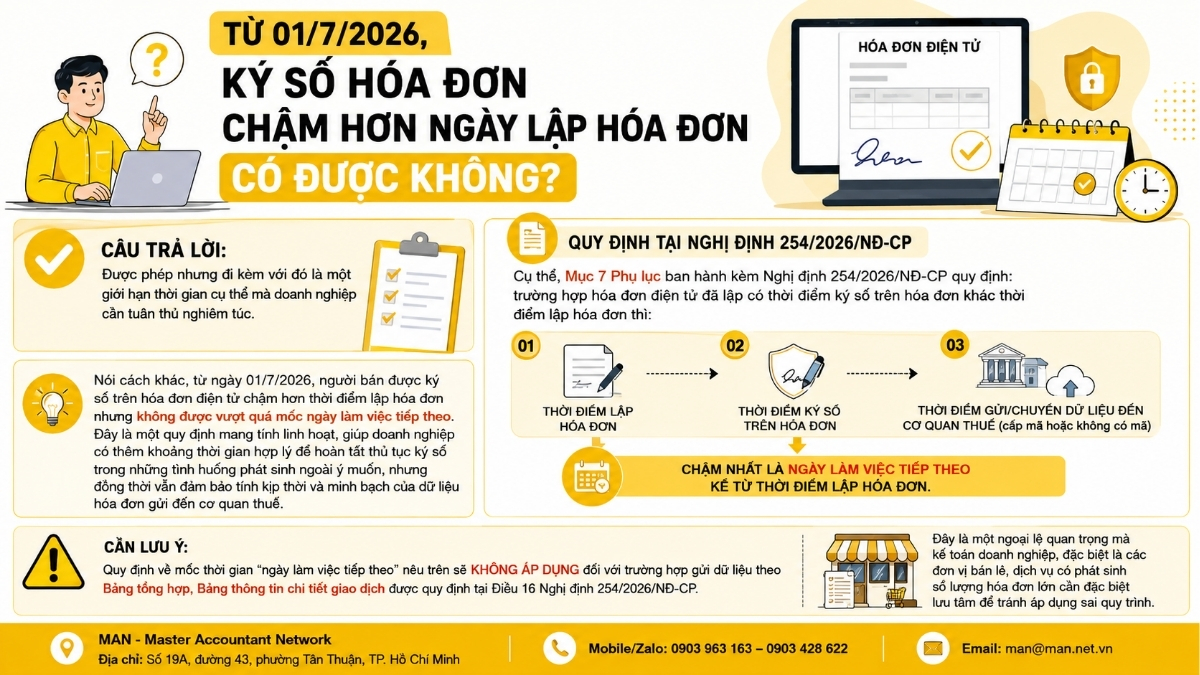
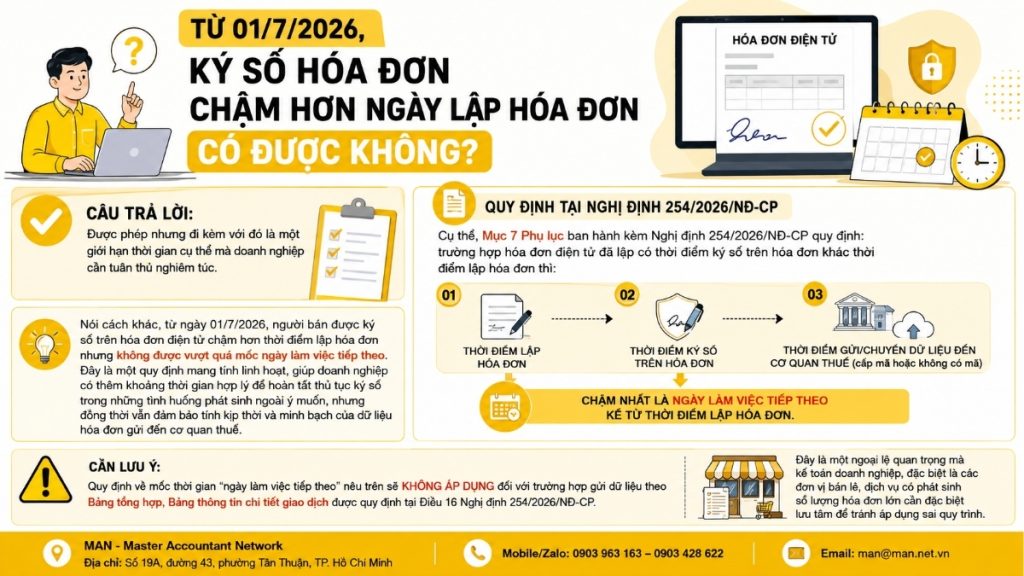
The answer is allowedHowever, this comes with a specific time limit that businesses must strictly adhere to.
Specifically, Section 7 of the Appendix issued with Decree 254/2026/ND-CP stipulates that: in cases where an issued electronic invoice has a digital signature date different from the invoice issuance date, the digital signature date and the date of sending the invoice to the tax authority for code issuance (for invoices with a tax authority code) or the date of transferring electronic invoice data to the tax authority (for electronic invoices without a tax authority code) must be no later than... next working day from the time the invoice is issued.
In other words, from July 1st, 2026, sellers are allowed to digitally sign electronic invoices later than the invoice creation date, but not exceeding the next working day. This is a flexible regulation that gives businesses a reasonable amount of time to complete the digital signing procedure in unforeseen circumstances, while still ensuring the timeliness and transparency of invoice data sent to the tax authorities.
Please note: The aforementioned regulation regarding the "next working day" timeframe will not apply to data submissions in the form of Summary Tables and Transaction Details Tables as stipulated in Article 16 of Decree 254/2026/ND-CP. This is an important exception that business accountants, especially those in retail and service businesses with a large number of invoices, need to pay particular attention to in order to avoid misapplying the procedure.
In which cases does the next working day benchmark apply?
To make it easier to understand, the regulations regarding digitally signing invoices later than the invoice creation date can be summarized in the following table:
| Invoice type | Tasks to be completed | Latest deadline |
| Electronic invoices have a tax authority code. | Digitally sign the invoice and send it to the tax authority to obtain a code. | The next business day after the invoice date. |
| Electronic invoices without codes | Digitally sign invoices and transfer invoice data to the tax authorities. | The next business day after the invoice date. |
| The invoice submits data via the Summary Table and Transaction Details Table. | According to the separate aggregated data submission procedure. | The next business day deadline does not apply. |
Therefore, whether the invoice has a tax authority code or not, the general principle remains: if the time of digital signing differs from the time of invoice creation, businesses have up to the end of the next working day to complete the digital signing and send/transfer the data to the tax authority.
When filing taxes, if the digitally signed invoice is later than the invoice issuance date, which date should be used for calculation?

One of the biggest concerns for accountants when dealing with situations where invoices are digitally signed later than the invoice date is: which date should be used for tax declaration – the invoice date or the digital signing date?
This is a crucial point that needs clarification, because if the declaration deadline is incorrectly determined, businesses may face the risk of discrepancies between the declared figures and the invoice data in the tax authority's system.
For sellers
According to the provisions of Section 7 of the Appendix issued with Decree 254/2026/ND-CP, the seller declares tax according time of invoicingThis is based on the date the invoice is issued, not the date of digital signing. This means that even if the digital signing is delayed, within the permissible timeframe of the next business day, the seller's tax declaration obligation is still calculated from the date the invoice is created, and is not shifted according to the actual date of digital signing.
This is a crucial point for businesses to remember, as many accountants mistakenly believe that the date of digital signature determines the tax period for value-added tax or corporate income tax related to that invoice. Understanding the regulations correctly helps businesses avoid errors when preparing tax returns, especially in cases where invoices are issued at the end of the month or tax period, but the digital signature falls in the following month or tax period.
For buyers
Unlike the seller, the tax filing time for the buyer is determined as the time received the invoice Ensure that the form and content are correct and complete as prescribed in Article 10 of Decree 254/2026/ND-CP.
This difference stems from the fact that buyers can only use invoices as a basis for tax declaration and deduction when they have actually received a valid invoice in hand (or on the electronic system). Therefore, even if the invoice was issued previously, if the buyer only receives a valid invoice at a later time (for example, due to the invoice being digitally signed later than the invoice date, resulting in a delay in sending the invoice), the buyer's tax declaration period will be calculated based on the time of receiving that valid invoice.
This is a point that the buyer's accounting department needs to pay special attention to when reconciling and accounting for expenses and declaring input tax, to avoid incorrect recording periods that lead to discrepancies in figures during tax settlement.
The principles for creating, managing, and using electronic invoices involve digital signatures.
According to Article 4 of Decree 254/2026/ND-CP:
When selling goods or providing services, sellers must issue electronic invoices to buyers, including cases where goods or services are used for promotions, advertising, or as samples; goods or services used for gifts, donations, exchanges, as payment in lieu of wages for employees, or for internal consumption; and goods exported in the form of loans or borrowings.
Electronic invoices must be prepared in the correct standard data format, fully recording the content as prescribed by tax law, accounting law, and Article 10 of Decree 254/2026/ND-CP, ensuring that they fully and truthfully reflect the content of the economic transaction. In particular, the Decree clearly states:
The seller is legally responsible for the accuracy of the issued invoice, including adhering to the deadline for digitally signing the invoice, which must be later than the invoice issuance date as stated in the section above (next working day).
Furthermore, before using electronic invoices, economic organizations, other organizations, business households, and individual businesses must register to use electronic invoices in accordance with the regulations of the Minister of Finance. The registration, management, and use of electronic invoices must comply with the provisions of the law on electronic transactions, accounting, taxation, and tax administration.
Why do businesses need to adhere to digital signature deadlines?
Understanding and complying with regulations regarding digitally signing invoices later than the invoice issuance date is not only a technical issue but also directly related to the validity of the invoice and the legal security of the business.
If the digital signing process exceeds the next working day from the time the invoice is issued, the invoice may be considered non-compliant with the procedures stipulated in Decree 254/2026/ND-CP. This poses a risk when the tax authorities compare the invoice data with the tax declaration data, potentially leading to the business having to provide explanations, make adjustments, or even affecting the buyer's tax deduction rights if the invoice does not meet the requirements in terms of form and content as stipulated in Article 10.
Conversely, when businesses adhere to the deadline for digitally signing invoices later than the invoice issuance date as stipulated, it brings many practical benefits:
- Ensuring that electronic invoices have full legal validity facilitates tax declarations for both sellers and buyers.
- Minimize the risk of being required by tax authorities to explain or verify data due to discrepancies between the time the invoice was created and the time it was digitally signed.
- Contributing to the development of a transparent and accurate electronic invoice and document data system, which serves as a database for tax management as stipulated in Article 4 of Decree 254/2026/ND-CP.
For businesses with a high volume of invoice issuance processes, it is advisable to consult a reference. internal accounting services Strict control over the timing of digital signatures relative to the time of invoice creation is essential to ensure that no invoices are digitally signed later than the next working day without a valid reason or without an exception as stipulated in Article 16 of Decree 254/2026/ND-CP.
What steps should businesses take to ensure compliance with regulations?
In summary, to fully answer the question "Is it permissible to digitally sign invoices later than the invoice creation date?", there are three core points that accountants and businesses need to remember:
- Digital signatures may be signed later than the invoice date.However, the time of digital signing and the time of sending the code to the tax authority (or transferring data to the tax authority) must be no later than the next working day from the time the invoice is issued, except in the case of sending data according to the Summary Table and Transaction Details Table as per Article 16 of Decree 254/2026/ND-CP.
- Sellers declare taxes based on the date the invoice is issued., while Buyers declare taxes based on the date they receive the invoice. Ensure that the form and content comply with Article 10 of Decree 254/2026/ND-CP.
- The seller is legally responsible. Regarding the accuracy of issued invoices, this includes compliance with the new regulations regarding the deadline for digitally signing invoices later than the invoice issuance date.
This is the time for units to consider using it. full accounting service From specialized and experienced units like MAN – Master Accountant Network, you can receive support in controlling the entire process of creating, digitally signing, and declaring electronic invoices in accordance with regulations, avoiding the risk of exceeding the allowed deadline for digital signing.
Conclude
From July 1st, 2026, the date Decree 254/2026/ND-CP officially comes into effect, businesses should review their internal procedures for issuing electronic invoices and regularly update relevant guidance documents from the Ministry of Finance and the directly managing tax authorities to ensure accurate invoice issuance, digital signature, and tax declaration processes in compliance with the law.
For small or newly established businesses that do not have a dedicated accounting department to continuously update on new regulations such as Decree 254/2026/ND-CP, the solution is... hire an external accountant This is also a suitable option, helping to ensure that the digital signing of invoices later than the invoice creation date always remains within the stipulated time limit, while optimizing operating costs for businesses.
If your business needs advice, support, answers to questions, or updates on new policies effective from July 1, 2026, please don't hesitate to contact us. Contact the MAN – Master Accountant Network team. To receive prompt assistance!
Contact information MAN – Master Accountant Network
- Address: No. 19A, Street 43, Tan Thuan Ward, Ho Chi Minh City
- Mobile/Zalo: 0903 963 163 – 0903 428 622
- E-mail: man@man.net.vn
- Google Business Profile: View MAN – Master Accountant Network's Google Business Profile
- LinkedIn Founder: View expert Le Hoang Tuyen's LinkedIn profile.
Responsible for production and professional content review by: Mr. Le Hoang Tuyen – Founder & CEO of MAN – Master Accountant NetworkHe is a CPA Vietnam auditor with over 30 years of in-depth experience in accounting, auditing, taxation, and corporate legal consulting.
Frequently Asked Questions Regarding Digitally Signing Invoices Later Than the Invoice Date
Is signing an invoice digitally later than the invoice creation date considered a violation?
No, if the digital signing is done within the permitted limits. According to Section 7 of the Appendix issued with Decree 254/2026/ND-CP, sellers are allowed to digitally sign electronic invoices later than the time of invoice creation, provided that the digital signing and submission to the tax authority for code issuance are completed no later than the next working day. Only when exceeding this timeframe does the invoice pose a risk of not complying with the correct procedure.
If the invoice is created on Friday, what is the latest deadline for digital signature?
Decree 254/2026/ND-CP stipulates that the deadline is the next working day from the time the invoice is issued, not the immediately following calendar day. Therefore, businesses need to base their calculations on the actual working days of their unit to accurately determine the digital signature deadline for each specific case.
Does signing an invoice later than the invoice date change the seller's tax filing period?
No. Sellers still declare taxes based on the invoice date, not the date of digital signature. This is an important principle that helps businesses avoid confusion when determining the tax reporting period, especially with invoices issued at the end of the period but digitally signed in the following period.
In which cases is the next working day not applicable when digitally signing invoices?
This timeframe does not apply to cases where invoice data is submitted via the Summary Table or Transaction Details Table as stipulated in Article 16 of Decree 254/2026/ND-CP.