
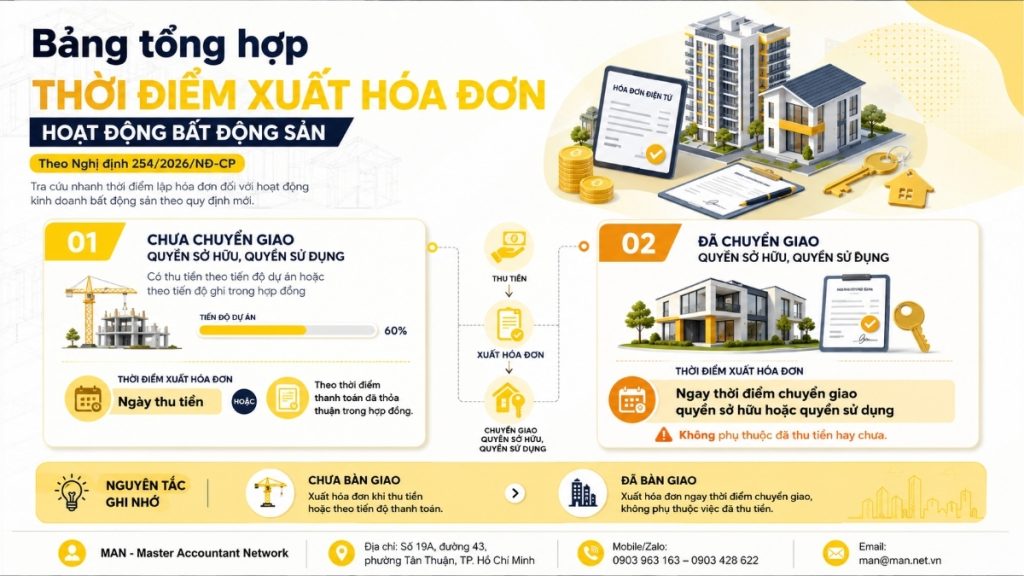
The timing of real estate transaction invoices is a problem that has caused considerable confusion for many accountants in real estate businesses: customers have made the second payment according to the contract schedule, but it's unclear whether invoices should be issued immediately or wait until the property is handed over. Even a small mistake in determining this timing can lead to administrative penalties for invoice violations, and may directly affect the declaration of value-added tax and corporate income tax for the period.
From July 1st, 2026, regulations regarding the timing of invoice issuance for real estate transactions have been clarified. Decree 254/2026/ND-CPThis replaces previous regulations that caused confusion for many businesses during implementation. So, what specific principles does this new regulation outline, what cases does it apply to, and what should accountants be aware of to avoid legal risks? This article will provide a detailed analysis, closely following current legal documents, to give readers the most complete and accurate understanding.
Legal basis stipulating the timing of invoice issuance for real estate activities.

The regulations regarding the timing of invoice issuance for real estate activities are currently clearly stated in point d, clause 4, Article 9 of Decree 254/2026/ND-CP – a document effective from July 1, 2026. This is a specific regulation, reserved for organizations engaged in real estate business, infrastructure construction, and building houses for sale or transfer, differing from the general principle on the timing of invoice issuance applicable to ordinary goods and services as stipulated in clause 1 of the same Article 9.
The reason the law designs specific regulations for the real estate sector stems from the industry's unique characteristics: high transaction values, long contract execution times, payment methods involving multiple installments, and a clear separation between the time of payment collection and the time of transfer of ownership or right to use the property to the customer. If general principles were applied to the same goods and services, real estate businesses would find it difficult to accurately determine the exact time when the obligation to issue invoices arises.
See more: Invoices must be issued in accordance with Decree 254/2026/ND-CP.
Why do real estate businesses need to understand this regulation?
In practice, real estate projects are often sold through advance payments based on construction progress or a payment schedule agreed upon in the sales contract. This means that a single contract may involve multiple payments, each associated with a different invoice date, depending on whether ownership or usage rights have been transferred.
If accountants are not familiar with regulations regarding the timing of real estate transaction invoices, businesses can easily issue invoices late compared to the time the obligation arises, or conversely, issue invoices that do not reflect the nature of the transaction. Both situations carry the risk of administrative penalties and affect the correct determination of the output value-added tax declaration period and the recognition of revenue for corporate income tax purposes.
This is also why businesses operating in the real estate industry should take note. full accounting service With the expertise of specialized units like MAN – Master Accountant Network, we ensure that the invoicing and tax declaration process is tightly controlled and compliant with regulations right from the start.
The timing of issuing invoices for real estate transactions varies depending on the specific case.

According to point d, clause 4, Article 9 of Decree 254/2026/ND-CP, the time of issuing invoices for real estate transactions is determined in two main cases, depending on whether the ownership or usage rights of the real estate have been transferred to the buyer or not.
In cases where ownership or usage rights have not yet been transferred, but payments are collected according to progress.
In cases where a business has not yet transferred ownership or usage rights of real estate to the customer but has collected payments according to the project progress or the payment schedule stipulated in the contract, the time of issuing the real estate transaction invoice in this case is the date of payment collection or the payment agreement specified in the contract.
For example: In a condominium project sold according to construction progress, the contract stipulates that customers pay in 5 installments corresponding to the completion of the foundation, the rough construction, finishing, handover, and issuance of the ownership certificate. For each payment made according to this schedule, the real estate business is responsible for issuing an invoice for the amount collected, regardless of whether the apartment has been actually handed over.
This is a point that accountants need to pay special attention to: The obligation to issue invoices arises at the time of payment collection or according to the payment schedule in the contract, not after the completion of asset transfer. Therefore, the accounting department needs to coordinate closely with the sales and collection departments to promptly update revenue and avoid delays in issuing invoices.
In cases where ownership or usage rights of real estate have been transferred.
When a business has transferred ownership or the right to use the real estate to the buyer, the time of issuing the real estate transaction invoice no longer follows the principle of collecting payments according to progress, but is governed by the provisions of Clause 1, Article 9 of Decree 254/2026/ND-CP, which is the time of transferring ownership or the right to use the property to the buyer.
The key point to emphasize: The timing of invoicing in this case regardless of whether the business has received the money or not.In other words, even if the customer has not yet paid the full contract value, if the business has completed the handover of the house, the transfer of land use rights, or has carried out the procedures for transferring ownership as prescribed by law, then the obligation to issue an invoice has arisen at that time.
This is the biggest difference compared to the first case, and also the most confusing aspect in practice. Many businesses tend to only issue invoices after receiving full payment, leading to delays compared to the actual asset transfer time. This is a risk that needs to be tightly controlled in the company's internal processes.
Summary table of invoice issuance times for real estate activities

For ease of reference and application, accountants can refer to the summary table below regarding the timing of invoice issuance for real estate activities according to Decree 254/2026/ND-CP:
| Situation | Invoice issuance time |
| Ownership and usage rights have not yet been transferred; payments are collected according to the project progress or the schedule specified in the contract. | Payment date or as agreed in the contract. |
| Ownership and usage rights of the real estate have been transferred. | The time of transfer of ownership or usage rights, regardless of whether payment has been received or not. |
This summary table helps businesses and accountants easily and quickly cross-reference data during daily transaction processing, especially for projects with multiple payment installments interspersed with different handover dates.
Corporate income tax obligations for real estate activities.
Besides correctly identifying the timing of real estate transaction invoices, accountants also need to understand the relationship between the timing of invoice issuance and corporate income tax obligations, because the timing of revenue recognition for tax purposes is usually linked to the timing of invoice creation.
According to Clause 2, Article 3 of the Corporate Income Tax Law 2025:
Income from the transfer of real estate by real estate businesses is not classified as "other income" as it is for businesses not specializing in real estate, but is considered income from the business's main production and business activities.
At the same time, based on Article 15 of Decree 320/2025/ND-CP:
Income from real estate transfer activities includes many items, most notably income from leasing and subleasing land use rights by real estate businesses.
The regulations state that this income subject to corporate income taxRegardless of whether the land has infrastructure or attached structures, it should be noted that if a business only leases houses, infrastructure, or structures on the land without having the right to sublease or sublease the land use rights as stipulated in land law, then that income is not subject to the provisions of this regulation.
Determining the correct timing for issuing invoices for real estate transactions is therefore crucial not only for compliance with invoicing regulations, but also directly impacts the correct determination of the tax period and the correct taxable revenue for corporate income tax purposes at each stage of the business's operations.
Expenses that are deductible when transferring real estate.
In parallel with determining revenue, businesses also need to understand the deductible expenses when calculating taxable income from real estate transfer activities. Clause 2, Article 17 of Decree 320/2025/ND-CPThe deductible expenses include:
- The cost basis of transferred land is determined according to the origin of the land use rights (land allocated by the State with payment, land acquired through transfer from other organizations or individuals, inherited/gifted/donated land, land contributed as capital, land won through auction, etc.);
- Compensation, support, and resettlement costs are voluntarily advanced by the enterprise according to a plan approved by the competent authority;
- Fees and charges related to granting land use rights as prescribed by law;
- Costs of land reclamation and leveling;
- Investment costs for constructing infrastructure such as roads, electricity, water supply and drainage, and postal and telecommunications services;
- The value of existing infrastructure and architectural structures on the land;
- Other expenses directly related to the property being transferred.
It is worth noting: For businesses engaged in both real estate transactions and other tax-incentivized business activities, the law requires separate accounting for the costs of each activity. If separate accounting is not possible, the general expenses will be allocated proportionally to the revenue from real estate transfers relative to the business's total revenue. Furthermore, expenses already paid by the State or from other sources of funding will not be included in the real estate transfer costs.
Risks of incorrectly determining the timing of real estate transaction invoices.
Incorrectly determining the timing of real estate transaction invoices is not only a technical operational error, but also leads to a series of legal and financial consequences for businesses:
- Risks of being penalized for administrative violations related to invoices: Issuing invoices late compared to the prescribed time, or issuing invoices at a time when the obligation does not arise, can both be considered violations of regulations on invoices and supporting documents.
- Impact on value-added tax declaration: The time of invoice issuance is closely linked to the time of recording output VAT. Incorrectly determining the time can lead to incorrect tax period declarations and discrepancies when reconciling with the tax authorities.
- Impact on the recognition of revenue for corporate income tax purposes: Revenue from real estate activities is a crucial basis for calculating corporate income tax. If the invoice issuance date is incorrect, the taxable revenue for the period will also be recorded inaccurately.
- Risks associated with tax settlement, tax audits, and tax inspections: The tax authorities may require adjustments to the revenue recognition date, leading to tax arrears and late payment penalties, if discrepancies are found between the actual invoice date and the legally mandated date.
To mitigate these risks, real estate businesses should establish rigorous internal control processes, including regular coordination between the accounting, sales, and legal departments to promptly update the progress of contract payments as well as the progress of handover and transfer of ownership and usage rights of real estate to customers. Regularly reviewing sales contracts and comparing payment schedules with actual payments is also a useful measure to help businesses proactively comply with regulations regarding the timing of real estate transaction invoices.
For projects with complex revenue collection structures, the use of tax accounting services This will help businesses significantly reduce the risk of incorrectly declaring the tax period and being subject to back taxes during final settlement.
Conclude
From July 1st, 2026, the regulations regarding the timing of issuing invoices for real estate activities under Decree 254/2026/ND-CP will be determined based on two main milestones:
- Payment is due on the agreed date in the contract, applicable when the business has not yet transferred ownership or usage rights;
- And the transfer of ownership and usage rights of real estate applies when the business has completed the handover of the property to the customer, regardless of whether full payment has been received or not.
Mastering this regulation, combined with a thorough understanding of corporate income tax obligations and deductible expenses under the Corporate Income Tax Law 2025 and Decree 320/2025/ND-CP, will help real estate businesses be more proactive in accounting and tax matters, minimizing the risk of administrative penalties as well as risks during tax settlement and audits.
If a business does not have an internal accounting department with sufficient expertise to handle the specific operations of the real estate industry, the business can implement solutions. hire accounting services Professionalism is key to ensuring compliance with legal regulations right from the start.
If your business has a real estate project with multiple payment installments and complex handover timelines, don't hesitate to contact us. Contact MAN – Master Accountant Network For more specific advice and support tailored to your particular situation.
Contact information MAN – Master Accountant Network
- Address: No. 19A, Street 43, Tan Thuan Ward, Ho Chi Minh City
- Mobile/Zalo: 0903 963 163 – 0903 428 622
- E-mail: man@man.net.vn
- Google Business Profile: View MAN – Master Accountant Network's Google Business Profile
- LinkedIn Founder: View expert Le Hoang Tuyen's LinkedIn profile.
Responsible for production and professional content review by: Mr. Le Hoang Tuyen – Founder & CEO of MAN – Master Accountant NetworkHe is a CPA Vietnam auditor with over 30 years of in-depth experience in accounting, auditing, taxation, and corporate legal consulting.
Frequently Asked Questions about When to Issue Invoices for Real Estate Transactions
I've received a deposit but haven't signed a formal sales contract. Do I need to issue an invoice?
The regulations regarding the timing of invoice issuance for real estate transactions, as stipulated in point d, clause 4, Article 9 of Decree 254/2026/ND-CP, apply to cases where payments are collected according to the project's progress or the payment schedule specified in the contract. Therefore, any deposit made before the official signing of the sales contract needs to be compared by the business with the nature of the transaction and relevant regulations on invoices and supporting documents to accurately determine the obligation to issue an invoice.
If payments are collected in installments but the customer pays late compared to the schedule in the contract, on which date should the invoice be issued?
According to point d.1, clause 4, Article 9 of Decree 254/2026/ND-CP, the time of issuing invoices for real estate transactions in this case is the date of payment or as agreed upon in the contract. Therefore, if the customer pays later than the schedule in the contract, the business needs to base the invoice on the actual date of receipt of payment, and at the same time review the payment agreement in the contract to ensure consistency between payment installments.
The house has been handed over, but the customer still owes a portion of the money. Is it mandatory to issue an invoice immediately?
Yes. According to point d.2, clause 4, Article 9 of Decree 254/2026/ND-CP, when a business has transferred ownership or usage rights of real estate, the time of issuing invoices for real estate transactions is determined as the time of transfer, regardless of whether full payment has been received or not. Therefore, even if the customer still owes a portion of the contract value, the business must still issue an invoice for the entire value of the real estate at the time of handover.
Do businesses that lease land use rights have to issue invoices and pay corporate income tax like they do when transferring real estate?
Regarding tax obligations, according to Article 15 of Decree 320/2025/ND-CP, income from leasing and subleasing land use rights by real estate businesses is considered income from real estate transfers and is subject to corporate income tax, regardless of whether the land has infrastructure or not. Regarding invoices, businesses still need to determine the correct time of invoice issuance based on the specific nature of the transaction, as stipulated in Decree 254/2026/TT-BTC.
Do the new regulations regarding the timing of real estate invoice issuance apply to contracts signed before July 1, 2026?
For contracts signed before this date but with outstanding payments or transfers occurring after July 1, 2026, businesses should proactively review and consult on transitional regulations or the opinions of their direct tax authorities to ensure correct application and avoid future risks.






