
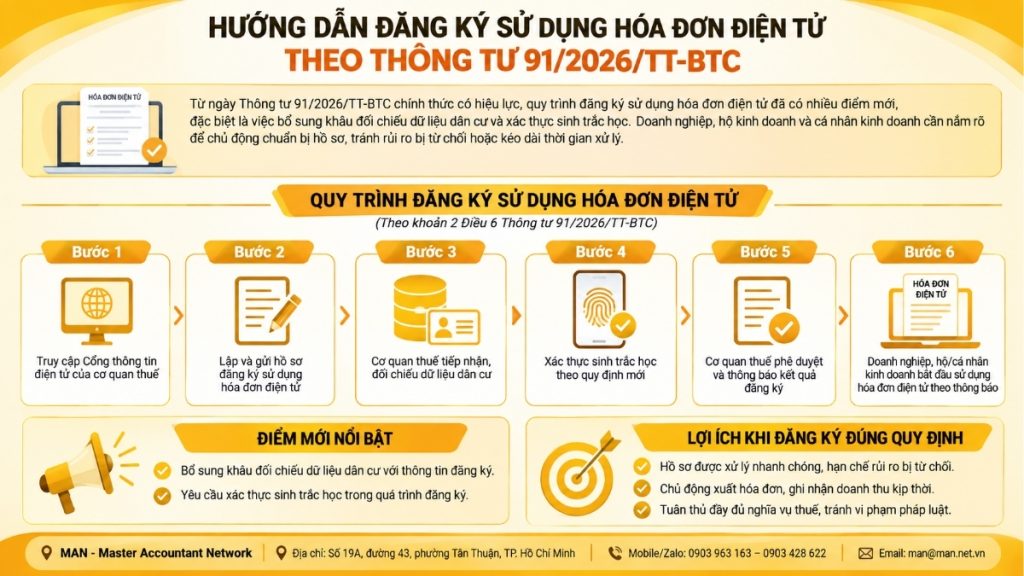
Since Circular 91/2026/TT-BTC Officially issued, the registration process for using electronic invoices under Circular 91 has many new points compared to before, especially the addition of a step to cross-check population data and biometric authentication. This is a change that any business, household business, or individual business needs to understand before carrying out the registration procedure, because even a small discrepancy in information can cause the application to be rejected or prolong the processing time.
As accounting professionals, we understand that delays in registering for electronic invoices can directly impact a business's invoicing operations, revenue recognition, and tax compliance. Therefore, this article will present a complete and accurate process for registering for electronic invoices according to Circular 91, based on the legal basis in Clause 2, Article 6 of Circular 91/2026/TT-BTC, helping you proactively prepare your documents and avoid unnecessary risks during the process.
Legal basis for registering to use electronic invoices according to Circular 91.
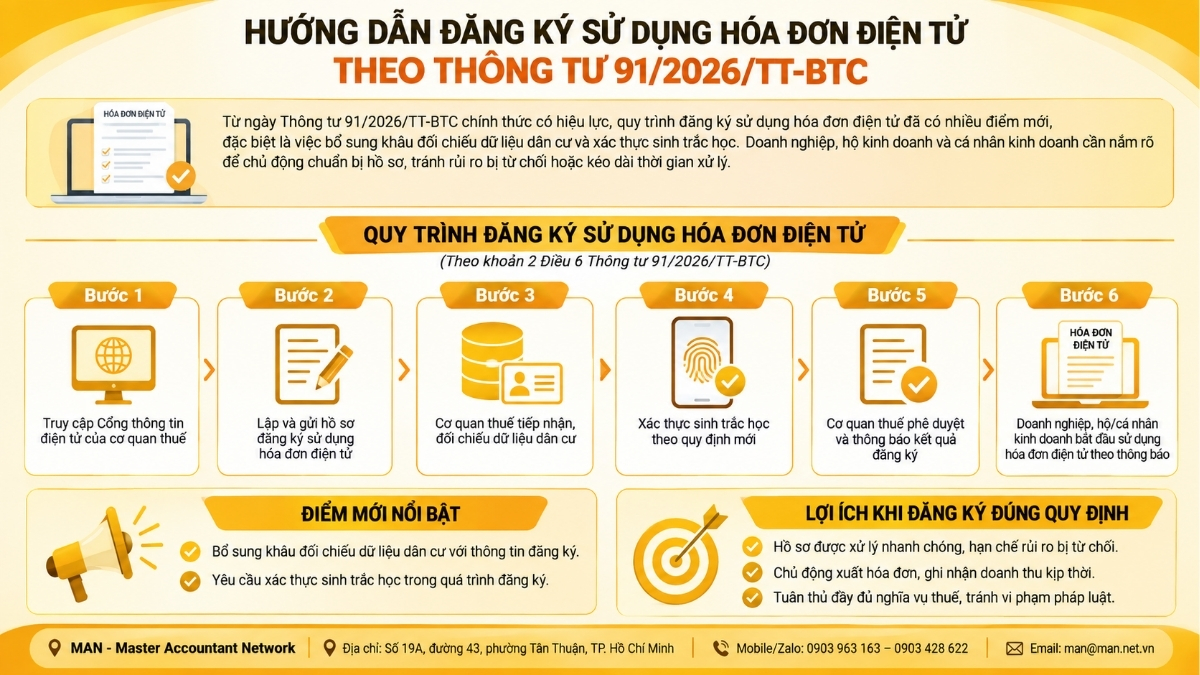
The regulations on registering for the use of electronic invoices under Circular 91 are specifically outlined in Clause 2, Article 6 of Circular 91/2026/TT-BTC. Accordingly, the registration process applies to legal representatives, business household representatives, individual business owners, and private enterprise owners when registering for the use of invoices.
Key points to note: Right from the application stage, the Tax Management Information System will automatically cross-reference the applicant's information, including biometric information as stipulated by the Government's regulations on electronic identification and authentication, with data in the National Population Database or data in the Electronic Identification and Authentication System. This is the biggest difference in the electronic invoice registration process under Circular 91 compared to the previous phase, aiming to tighten the verification of taxpayer identity and limit the use of electronic invoices for tax evasion.
What is the procedure for registering to use electronic invoices according to Circular 91?
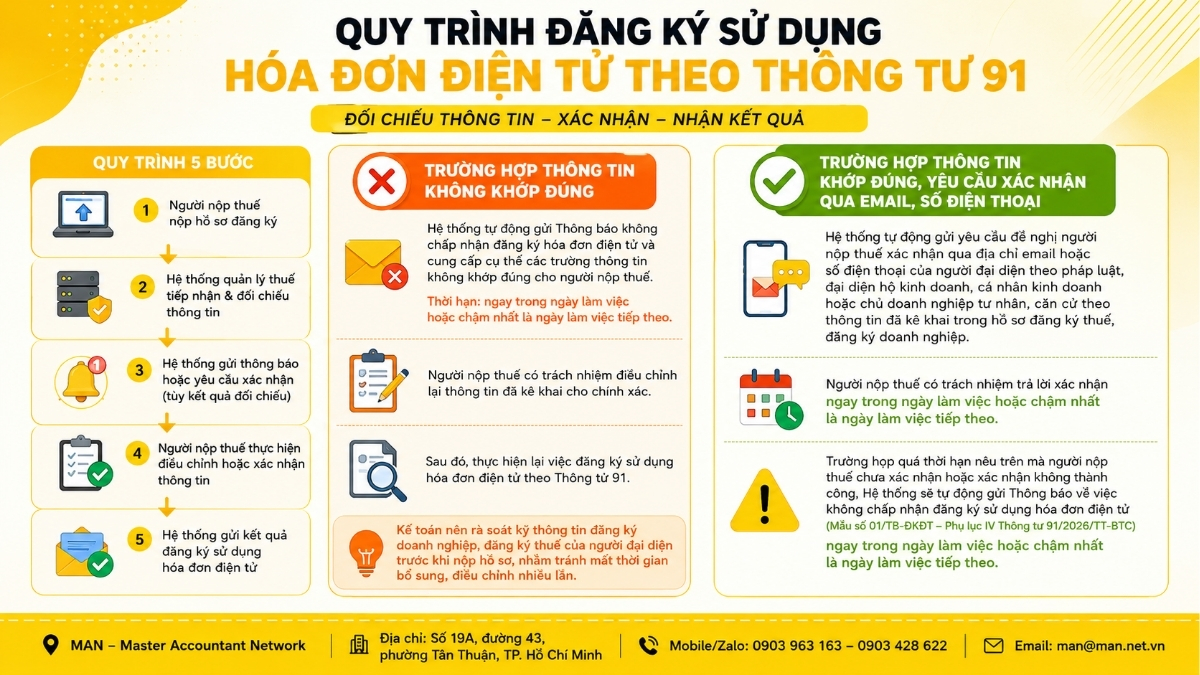
To understand how to register for the use of electronic invoices according to Circular 91, business accountants need to understand the following steps in processing documents within the Tax Management Information System.
Within one working day from the date of receiving the registration, the Tax Management Information System will automatically compare the information on business registration, tax registration of the legal representative, representative of household businesses, individual business owners or private enterprise owners with data in the National Population Database System or the Electronic Identification and Authentication System.
This is a crucial step that determines whether the application for using electronic invoices under Circular 91 will be processed smoothly, because the verification results will lead to two completely different handling approaches.
In case the information does not match
If the verification results show that the information does not match, the Tax Management Information System will automatically send a Notice of Rejection of Electronic Invoice Registration, along with specific details of the mismatched information fields to the taxpayer. This notice must be sent on the same working day or at the latest the next working day.
Upon receiving the notification, taxpayers are responsible for correcting the declared information and then re-registering for the use of electronic invoices according to Circular 91. Therefore, accountants should carefully review the business registration and tax registration information of the representative before submitting the application to avoid wasting time on multiple additions and corrections.
If the information matches, please confirm via email or phone number.
Conversely, if the information matches correctly, the Tax Management Information System will automatically send a request for confirmation to the taxpayer via email or phone number of the legal representative, business household representative, individual business owner, or private enterprise owner, based on the information declared in the tax registration or business registration file.
Taxpayers are responsible for responding with confirmation within the same working day or at the latest the next working day. If the taxpayer fails to confirm or the confirmation is unsuccessful within the aforementioned timeframe, the Tax Management Information System will automatically send a Notice of Rejection of Electronic Invoice Registration according to Form No. 01/TB-ĐKĐT in Appendix IV of Circular 91/2026/TT-BTC, also within the same working day or at the latest the next working day.
Furthermore, Circular 91/2026/TT-BTC also stipulates that tax authorities may apply biometric technology in the registration of electronic invoices in accordance with current legal regulations, aiming to enhance the authenticity and security of the entire process.
It is clear that closely monitoring the email and phone number registered with the tax authorities is extremely important in the process of registering to use electronic invoices according to Circular 91, because missing the confirmation deadline by just 1-2 working days can result in immediate rejection of the application.
Cases eligible for registration to use electronic invoices according to Circular 91
After the taxpayer has confirmed the deadline on the Tax Management Information System, if the taxpayer does not fall under the risk-related cases as stipulated in Article 7 of Circular 91/2026/TT-BTC (which will be detailed later), then no later than the next working day, the tax authority will issue a Notice of Acceptance of Registration for Electronic Invoice Use as stipulated in Clause 3 of Circular 91/2026/TT-BTC.
In other words, if the application for using electronic invoices under Circular 91 simultaneously meets two conditions: the verification information matches correctly and the taxpayer confirms within the deadline, and the applicant does not belong to a high-risk group, then the entire processing time may only take about 2 working days from the date of receipt of the application. This is an ideal condition that all businesses and household businesses should aim for when preparing their application.
Cases where clarification or additional information is required when registering for electronic invoices.
Not all applications for electronic invoice registration under Circular 91 are processed as smoothly as described above. In some cases, even if the information verification results match and the taxpayer confirms within the deadline, the application may still require further explanation or additional information if it falls under the high-risk category.
The group of high-risk subjects is defined in Article 7 of Circular 91/2026/TT-BTC.
According to regulations, the following cases are identified as high-risk for registering to use electronic invoices under Circular 91:
- The legal representative, business household representative, individual business owner, or private enterprise owner registering to use invoices is currently also the legal representative, business household representative, individual business owner, or private enterprise owner of another organization or individual whose tax identification number is inactive at the registered business address;
- The taxpayer has ceased operations but has not yet completed the procedures for terminating their tax identification number.
- The taxpayer is temporarily suspending operations but has not yet fulfilled their tax obligations;
- The taxpayer committed violations related to taxes, invoices, and supporting documents.
These are situations that corporate accountants need to pay special attention to, especially when the legal representative is listed as the owner of multiple different business entities. Reviewing the tax identification number status of related entities before submitting the application for electronic invoice registration under Circular 91 will help minimize the risk of being classified as a high-risk entity.
Procedure for handling high-risk applications
If the information verification results match correctly, and the taxpayer has confirmed within the deadline but falls into one of the risk groups mentioned above, then within 01 working day from the date of receiving the application for electronic invoice use, the tax authority will take one of two actions:
- Issue a Notice regarding the explanation and supplementation of information and documents according to Form No. 01/TB-BSTT-NNT in Appendix IV attached to Circular 91/2026/TT-BTC and send it to the taxpayer; or
- The tax authority directly responsible for managing the taxpayer's affairs shall verify the actual business operations at the taxpayer's registered address in accordance with the tax administration laws.
After receiving the Notice to Provide Explanation and Additional Information, taxpayers have 3 working days to provide the explanation and supplement the required documents and records.
Results of processing after explanation and additional information provided.
After the taxpayer completes the explanation, provides additional information, or after the tax authority conducts on-site verification, the processing of the application for registration to use electronic invoices under Circular 91 will follow one of the two directions below.
Cases where registration is accepted
If the tax authority accepts the taxpayer's explanatory or supplementary information, or if the verification results show that the taxpayer is actually operating at the registered address, the directly managing tax authority will issue a Notice of Acceptance of Electronic Invoice Registration to the taxpayer.
In case the registration is not accepted
Conversely, if the taxpayer fails to provide an explanation, or fails to provide the information within the prescribed time limit, or if verification results show that the taxpayer does not operate at the registered address, then no later than the next working day, the tax authority will issue a Notice of Rejection of Electronic Invoice Registration, clearly stating the reason for rejection as stipulated in Clause 3, Article 6 of Circular 91/2026/TT-BTC.
Thus, it can be seen that the entire process of registering to use electronic invoices according to Circular 91 is built on transparency, with specific processing times for each step, but at the same time, it places quite high demands on taxpayers in ensuring accurate information and timely responses.
See more: New points in Circular 91/2026/TT-BTC regarding electronic documents and invoices.
Why do businesses need to understand the regulations for registering to use electronic invoices according to Circular 91?
A proper and complete understanding of the process. Register to use electronic invoices according to Circular 91 It brings many practical benefits to businesses, household businesses, and individual entrepreneurs:
- Avoid disruptions to invoicing operations.A rejected application means the business cannot yet use electronic invoices to issue to customers, directly impacting business operations and cash flow.
- Minimize the risk of being classified as high-risk.By understanding the criteria in Circular 91/2026/TT-BTC, accountants can proactively check the tax identification number status of the representative before submitting the application.
- Proactively prepare your application documents and ensure accurate information from the start.Ensuring that tax registration and business registration information matches population data will help expedite the processing of applications for electronic invoice usage under Circular 91, right from the first verification round.
- Ensure that response deadlines are met.Because the deadlines for confirmation and explanation are very short (within the same day, the next business day, or 3 business days), businesses need an internal process to monitor registered emails and phone numbers to avoid missing any notifications from the tax authorities.
Reference: How to handle erroneous invoices according to Circular 91/2026.
Important notes when registering to use electronic invoices.
To ensure a smooth registration process for using electronic invoices according to Circular 91, accountants and business representatives should note the following points:
- Carefully check the tax registration and business registration information of the legal representative, business household representative, individual business owner, or private enterprise owner to ensure it matches the data in the National Population Database before submitting the application.
- Regularly check the email address and phone number registered with the tax authorities to avoid missing confirmation requests from the Tax Management Information System.
- Prepare documents proving actual business operations at the business address, in case the tax authorities conduct verification or request explanations or additional information.
- Review the tax identification numbers of other businesses and household businesses registered under the name of the legal representative, in order to avoid being classified as high-risk entities according to Article 7 of Circular 91/2026/TT-BTC.
- Understanding the application processing deadlines allows for proactive allocation of personnel to monitor applications throughout the registration process.
If, during the process, the business encounters difficulties with documentation, registration information, or needs to review the status of the relevant tax identification number, it should proactively contact the internal accounting department or hire accounting services It is advisable to seek assistance from professional organizations such as MAN – Master Accountant Network to receive timely review and support, avoiding any impact on the progress of using electronic invoices in business operations.
Conclusion and recommendations
In summary, the process of registering for the use of electronic invoices under Circular 91 is carried out through many rigorous steps, from automatic information verification and confirmation requests via email or phone number, to classifying dossiers according to risk level and handling explanations and supplementary information when necessary. Each step is linked to a specific processing deadline as stipulated in Clause 2, Article 6 of Circular 91/2026/TT-BTC, requiring businesses, household businesses, and individual business owners to proactively and closely monitor and respond to dossiers.
Thorough preparation of registration information from the outset, along with a clear understanding of potential risk categories, will significantly save businesses time and effort when registering to use electronic invoices according to Circular 91. For businesses and household businesses that do not have a dedicated accounting department or want to optimize operating costs, choosing the right option is crucial. full accounting service This is also a worthwhile solution. We assist in handling the entire process of registering for electronic invoices according to Circular 91, from preparation and information verification to monitoring the processing progress at the tax authorities, helping businesses focus on their core business activities.
If, during the process, the business encounters difficulties with documentation, registration information, or needs to review the status of the relevant tax identification number, it should proactively take action. Contact MAN – Master Accountant Network to receive timely advice and support.
Contact information MAN – Master Accountant Network
- Address: No. 19A, Street 43, Tan Thuan Ward, Ho Chi Minh City
- Mobile/Zalo: 0903 963 163 – 0903 428 622
- E-mail: man@man.net.vn
- Google Business Profile: View MAN – Master Accountant Network's Google Business Profile
- LinkedIn Founder: View expert Le Hoang Tuyen's LinkedIn profile.
Responsible for production and professional content review by: Mr. Le Hoang Tuyen – Founder & CEO of MAN – Master Accountant NetworkHe is a CPA Vietnam auditor with over 30 years of in-depth experience in accounting, auditing, taxation, and corporate legal consulting.
Frequently Asked Questions about registering for electronic invoice usage according to Circular 91
How long does it take to register for the use of electronic invoices according to Circular 91?
If all information matches correctly, processing time can take only about 2 business days from the date of receipt of the application. In cases requiring clarification or additional information, the processing time may be extended by up to 3 business days, according to the clarification deadline.
What happens if the registration information doesn't match the population data?
The tax management information system will automatically send a notification rejecting the electronic invoice registration, clearly indicating the mismatched information fields so that the taxpayer can make corrections.
Will my registration be rejected if I don't confirm it by the deadline?
Yes. If the deadline passes and the taxpayer has not confirmed or the confirmation is unsuccessful, the system will automatically send a Notification of Registration Rejection using Form No. 01/TB-ĐKĐT.
Which groups are considered high-risk when registering for electronic invoices?
This includes individuals who are representatives and also listed as owners of entities with inactive tax identification numbers; taxpayers who have ceased operations but whose tax identification numbers have not yet expired; individuals who have temporarily suspended operations but have not yet fulfilled their tax obligations; and individuals who have committed violations related to taxes, invoices, and documents as stipulated in Article 7 of Circular 91/2026/TT-BTC.
What is the deadline for providing additional information when requested?
Taxpayers have 3 working days from the date of receiving the Notice requesting explanation, additional information, and documents to respond to the tax authorities.