The method of storing electronic invoices according to Decree 254 is a top concern for accountants and business owners, as this document officially redefines the requirements for preserving and storing electronic invoices and documents. Beyond simply storing files on a computer, the new regulations require electronic invoices to be stored as data messages, ensuring security and integrity throughout the storage process, and readily available for printing or retrieval whenever requested by the tax authorities. This article is compiled based on the legal basis directly from Decree 254. Decree 254/2026/ND-CP and Accounting Law 2015This will help you fully understand the four mandatory requirements for archiving, important archiving deadlines, and the correct implementation process, so that businesses can proactively comply and avoid risks during inspections and audits.
Regulations on how to store electronic invoices according to Decree 254/2026/ND-CP
According to Clause 1, Article 5 of Decree 254/2026/ND-CP, the preservation and storage of invoices and documents are regulated into two main groups of requirements:
- Requirements regarding data security and integrity;
- And the requirement is for data to be stored in the form of messages.
This is the legal framework that every organization and individual issuing or using electronic invoices needs to understand before setting up an internal storage system. In other words, the method of storing electronic invoices according to Decree 254 is not simply about retaining the invoice file, but must simultaneously meet criteria for security, data integrity, and accessibility when requested by competent authorities.
Requirements for data security and integrity.
Point a, Clause 1, Article 5 of Decree 254/2026/ND-CP clearly stipulates:
Invoices and documents must be preserved and stored in a way that ensures their safety, security, integrity, completeness, and prevents them from being altered or corrupted throughout the storage period.
This is a crucial requirement because electronic invoices exist as digital data, making them significantly more susceptible to modification, forgery, or loss due to technical errors compared to traditional paper documents. If invoice data is altered during storage, whether intentionally or unintentionally, businesses will find it very difficult to prove the validity of the document when tax authorities conduct verification and inspection. Therefore, establishing a robust security mechanism (access control, data encryption, logging of operation history) is not just a technical recommendation but a mandatory legal requirement.
The method of storing electronic invoices is in the form of data messages.
In addition to data security requirements, Clause 2, Article 5 of Decree 254/2026/ND-CP stipulates that electronic invoices and electronic documents must be preserved and stored in the form of data messages.
Key points to note: Organizations, agencies, and individuals have the right to choose and apply preservation and storage methods that are appropriate to their specific operations and technological capabilities.
However, this flexibility comes with a condition: the chosen storage method must fully comply with the requirements stipulated in Article 13 of the Law on Electronic Transactions. In other words, businesses are not free to store data in any way that disregards the legal framework for electronic transactions.
In addition, the regulations also emphasize two mandatory conditions:
- Electronic invoices and electronic documents must be printable on paper.
- Or it can be looked up upon request.
These are two criteria that any entity applying the electronic invoice storage method according to Decree 254 must ensure, because in reality, tax authorities and inspection agencies can completely request businesses to present invoices in printed form or search directly on the system at any time.
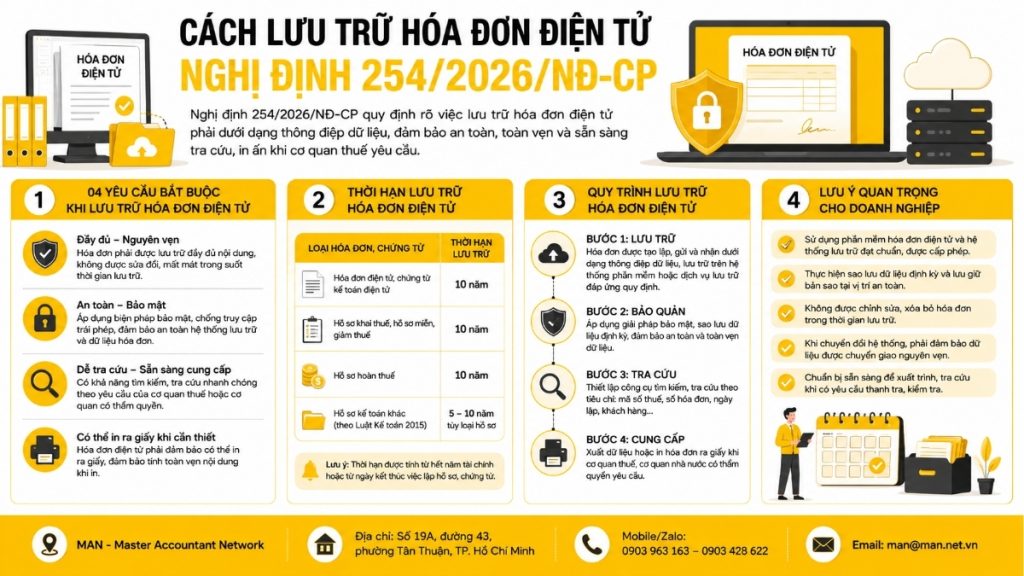
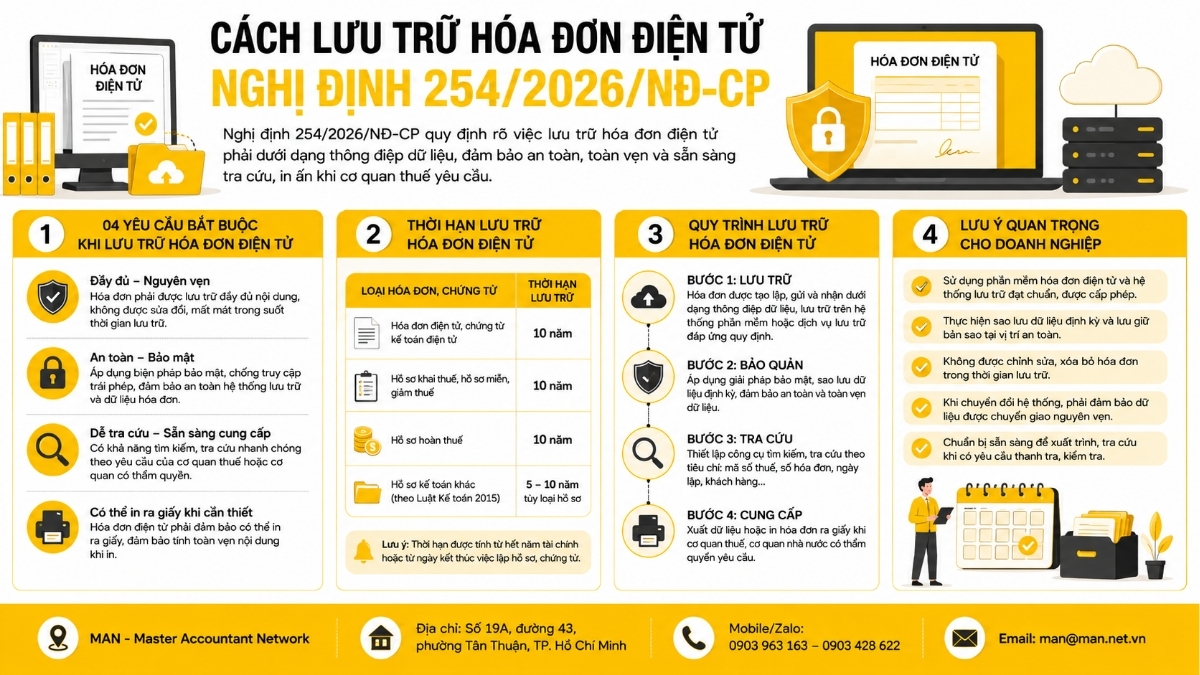
Summary of the four mandatory requirements for storing electronic invoices according to Decree 254:
- Ensuring safety, security, integrity, and completeness throughout the storage period, without alteration or corruption;
- Stored as data messages, in a suitable format, but must comply with Article 13 of the Law on Electronic Transactions;
- Ready to be printed on paper upon request;
- Available for immediate retrieval upon request.
The retention period for electronic invoices is regulated by accounting laws.
An important point to note is that Decree 254/2026/ND-CP does not specifically stipulate the retention period for electronic invoices, but rather refers to the application of accounting laws. Specifically, Clause 1, Article 5 of Decree 254/2026/ND-CP states that invoices and supporting documents must be stored correctly and for the full period as prescribed by accounting laws. Therefore, to fully understand how to store electronic invoices according to Decree 254, businesses must also refer to Article 41 of the 2015 Accounting Law.
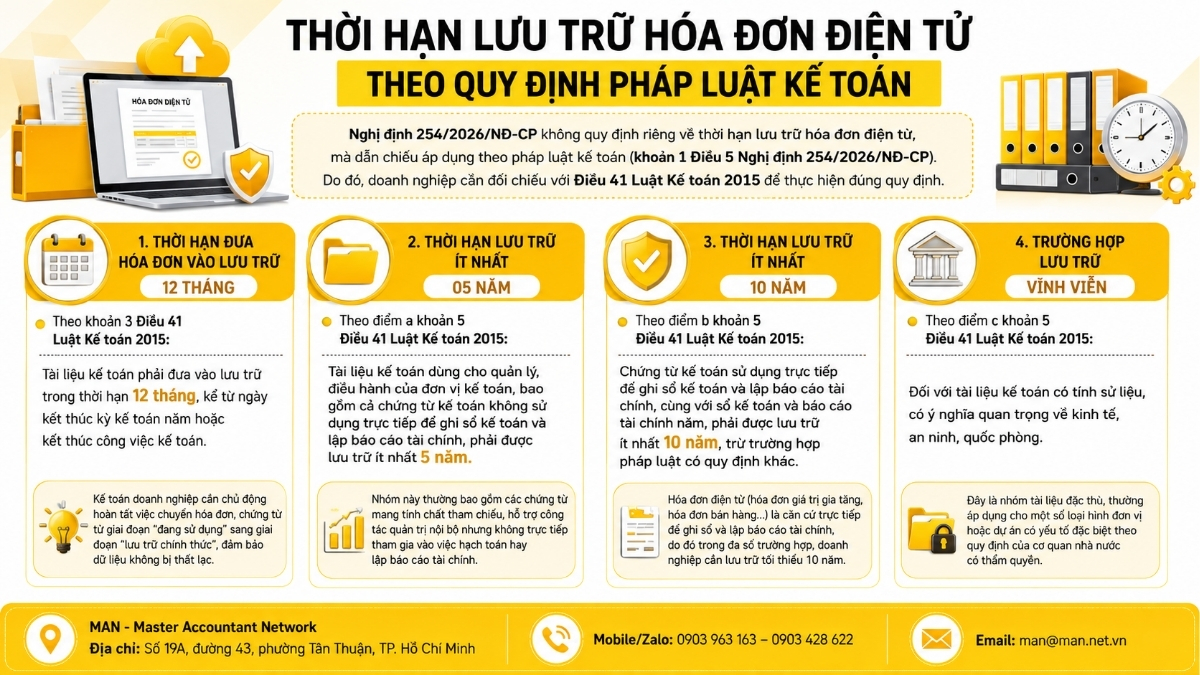
The deadline for archiving invoices is 12 months.
According to Clause 3, Article 41 of the 2015 Accounting Law:
Accounting documents must be archived for a period of 12 months from the end of the fiscal year or the completion of the accounting work.
This is a crucial timeframe that corporate accountants need to be aware of and proactively complete the transfer of invoices and documents from the "currently in use" stage to the "officially archived" stage, ensuring that data is not lost during the transition.
The minimum storage period is 05 years.
According to point a, clause 5, Article 41 of the 2015 Accounting Law:
Accounting documents used for the management and operation of an accounting unit, including accounting vouchers not directly used for recording accounting entries and preparing financial statements, must be stored for at least 5 years.
This group typically includes reference documents that support internal management but are not directly involved in accounting or financial reporting.
The storage period is at least 10 years.
This is the deadline that most businesses must comply with for both input and output electronic invoices. According to point b, clause 5, Article 41 of the 2015 Accounting Law:
Accounting documents used directly for recording accounting entries and preparing financial statements, along with accounting books and annual financial statements, must be retained for at least 10 years, unless otherwise stipulated by law.
Since electronic invoices (value-added tax invoices, sales invoices, etc.) are the direct basis for recording transactions and preparing financial statements, in most cases, businesses need to apply a minimum retention period of 10 years for this group of documents.
Permanent storage case
Point c, Clause 5, Article 41 of the 2015 Accounting Law also stipulates the following cases for permanent storage:
For accounting documents that are of historical value and have significant economic, security, and defense implications.
This is a specialized group of documents, typically applicable to certain types of units or projects with unique characteristics as stipulated by competent state authorities.
Summary of invoice retention periods according to Decree 254 and the Accounting Law 2015
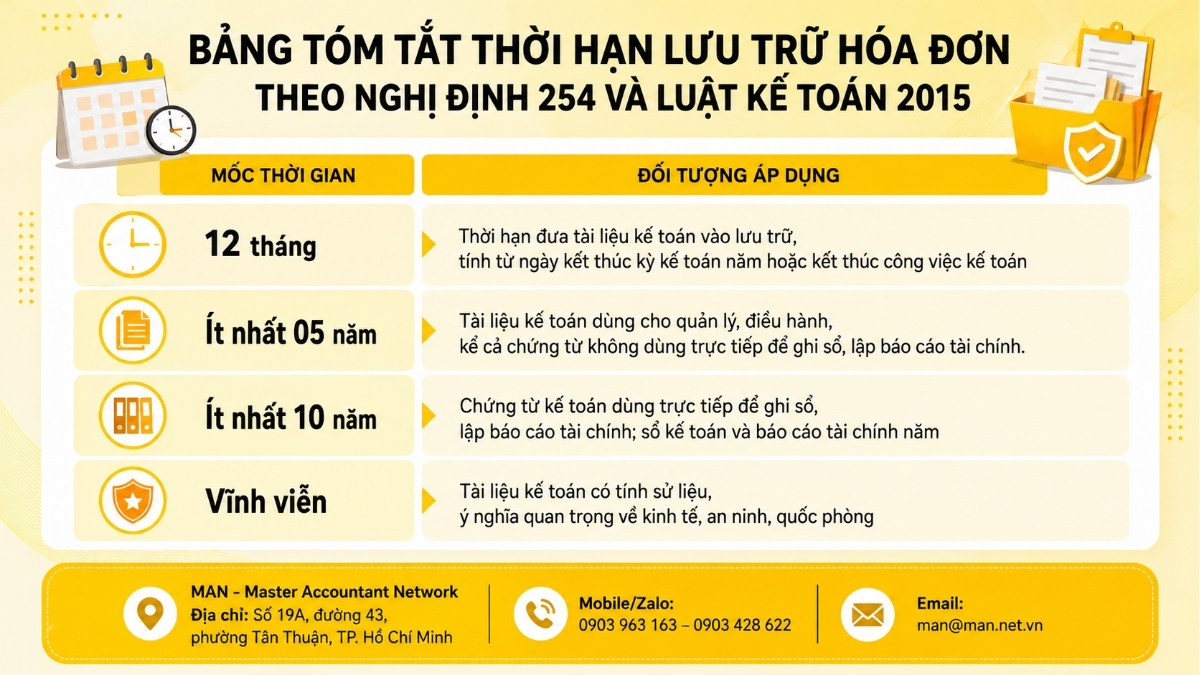
For easy tracking and accurate application to each type of invoice and document in practice, accountants can refer to the summary table of retention deadlines below, systematized based on the regulations in Clause 1, Article 5 of Decree 254/2026/ND-CP and Clauses 3 and 5, Article 41 of the Accounting Law 2015:
| Timeline | Applicable objects |
| 12 months | The deadline for archiving accounting documents is calculated from the end of the fiscal year or the completion of accounting work. |
| At least 5 years | Accounting documents used for management and operation, including vouchers not directly used for recording entries or preparing financial statements. |
| At least 10 years | Accounting documents used directly for recording entries and preparing financial statements; accounting books and annual financial statements. |
| forever | Accounting documents are historical documents with significant economic, security, and defense implications. |
As can be seen, the method of storing electronic invoices according to Decree 254 is inseparable from the aforementioned deadlines. This is an important basis for businesses to classify, organize, and manage invoices and documents scientifically from the outset, avoiding the situation of premature data destruction or insufficient storage time, which could lead to violations when inspected by tax authorities. Based on a clear understanding of these deadlines, businesses will find it easier to develop internal storage policies suitable for each specific type of document.
Why do businesses need to understand how to store electronic invoices according to Decree 254?
Understanding and properly complying with Decree 254 on electronic invoice storage is not only a legal obligation but also directly relates to the rights and financial security of businesses.
Firstly, if a business maintains invoices incorrectly or for an insufficient period as required, it may face administrative penalties for accounting and tax violations. During tax settlements, inspections, and audits, the inability to present valid invoices when requested by authorities can result in related expenses being disallowed as legitimate and reasonable expenses, directly impacting corporate income tax obligations.
Secondly, the risk of data loss due to technical failures and the lack of regular backup mechanisms is not uncommon in practice. When electronic invoices are lost or cannot be retrieved, businesses not only face difficulties in internal accounting but may also directly violate the requirement to "be readily printable or searchable upon request" as stipulated in Clause 2, Article 5 of Decree 254/2026/ND-CP.
Conversely, when businesses establish an electronic invoice storage system that fully complies with regulations, they will be more proactive in tax settlements and periodic audits, minimizing the risk of disputes with partners due to a lack of supporting documents. This also forms the foundation for building a transparent and professional financial management system.
This is why many small and medium-sized enterprises choose this solution. full accounting service With MAN – Master Accountant Network, you can have a team of professionals directly set up and supervise the process of storing electronic invoices and documents in accordance with Decree 254/2026/ND-CP and the 2015 Accounting Law, instead of trying to figure it out yourself and facing the risk of errors.
Instructions on how to properly store electronic invoices according to Decree 254.
Based on the legal grounds mentioned above, the following is a suggested process for businesses and accountants to implement the proper storage of electronic invoices.
Step 1: Choose the appropriate storage method and medium.
Businesses need to assess their specific operations and technological capabilities to choose the appropriate storage method. This could be an internal storage system, accounting software with integrated storage modules, or a dedicated data storage platform. Regardless of the chosen method, the prerequisite is that the storage medium must fully meet the requirements of Article 13 of the Law on Electronic Transactions, as stipulated in Clause 2, Article 5 of Decree 254/2026/ND-CP.
For organizations that do not have a dedicated accounting department or want to ensure compliance from the outset, the following is necessary. hire accounting services Professional advice is also a worthwhile option to consider when choosing a storage solution that suits the scale and specifics of your operations.
Step 2: Establish a mechanism to ensure data integrity.
To meet the safety, security, and integrity requirements under point a, clause 1, Article 5, businesses should establish a mechanism for regular data backup, clearly define access rights for each job position, and strictly control any modifications (if any) on the storage system to ensure that invoices are not altered or corrupted during the storage period.
Step 3: Ensure accessibility for searching and printing when required.
The storage system needs to be organized scientifically, arranged according to accounting period, document type, issuing entity, etc., to ensure that electronic invoices are always ready to be printed on paper or retrieved immediately when requested by the tax authorities or relevant parties, in accordance with the spirit of Clause 2, Article 5 of Decree 254/2026/ND-CP.
Step 4: Review the retention period for each type of document.
Finally, businesses need to classify invoices and documents according to the three deadlines mentioned in Clause 5, Article 41 of the 2015 Accounting Law, avoiding the situation of destroying data too early or storing it for less than the prescribed period, leading to violations when audited.
Conclude
In summary, the method of storing electronic invoices according to Decree 254 revolves around two main pillars: ensuring the security and integrity of data throughout the storage period, and complying fully with the storage deadlines stipulated by accounting laws. At the same time, electronic invoices must always be readily available for printing or retrieval whenever requested by competent authorities.
Establishing a systematic record-keeping process that fully complies with the aforementioned regulations not only helps businesses avoid legal risks but also forms the foundation for a professional, transparent, and sustainable financial and accounting management system in the long term.
If a business needs a professional team to provide comprehensive support from the creation, management, and storage of invoices and documents in accordance with regulations, the business can refer to the following: Quotation for comprehensive accounting services To choose a service package that suits the size of your business.
Contact MAN – Master Accountant Network For free support and advice!
Contact information MAN – Master Accountant Network
- Address: No. 19A, Street 43, Tan Thuan Ward, Ho Chi Minh City
- Mobile/Zalo: 0903 963 163 – 0903 428 622
- E-mail: man@man.net.vn
- Google Business Profile: View MAN – Master Accountant Network's Google Business Profile
- LinkedIn Founder: View expert Le Hoang Tuyen's LinkedIn profile.
Responsible for production and professional content review by: Mr. Le Hoang Tuyen – Founder & CEO of MAN – Master Accountant NetworkHe is a CPA Vietnam auditor with over 30 years of in-depth experience in accounting, auditing, taxation, and corporate legal consulting.
Frequently Asked Questions about Storing Electronic Invoices According to Decree 254
Is it mandatory to print out electronic invoices on paper for archiving?
Not mandatory. According to Clause 2, Article 5 of Decree 254/2026/ND-CP, electronic invoices are stored as data messages, only needing to be readily printable or searchable upon request. This means businesses can store them entirely electronically as long as they meet the requirements for printing or retrieval when needed.
If an electronic invoice is lost due to a technical issue, does that violate archiving regulations?
Data loss and failure to ensure data integrity and completeness throughout the storage period do not meet the requirements of point a, clause 1, Article 5 of Decree 254/2026/ND-CP.
Can businesses choose their own method of storing electronic invoices?
Yes. Decree 254/2026/ND-CP allows agencies, organizations, and individuals to choose and apply methods of preservation and storage that are suitable to their specific operations and technological capabilities, provided they meet the requirements of Article 13 of the Law on Electronic Transactions.
Do electronic invoices previously stored under Decree 123/2020/ND-CP need to be converted back to Decree 254?
This is a transitional issue between the old and new regulations that businesses need to carefully review according to the specific transitional guidelines of Decree 254/2026/ND-CP and the guidance documents of the tax authorities, to ensure that data stored before July 1, 2026, continues to meet the requirements for integrity and searchability according to the new regulations.
Can electronic invoices that have exceeded their legally mandated retention period be destroyed?
When invoices and supporting documents have been stored for the minimum period stipulated in Clause 5, Article 41 of the 2015 Accounting Law, the accounting unit may destroy them according to the procedures prescribed by accounting law, ensuring that a complete destruction record is available to avoid risks when they are later examined.