
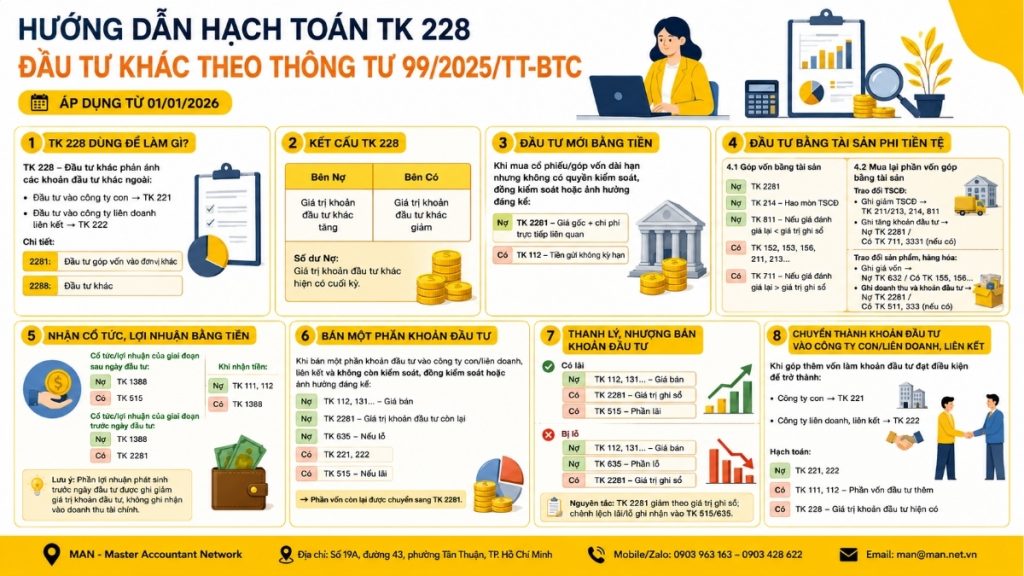
Accounting for account 228 is a task that the investment and finance accounting department of the enterprise has to familiarize itself with from scratch since its inception. Circular 99/2025/TT-BTC Officially replacing Circular 200/2014/TT-BTC, effective from January 1, 2026, and applicable to fiscal years beginning from that date onwards. For investments without control, co-control, or significant influence, an incorrect debit-credit entry or wrong corresponding account is enough to distort the investment value and financial revenue on the report. This article systematically reviews the principles, structure, and 5 most common accounting scenarios for account 228 according to Section B, Appendix II of Circular 99/2025/TT-BTC.
Why has the accounting method for account 228 changed since Circular 99/2025/TT-BTC?
On October 27, 2025, the Ministry of Finance issued Circular 99/2025/TT-BTC guiding the accounting regime for enterprises, replacing Circular 200/2014/TT-BTC. The Circular takes effect from January 1, 2026, and applies to fiscal years beginning on or after January 1, 2026. This represents the most significant restructuring of the accounting chart of accounts in over a decade, with the remaining 71 level 1 accounts aimed at aligning more closely with international accounting standards.
Account 228 – Other Investments is among the accounts directly affected. Therefore, accounting for account 228 cannot simply apply the familiar entries from the old accounting system; instead, each case must be re-examined according to Section B, Appendix II of Circular 99/2025/TT-BTC, the original document stipulating the accounting methods for major economic transactions arising with this account.
For accountants, errors in accounting for account 228 often don't lie in whether or not to record the transaction, but rather in choosing the wrong offsetting account between financial operating revenue (account 515), other income (account 711), and account 228. These three accounts are easily confused when investments increase, decrease, or when revaluation differences arise.
Principles and structure of account 228 according to Circular 99/2025/TT-BTC

What type of investment does account 228 reflect?
Account 228 – Other Investments is used to record amounts when a business purchases shares or makes long-term capital contributions to another entity but does not have control, joint control, or significant influence over the invested entity. This is the most important boundary to determine before accounting for account 228: if the investment reaches a level of controlling, joint control, or significant influence, the transaction must be recorded in account 221 or 222, not account 228..
Account structure 228
According to Section B of Appendix II of Circular 99/2025/TT-BTC, the structure of account 228 is stipulated as follows:
| Category | Reflective content |
| Debit side | The value of other investments increased. |
| The Owned Side | The value of other investments decreased. |
| Debit balance | The value of other investments held at the end of the accounting period. |
This account always has a debit balance. Any transaction that results in a credit balance after settlement is a sign of incorrect accounting for account 228 and needs to be reviewed immediately before preparing financial statements.
During the data migration process, many businesses choose the safe option of seeking external solutions. full accounting service Professional and experienced organizations such as MAN – Master Accountant Network will review all investment balances before officially implementing the new accounting system.
Instructions for accounting for account 228 when new investments arise.

When a business invests in purchasing shares or making long-term capital contributions but does not have control, co-control, or significant influence over the investee, the accounting for account 228 is divided according to the form of payment.
Case of investment using cash
Specifically:
- Debit Account 228 – Other Investments (2281): Based on the original cost of the investment plus related direct costs (brokerage fees, etc.)
- There is account 112 – Demand deposits.
At the same time, businesses must maintain detailed records of each type of share at par value (if investing in the form of purchasing shares) or track the value of the charter capital in the invested company (if the investee is not a joint-stock company).
Investment in the case of non-monetary assets
Contributing capital in the form of non-monetary assets is based on the revaluation of materials, goods, and fixed assets.
- Debit Account 228 – Other Investments (2281)
- Debit Account 214 – Depreciation of Fixed Assets (accumulated depreciation value)
- Debit Account 811 – Other Expenses (if the revalued price is less than the book value of inventory or the remaining value of fixed assets)
- There are accounts 152, 153, 156, 211, 213… (book value of inventory or original cost of fixed assets)
- Account 711 – Other income (if the revalued price is greater than the book value or remaining value)
The acquisition of equity stakes using non-monetary assets can be divided into two cases:
In the case of exchange involving fixed assets, the amount of assets being exchanged should be recorded as a decrease.
- Debit Account 811 – Other Expenses (remaining value of fixed assets)
- Debit Account 214 – Depreciation of Fixed Assets (depreciation value)
- There are accounts 211 and 213 (original cost).
Simultaneously record other income and increase investments:
- Debit Account 228 – Other Investments (2281)
- There is account 711 – Other income.
- There is account 3331 – Value Added Tax payable (33311) (if any)
In the case of exchange using products or goods when goods are withdrawn from the warehouse:
- Debit Account 632 – Cost of Goods Sold
- There are accounts 155, 156…
Simultaneously reflecting revenue and increased other investments:
- Debit Account 228 – Other Investments (2281)
- Account 511 – Revenue from sales and services
- There is account 333 – Taxes and other amounts payable to the State (33311) (if any)
Because each payment method entails a different pair of corresponding accounts, this is also a group of journal entries that accountants should consider referring to within the organization. accounting consulting services before recording the transaction, especially for high-value asset exchange deals.
Accounting entry for account 228 when receiving dividends or profits distributed in cash.

The most common mistake when accounting for account 228 in this transaction is determining whether dividends or distributed profits belong to the period before or after the investment date.
Step 1: Reflect accounts receivable
Specifically:
- Debit Account 138 – Other receivables (1388)
- Account 515 – Financial income (if dividends and profits are distributed to a period after the investment date)
- There is account 228 – Other investments (2281) if dividends and profits are distributed to the period before the investment date.
Step 2: When you actually receive the money
- Debit accounts 111, 112
- There is account 138 – Other receivables (1388)
Core principle: Dividends arising from profits accumulated before the company acquires the investment are not recognized as financial revenue, but must be recorded as a reduction in the investment value in account 228, because in nature it is a return of the principal rather than profit generated during the holding period.
Accounting entry for account 228 when selling a portion of an investment that results in loss of control.
This situation arises when an investor sells a portion of their investment in a subsidiary, joint venture, or associate company, resulting in the loss of control, joint control, or significant influence. The remaining capital is then transferred to another investment and must be accounted for in account 228 as follows:
- Debit accounts 112, 131…
- Debit Account 228 – Other Investments (2281)
- Debit Account 635 – Financial Expenses (if there is a loss)
- There are accounts 221 and 222.
- Account 515 – Financial income (if profitable)
This accounting entry accurately reflects the situation: The remaining capital contribution after the sale is no longer under significant control or influence, so it must be "renamed" from account 221 or 222 to account 228. Simultaneously, the difference between the selling price and the book value is immediately recorded in the business results for the period, without being amortized.
Accounting entry for account 228 when liquidating or selling other investments.
When a business liquidates or sells off all other investments, the accounting treatment of account 228 depends on whether the result is a profit or loss compared to the book value.
In the case of a profitable sale or liquidation:
- Debit accounts 112, 131… (selling price)
- Account 228 – Other investments (book value)
- Account 515 – Financial income (the portion of the selling price exceeding the book value)
In the case of selling or liquidating at a loss:
- Debit accounts 112, 131… (selling price)
- Debit Account 635 – Financial expenses (the portion of the selling price that is less than the book value)
- Account 228 – Other investments (book value)
Business note: Account 228 is always debited by exactly the same amount. book valueThis is not the selling price. The difference, whether positive or negative, always remains in account 515 or 635 and cannot be directly deducted from account 228.
Accounting for account 228 when converting it into an investment in a subsidiary or associated company.
When an investor contributes additional capital, causing another investment to become an investment in a subsidiary or associate company, meaning they gain control, joint control, or significant influence, the accounting entry for account 228 is as follows::
- Debit accounts 221, 222
- There are accounts 111 and 112 (additional investment amount).
- Account 228 – Other investments
This journal entry records two cash flows simultaneously: the additional capital contribution in cash and the existing balance in account 228, which is "transferred" at its book value to account 221 or 222, with no revaluation difference arising at the time of conversion.
4 common mistakes when accounting for account 228
First, there was a mix-up between the offsetting accounts for financial revenue and other income. Dividends from the period prior to the investment were mistakenly recorded in account 515 instead of decreasing account 228, resulting in inflated financial revenue.
Second, record the controlling investment in account 228. When the ownership stake or level of influence has reached a threshold of control, joint control, or significant influence, accounting for the transaction in account 228 instead of transferring it to account 221/222 is fundamentally incorrect.
Third, deduct the difference in selling price directly from account 228 upon liquidation. In principle, account 228 should only be debited at its book value; any profit or loss should be reflected separately through account 515 or 635.
Fourth, do not maintain detailed records for each type of stock or each unit invested in. The lack of detailed records prevents businesses from accurately determining the book value of each investment when a partial write-off is needed.
Checklist for pre-closing control of account 228
The checklist conducts a pre-closing audit of account 228, specifically as follows:
- Determine whether the investment falls within the scope of account 228 or needs to be transferred to account 221/222.
- Maintain detailed ledgers for each type of share or each entity receiving capital contributions.
- Properly separating dividends and profits between the periods before and after the investment date.
- Compare the book value with the original document before debiting account 228 when selling or liquidating.
- Check that the ending balance of account 228 is always on the debit side.
For businesses without a dedicated accounting department for financial investments, the outsource accounting services Conducting a separate review of investment account groups before each settlement period is an effective risk control method, especially during the transition to Circular 99/2025/TT-BTC.
Conclude
Accounting for account 228 under Circular 99/2025/TT-BTC retains its fundamental nature of recording investments without control, joint control, or significant influence, with the familiar structure: Debit when increasing, Credit when decreasing, Debit balance. Accountants need to master five main scenarios: new investments in cash or non-monetary assets, receiving dividends, selling a portion resulting in loss of control, liquidation of the entire investment, and conversion into an investment in a subsidiary or associate company. Each scenario has its own corresponding account pair; the methods cannot be applied mechanically from one transaction to another.
If your business is in the process of reviewing opening balances or converting its accounting system according to Circular 99/2025/TT-BTC, please Contact MAN – Master Accountant Network To receive advice and support to ensure the accuracy of account 228 data from the start.
Contact information MAN – Master Accountant Network
- Address: No. 19A, Street 43, Tan Thuan Ward, Ho Chi Minh City
- Mobile/Zalo: 0903 963 163 – 0903 428 622
- E-mail: man@man.net.vn
- Google Business Profile: View MAN – Master Accountant Network's Google Business Profile
- LinkedIn Founder: View expert Le Hoang Tuyen's LinkedIn profile.
Responsible for production and professional content review by: Mr. Le Hoang Tuyen – Founder & CEO of MAN – Master Accountant NetworkHe is a CPA Vietnam auditor with over 30 years of in-depth experience in accounting, auditing, taxation, and corporate legal consulting.
Frequently Asked Questions about Accounting for Account 228
What type of investment is account 228 used for?
Account 228 is used to record transactions related to the purchase of shares or long-term capital contributions where the enterprise does not have control, joint control, or significant influence over the invested party.
When are dividends recorded as a reduction in account 228 instead of as financial revenue?
When dividends or profits are distributed to the period prior to the date the business made the investment, this amount is recorded as a credit to account 228 (debit to account 138) instead of a credit to account 515.
How should account 228 be recorded when selling a portion of an investment in a subsidiary results in the loss of control?
The remaining capital is debited to account 228, offset by credit to account 221 or 222; the profit difference is credited to account 515, and the loss difference is debited to account 635.
How should we account for the liquidation of other investments that result in losses?
Debit account 112 or 131 at the selling price, debit account 635 for the difference between the selling price and the book value, and credit account 228 at the exact book value.