Accounting for installment purchases is a task that any accountant will encounter again from fiscal year 2026, when Circular 99/2025/TT-BTC Officially replacing Circular 200/2014/TT-BTC. This procedure, though seemingly familiar, is actually the most common source of errors:
- Incorrectly recording the value of goods, calculating installment interest for the wrong period;
- Alternatively, include the profit margin in the VAT calculation.
This article systematically reviews the legal basis, accounting entries, and illustrative examples, helping accountants correctly close the books right from the first transaction.
Why do accounting entries for installment purchases need to be updated immediately?
Circular 99/2025/TT-BTC, issued by the Ministry of Finance on October 27, 2025, takes effect from January 1, 2026, and applies to fiscal years beginning on or after this date, completely replacing Circular 200/2014/TT-BTC. This is the mandatory deadline for businesses to review all accounting guidelines, including the specific regulations on purchasing goods on deferred payment or installment plans in Appendix II.
Point to note: the accounting system under Circular 99 has some name changes (for example, account 112 is renamed "Demand Deposits" instead of "Bank Deposits" as in Circular 200), but the fundamental principle of accounting when purchasing goods on installment, separating the principal and interest, remains unchanged.
Legal basis for accounting when purchasing goods on installment.
The entire accounting process for purchasing goods on installment is regulated in Appendix II issued with Circular 99/2025/TT-BTC, applicable to four groups of transactions for purchases made on deferred payment or installment plans:
- Purchase goods (receive into inventory according to account 156).
- Purchase of tangible fixed assets for immediate use in production and business (Account 211).
- Purchase of intangible fixed assets (Account 213).
- Purchase of supplies, goods, and fixed assets for immediate use in production and business operations (Accounts 152, 153, 156, 211, 213).
All four cases follow a common principle, so accountants only need to understand the basic principle to apply it consistently to all situations that arise.
The core principle when accounting for installment purchases of goods.
Before delving into detailed accounting entries, accountants must understand three fundamental principles of accounting when purchasing goods on installment plans:
- The asset value is recorded at the cash purchase price, excluding any interest on deferred or installment payments. This is a fundamental difference from how some businesses habitually include interest in the cost of goods sold.
- Interest on late payments and installments is recorded periodically in account 635 – Financial expenses, corresponding to each period in which the debt repayment obligation arises, rather than being accounted for all at once at the time of purchase.
- Businesses must maintain a separate, detailed record of increases and decreases in interest payments due on deferred or installment payments when purchasing assets, for verification and explanation purposes when needed.
Instructions for accounting entries when purchasing goods on installment.
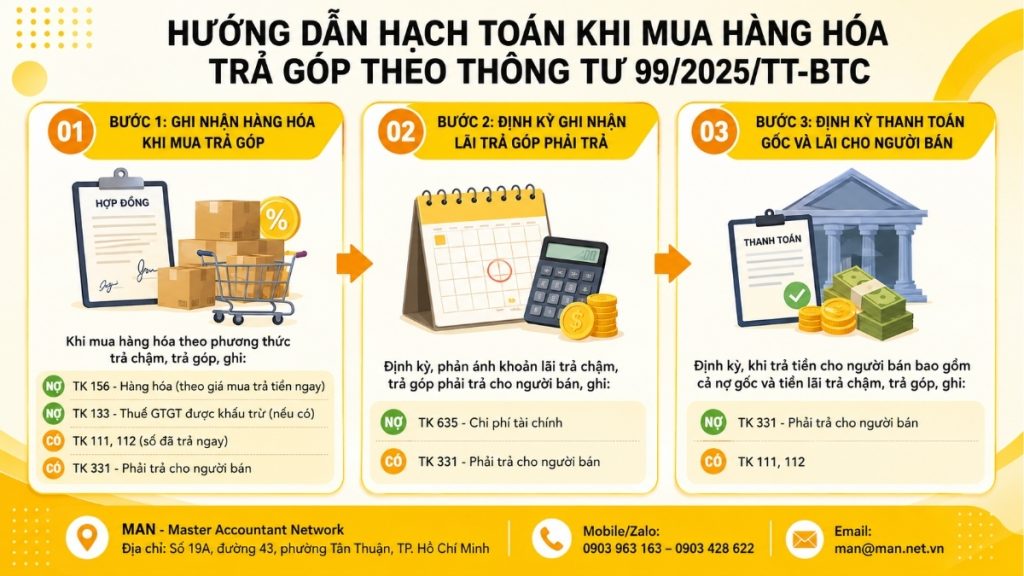
This is the most important part of accounting when purchasing goods on installment according to Appendix II of Circular 99/2025/TT-BTC, consisting of three fixed steps.
Step 1: Record the goods when purchasing on installment.
When purchasing goods using deferred payment or installment plans, record the following:
- Debit Account 156 – Goods (at cash purchase price)
- Debit Account 133 – Deductible VAT (if any)
- Accounts 111 and 112 (amounts paid immediately) are available.
- Account 331 – Accounts Payable to Suppliers.
Step 2 – Periodically record the installment interest payable.
Periodically, reflect the interest payable on late payments or installments to the seller, recording:
- Debit Account 635 – Financial Expenses
- Account 331 – Accounts Payable to Suppliers
Step 3 – Regularly make principal and interest payments to the seller.
Periodically, when making payments to the seller, including both principal and late payment/installment interest, record:
- Debit Account 331 – Accounts Payable to Suppliers
- There are accounts 111 and 112.
Accounting for the purchase of fixed assets and supplies through installment payments.
The accounting principles for purchasing goods on installment plans are applied similarly, only the account used to record the initial asset changes.
Purchase tangible fixed assets that can be put into immediate use:
- Debit Account 211 – Tangible Fixed Assets (recorded at the purchase price paid immediately)
- Debit Account 133 – Deductible VAT (1332) (if any)
- There are accounts 111, 112, 331…
Then, periodically record the installment interest in account 635 offsetting account 331, and periodically make principal and interest payments exactly as in step 3 above.
Purchase of intangible fixed assets:
- Debit Account 213 – Intangible Fixed Assets (Cash Purchase Price)
- Debit Account 133 – Deductible VAT (1332) (if any)
- There are accounts 111, 112, 331…
The procedure for recognizing interest and making periodic payments is similar to that for tangible fixed assets.
Purchase supplies, goods, and fixed assets for immediate use in production and business operations:
- Debit accounts 152, 153, 156, 211, 213 (at cash purchase price)
- Debit Account 133 – Deductible VAT (if any)
- There are accounts 111, 112, 331…
Simultaneously, businesses are required to maintain separate, detailed records of increases and decreases in interest payments for late payments and installments when purchasing assets; this is a general requirement applicable to all such cases.
Example illustrating accounting when purchasing goods on installment
Company B purchased a batch of goods for a cash purchase price (excluding VAT) of 200 million VND, with VAT of 20 million VND. The company paid 50 million VND immediately via bank transfer, and the remaining amount was paid in installments over 12 months, with monthly interest of 2 million VND.
Upon receiving the goods:
- Debit Account 156: 200 million VND
- Debit Account 133: 20 million VND
- Account 112 has 50 million VND.
- Account 331 has 170 million VND.
At the end of each month, record the installment interest:
- Debit account 635: 2 million VND
- Account 331 has 2 million VND.
When making installment payments (assuming equal monthly payments of 14.17 million VND plus interest):
- Debit Account 331: principal amount + interest paid during the period
- Account 112 has the same amount.
This method ensures that the book value of goods always accurately reflects the purchase price paid immediately, while all financial costs incurred due to delayed payments are separately recorded in account 635.
Determining the VAT taxable value when purchasing goods on installment.
An integral part of accounting when purchasing goods on installment plans is determining the VAT taxable value. According to the Value Added Tax Law 2024:
The VAT taxable price for goods sold on an installment or deferred payment basis is the one-time selling price of the goods, excluding VAT, and not including installment or deferred payment interest.
Principles for determining the VAT taxable value at Decree 181/2025/ND-CP also reaffirmed:
The taxable price includes surcharges and additional fees directly related to the goods, but excludes financial income unrelated to the sale of the goods.
Applying this to purchasing transactions: The deductible input VAT (Account 133) is calculated only on the cash purchase price, not on any interest accrued on installment payments later. This is the direct basis for declaring Account 133 in Step 1 above.
Common mistakes when accounting for installment purchases.
Here are some common mistakes when accounting for installment purchases:
- Including installment interest in the cost of goods sold (Account 156) instead of separating it into Account 635 distorts the cost of goods sold and gross profit.
- Declaring input VAT on the installment interest portion resulted in incorrect VAT deductions.
- Not maintaining detailed records of late payment interest and installment payments makes it difficult to reconcile accounts payable with suppliers and to provide explanations during settlement.
- Record the full installment interest payment at the time of purchase instead of allocating it over each payment period as the actual repayment obligation arises.
Why is it important to have an expert present when implementing Circular 99/2025?
The conversion of the accounting system and updating of accounting methods for installment purchases according to Circular 99/2025/TT-BTC requires a simultaneous review of accounting, inventory, and accounts receivable processes. For businesses with a large volume of installment transactions, one full accounting service This will help standardize accounting entries right from the beginning of the period, avoiding the need for retrospective adjustments when errors are discovered.
If a business simply needs to review recorded accounting entries or rebuild internal processes, that might be worth considering. accounting consulting services Based on the expertise and experience of our team, we will directly compare each specific case with Appendix II of Circular 99/2025/TT-BTC.
Quick checklist for accounting for installment purchase transactions.
Specifically:
- Separate the cash purchase price from the interest or installment payment portion in the sales contract.
- Record the correct corresponding asset accounts (156, 211, 213, 152, 153) at the cash purchase price.
- The deductible VAT is only accounted for on the portion of the purchase price paid immediately.
- Record the periodic installment interest payments in account 635, not all at once.
- Maintain a detailed record of increases and decreases in interest on late payments and installments.
- Compare the balance of account 331 with the contract and the payment schedule for each period.
Conclude
Accounting for installment purchases under Circular 99/2025/TT-BTC remains essentially unchanged from before, but requires accountants to cross-reference with Appendix II starting from the 2026 fiscal year. Three key points to remember:
- Record the asset at the cash purchase price;
- Record the periodic installment interest payments in account 635;
- And determine the VAT amount excluding the interest on installment payments.
If a business lacks the internal resources to fully update itself on the changes in Circular 99/2025/TT-BTC, the solution is... outsource accounting services This approach helps businesses ensure compliance with regulations without having to review all legal documents themselves.
Contact MAN – Master Accountant Network For free support and advice!
Contact information MAN – Master Accountant Network
- Address: No. 19A, Street 43, Tan Thuan Ward, Ho Chi Minh City
- Mobile/Zalo: 0903 963 163 – 0903 428 622
- E-mail: man@man.net.vn
- Google Business Profile: View MAN – Master Accountant Network's Google Business Profile
- LinkedIn Founder: View expert Le Hoang Tuyen's LinkedIn profile.
Responsible for production and professional content review by: Mr. Le Hoang Tuyen – Founder & CEO of MAN – Master Accountant NetworkHe is a CPA Vietnam auditor with over 30 years of in-depth experience in accounting, auditing, taxation, and corporate legal consulting.
Frequently Asked Questions about Accounting When Purchasing Goods on Installments
When accounting for goods purchased on installment plans, should the installment interest be included in the cost of goods sold?
No. Goods are recorded in account 156 at the cash purchase price; interest on delayed payments and installments is accounted for separately in account 635 – Financial expenses for each period.
On what price is input VAT calculated when purchasing goods on installment plans?
Calculated based on the cash purchase price, excluding installment interest and late payment interest, as stipulated in the Value Added Tax Law 2024 and Decree 181/2025/ND-CP.
Is the accounting treatment for purchasing fixed assets on installment different from that for purchasing goods on installment?
The principles are the same, only the accounts for recording assets are different: Account 211 for tangible fixed assets, Account 213 for intangible fixed assets, instead of Account 156 as for purchasing goods.
Is it mandatory for businesses to maintain a separate ledger to track installment interest payments?
Yes. According to Appendix II of Circular 99/2025/TT-BTC, businesses must maintain a detailed record of increases and decreases in interest payments on deferred and installment payments when purchasing assets.
When does Circular 99/2025/TT-BTC come into effect?
The Circular takes effect from January 1, 2026, and applies to fiscal years beginning on or after this date, replacing Circular 200/2014/TT-BTC.