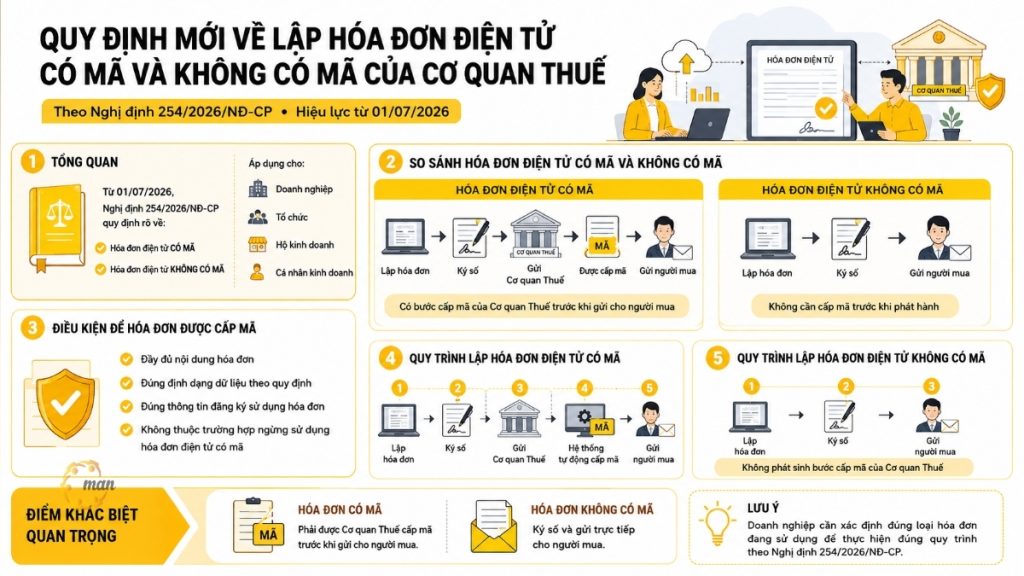
Issuing electronic invoices with and without tax authority codes is a topic of particular interest to many businesses, household businesses, and individual business owners. Decree 254/2026/ND-CP Officially effective from July 1, 2026, the Decree clearly stipulates the process for issuing electronic invoices with and without tax authority codes, as well as the requirements for the content of electronic invoices. Updating to these new regulations not only helps taxpayers fulfill their obligations according to the law but also minimizes errors in the process of creating, issuing, and sending electronic invoices to buyers. In this article, MAN – Master Accountant Network will summarize the important points regarding the creation of electronic invoices with and without codes according to Decree 254/2026/ND-CP, helping businesses easily understand and apply them correctly from July 1, 2026.
Overview of the new regulations on issuing electronic invoices with and without codes by the Tax Authority.
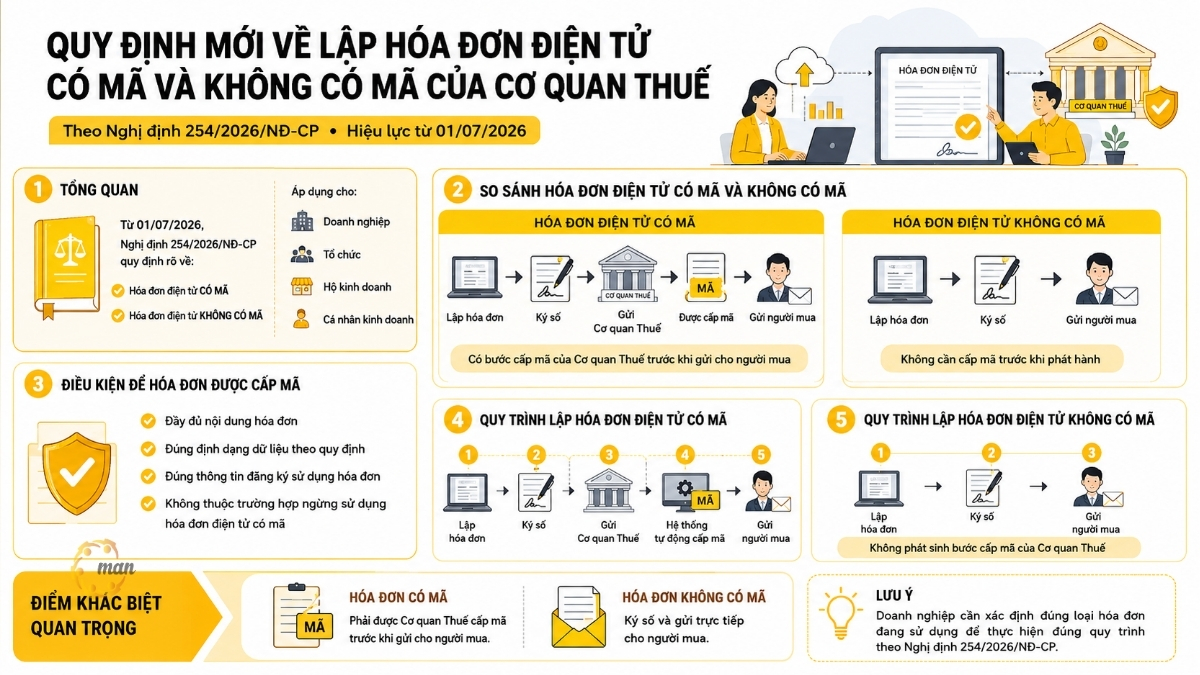
From July 1st, 2026, Decree 254/2026/ND-CP officially comes into effect, clearly regulating invoices, supporting documents, and the management of electronic invoices. This is a matter that businesses, household businesses, and individual business owners need to pay special attention to, as it directly relates to the creation of electronic invoices with and without codes during the sale of goods and provision of services.
The most important point is that the invoicing process is divided into two forms:
- Electronic invoices with tax authority codes: The seller creates the invoice, digitally signs it, and submits it to the tax authority to obtain a code before sending it to the buyer.
- Electronic invoices without a tax authority code: The seller creates the invoice, digitally signs it, and sends it directly to the buyer electronically in accordance with regulations.
In addition to the invoicing process, Decree 254/2026/ND-CP also stipulates:
- Conditions for electronic invoices to be issued a code;
- Required information on electronic invoices;
- Seller's responsibilities after the invoice has been issued with a code;
- How invoices are sent and received between sellers and buyers.
These regulations apply to economic organizations, other organizations, business households, and individual businesses within the scope of the decree. Therefore, businesses need to promptly review their processes, update their electronic invoicing software, and disseminate the new regulations to their accounting and sales departments to minimize errors.
One of the mandatory contents that must be included on an electronic invoice is: time of invoicingBusinesses need to determine the correct timeframe according to regulations to apply them precisely in each case.
In the following section, MAN will analyze and clarify the differences between electronic invoices with and without codes, along with detailed regulations to note according to Decree 254/2026/ND-CP.
See more: Full text of Decree 254/2026/ND-CP.
What is the difference between electronic invoices with and without codes?
The process for issuing electronic invoices, both with and without codes, differs. The biggest difference lies in the fact that electronic invoices with codes must be issued by the tax authorities before the seller sends them to the buyer, while electronic invoices without codes are created, digitally signed, and sent directly to the buyer electronically by the seller, in accordance with the law on electronic transactions.
To make it easier to understand, businesses can refer to the comparison table below.
| Criteria | Electronic invoices with codes | Electronic invoices without codes |
| Invoice creation process | Create invoices, digitally sign them, and submit them to the tax authorities to obtain a code before sending them to the buyer. | Generate invoices, digitally sign them, and send them directly to the buyer. |
| The tax authority issues the code. | The Tax Department's invoice code issuance system automatically issues codes and returns results to the sender. | Code not issued |
| Method of implementation | This can be done through the Tax Management Information System or via an electronic invoicing service provider. | This is done using the company's electronic invoicing software. |
| Time of delivery to buyer | After the invoice has been assigned a code by the tax authorities. | After the seller creates and digitally signs the electronic invoice. |
| Seller's responsibilities | Send the electronic invoice with the assigned code to the buyer using the method agreed upon by both parties. | Send electronic invoices to buyers via electronic means as agreed upon by both parties. |
As can be seen, although both are forms of electronic invoicing, with and without codes, as stipulated in Decree 254/2026/ND-CP, the procedures for issuing the two types of invoices differ significantly.
For electronic invoices with a tax authority code.
The seller cannot send the invoice immediately after creation. After creating and digitally signing the invoice, it must be sent to the tax authority for code issuance. Only when the Tax Department's system automatically issues the code and returns the result is the seller responsible for sending the coded electronic invoice to the buyer according to the agreed method, ensuring compliance with the law on electronic transactions.
In addition, sellers can issue invoices directly on the Tax Management Information System or through an electronic invoice service provider as prescribed.
For electronic invoices without a tax authority code.
According to Article 13 of Decree 254/2026/ND-CP, businesses using software to create electronic invoices when selling goods or providing services must digitally sign the electronic invoices and send them to buyers electronically as agreed upon between the seller and the buyer, ensuring compliance with the law on electronic transactions.
Therefore, with this method, the process does not include sending invoices to the tax authorities for a code before issuing them to the buyer.
Choosing and implementing the correct procedures for creating electronic invoices, both with and without codes, is crucial for compliance with electronic invoicing regulations. Each method has its own process, so businesses need to identify the correct method to use, ensuring that the creation, digital signing, sending of invoices, and related steps are carried out in accordance with the regulations of Decree 254/2026/ND-CP.
Regulations on issuing electronic invoices with codes
According to Clause 1, Article 12 of Decree 254/2026/ND-CP, the procedures for issuing electronic invoices with and without codes are different. For electronic invoices with a tax authority code, the seller must complete all steps from creating the invoice, digitally signing it, to submitting it to the tax authority to obtain a code before sending it to the buyer.
Following the correct procedures not only ensures that invoices meet regulatory requirements but also guarantees that invoice data is managed uniformly through the tax authority's system.
The entity issuing the electronic invoice has a code.
According to Clause 1, Article 12 of Decree 254/2026/ND-CP, economic organizations, other organizations, business households, and individual businesses falling under the scope of Article 6 of the Decree shall issue electronic invoices with tax authority codes as prescribed.
Users of electronic invoices with codes can choose one of two methods:
- Directly on the Tax Management Information System;
- Or through an electronic invoicing service provider.
Regardless of the method chosen, invoicing must still be carried out in accordance with the procedures stipulated in Article 12 of Decree 254/2026/ND-CP.
The process of creating electronic invoices with codes.
The process for issuing electronic invoices with and without codes differs significantly in the tax authority's code issuance step. For electronic invoices with codes, the seller follows this procedure:
| Step | Implementation content |
| Step 1 | The seller issues an invoice for the sale of goods or provision of services in accordance with regulations. |
| Step 2 | After completing the invoicing process, the seller digitally signs the generated electronic invoice. |
| Step 3 | Digitally signed electronic invoices are sent to the tax authorities through the Tax Management Information System or through an electronic invoice service provider to request a code. |
| Step 4 | The Tax Department's invoice code issuance system automatically issues codes and sends the results back to the sender. |
| Step 5 | After the invoice has been assigned a code by the tax authority, the seller is responsible for sending the electronic invoice to the buyer using the method agreed upon by both parties, ensuring compliance with the law on electronic transactions. |
In the case of issuing electronic invoices with codes through a service provider.
In addition to directly accessing the Tax Management Information System, Clause 1, Article 12 of Decree 254/2026/ND-CP also stipulates that sellers can use the services of organizations providing electronic invoice services.
Accordingly, economic organizations, other organizations, business households, and individual businesses shall comply with the following:
- Step 1: Access the website of the electronic invoice service provider or use the electronic invoice software provided by the service provider.
- Step 2: Prepare invoices for the sale of goods and provision of services.
- Step 3: Digitally sign the generated electronic invoice.
- Step 4: Submit the invoice through the electronic invoice service provider so that the tax authority can issue a code.
Therefore, when using the services of an electronic invoicing solution provider, businesses do not send invoices directly to the tax authorities; instead, data transmission is carried out through the service provider in accordance with regulations.
Conditions for electronic invoices to be issued a code by the tax authority.
Not all invoices submitted to the tax authorities are assigned a code. According to Clause 2, Article 12 of Decree 254/2026/ND-CP, electronic invoices are only assigned a code when they fully meet the prescribed conditions.
Specifically, the invoice must ensure:
- The electronic invoice contains all the information required by Article 10 of Decree 254/2026/ND-CP.
- The electronic invoice must conform to the format prescribed by the Minister of Finance.
- The registration information is correct as prescribed by the Minister of Finance.
- This does not fall under the cases where the use of electronic invoices with tax authority codes is discontinued, as stipulated by the Minister of Finance.
These are important conditions that businesses and accountants need to check before submitting invoices to the tax authorities in order to minimize the risk of invoices not meeting regulatory requirements.
The invoice code generation system is automated.
Clause 3, Article 12 of Decree 254/2026/ND-CP stipulates that the tax authority's invoice code issuance system automatically issues invoice codes and sends the results back to the sender.
After receiving the electronically coded invoice, economic organizations, other organizations, business households, and individuals selling goods or providing services are responsible for sending that electronic invoice to the buyer. The method of sending and receiving invoices shall be in accordance with the agreement between the seller and the buyer, and must comply with the provisions of the law on electronic transactions.
Therefore, in the process of issuing electronic invoices with and without codes, the core difference is that electronic invoices with codes must go through the tax authority's code issuance step before being sent to the buyer. This is also a point that business accountants need to pay special attention to when implementing the process of creating and issuing electronic invoices from July 1, 2026.
Regulations on issuing electronic invoices without a tax authority code.
After understanding the process of creating electronic invoices with codes, businesses also need to be aware of the regulations applicable to electronic invoices without codes.
According to Article 13 of Decree 254/2026/ND-CP, businesses using software to create electronic invoices when selling goods or providing services must digitally sign the electronic invoices and send them to buyers electronically as agreed upon between the seller and the buyer, ensuring compliance with the law on electronic transactions.
As can be seen, the process of creating electronic invoices with and without codes is simpler for electronic invoices without codes because there is no step of sending the invoice to the tax authority to obtain a code before issuance.
The process of creating electronic invoices without a code.
Based on the provisions of Article 13 of Decree 254/2026/ND-CP, enterprises shall follow the following procedure:
| Step | Implementation content |
| Step 1 | Use software to generate electronic invoices when selling goods or providing services. |
| Step 2 | Digitally sign the generated electronic invoice. |
| Step 3 | Send electronic invoices to buyers using electronic methods as agreed upon between the seller and buyer, ensuring compliance with legal regulations on electronic transactions. |
Compared to electronic invoices with tax authority codes, this process does not involve the step of sending the invoice to the tax authority for code issuance before the invoice is sent to the buyer.
Businesses should take note when issuing electronic invoices that do not have a tax authority code.
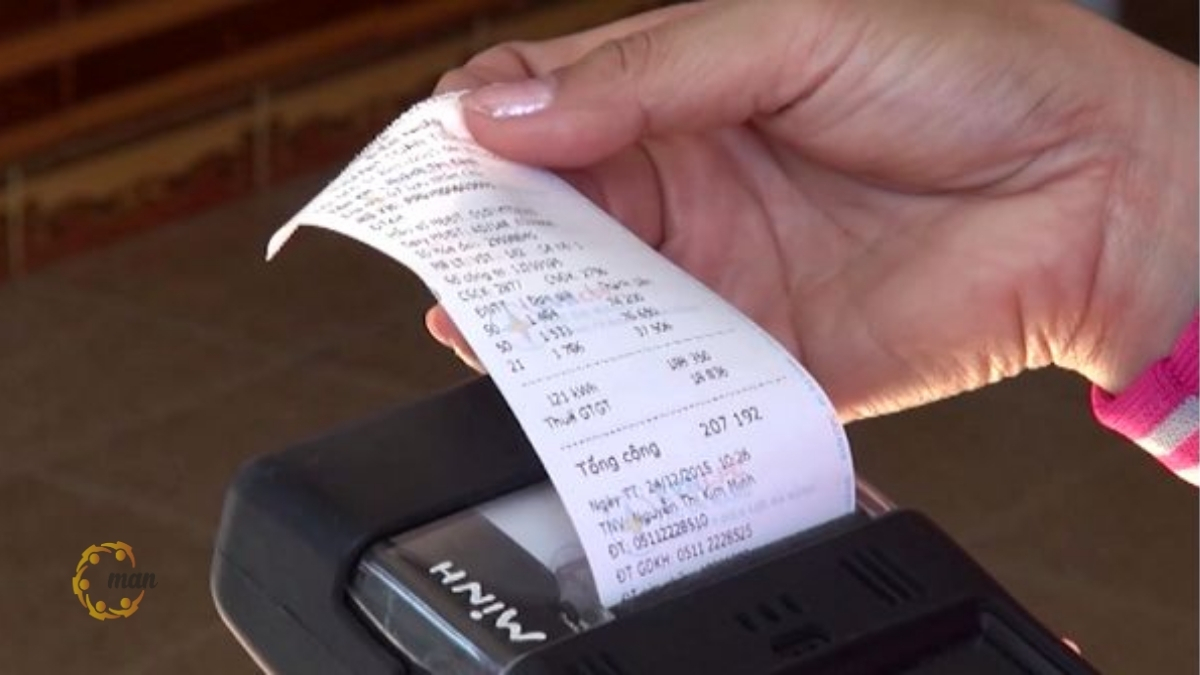
Even without going through the tax authority's code issuance procedure, businesses must still fully comply with the steps stipulated in Article 13 of Decree 254/2026/ND-CP.
Specifically, digitally signing the electronic invoice before sending it to the buyer is a step in the process stipulated in Article 13. Furthermore, the method of sending the electronic invoice must be in accordance with the agreement between the seller and the buyer and must comply with the legal regulations on electronic transactions.
Businesses also need to ensure that electronic invoices are generated using electronic invoicing software and contain all the mandatory information required by law.
Comparing the electronic invoicing process with and without codes.
To easily distinguish between the two forms, businesses can refer to the summary table below.
| Criteria | Electronic invoices with codes | Electronic invoices without codes |
| Legal basis | Article 12 of Decree 254/2026/ND-CP | Article 13 of Decree 254/2026/ND-CP |
| Invoice software | Have | Have |
| Digitally sign the invoice. | Have | Have |
| To the Tax Authority | Have | Are not |
| Send the invoice to the buyer. | After being assigned the code | After digitally signing the invoice |
| Invoice delivery method | According to the agreement between the seller and the buyer, in accordance with the regulations on electronic transactions. | According to the agreement between the seller and the buyer, in accordance with the regulations on electronic transactions. |
As can be seen from the comparison table, the key difference is that electronic invoices with codes must be issued by the tax authority before being sent to the buyer, while electronic invoices without codes do not have this step.
Understanding the correct procedures for each type of invoice will help businesses apply the regulations of Decree 254/2026/ND-CP correctly, while minimizing errors in the process of creating and issuing electronic invoices.
In addition to understanding the process of creating electronic invoices with and without codes, businesses can refer to the regulations. Issuing invoices according to Decree 254 To apply the correct method in each situation that arises, minimize errors in the invoice issuance process.
Conclude
From July 1st, 2026, businesses, economic organizations, household businesses, and individual business owners are required to issue electronic invoices with and without codes in accordance with the regulations in Decree 254/2026/ND-CP.
Each type of invoice has its own process. Electronic invoices with codes must be issued by the tax authority before being sent to the buyer, while electronic invoices without codes are created, digitally signed, and sent directly according to regulations.
At the same time, electronic invoices must fully comply with all mandatory content and format requirements as stipulated in current regulations. Timely updating of new regulations, reviewing processes, and using appropriate electronic invoicing software will help businesses comply with the law, minimize errors, and improve efficiency in invoice management.
Staying up-to-date with new regulations, standardizing invoicing processes, and building a robust accounting system will help businesses minimize risks in complying with tax laws. If your business needs support in implementing or reviewing its accounting processes, full accounting service MAN's solution will help optimize resources and ensure compliance with current regulations.
Contact MAN – Master Accountant Network For free support and advice!
Contact information MAN – Master Accountant Network
- Address: No. 19A, Street 43, Tan Thuan Ward, Ho Chi Minh City
- Mobile/Zalo: 0903 963 163 – 0903 428 622
- E-mail: man@man.net.vn
- Google Business Profile: View MAN – Master Accountant Network's Google Business Profile
- LinkedIn Founder: View expert Le Hoang Tuyen's LinkedIn profile.
Responsible for production and professional content review by: Mr. Le Hoang Tuyen – Founder & CEO of MAN – Master Accountant NetworkHe is a CPA Vietnam auditor with over 30 years of in-depth experience in accounting, auditing, taxation, and corporate legal consulting.
Frequently Asked Questions about Electronic Invoices with and without Codes
The core difference lies in the tax authority's role in issuing the code. Invoices with codes must be sent to the Tax Management Information System for code issuance before being sent to the buyer, while invoices without codes are created, digitally signed, and sent directly to the buyer by the business itself.
The entities to which electronic invoices with codes apply are specifically defined in Article 6 of Decree 254/2026/ND-CP, including economic organizations, other organizations, business households, and individual businesses falling under the prescribed categories.
No. According to Article 13 of Decree 254/2026/ND-CP, businesses can create, digitally sign, and send invoices directly to buyers without waiting for the tax authorities to issue a code or approve it beforehand.
Not mandatory. According to Article 10 of Decree 254/2026/ND-CP, the digital signature of the buyer is not required on electronic invoices, unless the buyer and seller have agreed otherwise. What is the difference between electronic invoices with and without codes?
Who is required to issue electronic invoices with a tax authority code?
Do electronic invoices without a code need prior approval from the Tax Authority?
Do electronic invoices with codes require the buyer's digital signature?