
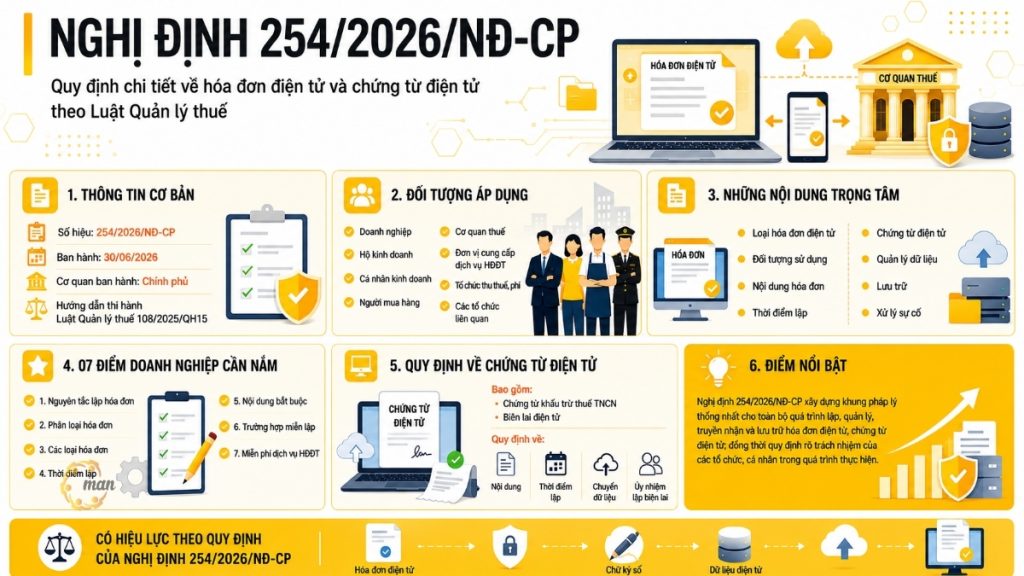
Decree 254/2026/ND-CP It is a government document that specifies certain provisions and measures for organizing and guiding implementation. Law on Tax Administration No. 108/2025/QH15 Regarding electronic invoices and electronic documents, the Decree fully regulates important contents such as the subjects using electronic invoices, types of invoices, the time of invoice creation, invoice content, principles of management, storage, conversion, troubleshooting, as well as the responsibilities of relevant organizations and individuals. In this article, MAN – Master Accountant Network comprehensively summarizes and analyzes the prominent regulations of Decree 254/2026/ND-CP based on the content of the legal document, helping businesses, business households, and accountants easily look up, update, and correctly apply the regulations in practice..
What is Decree 254/2026/ND-CP? Legal basis and scope of application.

Decree 254/2026/ND-CP, issued by the Government, contains the following basic information:
| Number | 254/2026/ND-CP |
| Date of issuance | 30/6/2026 |
| Issuing authority | Government |
| Basis for issuance | Law on Government Organization No. 63/2025/QH15 and Law on Tax Administration No. 108/2025/QH15. |
| Document title | This document details certain provisions and measures for organizing and guiding the implementation of Law No. 108/2025/QH15 on Tax Administration regarding electronic invoices and electronic documents. |
As a guiding document for the implementation of the Law on Tax Administration, Decree 254/2026/ND-CP specifically regulates matters related to electronic invoices and electronic documents, creating a legal basis for organizations and individuals to uniformly implement their tax obligations.
Scope of regulation
Article 1 of Decree 254/2026/ND-CP stipulates that the scope of application includes detailed guidance on Clause 6 of Article 26, Clause 4 of Article 27, and Clause 5 of Article 52 of the Law on Tax Administration No. 108/2025/QH15 regarding electronic invoices and electronic documents.
Regulations on electronic invoices
Regarding electronic invoices, Decree 254/2026/ND-CP specifies the following details:
- Electronic invoice type.
- Who uses electronic invoices?
- Contents of the electronic invoice.
- The time of issuing the electronic invoice.
- Cases where electronic invoices are not required.
- The service is free of charge for the use of electronic invoices.
- The duties, powers, and responsibilities of organizations and individuals in managing and using electronic invoices.
These provisions form a unified regulatory system to ensure that entities comply with regulations when engaging in the sale of goods or provision of services.
Regulations on electronic documents
In addition to electronic invoices, the Decree also provides specific guidance on electronic documents. The provisions include:
- Electronic document type.
- Content of the electronic document.
- The time of creating the electronic document.
- Methods for creating electronic documents.
- Electronic tax administration documents.
- Connecting and transmitting electronic document data.
- The service is free of charge if electronic documents are used.
- Responsibilities of organizations and individuals in managing and using electronic documents.
The regulation synchronizing electronic invoices and electronic documents contributes to unifying the database for tax management purposes.
Other management provisions are stipulated.
In addition to direct regulations on electronic invoices and electronic documents, the document also stipulates many contents serving tax management work, including:
- Principles for creating, managing, and using electronic invoices and electronic documents.
- Preserving, storing, and converting electronic invoices and electronic documents.
- Regulations regarding the issuance of electronic invoices with tax authority codes and electronic invoices without tax authority codes.
- Regulations on handling incidents during the use of electronic invoices.
- Regulations regarding authorization for issuing receipts.
- Develop information technology infrastructure to support the electronic invoicing and electronic document system.
- Collect, process, and manage the electronic invoice database.
- Searching, providing, and using electronic invoice information.
- The responsibility for sharing and connecting data between relevant agencies and organizations.
- Regulations regarding rewarding consumers who report sellers who fail to issue and deliver electronic invoices as required.
As can be seen, the scope of the Decree does not stop at guiding the preparation of invoices but also covers the entire process of managing electronic invoice data from generation, transmission, storage to exploitation and use of information.
The subjects to which this Decree 254/2026/ND-CP applies are those specified in Decree 254/2026/ND-CP.
Decree 254/2026/ND-CP clearly defines 8 groups of subjects to which it applies in Article 2, including:
- Organizations and individuals selling goods or providing services (collectively referred to as sellers), including enterprises, cooperatives, cooperative unions, branches or representative offices of foreign enterprises; household businesses, individual businesses, cooperative groups; public service units that sell goods or provide services; and foreign organizations doing business on e-commerce platforms or digital platforms that generate taxable revenue in Vietnam.
- Organizations and individuals purchasing goods and services.
- The organization collects taxes, fees, and charges.
- Taxpayers, fee payers.
- Organizations and individuals are responsible for withholding tax, filing tax returns, and paying taxes on behalf of others.
- Organizations providing electronic invoicing and electronic document services.
- Tax administration agency.
- Other relevant organizations and individuals.
Defining the full scope of application helps ensure that all entities involved in the creation, management, transmission, and use of electronic invoices comply consistently with legal regulations.
For many businesses, especially small and medium-sized enterprises or those without a dedicated accounting department, updating and correctly applying the regulations of the Decree can be quite challenging. In this case, hire accounting services It is a solution that helps businesses comply with regulations on electronic invoices, electronic documents, and related tax obligations, while minimizing risks in the declaration and record management process.
Key points of Decree 254/2026/ND-CP on electronic invoices
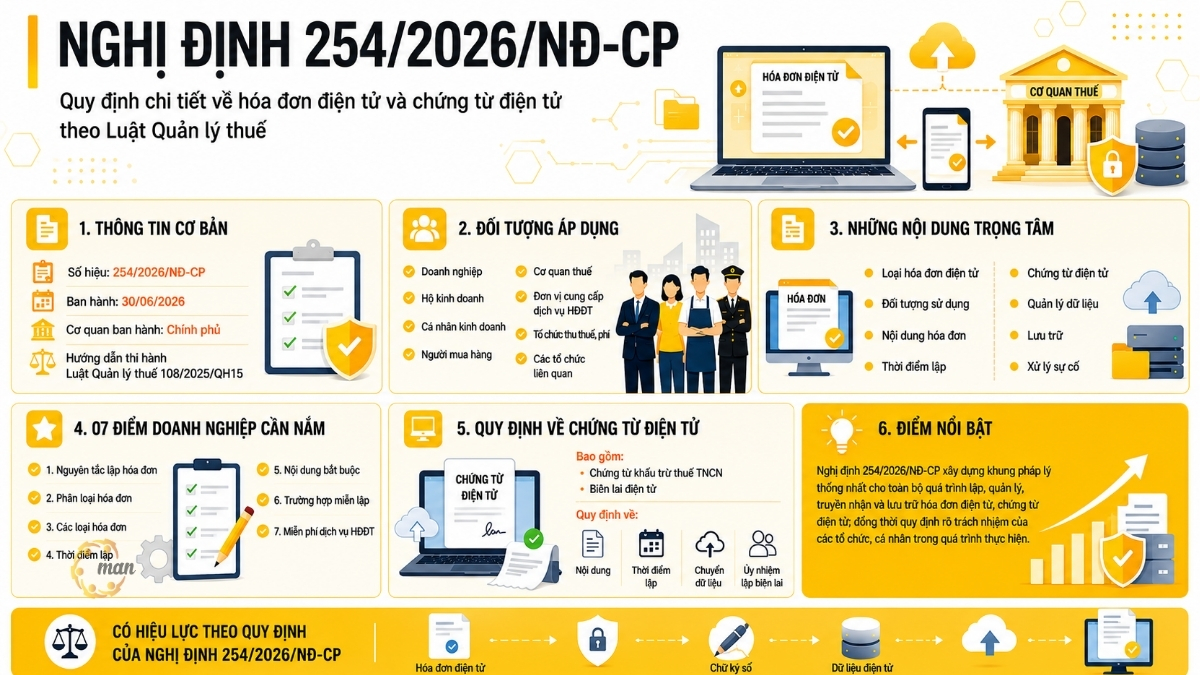
Key Points of Decree 254/ND-CP on Electronic Invoices
Decree 254 focuses on clarifying seven key areas that businesses and household businesses must understand in order to apply them correctly from the outset, specifically as follows:
Principles for creating, managing, and using electronic invoices.
Article 4 of Decree 254/2026/ND-CP affirms the overarching principle:
When selling goods or providing services, sellers must issue electronic invoices to buyers, even in cases where goods or services are used for promotions, advertising, samples, gifts, exchanges, as payment in lieu of employee wages, internal consumption, or as loans or borrowings.
According to Decree 254, electronic invoices must comply with standard data formats, record all content as prescribed by tax and accounting laws, and accurately and truthfully reflect the economic transactions that have occurred. The seller is legally responsible for the accuracy of the issued invoice.
Key points to note: Decree 254/2026/ND-CP allows sellers to authorize third parties to issue electronic invoices, as well as allowing fee-collecting organizations to authorize the issuance of receipts, provided that the authorization is established in writing and notified to the tax authorities.
The entities using electronic invoices include those with and without tax authority codes.
This is a topic of great interest to many accountants, as correctly identifying the type of invoice to use directly impacts a business's operational processes. According to Article 6, the entities using electronic invoices are divided into three main groups:
| Target group | Applicable invoice type | Conditions/Areas |
| Economic organizations, other organizations, business households, and individual businesses in general (including high-risk tax cases) | Electronic invoices have a tax authority code. | The default settings apply, unless you fall into one of the two groups below. |
| The company has built IT infrastructure and accounting software that meets the requirements for transmitting and storing invoice data. | Electronic invoices without a tax authority code. | Electricity, petroleum, postal services, telecommunications, clean water, finance and banking, securities, cryptocurrencies, trading support services on carbon exchanges, insurance, healthcare, e-commerce, supermarkets, trade, air transport, road transport, rail transport, sea transport, inland waterway transport. |
Furthermore, Decree 254 stipulates that business households and individual businesses with annual revenue exceeding 1 billion VND or those selling assets requiring registration of ownership or usage rights are required to use electronic invoices with tax authority codes or electronic invoices generated from cash registers connected to the tax authority's data system.
In addition to understanding legal regulations, businesses also need to establish procedures for controlling the creation, issuance, and storage of electronic invoices. For organizations requiring in-depth consulting on accounting system organization and compliance control, hire chief accountant This will help review the process of creating and managing electronic invoices, and provide advice on the correct application of tax management regulations.
Types of electronic invoices according to Decree 254/2026/ND-CP
Article 8 of the Decree clarifies the types of invoices to be used, including:
- Value-added tax (VAT) invoice: For economic organizations declaring VAT using the deduction method, used for domestic sales, international transportation, exports to free trade zones, and exports of goods/services abroad.
- Sales invoice: For organizations, business households, and individuals declaring VAT using the direct method, or organizations and individuals in non-taxable zones.
- Electronic commercial invoices: Applicable to the export of goods and provision of services abroad when the exporter meets the conditions for transferring commercial invoice data electronically to the tax authorities.
- Electronic invoices for the sale of public assets and electronic invoices for the sale of national reserve goods.
- Other types of invoices: Stamps, tickets, cards; air freight payment receipts; international transport fee receipts; bank service fee receipts.
In addition, Decree 254/2026/ND-CP also stipulates that documents registered, used, and managed like invoices include internal warehouse release and transportation slips and warehouse release slips for goods consigned to agents.
Regulations specifying the timing for issuing electronic invoices, detailed by industry.
One of the most complex and important aspects of the Decree is the regulation on the timing of invoice issuance in Article 9. In general, for the sale of goods, the time of invoice issuance is the time of transfer of ownership or the right to use the goods to the buyer, regardless of whether payment has been received or not. For the provision of services, the time of invoice issuance is the time of completion of the service, or the time of payment if payment is received before or during the provision of the service.
The table below clearly shows each industry group with regulations regarding the timing of issuing electronic invoices:
| Occupation | Time of issuing electronic invoices |
| Exporting goods | No later than the next working day after the goods are cleared through customs. |
| Construction and installation | Time of acceptance and handover of the construction project or project component. |
| Real estate business | If ownership has not yet been transferred but payments are collected in installments: the payment date or the payment schedule as agreed in the contract. |
| Telecommunications services, information technology, data | No later than two months from the month the service fee was incurred. |
| Retail sale of petroleum products | The time when gasoline and diesel sales end for each sale. |
| Passenger transportation by ride-hailing taxis using software for calculating fares. | At the end of the trip |
| Medical examination and treatment facilities | At the end of the day, compile a summary and prepare an invoice if the customer does not request one immediately. |
| Casino activities, electronic games with prizes. | No later than one day from the end of the revenue determination period. |
| Electronic toll collection is not available. | The day vehicles pass through the toll station, or periodically at the end of the month. |
Understanding the invoicing deadlines as stipulated in Decree 254/2026/ND-CP helps businesses avoid the risk of penalties for issuing invoices at the wrong time, one of the most common errors in accounting and tax practice.
To ensure timely tax declarations, reports, and fulfillment of tax obligations, and to minimize errors in the application of electronic invoice regulations, businesses should consider exploring the following solutions. hire an accountant to prepare tax reports. from specialized and experienced organizations such as MAN – Master Accountant Network.
Required information on electronic invoices
According to Article 10 of Decree 254/2026/ND-CP, a valid electronic invoice must contain all of the following information:
- Invoice name, invoice symbol, invoice form number symbol
- Invoice number
- Name, address, and tax identification number of the seller
- Name, address, tax identification number, or personal identification number of the buyer
- Name, unit of measurement, quantity, and unit price of goods and services.
- Amount before tax, tax rate, VAT amount, total payment
- Signatures of the seller and the buyer (the buyer's digital signature is not required unless otherwise agreed).
- Invoice date
- Time of digital signature
- Tax authority code (if applicable)
- Other information such as fees, charges, trade discounts, and promotions, if any.
Specifically for electronic invoices generated from cash registers, Decree 254 stipulates a simpler content requirement, but it must still ensure the core elements:
- Name, address, and tax identification number of the seller
- Name of goods/services, unit price, quantity, payment amount
- Invoice date
- The tax authority code or electronic data is available for buyers to look up.
Cases where electronic invoices are not required.
Not all transactions are required to be invoiced electronically. Article 7 specifies the cases that are exempt, specifically:
- Household businesses and individual business owners are required to prepare a list of purchased goods and services.
- Income from renting real estate or providing digital content products and services to foreign organizations or individuals.
- Lottery agents, insurance agents, and sales agents have had taxes deducted.
- Fees from reinsurance activities, deposit taking, foreign exchange transactions, and derivative products.
- Contributing capital in the form of assets
- Assets transferred internally between subsidiary accounting units.
- Machinery and equipment are provided free of charge.
Clearly distinguishing between cases where the use of electronic invoices is mandatory and those where it is not required, as stipulated in Decree 254/2026/ND-CP, helps businesses optimize their operational processes and avoid unnecessary costs or procedures.
Cases where electronic invoicing services are free of charge.
One notable aspect of Decree 254/ND-CP is the policy supporting small businesses and household businesses in disadvantaged areas. According to Article 11:
Small and medium-sized enterprises, cooperatives, cooperative unions, household businesses, and individual businesses in areas with difficult or extremely difficult socio-economic conditions are exempt from electronic invoice service fees for 12 months from the start of use, either directly implemented by the Tax Department or delegated to an electronic invoice service provider.
Regulations on electronic documents in Decree 254/2026/ND-CP
Besides electronic invoices, Decree 254 dedicates Chapter III to regulating electronic documents in the field of tax, fee, and charge management. According to Article 22, electronic documents include two main types:
- Personal income tax deduction certificate
- Receipts for taxes, fees, and charges.
Content and timing of creating electronic documents
The personal income tax deduction certificate must show the following in full:
- Name, form symbol, document serial number
- Information about the organization or individual paying the income.
- Personal information for receiving income
- Income, total taxable income, amount of tax withheld.
- Date of document creation
- The signature of the income payer (which is a digital signature for electronic documents).
Regarding the timing of establishment, Article 24 of Decree 254/2026/ND-CP stipulates:
At the time of withholding personal income tax or collecting taxes, fees, and charges, the responsible organization must immediately issue a document to the taxpayer, except in certain exceptional cases such as individuals authorizing tax settlement, or income from the transfer of securities, capital investments, crypto assets, gold bars, copyrights, etc., which have already been withheld and taxed at source, in which case a separate withholding document is not required.
Authorization for receipt generation and data transfer responsibility.
Decree 254/2026/ND-CP allows tax, fee, and levy collection organizations to authorize a third party to issue receipts, provided that the authorization is in writing and notified to the directly managing tax authority at least 3 days before the authorized party issues the receipt. The authorized party is responsible for issuing receipts accurately reflecting the actual transactions and transferring electronic receipt data to the directly managing tax authority or through a service provider.
What steps do businesses need to take to comply with Decree 254/2026/ND-CP?
Review the currently used electronic invoice format.
The first thing businesses need to do after the Decree officially takes effect on July 1, 2026, is to review whether their unit falls under the category specified in Article 6. This will allow them to accurately determine whether they need to use electronic invoices with codes, without codes, or invoices generated from cash registers. Using the wrong type of invoice not only creates difficulties in tax declaration but also carries the risk of penalties.
Update accounting and electronic invoicing software to the new standard data format.
Decree 254/2026/ND-CP requires electronic invoice and document data to comply with the standard data format prescribed by the Minister of Finance. Therefore, businesses need to proactively work with their electronic invoice software providers to ensure that the system meets the requirements for connecting and transmitting data with tax authorities in accordance with the new regulations.
Training and updating the accounting department on new regulations.
Decree 254/2026/ND-CP specifies the timing of invoice issuance in great detail for each business sector. This is also the most complex and important aspect, and businesses should organize training and update the knowledge of their accounting staff to ensure invoices are issued on time, avoiding tax arrears and penalties during tax audits and inspections.
In reality, not every business has the resources to independently review each clause and apply it accurately from the outset. In cases where there are uncertainties when implementing and applying Decree 254/20206/ND-CP in practice, it is advisable to refer to relevant regulations. full accounting service Consulting with specialized and experienced organizations like MAN – Master Accountant Network will help ensure a smooth transition, minimize errors, and guarantee compliance with regulations right from the start.
Conclude
Decree 254/2026/ND-CP is an important document detailing and guiding the implementation of Law No. 108/2025/QH15 on Tax Administration regarding electronic invoices and electronic documents. The Decree comprehensively regulates all aspects, from the scope of application, types of invoices, issuance time, invoice content, to the principles of management, storage, data transmission, and the responsibilities of relevant organizations and individuals.
Businesses, household businesses, and accountants need to study and fully update themselves on the regulations of Decree 254/2026/ND-CP to implement them correctly according to the law, ensuring the creation, management, and use of electronic invoices and electronic documents are consistent, accurate, and in line with current tax management requirements.
For any questions or assistance, please contact us. Contact MAN – Master Accountant Network:
Contact information MAN – Master Accountant Network
- Address: No. 19A, Street 43, Tan Thuan Ward, Ho Chi Minh City
- Mobile/Zalo: 0903 963 163 – 0903 428 622
- E-mail: man@man.net.vn
- Google Business Profile: View MAN – Master Accountant Network's Google Business Profile
- LinkedIn Founder: View expert Le Hoang Tuyen's LinkedIn profile.
Responsible for production and professional content review by: Mr. Le Hoang Tuyen – Founder & CEO of MAN – Master Accountant NetworkHe is a CPA Vietnam auditor with over 30 years of in-depth experience in accounting, auditing, taxation, and corporate legal consulting.
Frequently Asked Questions about Decree 254/2026/ND-CP
Decree 254/2026/ND-CP applies to organizations and individuals selling goods and providing services; buyers of goods and services; organizations collecting taxes, fees, and charges; taxpayers; organizations and individuals responsible for tax withholding; organizations providing electronic invoice and electronic document services; tax authorities; and other relevant organizations and individuals as stipulated in the Decree.
According to Decree 254/2026/ND-CP, the electronic invoice system includes various types such as value-added tax invoices, sales invoices, electronic invoices generated from cash registers, e-commerce invoices, and other types of invoices as prescribed. The choice of invoice type depends on the target and business activities of each organization or individual.
Yes, for household businesses and individual business owners with annual revenue exceeding 1 billion VND or those selling assets requiring registration of ownership or usage rights, Decree 254/2026/ND-CP stipulates that they must use electronic invoices with tax authority codes or electronic invoices generated from cash registers.
Electronic invoices generated from cash registers are mandatory for sectors selling directly to consumers such as supermarkets, retail, food and beverage, restaurants, hotels, passenger transport services, entertainment, etc., and do not require a digital signature.
Electronic invoices are associated with the sale of goods and provision of services between sellers and buyers, while electronic documents, according to Decree 254/2026/ND-CP, are documents arising in the field of tax, fee, and charge management, including personal income tax withholding certificates and receipts for tax, fee, and charge collection issued by tax withholding organizations or fee and charge collection organizations. Which entities are covered by Decree 254/2026/ND-CP?
What types of electronic invoices are stipulated in Decree 254?
Is it mandatory for household businesses to use electronic invoices according to Decree 254?
What does Decree 254/2026/ND-CP stipulate regarding electronic invoices generated from cash registers?
What is the difference between electronic invoices and electronic documents under Decree 254?