
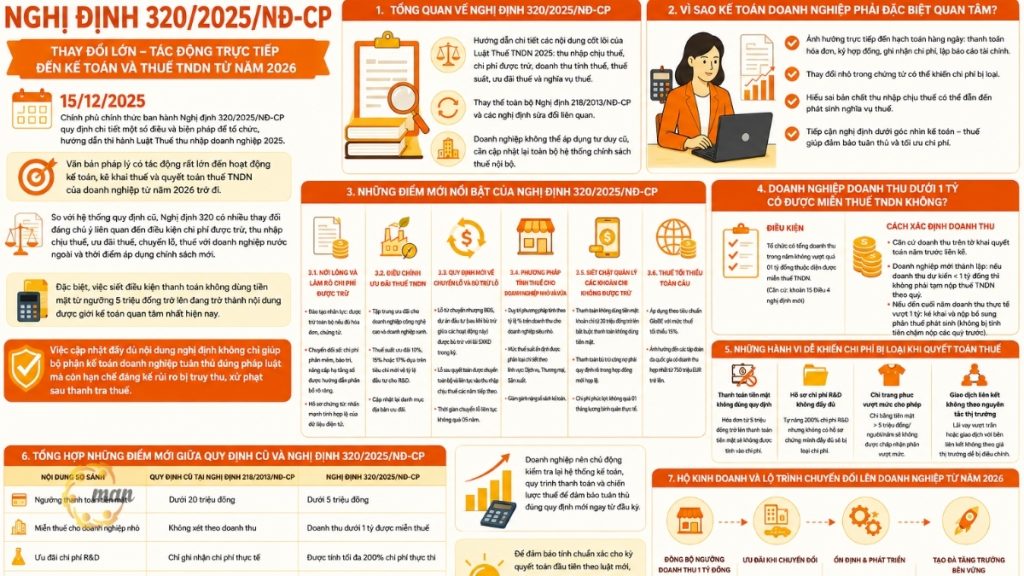
On December 15, 2025, the Government officially issued... Decree 320/2025/ND-CP This document details certain provisions and measures for organizing and guiding the implementation of the Corporate Income Tax Law 2025. This legal document has a significant impact on accounting, tax declaration, and corporate income tax settlement activities for businesses from 2026 onwards.
Compared to the old regulatory system, Decree 320/2025/ND-CP introduces several notable changes related to deductible expenses, taxable income, tax incentives, loss carryforward, taxes for foreign businesses, and the timing of the new policy's application. In particular, the tightening of non-cash payment requirements, requiring a minimum payment of 5 million VND, is currently the most discussed topic among accountants.
Staying fully updated on the decree's content not only helps corporate accounting departments comply with the law but also significantly reduces the risk of being subject to back taxes or penalties after tax audits.
Overview of Decree 320/2025/ND-CP
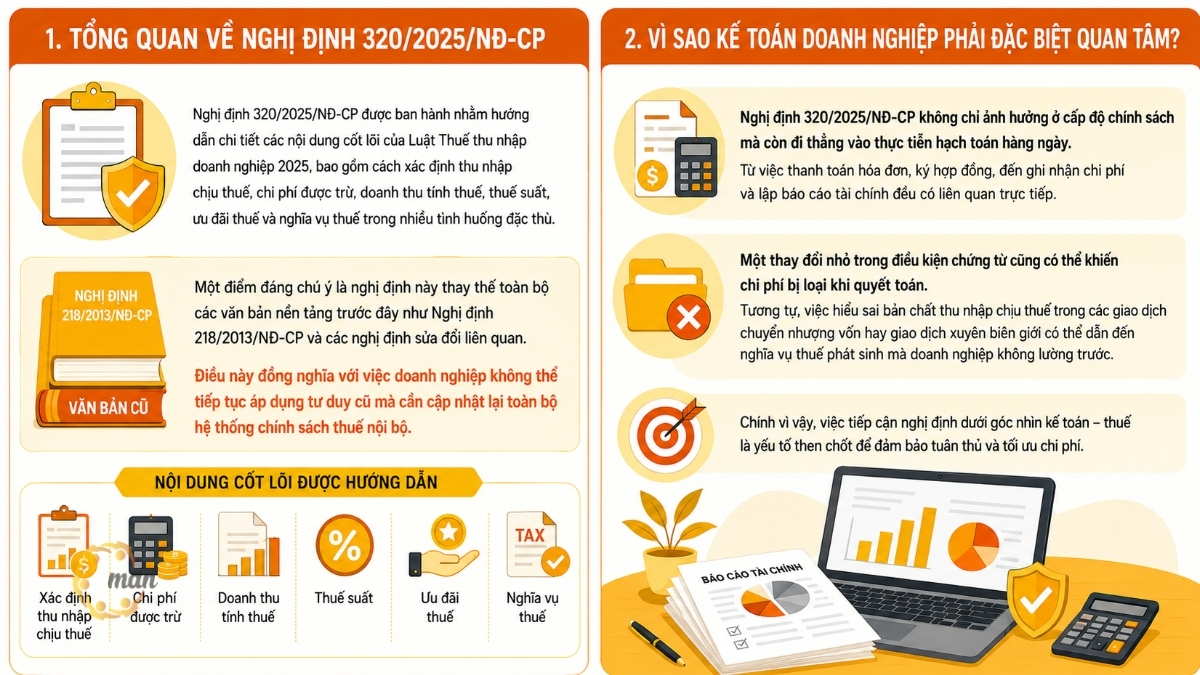
Decree 320/2025/ND-CP was issued to provide detailed guidance on the core contents of the 2025 Corporate Income Tax Law, including how to determine taxable income, deductible expenses, taxable revenue, tax rates, tax incentives, and tax obligations in various specific situations.
One notable point is that this decree completely replaces all previous foundational documents such as Decree 218/2013/ND-CP and related amending decrees. This means that businesses can no longer continue to apply outdated thinking and need to update their entire internal tax policy system.
Why is corporate accounting so important?
Decree 320/2025/ND-CP not only has an impact at the policy level but also directly affects daily accounting practices. From paying invoices and signing contracts to recording expenses and preparing financial statements, everything is directly related.
Even a minor change in documentation can cause expenses to be disallowed during tax settlement. Similarly, misunderstanding the nature of taxable income in capital gains or cross-border transactions can lead to unforeseen tax liabilities for the business.
Therefore, approaching the decree from an accounting and tax perspective is crucial to ensuring compliance and optimizing costs.
Key new features of Decree 320/2025/ND-CP
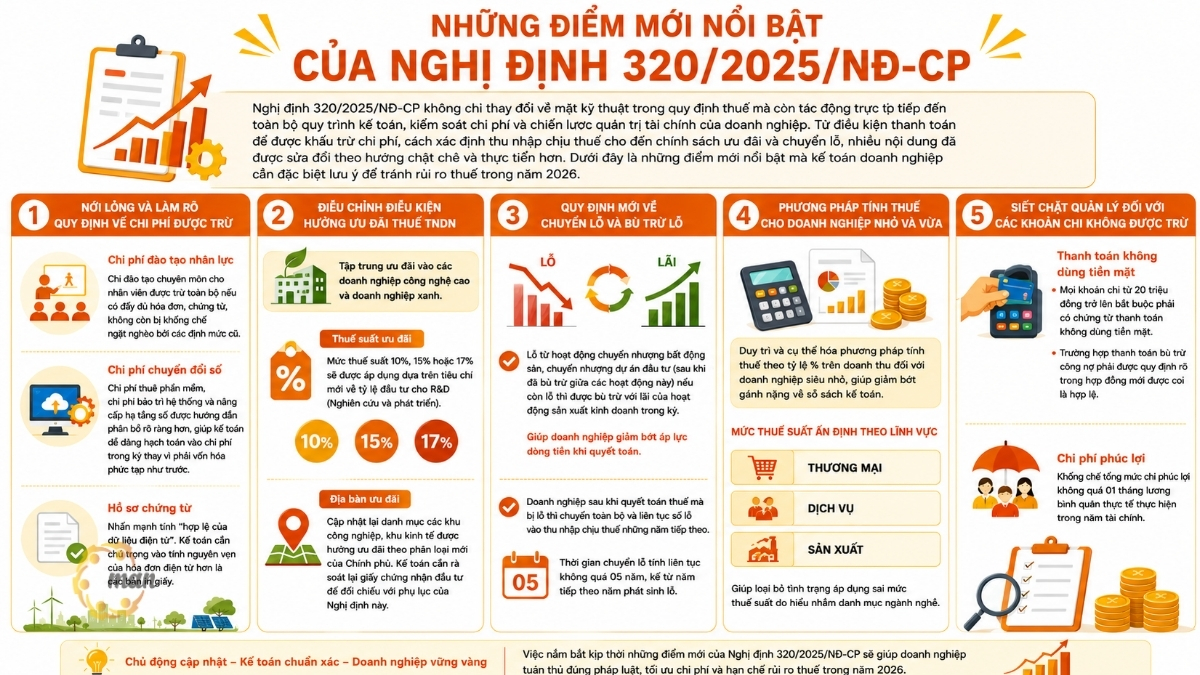
Decree 320/2025/ND-CP not only brings about technical changes in tax regulations but also directly impacts the entire accounting process, cost control, and financial management strategy of businesses. From payment conditions for expense deductions and methods for determining taxable income to incentive policies and loss carryforward, many provisions have been revised to be more stringent and practical. Below are the key new points that corporate accountants need to pay special attention to in order to avoid tax risks in 2026.
Relax and clarify regulations regarding deductible expenses.
The most notable new feature of Decree 320/2025/ND-CP is the flexibility in recognizing expenditures related to digital transformation and sustainable green development.
- Human resource training costs: Expenses for professional training of employees are fully deductible if supported by complete invoices and documents, and are no longer strictly limited by the old limits.
- Digital transformation costs: Costs for software leasing, system maintenance, and digital infrastructure upgrades are now more clearly allocated, making it easier for accountants to record them as expenses in the current period instead of the complex capitalization process required previously.
- Documentation: The decree emphasizes the "validity of electronic data." This means accountants need to focus more on the integrity of electronic invoices than on printed paper copies.
Adjusting the conditions for enjoying corporate income tax incentives.
Decree 320/2025/ND-CP focuses on providing incentives for high-tech and green businesses.
- Preferential tax rates: Tax rates of 10%, 15%, or 17% will be applied based on new criteria regarding the proportion of investment in R&D (Research and Development).
- Preferential areas: Update the list of industrial parks and economic zones eligible for preferential treatment according to the Government's new classification. Accountants need to review investment certificates to compare them with the appendix of this Decree.
New regulations on loss carryforward and loss offsetting.
One way for diversified corporations to overcome difficulties is through a mechanism for offsetting losses between their various business activities.
- According to Decree 320/2025/ND-CP, losses from real estate transfers and investment project transfers (after offsetting between these activities) can be offset against profits from production and business activities during the period. This is a step forward that helps businesses reduce cash flow pressure during final accounting.
- If a business incurs a loss after tax settlement, it must carry forward the entire loss continuously to taxable income in subsequent years. The loss carryforward period is calculated continuously for no more than 5 years, starting from the year following the year in which the loss occurred.
Methods for calculating taxes for small and medium-sized enterprises.
The decree continues to maintain and specify the tax calculation method based on a % ratio of revenue for micro-enterprises, helping to reduce the burden of accounting records. For units without a dedicated department, the use of full accounting service This is the optimal solution to ensure that all changes to Decree 320 are applied correctly from the outset.
- The fixed tax rates are categorized in detail by sector: Services, Trade, and Manufacturing. This helps eliminate the application of incorrect tax rates due to misunderstandings about industry classifications.
Tighten control over non-deductible expenses.
Besides loosening regulations, the Decree also tightens them to prevent loopholes for tax evasion:
- Non-cash payments: All expenditures of 20 million VND or more must be supported by non-cash payment documentation. Decree 320 clarifies that in cases of offsetting debts, the payment must be clearly stipulated in the contract to be considered valid.
- Welfare expenses: The total amount of welfare expenses must not exceed one month's average actual salary paid during the fiscal year.
Are businesses with revenue under 1 billion VND exempt from corporate income tax?
This is one of the questions that many accountants and business owners are particularly concerned about when applying the new tax regulations. In accordance with Decree No. 320/2025/ND-CP and policies supporting micro-enterprises, businesses with low revenue are enjoying significant incentives regarding corporate income tax.
Conditions for micro-enterprises to be exempt from corporate income tax.
According to Clause 15, Article 4 of the new regulations, organizations with total annual revenue not exceeding 1 billion VND are exempt from corporate income tax. This is considered a practical support policy aimed at reducing the financial burden on newly established businesses, startups, and small-scale entities, while also enabling businesses to retain resources for reinvestment and expansion.
For example: A startup business established in 2026 will have total revenue of 800 million VND. With this revenue level, the business will not incur corporate income tax obligations on the profits generated during the year, thereby having additional capital to maintain operations and develop the business.
How to determine revenue and principles for exemption from provisional tax payments.
The application of tax exemption incentives under Decree No. 320/2025/ND-CP is determined based on the total revenue recorded in the tax settlement documents of the immediately preceding year.
For businesses that are operating stably, the tax authorities will base their assessment on the total revenue reported in the previous year's tax return to determine whether they are eligible for tax exemption.
For newly established businesses, if projected revenue in the first year is below 1 billion VND, the business is not required to make quarterly provisional corporate income tax payments. If, by the end of the year, actual revenue exceeds the threshold, the business only needs to declare and pay the additional tax amount without incurring late payment penalties for previous quarters. This mechanism helps reduce cash flow pressure and provides flexibility during the initial operating phase.
Actions that can easily lead to expenses being disallowed during tax settlement.
Besides tax exemptions, businesses also need to pay special attention to expenses that are easily disallowed by tax authorities if they do not meet the requirements for supporting documents and the nature of the transaction.
Cash payment is not in accordance with regulations.
One of the notable changes is the tightening of conditions for cashless payments. Invoices of 5 million VND or more, if paid in cash, will not be considered deductible expenses when determining taxable income. This is a very common mistake that leads many businesses to face tax audits during the final settlement process.
The R&D expense record is incomplete.
Businesses are entitled to incentives for research and development (R&D) expenses; however, if they increase their spending to 200% without sufficient supporting documentation such as research proposals, implementation plans, acceptance reports, or specific scientific results, this expenditure is very likely to be disallowed.
Clothing expenses exceed the permitted limit.
Cash payments for uniforms exceeding 5 million VND per person per year will not be fully accepted. Businesses need to carefully monitor the payment method and regulatory limits to avoid unnecessary tax risks.
Related-party transactions are not governed by market principles.
Interest expenses exceeding the ceiling or transactions with related parties that do not comply with the free-price principle may be subject to adjustments in taxable income by the tax authorities. This is a particularly high risk for businesses with parent companies, subsidiaries, or cross-ownership relationships.
Summary of new points between the old regulations and Decree 320/2025/ND-CP
Below is a summary of key changes to help businesses easily compare and update their tax plans for the next accounting period.
| Comparison content | The old regulations are in Decree 218/2013/ND-CP. | Decree 320/2025/ND-CP |
| Cash payment threshold | Under 20 million VND | Under 5 million VND |
| Tax exemption for small businesses | Not based on revenue. | Revenue under 1 billion VND is tax-exempt. |
| R&D cost incentives | Only record actual expenses. | The maximum execution cost is calculated at 200%. |
| Carbon credit transfer | There are no specific guidelines yet. | Tax exemption for the first transfer. |
| Global minimum tax | Not yet applied | Complies with GloBE standards with a minimum level of 15%. |
Based on this reconciliation statement, businesses should proactively review their accounting systems, payment processes, and tax strategies to ensure compliance with the new regulations from the beginning of the period.
2026 will be a busy year for accounting departments. The implementation of Decree 320/2025/ND-CP requires a shift in management thinking and timely updates. In particular, to ensure accuracy for the first tax settlement period under the new law, many businesses have proactively taken steps. hire an accountant to prepare financial statements. The purpose is to review all potential errors before submitting the documents to the tax authorities.
Household businesses and the roadmap for converting to enterprises starting in 2026.
According to experts, the combination of Decree No. 320/2025/ND-CP and new regulations for household businesses is creating a more favorable legal framework for the model transformation process.
One notable point is the standardization of the 1 billion VND revenue threshold between household businesses and micro-enterprises. This will be an important basis for determining tax obligations as well as appropriate declaration methods.
In addition, household businesses that convert to a corporate model also enjoy the benefit of being exempt from corporate income tax for the first two years of operation. This policy helps new businesses stabilize their organizational structure, standardize management, and reduce financial pressure during the initial conversion period, which is the most sensitive time in the development process.
Conclude
Decree 320/2025/ND-CP is not only a guiding document for the Corporate Income Tax Law but also a new operational framework for all corporate tax accounting activities from 2026 onwards. Early updating and proper implementation from the outset will help businesses minimize the risk of tax arrears and penalties, and optimize financial management efficiency. For accounting departments, this is the time to comprehensively review tax procedures to adapt promptly to the latest changes.
For businesses with complex structures or those eligible for new tax incentives, the hire chief accountant Extensive experience will be a key factor in planning long-term tax strategies and protecting the organization's best interests.
Contact MAN – Master Accountant Network for free support and advice!
Contact information MAN – Master Accountant Network
- Address: No. 19A, Street 43, Tan Thuan Ward, Ho Chi Minh City
- Mobile/Zalo: 0903 963 163 – 0903 428 622
- Email: man@man.net.vn
Content production by: Mr. Le Hoang Tuyen – Founder & CEO of MAN – Master Accountant NetworkCPA Vietnam auditors with over 30 years of experience in accounting, auditing, and financial consulting.
Frequently Asked Questions about Decree 320/2025/ND-CP
Yes. The conditions for corporate income tax exemption are determined primarily based on total annual revenue, not directly dependent on the profit margin. If a business meets the revenue threshold of no more than 1 billion VND as stipulated, it may still be exempt from tax even with a high profit margin.
For newly established businesses, the tax authorities will base their quarterly provisional corporate income tax payment obligations on the projected revenue for the first year of operation. If the projected revenue is less than 1 billion VND, the business may not be required to make provisional payments and will settle the final tax at the end of the year.
Normally not. When actual revenue exceeds the tax-free threshold, businesses only need to file an amended tax return and pay the resulting corporate income tax according to the annual settlement. In line with the supportive spirit of the new regulations, this tax portion will not be subject to late payment penalties for previous quarters if declared correctly.
No. According to Decree No. 320/2025/ND-CP, expenses for purchasing goods and services of 5 million VND or more per day must be paid by bank transfer. If the business pays in cash, that expense may be disallowed as a deductible expense when calculating corporate income tax.
Yes. In addition to tax exemptions for micro-enterprises based on revenue thresholds, many household businesses converting to enterprises also enjoy corporate income tax exemptions for the first two years of operation. This is an important support policy to help businesses stabilize during the initial transition period. Are businesses with revenue under 1 billion VND exempt from corporate income tax?
How is tax exemption determined for newly established businesses that do not have financial statements from the previous year?
If a business's revenue exceeds 1 billion VND by the end of the year, will it be penalized for late tax payments?
Are invoices exceeding 5 million VND paid in cash considered deductible expenses?
Are businesses that convert from sole proprietorships to companies exempt from corporate income tax?






