
In the digital age of 2026, collecting and classifying original documents is no longer just an administrative task, but has become a cornerstone of financial risk management and tax compliance for businesses. Under the impact of Circular 99/2025/TT-BTC and the comprehensive electronic invoicing system, any errors in original documents can lead to expense disallowance, tax arrears, and accounting penalties. This article, from the perspective of a Chief Accountant with 30 years of experience, will provide an in-depth analysis of the strategy for collecting and classifying original documents in 2026, from controlling transactions at the point of origin and scientifically classifying them according to digital data standards, to building a solid "legal shield" before each tax audit and settlement.
What are original documents?
Original documents are initial accounting evidence reflecting an economic and financial transaction that has occurred and been completed. They are prepared at the time the transaction occurs and serve as the direct legal basis for recording in accounting books and settling taxes.
The core characteristics of original documents
A document is considered a valid original document if it meets the following criteria:
- The first occurrence when a transaction takes place.
- Accurately reflect the content, value, and subject matter of the transaction.
- It has all the necessary legal elements (date, signature/digital signature, tax code, content, etc.).
- It serves as the direct basis for preparing accounting vouchers.
The Importance of Original Documents in 2026

According to the 2015 Accounting Law and the latest guidelines in Circular 99/2025/TT-BTC, accounting documents are papers and information carriers that reflect economic and financial transactions that have occurred and been completed, serving as the basis for recording in accounting books. Of these, original documents are the primary legal evidence, not subject to aggregation or data transformation.
Why will collecting and classifying original documents become crucial in 2026? This is due to the widespread adoption of electronic invoices generated by cash registers and digital documents with unique identifiers. Management will no longer be about "picking up paper invoices," but about managing the integrity of digital data.
Many accountants today still make the mistake of collecting fragmented documents, leading to situations where "invoices exist but transactions are not genuine," or documents are outdated. This is the biggest loophole that causes businesses to be subject to tax audits.
Collecting original documents: The art of control from the "Gateway"
This is the crucial first step in determining the quality of the entire accounting system. A proper process for collecting and classifying original documents must begin as soon as an economic transaction occurs.
Distinguishing between Original Documents and Journal Entries
To avoid confusion during the collection, classification, and accounting process, accountants need to clearly distinguish between source documents and journal entries. In fact, many errors in tax settlement stem from businesses having complete journal entries but lacking or having incorrect valid source documents, leading to the rejection of expenses. The table below will help clarify the core differences between these two types of documents in terms of legal nature, timing of creation, and role in the accounting system.
| Criteria | Original documents | Journal voucher |
| Nature | Initial legal evidence | Accounting tools |
| Time of creation | When a transaction occurs | After receiving the original documents |
| Legal value | Highest | Dependent on the original document. |
| For example | Invoice, warehouse receipt | Accounting vouchers, Journal entries |
Original documents play a fundamental role and possess the highest legal value in the entire accounting system, while journal entries are merely tools for accounting and data aggregation. Any errors or omissions in original documents cannot be "compensated" by journal entries, no matter how complete the accounting records are. Therefore, businesses need to prioritize strict control over the collection and classification of original documents from the moment a transaction occurs to protect the validity of expenses and minimize risks during audits and tax settlements.
Examples of original documents:
- Electronic invoice (XML is the legal original)
- Receipt and payment voucher
- Warehouse receipt, warehouse delivery note
- Handover and acceptance record
- Economic contract, contract addendum
- Bank debit/credit notice
- Time sheets, payrolls, employment contracts
List of required documents for each transaction
To collect and categorize original documents efficiently, you need to group them clearly:
- Currency Group: Receipts, payment vouchers, and debit/credit notes must have sufficient digital or handwritten signatures depending on the format.
- Sales/Purchase Group: Electronic invoices according to Decree 123 and information retrieved from the General Department of Taxation's system. Note that cash register (POS) invoices must have a tax authority code to be considered valid.
- Labor Group: In addition to payroll records, it is necessary to collect digital attendance records and electronic employment contracts to ensure accuracy and consistency.
Professional data collection process
The following is a three-tiered process to ensure that no documents are missed or inaccurate:
- Level 1 (At the point of origin): Sales or warehouse staff must hand over documents immediately upon completion of the transaction.
- Layer 2 (Legal Verification): Payment accountants verify the validity of digital signatures, QR codes, and the supplier's operational status on the tax portal.
- Level 3 (Confirmation): The chief accountant or accounting manager signs off on the data, officially entering it into the accounting process.
See details: Business accounting process
Classification of original documents: Professional document management science
After collection, the next step in collecting and classifying original documents is to organize them into systematic storage compartments.
Classification by function
Classify documents according to their actual purpose to ensure transparency and ease of verification when tax explanations are required.
- Execution documents: Used to prove that a transaction has been performed (Invoices, warehouse receipts).
- Order documents: Used to issue orders for execution (Payment orders, dispatch orders).
- Procedural documents: Used to complete accounting records (Depreciation allocation schedule).
Classification by form
In 2026, it will be divided into two main branches:
- Physical documents: Old or specialized records that have not yet been digitized (require physical storage).
- Data-driven documents: XML and PDF files with digital signatures. Note: The XML file is the original legal document; the PDF file is only a display version.
Verify legal compliance before tax settlement.
When collecting and classifying original documents, verification is crucial. A "clean" original document in 2026 must satisfy the following criteria:
- Completeness: Contains all 7 mandatory elements as stipulated in Article 16 of the Accounting Law.
- Matching requirements: A purchase invoice worth 1 billion VND must be accompanied by a corresponding warehouse receipt and acceptance report. If either is missing, this expense is highly likely to be disallowed during an audit.
- Timeliness: Documents must be prepared immediately upon the occurrence of a transaction. Delays in preparation may result in fines of 3-5 million VND per document according to administrative penalty regulations.
Storage and preservation in accordance with Circular 99/2025/ND-CP and penalties for violations.
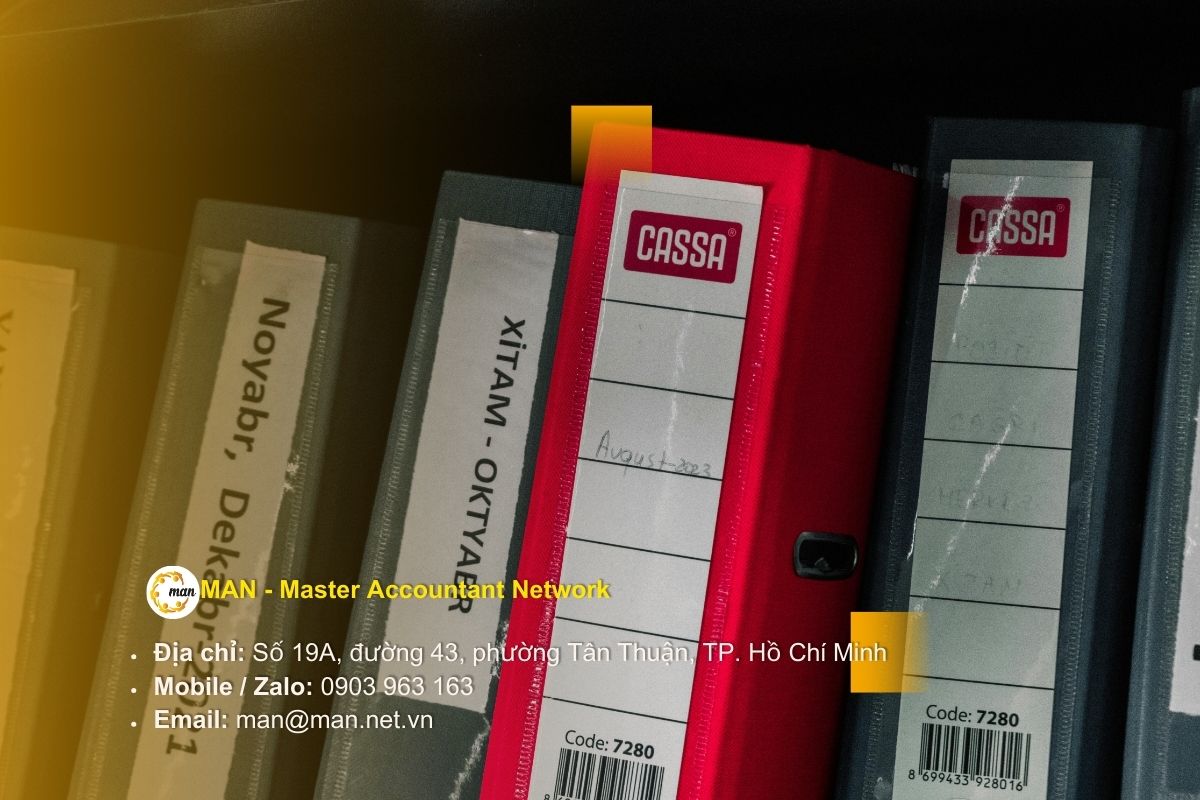
The process of collecting and classifying original documents only truly ends when the documents are placed in a secure archive. However, the biggest risk is not just data loss, but also very heavy administrative penalties if businesses neglect this step.
Storage regulations
To ensure that records are readily available for audits and specialized inspections, businesses must strictly adhere to the following timelines and technical standards for record keeping:
- Retention period: Still adheres to the 5-year (administrative documents), 10-year (accounting documents, financial reports) and permanent (documents important for security, defense, and specific economic matters).
- Electronic archiving standards: Access availability must be ensured. I recommend that businesses use an E-Archive system with multi-point backup capabilities.
Penalties for violations related to storage and preservation.
To ensure that the collection and classification of original documents are carried out rigorously, accountants should be aware of the following penalties:
Fines ranging from 5,000,000 to 10,000,000 VND will be imposed for the following acts:
- Accounting documents are not being stored completely as required.
- Poor storage of accounting documents, resulting in damage or loss of documents within the retention period.
- Using accounting documents that are not within the prescribed retention period.
Fines ranging from 10,000,000 to 20,000,000 VND will be imposed for the following acts:
- Cancel accounting documents before the retention period stipulated by the Accounting Law has expired.
- Failure to establish a destruction council and failure to properly destroy documents after their retention period has expired.
Note: If the conduct leads to the falsification of financial statements or the loss of tax revenue, the business will also face very high tax and late payment penalties (usually the amount of underdeclared tax).
Conclusion and recommendations
With the accounting and tax legal framework becoming increasingly stringent from 2026 onwards, collecting and classifying original documents is no longer a procedural task, but has become a financial risk management strategy for businesses. A well-controlled documentation system from the point of origin will help businesses proactively prepare for audits, protect legitimate expenses, and maintain transparency in operations.
In reality, most tax risks don't stem from incorrect figures, but rather from incomplete or insufficiently legally valid documentation. Therefore, businesses should periodically review the process of collecting, classifying, checking, and storing original documents, rather than waiting until the tax settlement period to address them.
If your business is struggling with standardizing documentation, establishing internal control processes, or preparing accounting and tax records in accordance with Circular 99/2025/TT-BTC, consulting with MAN – Master Accountant Network, with its team of experienced chief accountants and tax experts, will significantly save you time, costs, and legal risks. A timely check can help your business avoid major consequences later on.
Contact information MAN – Master Accountant Network
- Address: No. 19A, Street 43, Tan Thuan Ward, Ho Chi Minh City
- Mobile/Zalo: 0903 963 163 – 0903 428 622
- Email: man@man.net.vn
Content production by: Mr. Le Hoang Tuyen – Founder & CEO MAN – Master Accountant Network, Vietnamese CPA Auditor with over 30 years of experience in Accounting, Auditing and Financial Consulting.