
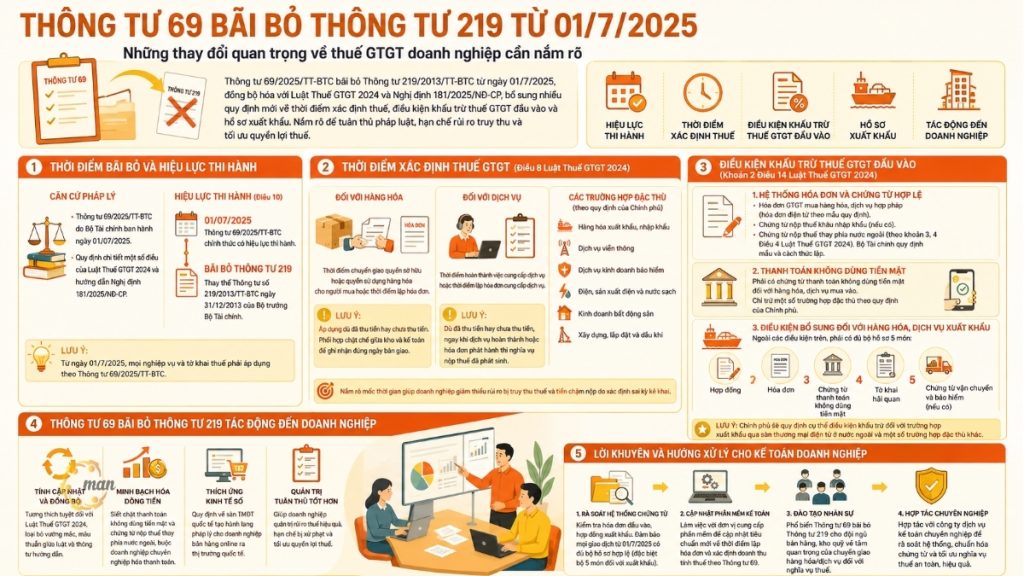
Circular 69/2025, which repeals Circular 219/2013 effective July 1, 2025, marks a significant change in Vietnam's value-added tax (VAT) legal system, directly impacting businesses' tax declaration, deduction, and refund activities. It not only replaces a guiding document that has been in effect for over 10 years, Circular 69/2025/TT-BTC and synchronize with Value Added Tax Law 2024 and Decree 181/2025/ND-CPCircular 69/2025, which repeals Circular 219/2013, adds many new regulations regarding the timing of tax determination, conditions for input VAT deduction, and export documentation. Understanding Circular 69/2025 will help corporate accountants proactively comply with the law, minimize the risk of tax arrears, and optimize tax benefits in the coming period.
This article will provide a comprehensive, in-depth, and closely-following look at the legal regulations regarding Circular 69/2025 repealing Circular 219/2013, focusing on the core points:
- Effective date
- Tax determination time
- Conditions for deducting input VAT according to the new regulations.
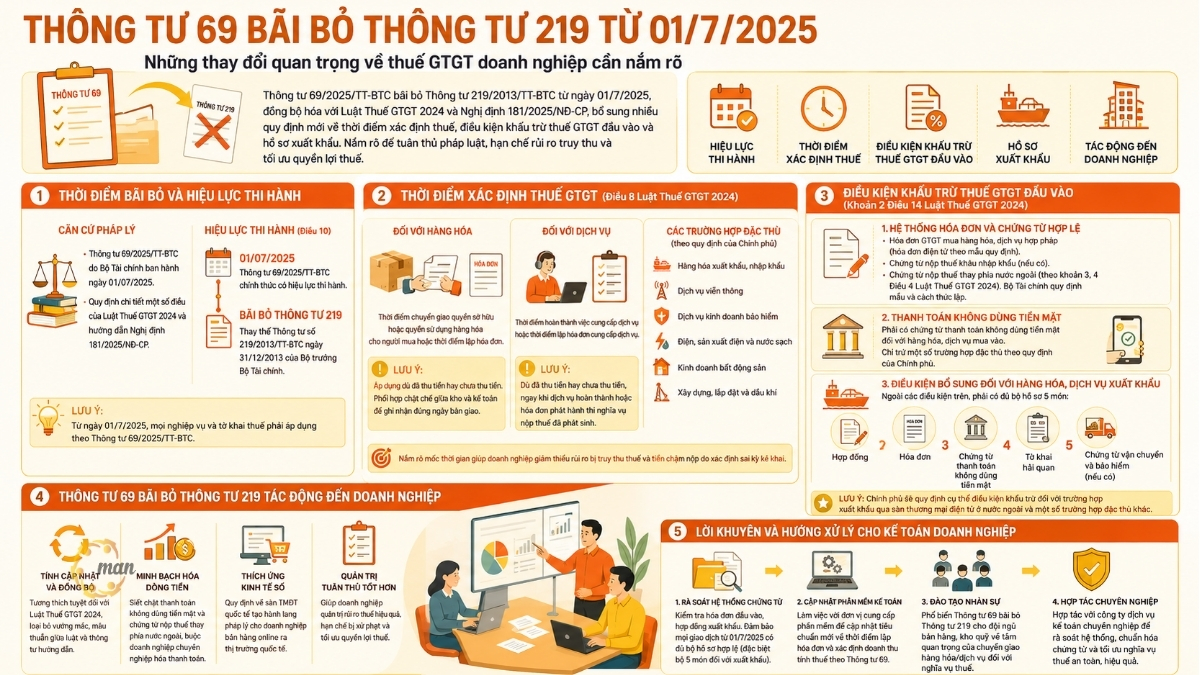
The official date when Circular 69/2025 repeals Circular 219/2013 and comes into effect.
Circular 219/2013/TT-BTC has long been considered a very familiar document for all tax accountants when performing tasks related to Value Added Tax (VAT). However, to provide detailed guidance for the 2024 Value Added Tax Law and Decree 181/2025/ND-CP, a new legal framework is necessary.
Legal basis for issuing Circular 69/2025/TT-BTC
On July 1, 2025, the Ministry of Finance officially issued Circular 69/2025/TT-BTC. This document provides detailed regulations on several articles of the 2024 Value Added Tax Law and serves as guidance for the implementation of Government Decree 181/2025/ND-CP. The issuance of Circular 69 aims to create a unified, transparent guidance system that is consistent with modern business practices in the digital economy era.
When discussing Circular 69/2025's repeal of Circular 219/2013, it's important to understand that this is a systemic transition. All outdated regulations that are no longer compatible with the 2024 VAT Law will be completely abolished to make way for more practical guidelines that are more closely aligned with current tax management processes.
Effective date and replacement schedule for the old document.
According to Article 10 of Circular 69/2025/TT-BTC, the effective date is clearly defined through the following two main points:
- Effective date: Circular 69/2025/TT-BTC officially comes into effect on July 1, 2025.
- List of superseded documents: This Circular officially replaces Circular No. 219/2013/TT-BTC dated December 31, 2013 of the Minister of Finance.
Therefore, from July 1st, 2025, the repeal of Circular 219/2013 by Circular 69/2025 becomes the most important legal fact that corporate accountants need to remember. All transactions and tax declarations from this point onward must comply with the new standards, methods, and guidelines of Circular 69. This requires a synchronized transition from invoice recording to accounting practices within the enterprise.
Regulations on the timing of VAT determination when Circular 69/2025 repeals Circular 219/2013.

One of the most important things businesses need to understand when Circular 69/2025 repeals Circular 219/2013 is the timing of tax determination. This regulation directly affects legal compliance, timely invoicing, and cash flow management. To ensure absolute accuracy in applying these timelines, many businesses have proactively taken steps to address this issue. hire chief accountant Experienced in reviewing the entire revenue recognition and invoicing process according to the new law.
According to Article 8 of the Value Added Tax Law 2024, the time of tax determination is specified in detail for each type of activity as follows:
For the business of trading goods
The time of determining VAT liability is the time of transferring ownership or the right to use the goods to the buyer. In addition, the time of issuing the invoice is also considered a benchmark for determining VAT liability.
Note: This regulation applies regardless of whether the business has received payment from the customer or not. While Circular 69/2025 repeals Circular 219/2013, this principle is still retained and further emphasized to ensure that tax authorities can control the flow of goods immediately upon the transfer of ownership. Businesses need close coordination between the warehouse and accounting departments to accurately record the handover date, avoiding the issuance of invoices at the wrong time, which could lead to administrative penalties.
Regarding service provision activities
When Circular 69/2025 repeals Circular 219/2013, the time for determining tax on services is stipulated as the time when the service is completed or the time when the invoice for the service is issued.
Similar to goods, whether or not payment has been received by the business does not change the tax liability at the aforementioned time points. This means that as soon as the service is completed or the invoice is issued, the VAT payment obligation arises. Businesses need to proactively secure funds to pay taxes even if the customer is in arrears.
Reference: Tax accounting services.
Special cases as stipulated by the Government.
In addition to general regulations, Circular 69/2025, which repeals Circular 219/2013, also opens up a separate guidance framework for certain types of goods and services with complex characteristics. Specifically, the time of determining VAT for the following subjects will be specified in detail by the Government:
- Exported and imported goods (ensuring compliance with Customs laws).
- Telecommunications services: A sector with complex billing processes.
- Insurance business services: Specific characteristics regarding the timing of premium payments.
- Electricity supply, power generation, and clean water services: These essential services have their own meter reading cycles.
- Real estate business activities: Related to payment schedules and handover of apartments/land.
- Construction, installation, and oil and gas operations: Long-term projects, often taxed based on phased completion or completed work volume.
Understanding these timelines, as Circular 69/2025 repeals Circular 219/2013, helps businesses minimize the risk of being subject to tax arrears and late payment penalties due to incorrect determination of the tax declaration period.
Conditions for deducting input VAT: Changes to note

When Circular 69/2025 repeals Circular 219/2013, the conditions for input VAT deduction are standardized based on Clause 2, Article 14 of the 2024 Value Added Tax Law. To optimize the process of managing input invoices and documents professionally and cost-effectively, the use of online accounting services It is becoming an effective solution for small and medium-sized enterprises in the digital age of 2026.
Below are the strict standards to ensure that input taxes are fully deductible:
Valid invoicing and documentation system
Businesses must have all the necessary documents to prove the legality of the purchase transaction:
- VAT invoice: A valid VAT invoice for the purchase of goods and services (electronic invoice in the prescribed format) is required.
- Import tax payment receipt: Applicable when a business directly imports goods from abroad.
- Foreign-subsidized tax payment certificate: This applies to transactions with foreign contractors as stipulated in Clauses 3 and 4, Article 4 of the 2024 Value Added Tax Law. Note that the Minister of Finance will issue specific regulations regarding the form and method of preparing this tax payment certificate.
Conditions regarding cashless payments
This is one of the core regulations that helps to increase transparency in economic transactions. When Circular 69/2025 repeals Circular 219/2013, the mandatory condition for tax deduction is that businesses must have non-cash payment documents for purchased goods and services.
- Except for certain specific cases as stipulated by the Government, cash payments are not accepted. Businesses should minimize cash payments for large-value invoices.
Under these conditions, there was Official Document 5082/BTC-CST Direct guidance on cashless payment thresholds.
Additional conditions for exported goods and services
Exports have always been the sector most closely monitored by tax authorities to prevent tax refund fraud. With Circular 69/2025 repealing Circular 219/2013, in order to deduct input tax for exported goods (tax rate 0%), in addition to the invoices and payment documents mentioned above, businesses are required to have:
- Contract: A contract signed with a foreign party for the sale, processing of goods, or provision of services, clearly specifying the quantity, unit price, and method of payment.
- Invoice: An invoice for the sale of goods or provision of services corresponding to the contract.
- Payment documents: Non-cash payment documents processed through the banking system.
- Customs declaration form: For exported goods (this is the most crucial document proving that the goods have actually been exported).
- Shipping and insurance documents: Packing list, bill of lading, cargo insurance certificate (if applicable as per contract agreement).
Important notes from the 2024 Value Added Tax Law: The government will specify the conditions for tax deductions in cases of exporting goods through overseas e-commerce platforms and some other specific cases. This is a very progressive new development as Circular 69/2025 repeals Circular 219/2013, creating a legal framework for businesses selling online to international markets.
How will Circular 69/2025, which repeals Circular 219/2013, affect businesses?
The repeal of Circular 219/2013 by Circular 69/2025 is not merely an administrative procedure to change the name of a legal document. It brings about far-reaching impacts on the operational and compliance strategies of businesses. Specifically:
- Timeliness and consistency: Circular 69 is designed to be fully compatible with the 2024 Value Added Tax Law, eliminating any conflicts or inconsistencies that existed between the law and its guiding circulars previously.
- Cash flow transparency: The tightening of conditions for cashless payments and types of tax payment documents on behalf of foreign parties, as Circular 69/2025 repeals Circular 219/2013, forces businesses to professionalize their payment systems.
- Adapting to the digital economy: The emergence of regulations on international e-commerce platforms shows that tax management thinking has caught up with modern business trends, giving businesses more confidence when expanding into foreign markets.
With Circular 69/2025 repealing Circular 219/2013, the accounting department needs to proactively review long-term contracts exceeding the July 1, 2025 deadline to ensure that the terms regarding invoices and payments remain consistent with the new legal framework.
To adapt quickly to these changes, it is essential to collaborate with a accounting services company Reputable and experienced professionals will help businesses review their systems, standardize documents, and optimize tax obligations in the safest way possible.
Advice and solutions for business accountants.
To best prepare for the transition period when Circular 69/2025 repeals Circular 219/2013, businesses should immediately take the following steps:
- Review the documentation system: Check input invoices and export contracts. Ensure that all transactions after July 1, 2025, have a complete set of 5 documents (for exports) as stated in Article 14 of the 2024 Value Added Tax Law.
- Updating accounting software: Working with the software provider to update to the new standards regarding the timing of invoicing and determining taxable revenue as guided by Circular 69/2025/TT-BTC.
- Personnel training: Widely disseminate information about Circular 69/2025, which repeals Circular 219/2013, to sales and treasury staff so they understand the importance of goods/service delivery in relation to the company's tax obligations.
Clarifying questions regarding Circular 69/2025 repealing Circular 219/2013.
Yes. Accountants need to clearly separate transactions before and after July 1, 2025, to apply the correct legal basis. Invoices, long-term contracts, and transitional transactions need to be carefully checked to avoid errors regarding the timing of invoicing, tax declarations, and input tax deduction conditions.
The principle of cashless payment remains a crucial condition for deducting input VAT. Businesses need to maintain complete records of bank transfers, account reconciliation, and payment documents to prove the legality of transactions, especially for high-value invoices and export transactions.
In addition to VAT invoices and bank payment documents, businesses must have contracts with foreign partners, customs declarations, shipping documents, and records related to the delivery and receipt of goods. This is crucial evidence to prove that the goods have been exported and are eligible for the 0% tax rate. Do invoices and supporting documents issued before July 1, 2025 need to be reviewed?
Will the conditions for cashless payments change when Circular 69 comes into effect?
What additional documents are needed for exported goods to be eligible for VAT deduction?
Conclude
Circular 69/2025, which repeals Circular 219/2013, is a necessary step in the modernization of Vietnam's tax legal system. Adhering to the regulations in Circular 69/2025/TT-BTC and the 2024 Value Added Tax Law not only helps businesses comply with the law but is also key to maximizing their rights regarding tax deductions and refunds.
Contact MAN – Master Accountant Network for free support and advice!
Contact information MAN – Master Accountant Network
- Address: No. 19A, Street 43, Tan Thuan Ward, Ho Chi Minh City
- Mobile/Zalo: 0903 963 163 – 0903 428 622
- Email: man@man.net.vn
Content production by: Mr. Le Hoang Tuyen – Founder & CEO of MAN – Master Accountant NetworkCPA Vietnam auditors with over 30 years of experience in accounting, auditing, and financial consulting.






