
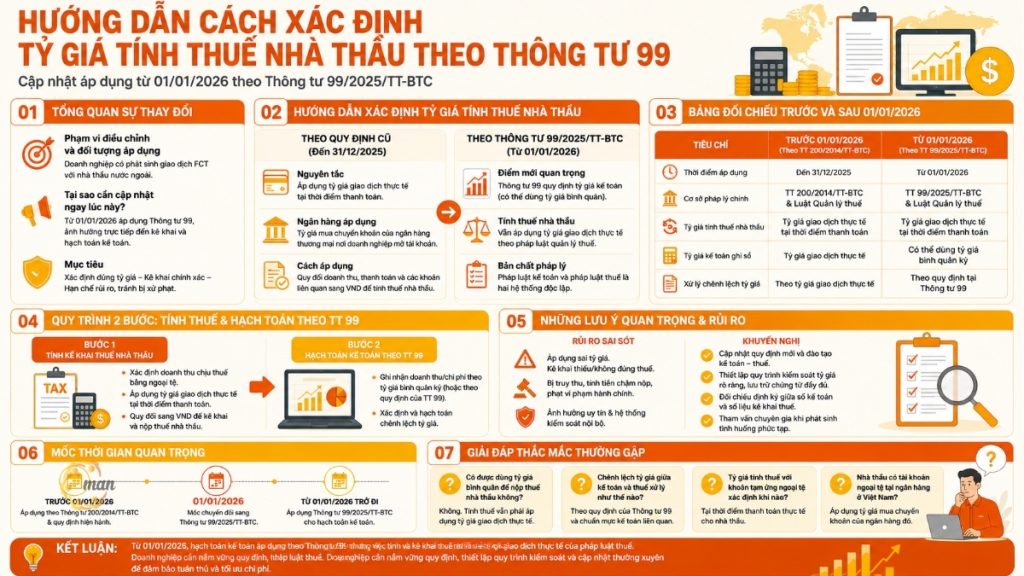
In the context of global economic integration, cross-border economic transactions between Vietnamese businesses and foreign contractors (FCT – Foreign Contractor Tax) are becoming increasingly common. One of the most complex and error-prone aspects of contractor tax accounting is determining the foreign exchange rate for tax calculation.
Specifically, from January 1, 2026, Circular 99/2025/TT-BTC Regarding the official corporate accounting system that has come into effect, it completely replaces the previous one. Circular 200/2014/TT-BTCThis policy shift brought about many fundamental changes in the recording of exchange rates. The article below will provide a detailed update on the Tax Department's guidance on how to determine the exchange rate for contractor tax purposes according to Circular 99 before and after this historical milestone.
Overview of changes in the exchange rate for contractor tax calculation according to Circular 99
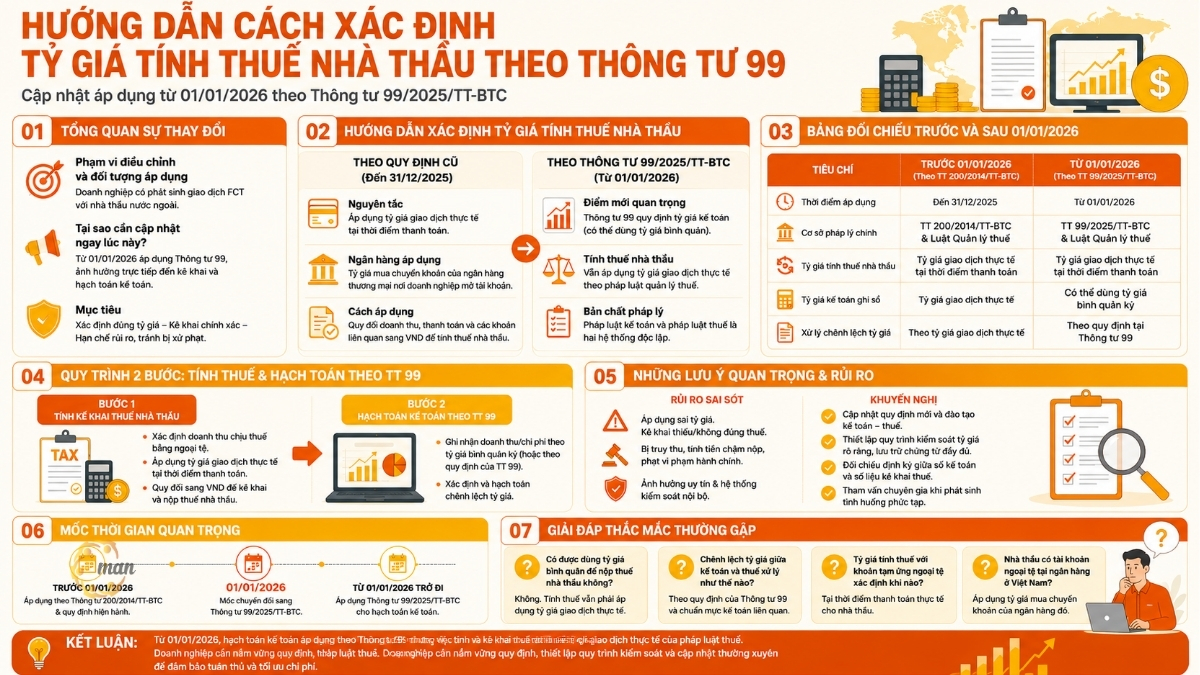
Any major shift in accounting policy systems requires businesses to have a comprehensive perspective before implementing it in practice. The transition from the old system to the new Circular from 2026 is not simply a matter of changing accounting accounts; it also directly impacts the foreign exchange conversion obligations for cross-border transactions. To help finance and accounting departments proactively manage risks, this section will outline the overall picture of those directly affected and why updating the exchange rate for contractor tax calculation according to Circular 99 has become a top priority for businesses at this time.
Scope of regulation and subjects of application
When a Vietnamese business purchases services or goods related to those services from foreign organizations or individuals not operating under Vietnamese Enterprise Law, the business is obligated to deduct, declare, and pay contractor tax on behalf of the foreign partner. If the contract is signed and paid in foreign currencies such as USD, EUR, JPY, etc., the accountant must convert the transaction value into Vietnamese Dong (VND).
The correct application of the contractor tax exchange rate as stipulated in Circular 99 is a mandatory requirement for all businesses with FCT transactions from the 2026 fiscal year onwards. Those directly affected include tax accountants, auditors, chief financial officers (CFOs) responsible for approving tax returns, and legal representatives of FDI enterprises as well as domestic enterprises using cross-border services.
Reference: Circular 99/2025/TT-BTC stipulates the exchange rate for contractor tax.
Why do businesses need to update the exchange rate for contractor tax calculation according to Circular 99 right now?
The transition from Circular 200/2014/TT-BTC to Circular 99/2025/TT-BTC, effective January 1, 2026, is systemic for the entire Vietnamese accounting system. A lack of understanding of the intersection between the new accounting law and current tax management laws will lead to the risk of discrepancies in accounting and tax declarations.
When conducting tax audits for the 2026 tax year, the Tax Authority will pay special attention to how businesses handle exchange rate differences and the sources of exchange rate information applied. Understanding the nature of the exchange rate used for contractor tax calculation under Circular 99 helps businesses optimize compliance costs, protect their legitimate rights, and eliminate the risk of penalties for late tax payments due to incorrect application of exchange rates.
Guidelines for determining the exchange rate for contractor tax calculation according to Circular 99

To understand the continuity and core changes from 2026 onwards, businesses need to review how they handle exchange rates for contractor tax calculation. This is a crucial frame of reference that helps accountants compare their practices with the new regulations on exchange rates for contractor tax calculation under Circular 99.
Principles for determining the actual exchange rate according to the old regulations.
The entire business system applies the accounting regime according to Circular 200/2014/TT-BTC in close coordination with the regulations in Tax Administration Law No. 38/2019/QH14When payments to foreign contractors are made in foreign currency, the accountant must determine the actual exchange rate at the time of payment to convert the contractor's taxable revenue.
The specific principles for application are as follows:
- For immediate payment: The transfer buying rate of the commercial bank where the enterprise maintains its account for making payments to the foreign contractor will be applied.
- In cases where accounts payable arise before final payment: Taxable revenue and deductible tax amounts are converted using the transfer selling exchange rate of the commercial bank where the business maintains its transaction account at the time of actual payment (for contracts with Net price converted to Gross price).
Commercial banks are selected as the basis for foreign currency exchange.
Businesses are required to use the exact exchange rate published by the commercial bank where they actually conduct transactions and transfer funds from their accounts. Using the exchange rate of another intermediary bank or the central exchange rate of the State Bank of Vietnam for the purpose of calculating contractor tax during this period is considered non-compliant and is often subject to upward adjustments by the tax authorities if there is an unfavorable difference.
How to apply the exchange rate for contractor tax calculation according to Circular 99.
Circular 99/2025/TT-BTC has opened a new chapter for financial accounting. However, when comparing it with the regulations on exchange rates for contractor tax calculation under Circular 99, accountants must be extremely discerning to distinguish between the exchange rate recorded in accounting books and the exchange rate declared for tax calculation.
New points regarding accounting exchange rates according to Circular 99/2025/TT-BTC
One of the groundbreaking improvements of Circular 99/2025/TT-BTC is that it allows businesses to simplify the daily monitoring of exchange rates. Specifically:
- Businesses are allowed to choose to use the average buying and selling exchange rate of the commercial bank where they regularly conduct transactions for accounting purposes.
- Businesses may also apply an approximate exchange rate (the average exchange rate of the accounting period or an exchange rate with a difference not exceeding the margin stipulated by the State Bank of Vietnam compared to the actual transaction exchange rate) to record economic transactions arising in foreign currency during the period.
This change significantly reduces the workload of entering detailed exchange rate data for the general accounting department.
The legal nature of the exchange rate for contractor tax calculation according to Circular 99.

A major question arose at the beginning of 2026: Can businesses use the average or approximate exchange rate stipulated in Circular 99 to declare and calculate contractor tax?
Based on the professional guidelines and the principles of coordination between the Tax Law and the Accounting Law, the answer from the Tax Department is: ARE NOTThe Ministry of Finance and local tax departments clarify:
"Circular 99/2025/TT-BTC is a document regulating accounting practices and financial reporting. Specifically, regarding the issuance of invoices, declaration, and calculation of foreign currency transaction tax obligations (including foreign contractor tax), businesses are required to comply with current tax and invoice laws."
Therefore, when determining the exchange rate for contractor tax calculation according to Circular 99, accountants need to pay attention to the principle of separating purposes:
- For accounting purposes (recording revenue, expenses, or liabilities): Businesses may apply approximate exchange rates or average exchange rates as registered in their internal financial regulations in accordance with Circular 99.
- For declaring and calculating contractor tax (FCT): Accountants are absolutely prohibited from using approximate or average accounting exchange rates. Businesses must still adhere to the transfer selling exchange rate of the commercial bank where the business conducts actual payment transactions on the date the tax liability arises (for cases where the contract price is converted to gross value for tax calculation). This is the most accurate legal basis for determining the exchange rate for contractor tax calculation according to Circular 99.
This separation means that the business will record an exchange rate difference between the accounting records and the tax return. This difference will be tracked and processed through account 413 (Exchange Rate Differences) and transferred to the end-of-period financial revenue/expense in a legitimate manner.
See more: Instructions for accounting for contractor tax according to Circular 99.
Comparison table of exchange rates for contractor tax calculation according to Circular 99 before and after January 1, 2026
The differences in the operation of accounting and tax systems before and after the effective date of Circular 99 are illustrated in detail in the comparison table below:
Comparison table of actual criteria
Below is a comparison table for businesses to easily track. Specifically:
Comparison table of criteria before and after Circular 99 officially came into effect.
| Criteria | Before January 1, 2026 | From the date Circular 99 comes into effect |
| Accounting legal documents | Circular 200/2014/TT-BTC | Circular 99/2025/TT-BTC |
| Exchange rate applied for accounting purposes. | The actual exchange rate on the trading day (Detailed buy or sell rates for each specific bank involved). | You can choose the average or approximate exchange rate of your frequently used bank. |
| Exchange rate used for calculating contractor tax (FCT) | The actual exchange rate (selling or buying via bank transfer from the acquiring bank). | Mandatory compliance with tax laws: Use the actual exchange rate of the bank on the payment date (do not use approximate rates). |
| Handling exchange rate differences | The difference between the initial accounting exchange rate and the actual payment exchange rate is recorded directly in account 515 or account 635. | The difference between the accounting exchange rate (average exchange rate) and the actual tax exchange rate is scientifically reflected in account 413 before processing. |
In summary, the above comparison clearly reflects the legal boundaries between accounting law and administrative tax law. While the introduction of the new accounting system grants maximum flexibility to businesses in internal record-keeping, it does not undermine existing tax declaration principles. Therefore, accountants must absolutely avoid the inertia of applying a single exchange rate for both purposes. To help businesses easily visualize the accounting and data processing process, the following section will analyze a specific case study on determining the exchange rate for contractor tax calculation according to Circular 99 for the actual payment period arising during the year.
Here's a practical example illustrating how contractor tax is calculated.
To clarify the method of applying the exchange rate for contractor tax calculation according to Circular 99, let's analyze the following real-life situation with MAN – Master Accountant Network:
Situation: On April 15, 2026, Vietnam Technology Joint Stock Company paid Foreign Contractor X (in Japan) a software licensing fee of USD 20,000 under the Net price contract terms (the Vietnamese party bears all applicable contractor taxes).
Let's assume the contractor tax rate for copyright is 10% (including VAT which is tax-exempt or equal to 0% for software, and corporate income tax of 10% calculated as a percentage).
As of April 15, 2026, the exchange rate information at the commercial bank where the Company maintains its payment account is as follows:
- Transfer buying rate: 25,100 VND/USD.
- Transfer selling rate: 25,300 VND/USD.
- Average exchange rate during the accounting period (applied according to Circular 99 for bookkeeping): 25,200 VND/USD.
Step 1: Calculations for contractor tax declaration purposes.
Since this is a net-price contract, the accountant must convert the net revenue to gross revenue in foreign currency before multiplying it by the exchange rate to VND.
|
Taxable revenue (Gross) = Net revenue / (1 – 10%) = 20,000 / 0.9 = ~22,222 USD |
When calculating the tax payable on behalf of another party, accountants are required to apply the transfer selling exchange rate on the payment date (25,300 VND/USD), and are not allowed to apply the average accounting exchange rate (25,200 VND/USD).
|
Taxable revenue (converted to VND) = 22,222 USD x 25,300 VND/USD = 562,222 |
Then:
|
Contractor tax paid on behalf of another party (VND) = 562,222 VND x 10% = 56,222 VND |
Step 2: Record accounting entries according to Circular 99/2025/TT-BTC
When accounting for outsourced service costs in the accounting books, the enterprise applies the registered accounting exchange rate (assuming the average exchange rate for the accounting period is 25,200 VND/USD).
Record royalty expenses:
- Debit Account 642 (Business Management Expenses): 20,000 USD x 25,200 VND = 504,000,000 VND.
- Account 331 (Accounts Payable to Suppliers): 504,000,000 VND.
Record the contractor's tax obligation (calculated at the actual tax payment exchange rate of 25,300 VND):
- Debit Account 642: 56,222 VND
- Account 3338 (Other taxes payable – Contractor tax): 56,222 VND.
The difference between the actual payment exchange rate and the average accounting exchange rate for accounts payable to foreign contractors (25,300 – 25,200 = 100 VND/USD) will be handled by the accountant as an exchange rate difference arising from the settlement of account 331 through account 413 in accordance with the spirit of Circular 99.
Important notes regarding the exchange rate for contractor tax calculation according to Circular 99 to avoid penalties.

Entering a new era of finance always carries the risk of systemic errors due to the application of outdated regulations or confusion between accounting standards and tax laws. To protect businesses from major tax risks in 2026, accountants need to pay special attention to the following points.
Risk of exchange rate errors and administrative tax penalties.
If a business arbitrarily applies an accounting exchange rate (average exchange rate, approximate exchange rate) to declare contractor tax, and this rate is lower than the actual transaction rate at the payment bank, the business will be considered to have underdeclared the amount of tax payable. When the Tax authorities conduct an audit, severe financial penalties will be applied.
- Penalties for incorrect tax declarations: A penalty of 20% will be imposed on the amount of tax underdeclared or the amount of tax refunded in excess of the regulations stipulated in the current Tax Administration Law.
- Late payment penalty: Calculated at a rate of 0.031 TP3T/day on the amount of tax overdue. This penalty is accumulated from the deadline for filing the tax return for the period in question until the actual payment date, creating significant financial pressure on businesses if the delay extends over several fiscal years.
To avoid unfortunate risks that could affect the image and reputation of the business, it is advisable to consult... tax accounting services Choosing reputable and experienced professional units like MAN – Master Accountant Network will provide a secure solution to protect your business.
Recommendations for risk management solutions
To ensure the smooth operation of the accounting and tax filing system, MAN – Master Accountant Network should implement the following synchronized measures:
- Establish clear accounting regulations: Businesses must issue internal financial regulations detailing the method for determining accounting exchange rates (applying actual transaction exchange rates or average exchange rates as per Circular 99). These regulations are mandatory legal documents to be presented to the tax inspection team when auditing accounting records for 2026.
- Setting up a parallel lookup and comparison tool: The tax accounting department needs to set up an Excel spreadsheet or update the accounting software module to automatically record two types of exchange rates simultaneously on the date of payment to the contractor: the average exchange rate recorded in the accounting books and the actual exchange rate used by the bank for calculating contractor tax according to Circular 99, in order to calculate FCT tax.
- Maintain complete records of exchange rate evidence: For each contractor tax declaration period, the accountant must print and store, along with the payment documents (Contract, Invoice, Payment Order, FCT Tax Declaration), the daily exchange rate published by the commercial bank making the payment. This document serves as irrefutable evidence protecting the legality of the applied exchange rate before the regulatory authorities.
- Pay attention to the timing of tax liability: Contractor tax liability arises at the time the business pays the foreign contractor or at the time of acceptance and completion of the service, depending on the type of contract. Incorrectly determining the tax payment time will lead to the application of the wrong exchange rate conversion date, resulting in inaccurate calculations for the entire tax return.
Answers to frequently asked questions regarding the exchange rate for contractor tax calculation according to Circular 99.
Below is a summary of answers regarding the application of exchange rates for contractor tax calculation according to Circular 99:
Absolutely not. Circular 99/2025/TT-BTC is a document regulating accounting and financial reporting. Regarding the obligation to calculate, declare, and pay foreign contractor tax (FCT), businesses are required to comply with the Law on Tax Administration. Therefore, accountants must still apply the actual transaction exchange rate (the bank's transfer selling rate) on the date the tax payment obligation arises, and not the average accounting exchange rate.
This difference arises entirely legitimately due to the difference in objectives between Accounting and Taxation. When a business settles accounts payable to contractors (Account 331), the exchange rate difference between the accounting book exchange rate (average exchange rate according to Circular 99) and the actual exchange rate used for tax payment (actual transfer selling rate) will be reflected by the accountant through Account 413 (Exchange Rate Difference), and then transferred to the corresponding financial revenue account (Account 515) or financial expense account (Account 635) at the time of closing the books.
According to the Law on Tax Administration, the tax liability of foreign contractors arises at the moment the Vietnamese enterprise transfers the payment. Therefore, for advances in foreign currency, the accountant must determine the actual exchange rate for tax calculation on the day the advance is actually transferred (without waiting until the service is accepted or the remaining balance is paid). Each payment (advance or final payment) will apply a separate exchange rate applicable to that payment date.
If the foreign contractor has a payment account at a commercial bank in Vietnam, the exchange rate applied to calculate taxable revenue will be the buying rate of the commercial bank where the contractor has the account on the date of payment. Conversely, if the contractor does not have an account in Vietnam, the business will apply the selling rate of the bank where the Vietnamese party has the account for transferring funds to calculate the FCT tax. My company is applying Circular 99 to record accounting entries using the average exchange rate. Is it permissible to use this exchange rate for contractor tax payments?
How will the exchange rate difference arising between the accounting rate (average rate) and the actual tax calculation be handled?
For advances in foreign currency to contractors, at what point in time is the exchange rate used for calculating contractor tax, as stipulated in Circular 99, determined?
If a foreign contractor has a foreign currency account at a commercial bank in Vietnam, what exchange rate will be applied for tax calculation?
Conclusion regarding the application of the exchange rate for contractor tax calculation according to Circular 99.
Mastering the application of the exchange rate for calculating contractor tax according to Circular 99 is key to helping businesses take control of their financial and tax affairs during the crucial policy transition period of 2026. By clearly distinguishing between the average exchange rate used for accounting purposes and the actual transaction exchange rate required for declaring foreign contractor tax obligations, businesses not only ensure maximum legal compliance but also optimize the operational processes of their accounting system.
For any questions regarding the exchange rate for contractor tax calculation under Circular 99, please contact MAN – Master Accountant Network for free consultation and expert support.
Contact information MAN – Master Accountant Network
- Address: No. 19A, Street 43, Tan Thuan Ward, Ho Chi Minh City
- Mobile/Zalo: 0903 963 163 – 0903 428 622
- Email: man@man.net.vn
Content production by: Mr. Le Hoang Tuyen – Founder and CEO of MAN – Master Accountant NetworkCPA Vietnam auditors with over 30 years of experience in accounting, auditing, and financial consulting.






