
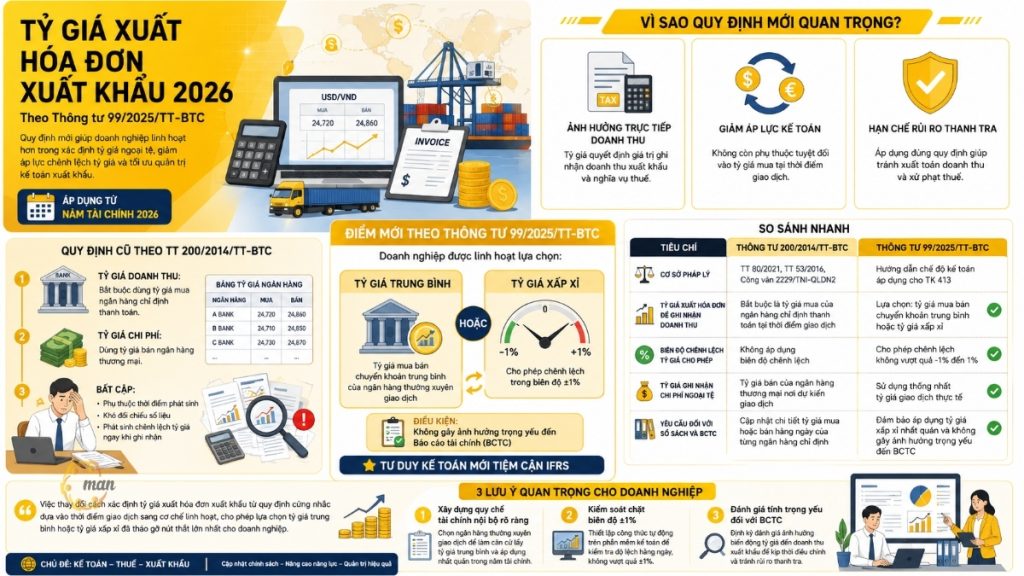
Entering the 2026 fiscal year, the accounting community and businesses operating in the manufacturing, processing, and export trade sectors are facing major reform changes in accounting regulations. One of the core innovations, directly impacting cash flow, revenue, debt recognition, and tax obligations, is the method for determining the exchange rate for export invoices.
Circular 99/2025/TT-BTC This has opened up a completely new legal framework, officially regulating the principles of foreign currency accounting, replacing or significantly adjusting the accounting principles that were already very familiar in the previous Circular 200/2014/TT-BTC. Understanding and accurately applying the export invoice exchange rate according to the new regulations not only helps businesses comply with tax and invoice management laws but also minimizes the risks of administrative penalties or revenue disallowance when tax authorities conduct audits.
This article will provide a comprehensive analysis, from the old legal basis to the new regulations applicable in 2026, helping accounting departments gain an accurate understanding to apply them consistently to their businesses.
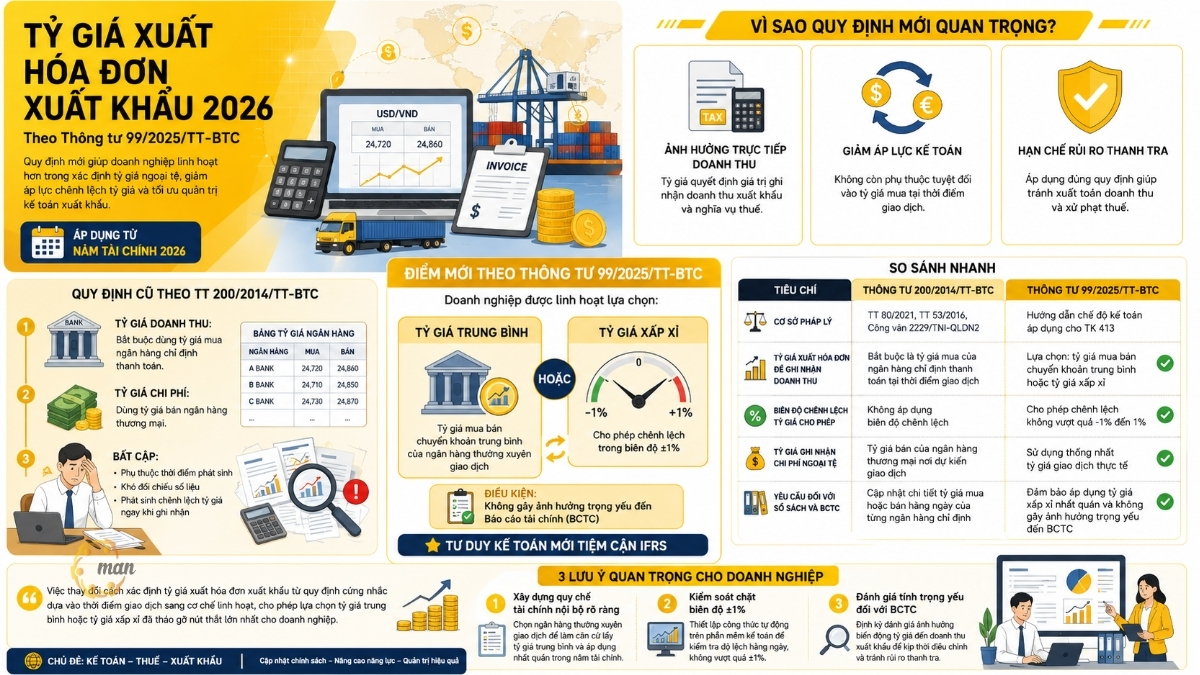
The old regulations on exchange rates for export invoices are based on Circular 200/2014/TT-BTC.
To fully understand the advantages and fundamental changes of the new regulations, MAN – Master Accountant Network first needs to review how the exchange rate for export invoices was determined during the period when Circular 200/2014/TT-BTC was in effect, as amended and supplemented by Circular 53/2016/TT-BTC.
Legal basis and guidance from the Tax authorities.
Previously, when conducting sales of goods or providing services abroad, the accounting department of a business often had to rely on an intertwined system of legal documents to determine the exchange rate:
- Clause 2, Article 4 Circular 80/2021/TT-BTC The regulations clearly state: The actual exchange rate used in transactions shall be in accordance with the legal provisions on accounting.
- Clause 3, Article 1 Circular 53/2016/TT-BTC This document specifies the principles for determining exchange rates for foreign currency transactions occurring during the period.
Furthermore, the consistency in practical application between the Tax Administration Law and the Accounting System has been clarified in Official Letter No. 2229/TNI-QLDN2 dated October 20, 2025, regarding the timing and method of determining the exchange rate for export invoices as follows:
- Regarding the timing of invoice issuance: For exported goods, businesses must comply with the regulations in Decree 70/2025/ND-CP.
- Regarding the exchange rate on the invoice: The exchange rate used to record revenue on the export invoice is the buying rate of the commercial bank where the business designates the customer to make payment at the time the transaction occurs.
- Regarding the exchange rate for recording expenses: In cases where the exchange rate stated on the export invoice is used to record expenses incurred in foreign currency, it should be the selling rate of the commercial bank where the business expects to conduct the transaction at the time the transaction occurs.
Current situation regarding the application of designated bank buying rates.
The exchange rate used for issuing export invoices to record revenue must be the transfer buying rate of the commercial bank where the business designates the foreign customer to make the payment at the exact time of the transaction.
This principle has, in practice, revealed several major shortcomings for corporate accounting:
- Extreme dependence on timing: Accountants must constantly check the bank's buying exchange rate table for the exact day, or even the exact hour, when the customs declaration is cleared or the ownership of the goods is transferred.
- Discrepancy between revenue and expenses: Accounting for revenue at the buying exchange rate but accounting for directly related expenses in foreign currency at the selling exchange rate of commercial banks creates an imbalance, leading to exchange rate differences arising from the initial recording, complicating the process of reconciling financial data.
New points regarding export invoice exchange rates in 2026 according to Circular 99/2025/TT-BTC
Starting from the 2026 fiscal year, Circular 99/2025/TT-BTC officially comes into effect, bringing about a more open accounting approach, closer to International Financial Reporting Standards (IFRS). The new regulations on accounting for Account 413 – Exchange Rate Differences have fundamentally changed the way businesses determine the exchange rate for export invoices.
A new definition of the actual exchange rate in 2026.
According to the guidelines on exchange rate application principles in Circular 99/2025/TT-BTC, in cases where businesses conduct economic transactions in foreign currency but the commercial contract does not specify a particular exchange rate, the business is required to use the actual transaction exchange rate.
The breakthrough reform lies in redefining the actual exchange rate. Accordingly, businesses have the right to choose the actual exchange rate on the trading day as follows:
- The average buying and selling exchange rate for transfers at the commercial bank where the business regularly conducts transactions.
- Approximate exchange rate: This is an exchange rate where the difference does not exceed 1% or -1%so compared to the average buying and selling transfer rates of the commercial bank where the business regularly conducts transactions. A prerequisite for applying the approximate exchange rate is that its use must ensure that it does not materially affect the financial statements of the business in the accounting period.
Therefore, under the new regulations, the exchange rate for export invoices in 2026 is no longer limited solely to the pure transfer buying rate at the designated payment bank. Accountants are now allowed to use the average transfer buying and selling rate or an approximate rate within the permitted range.
In summary, the export invoice exchange rate for 2026, according to Circular 99/2025/TT-BTC, is the average buying and selling rate for transfers or an approximate difference not exceeding -1% to 1% compared to the average buying and selling rate for transfers.
Regulations on the exchange rate for foreign currency accounting
In parallel with the actual exchange rate used for initial conversion when determining the exchange rate for export invoices, Circular 99/2025/TT-BTC also clarifies the concept and method of applying the book exchange rate. The book exchange rate is divided into two types:
- The actual book exchange rate is specifically identified: This applies to monetary items denominated in foreign currency that can be clearly identified for each specific transaction from the time of origin to the time of settlement.
- Weighted average book exchange rate: This applies to monetary items denominated in foreign currency that are continuously generated and circulate quickly, such as foreign currency bank deposits, accounts receivable from customers, and accounts payable to suppliers with large transaction volumes.
Businesses have the autonomy to choose whether to apply the actual specific exchange rate or the weighted average exchange rate, depending on the characteristics of their production and business operations.
Furthermore, for small and medium-sized enterprises that do not have the resources to operate a large, cumbersome finance department, the most cost-effective solution is... hire accounting services Outsourced package. A model that both minimizes personnel costs and ensures the accuracy of accounting records in the face of any regulatory changes for fiscal year 2026 and subsequent years.
A visual comparison table of export invoice exchange rates between the two Circulars.
To help businesses and accounting departments easily understand, compare risks, and adjust their accounting systems for the 2026 accounting period, below is a summary table of the core differences related to determining the exchange rate for export invoices:
| Comparison criteria | Circular 200/2014/TT-BTC | Circular 99/2025/TT-BTC |
| Legal basis | Clause 2, Article 4 of Circular 80/2021/TT-BTC, Clause 3, Article 1 of Circular 53/2016/TT-BTC, and Official Letter 2229/TNI-QLDN2. | Instructions on accounting procedures applicable to Account 413. |
| The exchange rate used for issuing export invoices to record revenue. | The required exchange rate is the buying rate of the commercial bank where the business designates the customer to make payment at the time of the transaction. | Choose between the average transfer buying and selling rates or the approximate rates of your usual bank. |
| Permissible exchange rate difference | No spread margin is applied (the exact exchange rate on the trading day must be used). | Allow a spread not exceeding -1% to 1% compared to the average transfer buy/sell rate. |
| Exchange rates record foreign currency costs. | The selling exchange rate of the commercial bank where the business plans to conduct the transaction at the time of occurrence. | Use a consistent actual exchange rate. |
| Requirements for accounting and financial reporting systems. | The daily buying or selling rates of each designated bank must be updated in detail. | Ensure that the application of approximate exchange rates is consistent and does not materially affect the financial statements. |
Changing the method of determining the exchange rate for export invoices from a somewhat rigid regulation dependent on the time of transaction to an open, flexible mechanism allowing the selection of an average or approximate exchange rate has removed the biggest bottleneck for businesses. This not only simplifies the financial data reconciliation process but also frees the accounting department from the pressure of updating daily exchange rate differences.
Principles for applying exchange rates to specific foreign currency transactions.

In addition to determining the standard exchange rate for export invoices in customs declarations and export VAT invoices, Circular 99/2025/TT-BTC also establishes a standardized system of principles for all other foreign currency transactions:
- Proactive foreign exchange trading: When businesses enter into specialized foreign exchange trading contracts such as spot contracts, forward contracts, futures contracts, options contracts, or swap contracts, the applicable exchange rate must be the rate directly agreed upon and signed in the contract itself.
- For economic transactions where the exchange rate is not specified in the contract: It is mandatory to apply the actual exchange rate of the commercial bank where the business regularly conducts transactions. This helps eliminate the arbitrary choice of exchange rates by accountants for the purpose of adjusting revenue or tax expenses.
Practical impacts and key considerations for export business accounting.

Changes in the method of calculating export invoice exchange rates from 2026 onwards require accountants to change their old accounting practices. Below are practical action recommendations to ensure the security of your accounting system:
- Establish clear internal financial regulations: Businesses need to issue a document clearly specifying which commercial bank will be selected. A bank with which the company frequently conducts transactions should be chosen as the basis for obtaining the average exchange rate. This regulation must be applied consistently throughout the entire fiscal year.
- Strictly control the range of -1% to 1%: If the business chooses to use an approximate exchange rate as the export invoice rate, the internal control department must set up an automatic formula in the accounting software to check the daily deviation, ensuring that it does not exceed the regulated threshold of 1% compared to the average buying and selling exchange rate of the chosen bank.
- Assessing Materiality in Financial Statements: In cases of significant exchange rate fluctuations during the year, the misuse of approximate exchange rates can considerably distort actual export revenue. The chief accountant needs to periodically reassess the extent of this impact to adjust the exchange rate calculation method accordingly, avoiding the risk of tax authorities rejecting or requiring conversion adjustments during audits.
- Ensuring the quality of accounting management personnel: New regulations emphasize accountability and consistency in financial policies. To ensure absolute compliance with the law, building a specialized accounting system is mandatory. On a broader scale, the solution... hire chief accountant Sufficient practical expertise will help guide and approve exchange rate policies and provide transparent explanations to relevant authorities.
Updated points in Decree 252/2026 regarding exchange rates for export invoices.
For exported goods, Clause 6, Article 12 of the 2025 Law on Tax Administration clearly stipulates:
The exchange rate used for calculating taxes on exported and imported goods is determined according to the regulations of customs law.
This regulation is further affirmed in Article 1 of Decree 252/2026/ND-CP, according to which the exchange rate for calculating taxes on exported and imported goods continues to be implemented according to the provisions of customs law. Thus, it can be seen that Decree 252/2026/ND-CP does not establish a completely new mechanism for determining the exchange rate, but directly refers to the current customs legal system.
In parallel, Decree 254/2026/ND-CP stipulates:
When issuing electronic invoices in foreign currency, businesses must show the exchange rate between the foreign currency and the Vietnamese Dong in accordance with the Law on Tax Administration and its implementing regulations.
This is the direct legal basis for determining the exchange rate for export invoices under Decree 252 on electronic invoices.
It is important to emphasize: This exchange rate is used for tax and customs declaration purposes and is shown on invoices; it is completely different from the accounting exchange rate that businesses use to record revenue and expenses in their books.
How to determine the exchange rate for export invoices according to Decree 252 in practice.
According to current customs regulations, the exchange rate for export invoices under Decree 252 is determined as follows:
- Applicable exchange rate: the buying rate for bank transfers of the Head Office of Vietnam Foreign Trade Commercial Bank (Vietcombank).
- The time of determination: at the end of Thursday of the immediately preceding week (or the preceding working day, if Thursday falls on a holiday).
- Scope of application: This exchange rate will be applied uniformly to all customs declarations registered in the following week.
This weekly exchange rate determination mechanism allows businesses to be more proactive in looking up and applying exchange rates for export shipments arising within the same week, instead of having to look up individual rates for each trading day as with accounting rates.
To further clarify the practical application, please refer to the guidance in Official Letter 2229/TNI-QLDN2 dated October 20, 2025, from the Tay Ninh Provincial Tax Department regarding the timing and exchange rates for issuing value-added tax invoices for exported goods. According to this document:
- When applying the exchange rate stated on the export invoice to record revenue, businesses use the buying rate of the commercial bank where the business designates the customer to make payment, at the time of the transaction.
- When applying the exchange rate stated on the export invoice to record expenses, businesses use the selling rate of the commercial bank where they intend to conduct the transaction, at the time of the transaction.
Distinguishing between the exchange rate used for export invoices under Decree 252 and the exchange rate used for accounting under Circular 99.
In parallel with the exchange rate used for tax and customs purposes as stipulated in Decree 252, businesses must also determine the accounting exchange rate according to Circular 99/2025/TT-BTC guiding the accounting regime for enterprises.
According to Circular 99/2025/TT-BTC, the conversion of foreign currency in accounting must be based on the actual transaction exchange rate or the book exchange rate, depending on each economic transaction, specifically including two types:
- First, the actual exchange rate. Businesses may choose the actual exchange rate on the transaction date as the average transfer buying and selling rate, or an approximate rate with a difference not exceeding +/- 1% compared to the average transfer buying and selling rate of the commercial bank where the business regularly conducts transactions. The use of an approximate exchange rate must ensure that it does not materially affect the financial statements.
- Secondly, the book exchange rate.This includes either the actual specific book exchange rate or the weighted average book exchange rate, depending on the characteristics and management requirements of each enterprise's foreign currency-denominated monetary items. The accounting department must meticulously track the quantity of the original currency and its converted value into the accounting currency unit, as a basis for determining the book exchange rate for each foreign currency-denominated monetary item; if necessary, the book exchange rate may need to be calculated separately for each type of original currency (cash, demand deposits, etc.) or each type of liability.
Accordingly, the exchange rate for export invoices is determined as the actual transaction rate at the time of the transaction, specifically the buying rate of the commercial bank where the enterprise designates the customer to make payment. Circular 99/2025/TT-BTC has expanded the option to include an approximate exchange rate, making it more convenient for businesses in accounting while still ensuring accuracy.
The differences can be summarized in the following table:
| Content | Accounting exchange rate | Exchange rates for tax declaration, invoicing, and customs purposes. |
| Legal basis | Circular 99/2025/TT-BTC | Law on Tax Administration 2025; Decree 252/2026/ND-CP; Decree 254/2026/ND-CP; customs law |
| Purpose of use | Recording revenue, expenses, and accounts payable; accounting entries. | Issuing electronic invoices, determining exchange rates for tax purposes, tax declaration, and customs declaration. |
| How to determine | The average buying and selling exchange rate for transfers, or the approximate exchange rate of +/- 1% of the commercial bank where the business regularly conducts transactions. | The buying exchange rate for bank transfers at Vietcombank's head office is in accordance with customs regulations. |
| Scope of application | Business accounting | Taxes and customs |
Looking at the comparison table above, it can be seen that the exchange rate for export invoices according to Decree 252 and the exchange rate for accounting purposes according to Circular 99/2025/TT-BTC, although both related to export activities, serve two independent purposes and cannot be substituted for each other. If a business mistakenly uses the accounting exchange rate to prepare invoices or customs declarations (or vice versa), the data on electronic invoices, customs declarations, and accounting records will not match, potentially leading to the risk of being required to explain, adjust, or collect back taxes from tax and customs authorities. Therefore, clearly separating these two types of exchange rates from the initial stage of establishing internal procedures is a prerequisite for export businesses to comply with current legal regulations.
Conclude
The new regulations on export invoice exchange rates in 2026 offer significant flexibility, helping businesses reduce the pressure of closely monitoring every fluctuation in the retail buying exchange rates of commercial banks at the exact time of transaction.
However, this flexibility requires a high degree of self-discipline, systematic approach, and consistency in the selection and application of accounting policies within the enterprise. From now on, business managers and chief accountants need to proactively update software, train personnel, and prepare optimal foreign exchange accounting scenarios in accordance with Circular 99/2025/TT-BTC to ensure a safe and efficient financial year in 2026.
To completely alleviate these pressures and risks, businesses in industrial parks and high-tech zones can choose to partner with specialized suppliers. accounting services Reputable, professional, and experienced partners provide support and partnership to maximize benefits and avoid potential risks.
Contact MAN – Master Accountant Network For prompt support and free advice!
Contact information MAN – Master Accountant Network
- Address: No. 19A, Street 43, Tan Thuan Ward, Ho Chi Minh City
- Mobile/Zalo: 0903 963 163 – 0903 428 622
- E-mail: man@man.net.vn
- Google Business Profile: View MAN – Master Accountant Network's Google Business Profile
- LinkedIn Founder: View expert Le Hoang Tuyen's LinkedIn profile.
Responsible for production and professional content review by: Mr. Le Hoang Tuyen – Founder & CEO of MAN – Master Accountant NetworkHe is a CPA Vietnam auditor with over 30 years of in-depth experience in accounting, auditing, taxation, and corporate legal consulting.
Answering questions about exchange rates for export invoices for manufacturing businesses.
If an export-oriented manufacturing company opens multiple foreign currency accounts, how does it determine the exchange rate for issuing export invoices?
According to Circular 99/2025/TT-BTC, businesses are not required to choose only one bank, but it must be a commercial bank where they regularly conduct transactions.
Since the time of customs clearance is different from the time of issuing the electronic export invoice, which exchange rate should manufacturing businesses use to record revenue and which exchange rate should they use for issuing export invoices?
Accountants need to clearly distinguish between two types of exchange rates serving different purposes. The exchange rate on the customs declaration is the rate published by the General Department of Customs on the date of registration. This rate is only valid for calculating export and import taxes and for customs clearance procedures; it is not used for accounting entries. The exchange rate on the export invoice and for recording accounting revenue is the average buying and selling rate of the commercial bank frequently used on the invoice date. Accounting revenue must be consistent with the converted value on this invoice.
How should businesses that manufacture and export goods under a processing contract for foreign traders account for processing fees in foreign currency?
For export processing, the nature of the enterprise's revenue is revenue from providing processing services. The exchange rate for processing fees on export invoices will follow the general regulations of Circular 99, which is to use the average buying and selling exchange rate for transfers or the approximate exchange rate of the bank where the enterprise designates the foreign partner to pay the processing fee on the date the processing service invoice is completed.
What are the consequences of using the wrong exchange rate on export invoices?
Incorrect exchange rate application, for example using the accounting exchange rate to prepare invoices or customs declarations instead of the tax exchange rate stipulated by customs law, can lead to inconsistencies in data on electronic invoices, customs declarations, and accounting records. This can result in the risk of being required to explain, adjust declared taxes, or face back taxes from tax and customs authorities.
When is the exchange rate used for calculating customs duties updated?
The exchange rate is determined at the end of Thursday of the preceding week (or the preceding working day if Thursday is a holiday) and is applied uniformly to customs declarations registered in the following week.






