From July 1st, 2026, Circular 91/2026/TT-BTC Officially takes effect, replacing Circular 32/2025/TT-BTC This document provides guidance on the implementation of the Law on Tax Administration, Decree 123/2020/ND-CP, and Decree 70/2025/ND-CP on invoices and supporting documents. This is a crucial document that any accountant, business, or household business needs to understand, as it directly impacts the daily process of creating, processing, and storing electronic invoices.
So, what exactly are the new points in Circular 91/2026/TT-BTC? How do these changes affect the accounting and tax practices of businesses? This article will provide a comprehensive summary, closely adhering to current legal regulations, to help readers easily update and apply them.
When does Circular 91/2026/TT-BTC replace Circular 32/2025/TT-BTC?
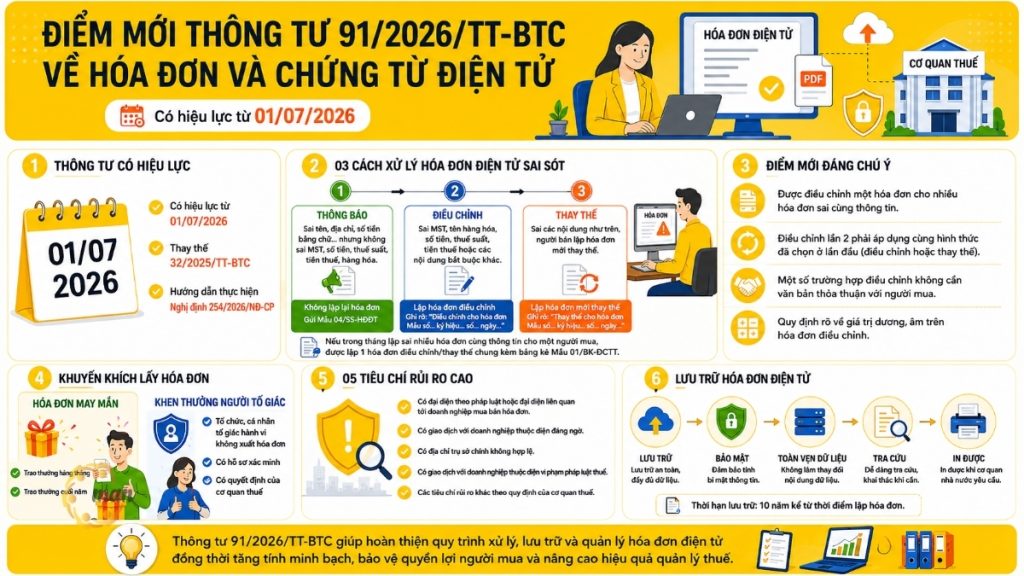
This is the fundamental information you need to understand first when studying the new provisions of Circular 91/2026/TT-BTC. According to Article 25 of Circular 91/2026/TT-BTC, from July 1, 2026, Circular 32/2025/TT-BTC dated May 31, 2025, issued by the Minister of Finance, guiding the implementation of some articles of the 2019 Law on Tax Administration, Decree 123/2020/ND-CP, and Decree 70/2025/ND-CP, officially ceases to be in effect.
This means that all professional guidelines related to electronic invoices and electronic documents that accountants are currently applying according to Circular 32/2025/TT-BTC will need to be reviewed and compared with Circular 91/2026/TT-BTC and Decree 254/2026/ND-CP to avoid mistakenly applying regulations that are no longer in effect.
New points in Circular 91/2026/TT-BTC on handling erroneous electronic invoices.
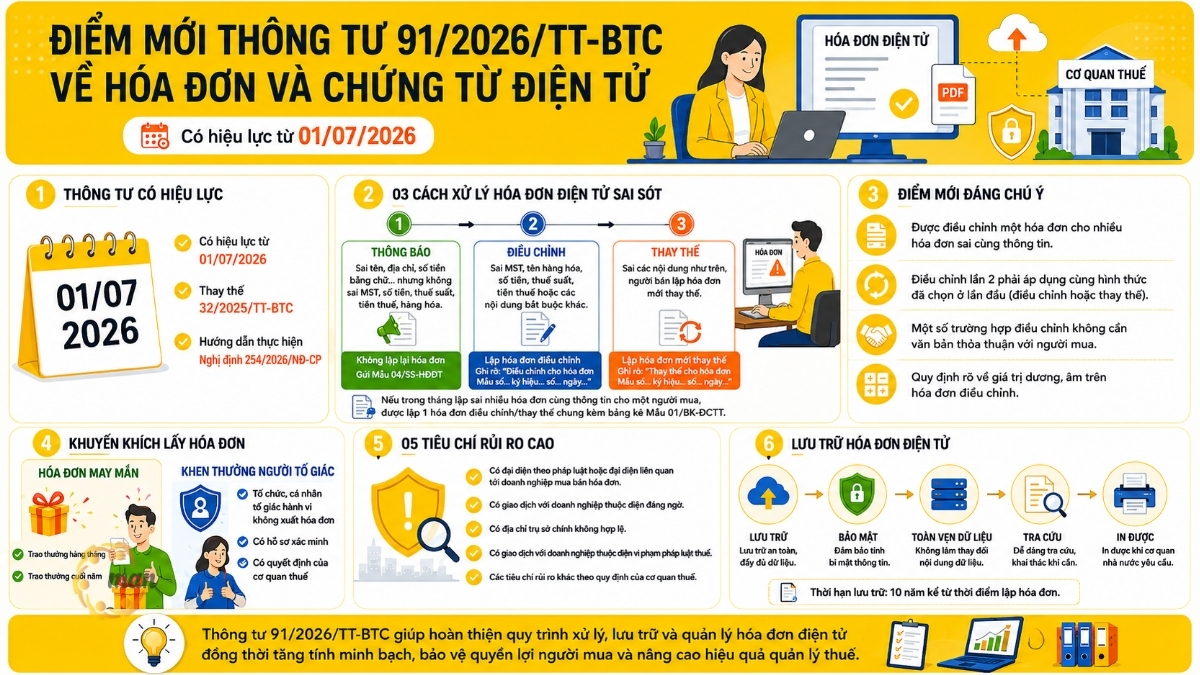
One of the issues of greatest concern to accountants is the new provision in Circular 91/2026/TT-BTC regarding the handling of incorrectly issued electronic invoices. This regulation is detailed in Article 10 of Circular 91/2026/TT-BTC and applies to both electronic invoices that have been assigned a tax authority code and electronic invoices without codes that have submitted data to the tax authority.
03 cases of handling incorrectly issued electronic invoices.
According to Article 10 of Circular 91/2026/TT-BTC, depending on the nature of the error, the seller will handle it in one of three ways as follows:
Case 1: Only notification, no need to reissue the invoice.
This applies when an invoice contains errors in the name, address, amount in words, or other details, but does not contain errors in the tax identification number, the amount written on the invoice, the tax rate, the tax amount, or the goods listed on the invoice. In this case, the seller only needs to notify the buyer about the incorrect invoice and simultaneously send a notification to the tax authority using Form No. 04/SS-HĐĐT (Appendix III attached to Circular 91/2026/TT-BTC).
Case 2: Issuing an electronic adjustment invoice.
This applies when an invoice contains errors such as incorrect tax identification number, product name, or if the goods do not meet specifications/quality standards, the amount stated on the invoice, tax rate, tax amount, or other mandatory information. The adjusted invoice must include the following text:
Adjustment for Invoice Form No… Symbol… Number… Date… Month… Year.
Case 3: Issue a new electronic invoice to replace the old one.
The same applies to errors as above, but if the seller chooses to issue a new replacement invoice instead of making an adjustment, the replacement invoice must clearly state:
This replaces invoice Form No… symbol… number… dated… month… year.
Key points to note: After issuing an adjustment or replacement invoice, the seller digitally signs the new electronic invoice and then sends it to the buyer (if the invoice does not have a tax authority code) or sends it to the tax authority to obtain a code before sending it to the buyer (if the invoice has a tax authority code).
In addition, Circular 91/2026/TT-BTC also adds the following regulations:
If, within a month, the seller makes errors in the buyer's information, product name, unit price, quantity, and tax rate on multiple invoices for the same buyer, the seller may issue a single adjustment or replacement invoice for all the incorrect invoices, accompanied by a list in accordance with Form No. 01/BK-ĐCTT (Appendix III).
Other specific invoice adjustment cases
Besides handling incorrectly issued invoices, Article 10 of Circular 91/2026/TT-BTC also stipulates situations requiring invoice adjustments even if the original invoice is not incorrect, but actual changes occur after issuance, including:
- Adjusting the final settlement value of an investment project when unit prices or quantities change; adjusting the selling price according to specialized laws; or adjusting based on the conclusions of a competent state agency.
- Adjusting wholesale electricity prices between Vietnam Electricity Group and the Electricity Corporations, and between the Electricity Corporations and the Electricity Companies.
- Quantity-based trade discounts: the discount amount is adjusted on the invoice of the last purchase, the next period, or an adjustment invoice is issued along with a list of invoices requiring adjustment.
- Returning goods or services: the seller issues an adjusted invoice, except in cases where both parties agree that the buyer issues the invoice upon returning the goods.
- Refunds, fee reductions, and insurance brokerage commission reductions: the seller issues an adjusted invoice to the customer, clearly stating the amount and reason for the refund/reduction.
- Cancel or terminate transactions related to advance payment invoices in the fields of real estate, infrastructure construction, and building houses for sale.
- Credit institutions and providers of cashless payment services may reimburse customers for service fees.
- For prepaid mobile telecommunications services: telecommunications companies will use the transaction statement to issue adjustment invoices.
- When natural gas is sold with prices stated in foreign currency but payment and invoices are issued in Vietnamese Dong, exchange rate differences arise during actual payment.
Reference: Invoices must be issued in accordance with Decree 254/2026/ND-CP.
How should I handle a second invoice adjustment?
This is also a noteworthy new point in Circular 91/2026/TT-BTC, specifically in Clause 6, Article 10:
If an invoice has been incorrectly issued and the seller has already corrected or replaced it, and another incorrect invoice is subsequently discovered, then subsequent corrections must follow the same method chosen in the first instance (if already corrected, continue to correct; if already replaced, continue to replace).
This regulation helps standardize the handling process, preventing businesses from arbitrarily changing their procedures between adjustments.
In addition, the Circular also clearly stipulates:
- In cases where an electronic invoice is issued without a form number symbol, invoice symbol, or invoice number and contains errors, the seller is only allowed to issue an adjustment invoice (not a replacement invoice).
- Regarding the value on the adjustment invoice, it is mandatory to record a positive number if the adjustment is upward, and a negative number if the adjustment is downward, reflecting the actual adjustment.
- For adjustments due to natural gas exchange rate differences, the seller declares the adjustment in the period in which the adjustment invoice is issued, and the buyer declares it in the period in which the adjustment invoice is received.
When is it not necessary to create a written agreement for invoice adjustments?
According to general regulations, before adjusting or replacing an incorrect invoice, if the buyer is an economic organization, other organization, business household, or individual business, both parties must draw up a written agreement clearly stating the incorrect information; if the buyer is an individual, the seller only needs to notify the buyer or announce it on the website (if available).
However, Circular 91/2026/TT-BTC stipulates that sellers are not required to draw up a written agreement in the following cases:
- Transfer electronic invoice data according to the Summary Table of Electronic Invoice Data (point a.1, clause 3, Article 16 of Decree 254/2026/ND-CP);
- Transfer the transaction details database according to the Transaction Details Table (point a.2, clause 3, Article 16 of Decree 254/2026/ND-CP);
- The buying and selling of goods on e-commerce platforms and other digital platforms.
This helps to reduce administrative procedures for e-commerce business models, which often generate a high frequency of invoices and find it difficult to create written agreements for each transaction.
New points in Circular 91/2026/TT-BTC regarding rewarding consumers who report acts of not issuing invoices.
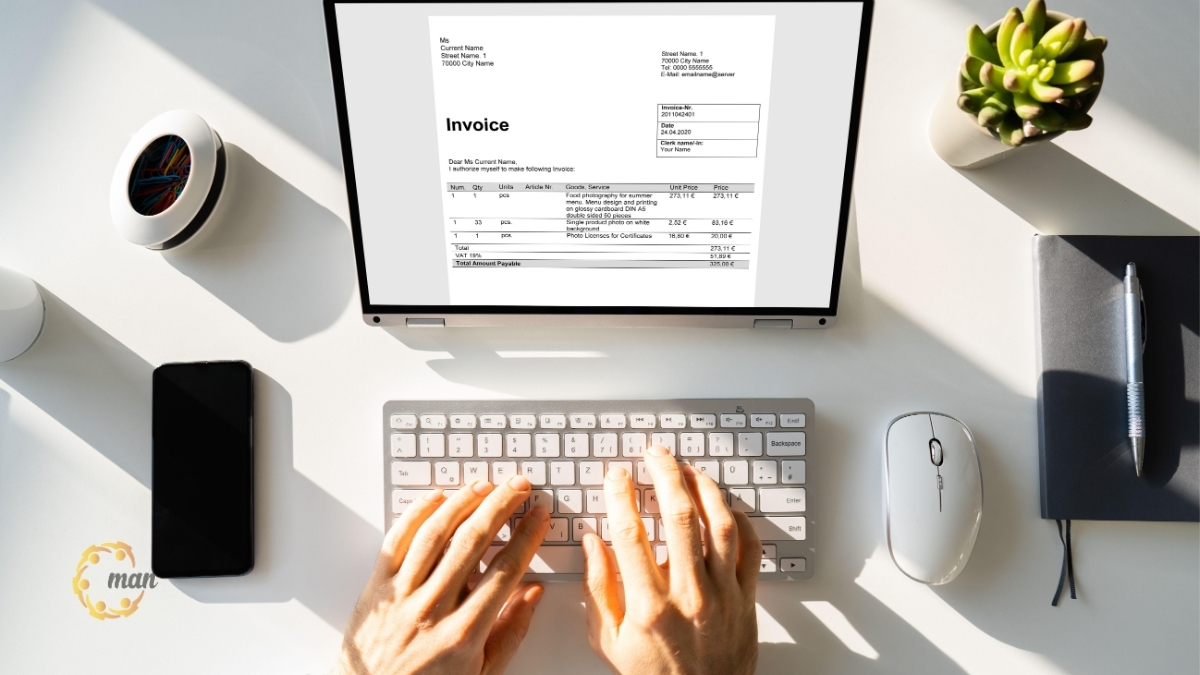
One notable new point in Circular 91/2026/TT-BTC is the mechanism for rewarding consumers who report sellers who fail to issue or deliver invoices. The reward procedure is as follows:
- Step 1: The tax authorities receive the complaint from the consumer, classify it for inspection and verification.
- Step 2: The dossier for awarding commendations includes: documents and evidence regarding the violation as per Article 41 of Decree 254/2026/ND-CP; inspection conclusions or administrative violation handling decisions regarding invoices from competent authorities; personal information of the individual nominated for commendation; and other relevant documents (if any).
- Step 3: Based on the above documents, the tax authority issues a reward decision for the individual who provided information meeting the conditions under Clause 1, Article 41 of Decree 254/2026/ND-CP.
See more: Full text of Decree 254/2026/ND-CP.
New points in Circular 91/2026/TT-BTC on measures to encourage buyers to request invoices.
In parallel with the mechanism for rewarding whistleblowers, Circular 91/2026/TT-BTC also adds regulations on measures to encourage buyers to proactively obtain invoices when purchasing goods and services. Accordingly:
- Sellers of goods, providers of services, organizations providing electronic invoicing services, and tax authorities will use the electronic invoice database to implement incentive measures.
- The tax authorities organize monthly and year-end "lucky invoice" programs for electronic invoices purchased by consumers, awarding cash prizes; along with other incentive measures.
- The budget for implementing these incentive measures shall not exceed 150 billion VND per year.
This is one of the groundbreaking new points in Circular 91/2026/TT-BTC, demonstrating an effort to build consumer habits of requesting invoices through financial incentives, rather than relying solely on administrative measures.
Criteria for identifying high-risk taxpayers in the registration process for using electronic invoices.
According to Article 7 of Circular 91/2026/TT-BTC, taxpayers are determined to be at high risk when registering to use electronic invoices if they meet one of the following five criteria:
- The owner/legal representative, business household representative, individual business owner, or private enterprise owner who is also the owner or representative of another legal entity has been found by a competent state agency to have committed fraud or invoice trading.
- Owners or representatives on the list of those involved in suspicious transactions under the Anti-Money Laundering Law.
- Registering a head office address without a specific address within administrative boundaries, or registering at an apartment (excluding the area permitted for business operations according to regulations), does not apply to individual businesses.
- The legal representative or owner is also involved with a legal entity that is in a state of inactivity but has not completed the procedures for terminating its tax identification number, is not operating at its registered address, or has committed violations regarding taxes, invoices, and documents as stipulated in Circular 94/2026/TT-BTC.
- There are other risk indicators identified by the tax authorities according to Circular 94/2026/TT-BTC, which will be notified to the taxpayer and require explanation.
Understanding these five criteria helps businesses proactively review their ownership structure, legal representatives, and registered business addresses, avoiding high-risk situations when registering for electronic invoices.
Are electronic invoices converted into paper invoices still valid for transactions?
This is a question many accountants wonder about when learning about the new provisions of Circular 91/2026/TT-BTC and the accompanying Decree 254/2026/ND-CP. According to Clause 4, Article 5 of Decree 254/2026/ND-CP, legally valid electronic invoices and documents can be converted into paper invoices and documents in two cases:
- As required by auditing, inspection, investigation, and other relevant legal regulations;
- According to accounting procedures, financial transactions arise to facilitate recording and monitoring in accordance with accounting laws and regulations.
Point to note: Converted invoices used for accounting purposes are NOT valid for transactions or payments. Except for electronic invoices generated from cash registers connected to the tax authorities for data transfer, this is an accounting regulation that needs to be strictly adhered to in order to avoid misuse of converted paper invoices, which could create legal risks for businesses in buying, selling, and payment transactions.
Regulations on the preservation and storage of electronic invoices and documents.
According to Article 5 of Decree 254/2026/ND-CP:
Invoices and supporting documents must be preserved and stored in a way that ensures safety, security, integrity, completeness, and prevents alteration or distortion throughout the storage period; and must be stored for the correct and full duration as prescribed by accounting laws.
Electronic invoices and electronic documents are stored as data messages. Businesses have the right to choose a storage method that suits their specific operations, technological capabilities, and meets the requirements of Article 13 of the 2023 Law on Electronic Transactions, and must be readily printable or searchable upon request.
Specifically for invoices printed by the tax authorities, printed documents, and self-printed documents:
- Invoices or documents that have not yet been issued are stored under the regime of valuable documents;
- Invoices issued by the accounting unit are stored in accordance with accounting regulations;
- Invoices issued by organizations, households, or individuals that are not accounting units are kept as private property.
With the sheer volume of new regulations that need constant updating, many small and medium-sized enterprises (SMEs) face difficulties in independently reviewing and processing invoices in accordance with regulations. This is also why businesses should consider using a service provider. full accounting service To receive timely updates on legal changes from MAN – Master Accountant Network's team of experts, and to ensure invoices and documents are processed accurately from the start.
Issuing electronic invoices without a tax authority code according to Decree 254.
According to Article 13 of Decree 254/2026/ND-CP:
Businesses use software to create electronic invoices when selling goods or providing services, digitally sign the electronic invoices, and send them to buyers electronically as agreed upon by both parties, ensuring compliance with legal regulations on electronic transactions.
This is a fundamental regulation, consistent with the operational guidelines in Circular 91/2026/TT-BTC on handling invoices without tax authority codes.
See more: Regulations on issuing invoices with and without tax codes by the tax authorities.
Conclude
In summary, the new points in Circular 91/2026/TT-BTC revolve around several core contents:
- The regulations detail three cases for handling incorrectly issued electronic invoices and how to process the second adjustment.
- A mechanism to reward consumers who report instances of failure to issue invoices;
- The policy encourages buyers to obtain invoices with a maximum budget of 150 billion VND per year.
- Criteria for identifying high-risk taxpayers;
- Regulations stipulate that converted paper invoices are not valid for transactions or payments.
- Along with guidelines on preserving, storing, and invoicing electronic invoices without tax authority codes.
To avoid tax and invoicing risks, corporate accountants should proactively review their entire current process for creating, processing, and storing electronic invoices, comparing it with the new regulations in Circular 91/2026/TT-BTC and Decree 254/2026/ND-CP, and promptly update the accounting team and sales department to ensure compliance.
If a business lacks the internal resources to keep up with these legal changes, the solution is... hire accounting services Professional and experienced units like MAN – Master Accountant Network will help reduce workload, minimize errors when processing electronic invoices, and ensure businesses always comply with the latest legal regulations.
Contact MAN – Master Accountant Network For free support and advice!
Contact information MAN – Master Accountant Network
- Address: No. 19A, Street 43, Tan Thuan Ward, Ho Chi Minh City
- Mobile/Zalo: 0903 963 163 – 0903 428 622
- E-mail: man@man.net.vn
- Google Business Profile: View MAN – Master Accountant Network's Google Business Profile
- LinkedIn Founder: View expert Le Hoang Tuyen's LinkedIn profile.
Responsible for production and professional content review by: Mr. Le Hoang Tuyen – Founder & CEO of MAN – Master Accountant NetworkHe is a CPA Vietnam auditor with over 30 years of in-depth experience in accounting, auditing, taxation, and corporate legal consulting.
Frequently Asked Questions about the new points in Circular 91/2026/TT-BTC
If the name, address, or amount in words is incorrect (but the tax code, amount, tax rate, or goods are correct), only a notification will be issued; a new invoice will not be created. If the tax code, amount, tax rate, tax amount, or goods are incorrect, the option to adjust or replace the invoice will be given.
The exact form chosen initially (if adjustments have been made, continue with the adjustments; if replacements have been made, continue with the replacements) as stipulated in Clause 6, Article 10 must be applied.
No. A written agreement is not required in the following three cases: Transfer via the Summary Table of Electronic Invoice Data, the Detailed Transaction and Sales Information Table via e-commerce or digital platforms.
Implementing electronic invoices with the buyer being the consumer, with monthly and annual prize draws; the total incentive budget shall not exceed 150 billion VND/year.
No, except for invoices generated from cash registers with data connections to the tax authorities (Clause 4, Article 5 of Decree 254/2026/ND-CP). If an invoice has been issued incorrectly, should you choose to notify, correct, or replace it?
The invoice has already been adjusted once. What happens if another error is discovered?
Is a written agreement required for all invoice adjustments?
Which types of invoices and what is the minimum payment amount eligible for the lucky bill program?
Can an electronic invoice converted to a paper invoice be used for payment?