
Electronic documents, as stipulated in Decree 254/2026/ND-CP, are crucial for all accountants, businesses, and individuals involved in business activities to understand before the most significant legal transition in the past six years. From July 1st, 2026, when Decree 123/2020/ND-CP and its amendments officially expire, incorrect document preparation or missing content as per Article 23 may render the document invalid for payment, accounting, and financial settlement. This article comprehensively outlines the three preparation methods, legal conditions, and mandatory principles in accordance with the regulations. Article 26 of Decree 254/2026/ND-CPThis helps you stay up-to-date and avoid risks when applying it to real-world business situations.
What are electronic documents created according to Decree 254?
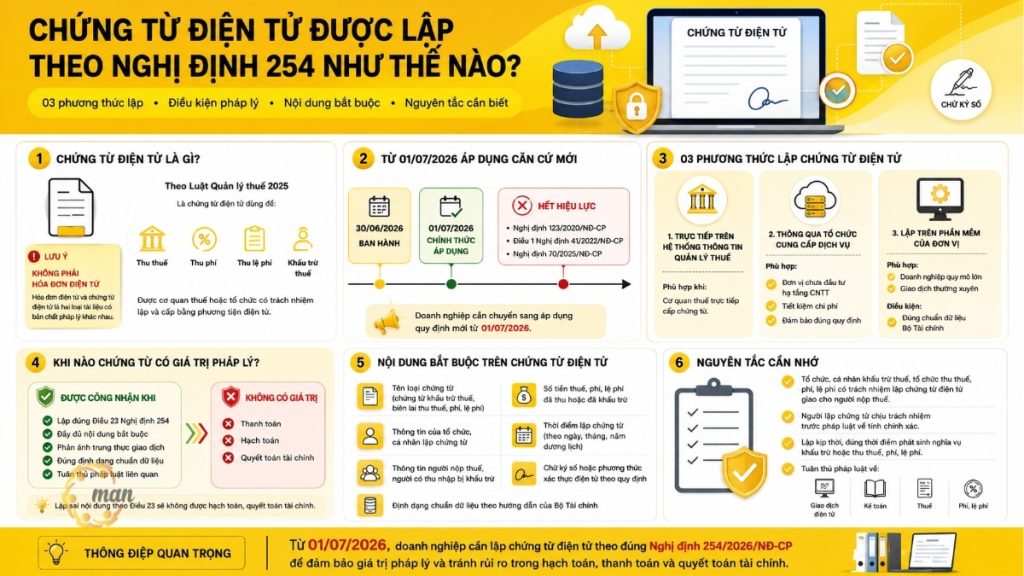
According to Clause 1, Article 27 Tax Administration Law 2025The content is guided in detail by Decree 254/2026/ND-CP on electronic documents. Electronic documents are understood as documents for collecting taxes, fees, or charges, or documents for tax deductions, in electronic data form, issued to taxpayers by tax authorities or organizations responsible for tax deductions using electronic means.
It's important to note that electronic documents are not the same as electronic invoices. While electronic invoices record the sale of goods or provision of services between the seller and the buyer, electronic documents are associated with the collection of taxes, fees, charges, or personal income tax deductions. These are two types of documents with different legal natures, although they are both regulated under the same Decree. Clearly distinguishing them from the outset will help accountants avoid confusion when applying the regulations later.
The legal basis for regulating the creation of electronic documents is Decree 254.

Decree 254/2026/ND-CP was issued by the Government on June 30, 2026, and officially came into effect on July 1, 2026. This document specifies certain provisions and organizational measures for the implementation of the 2025 Tax Administration Law, specifically clarifying Clause 6 of Article 26 and Clause 4 of Article 27 of the Law.
At the same time, from the date of their effective date, the following three legal documents officially cease to be in effect:
- Decree 123/2020/ND-CP regulates invoices and supporting documents;
- Article 1 of Decree 41/2022/ND-CP amends and supplements Decree 123/2020/ND-CP;
- Decree 70/2025/ND-CP amends and supplements Decree 123/2020/ND-CP.
This means that all businesses, organizations, and individuals engaged in business activities need to stop applying the old regulations and switch entirely to basing transactions on electronic documents created according to Decree 254 from July 1, 2026.
See more: Full text of Decree 254/2026/ND-CP.
03 methods for creating electronic documents according to the new regulations
This is core content that accountants need to master when implementing it in practice. According to Article 26 of Decree 254/2026/ND-CP, electronic documents prepared under Decree 254 can be made through one of the following three methods:
Created directly on the Tax Management Information System.
This is an electronic document method established under Decree 254 through infrastructure directly operated by the tax authority. This method is suitable for cases where the tax authority directly issues tax, fee, and levy collection documents to taxpayers without the need for intermediaries.
Prepared through a service provider.
Organizations and individuals deducting taxes or entities collecting taxes, fees, and charges may choose to create electronic documents through licensed intermediary service providers. This approach is suitable for entities that do not yet have the resources to invest in their own IT infrastructure, helping to save operating costs while still ensuring compliance with regulations.
Created using the unit's electronic document software.
For large organizations with a high volume of tax-deductible transactions, investing in and operating their own electronic document software is the optimal choice. A prerequisite is that the software must meet the standard data format prescribed by the Ministry of Finance.
As can be seen, regardless of which of the three methods mentioned above is chosen, the legal nature of electronic documents remains unchanged. The important thing is that the document must fully meet the conditions regarding content and the authenticity of the transaction, which will be discussed in detail in the following section.
See also: Issuing electronic invoices in accordance with Decree 254/2026/ND-CP.
Conditions for electronic documents to be legally valid.

According to Clause 2, Article 26:
"Documents are only recognized as legal documents for payment, accounting, and financial settlement when they are prepared in accordance with the regulations in Article 23 of the Decree."
Conversely, if the preparation of documents does not comply with the provisions of Article 23, those documents will be invalid for payment and will not be accounted for or settled financially. This is a point that accountants need to pay special attention to, because errors in document preparation can lead to the risk of expenses not being accepted when settling corporate income tax or personal income tax.
In addition to content requirements, the creation of electronic documents must ensure that they fully and truthfully reflect the transactions that occur; and at the same time comply with the law on electronic transactions, the law on accounting, and the law on taxes, fees, and charges.
This is the overarching principle that governs the entire process of creating electronic documents, regardless of the method used.
For small businesses and household businesses that do not have permanent staff in charge of this area, the solution is... hire an external accountant This is also a cost-effective approach that still ensures compliance with regulations on the creation, management, and storage of electronic documents.
Mandatory content requirements for electronic documents according to Decree 254

Based on Article 23 of Decree 254/2026/ND-CP determining the legal validity of documents, accountants need to understand the mandatory contents that must be included on the documents, including:
- Type of document (tax deduction certificate, tax receipt, fee receipt);
- Information of the organization or individual preparing the document, and the taxpayer or person whose income is subject to withholding;
- The amount of taxes, fees, and charges collected or deducted;
- The date the document was created should be shown in the format of day, month, and year according to the Gregorian calendar.
- Digital signatures or prescribed electronic authentication methods;
- Standard data format as guided by the Ministry of Finance.
Presenting these contents fully and accurately right from the document preparation stage is a prerequisite for electronic documents prepared according to Decree 254 to have legal validity, serving the accounting and financial settlement work later on.
Principles to keep in mind when creating electronic documents.
In addition to the specific regulations in Articles 26 and 23, organizations and individuals, when creating electronic documents in accordance with Decree 254, must comply with the following general principles:
- Organizations and individuals deducting personal income tax, and organizations collecting taxes, fees, and charges, are responsible for creating electronic tax deduction certificates and electronic receipts to be given to those whose income is being deducted and those paying taxes, fees, and charges.
- The person who prepares the document is legally responsible for the accuracy of the document prepared.
- Documents must be prepared promptly, at the exact time the obligation to deduct or collect taxes, fees, or charges arises, avoiding late preparation which could affect the rights of taxpayers.
In reality, not all businesses have sufficient personnel with in-depth knowledge of tax deduction procedures and the new electronic document creation process. For units that do not have a dedicated accounting department or want to minimize the risk of errors during the transition, consultation is recommended. full accounting service Choosing reputable and experienced providers like MAN – Master Accountant Network is the solution to ensure that documents and invoices are prepared correctly, on time, and with the right content right from the start.
Conclude
Electronic documents are created in accordance with Decree 254/2026/ND-CP through 3 methods:
- Directly on the Tax Management Information System
- Through the service provider
- The unit's software.
However, documents are only valid for payment, accounting, and settlement when they are prepared correctly according to the content in Article 23 and truthfully reflect the transaction that occurred; errors at this stage mean the document loses its legal validity.
From July 1st, 2026, when Decree 123/2020/ND-CP expires, businesses and accountants should immediately review their internal document preparation processes to avoid risks during tax settlement. Follow MAN – Master Accountant Network to learn more in-depth articles on electronic invoices and electronic documents according to Decree 254/2026/ND-CP.
Contact MAN – Master Accountant Network For free support and advice!
Contact information MAN – Master Accountant Network
- Address: No. 19A, Street 43, Tan Thuan Ward, Ho Chi Minh City
- Mobile/Zalo: 0903 963 163 – 0903 428 622
- E-mail: man@man.net.vn
- Google Business Profile: View MAN – Master Accountant Network's Google Business Profile
- LinkedIn Founder: View expert Le Hoang Tuyen's LinkedIn profile.
Responsible for production and professional content review by: Mr. Le Hoang Tuyen – Founder & CEO of MAN – Master Accountant NetworkHe is a CPA Vietnam auditor with over 30 years of in-depth experience in accounting, auditing, taxation, and corporate legal consulting.
Frequently Asked Questions about Electronic Documents Prepared According to Decree 254
Yes. All tax authorities and organizations responsible for withholding and collecting taxes, fees, and charges are subject to and must comply with the regulations on electronic document creation as stipulated in Decree 254.
Article 26 stipulates that legally valid documents must fully and truthfully reflect the transactions that have occurred. Incorrectly dated documents constitute a violation of the principle of truthfully reflecting transactions and may affect the acceptance of documents during accounting and settlement.
Electronic documents created under Decree 123/2020/ND-CP before July 1, 2026, remain legally valid and can continue to be used for accounting, bookkeeping, declaration, and payment purposes. Documents are only subject to restrictions on editing and must be processed according to the new regulations if errors arise from the date Decree 254/2026/ND-CP comes into effect.
Yes. This is one of the mandatory requirements under Article 23 to ensure the legal validity and authenticity of electronic documents.
This applies to tax authorities, organizations responsible for withholding personal income tax, and organizations collecting taxes, fees, and charges. These are the entities that directly create and issue electronic documents to taxpayers as stipulated in Articles 26 and 27 of Decree 254/2026/ND-CP. Are electronic documents, as stipulated in Decree 254, mandatory for all organizations?
Does an electronic document created at the wrong time affect its legal validity?
Are electronic documents created under Decree 123/2020 before July 1, 2026, still valid?
Do electronic documents created under Decree 254 require a digital signature?
Which entities are eligible for electronic documents issued under Decree 254?






