
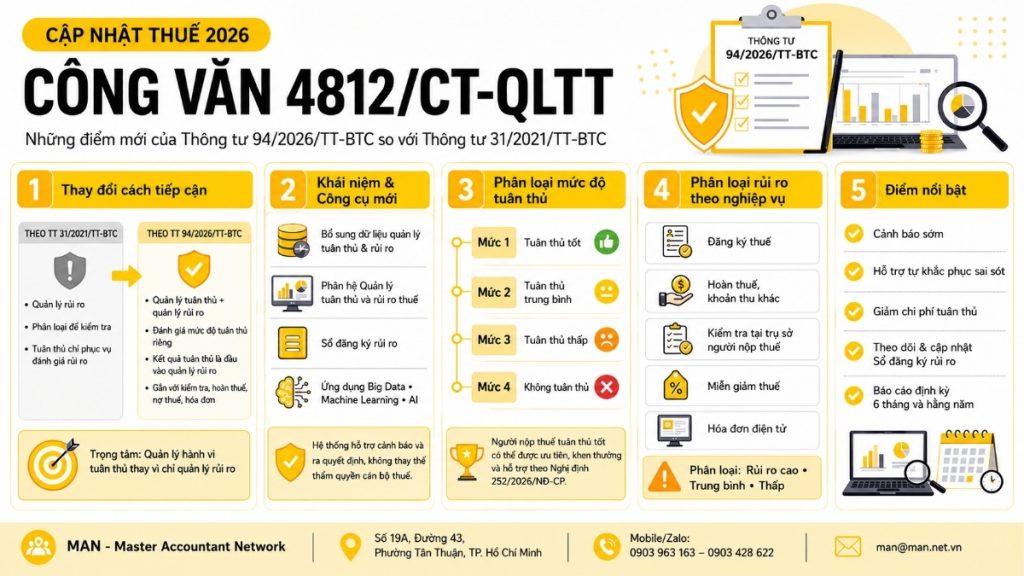
On July 14, 2026, the Tax Department issued... Official Document 4812/CT-QLTT Sent to provincial and city tax departments, large enterprise tax offices, and e-commerce tax offices, for introduction and implementation. Circular No. 94/2026/TT-BTC Regulations on compliance management and risk management in tax administration. This document is of significant importance to the entire tax authority system and will directly impact how taxpayers, especially corporate accounting departments, interact with tax authorities in the future.
For accountants, grasping the content of Circular 4812/CT-QLTT early is not only essential for updating tax law knowledge but also provides a basis for proactively reviewing and adjusting internal tax declaration and record management processes, avoiding being classified as high-risk when the tax authorities implement the new management model. This article will provide a detailed and comprehensive analysis, closely adhering to the original content of Circular 4812/CT-QLTT and its attached appendix, giving readers a complete and accurate understanding of the important changes in tax management in 2026.
Basis for issuance and purpose of Official Letter 4812/CT-QLTT
Purpose of issuing the Official Letter
The core purpose of Official Letter 4812/CT-QLTT is to urge tax authorities at all levels to promptly study and implement, as well as disseminate the content of Circular No. 94/2026/TT-BTC to tax officials and taxpayers for consistent implementation nationwide. In other words, this is an internal guidance document for the tax sector, but it has significant reference value for businesses and accountants because it systematically summarizes the most important changes in tax management policy.
Legal basis of Official Letter 4812/CT-QLTT
The content mentioned in Official Letter 4812/CT-QLTT is based on Circular No. 94/2026/TT-BTC issued by the Minister of Finance on July 1, 2026, and is built upon the foundation. Law on Tax Administration No. 108/2025/QH15 and the Government's Decrees guiding the implementation of the Law on Tax Administration. This is the overarching legal basis that determines all the changes in tax compliance management and tax risk management presented in this document.
Circular 94/2026/TT-BTC: The key document mentioned in Official Letter 4812/CT-QLTT
According to Official Letter 4812/CT-QLTT, Circular No. 94/2026/TT-BTC takes effect from July 1, 2026, and simultaneously replaces Circular No. 31/2021/TT-BTC regulating the application of risk management in tax administration. The replacement of the entire document, instead of merely amending or supplementing some provisions, demonstrates a fundamental shift in the tax administration mindset that the Ministry of Finance is aiming for.
The scope of regulation has been expanded.
A notable point emphasized in Official Letter 4812/CT-QLTT is that the scope of Circular No. 94/2026/TT-BTC is no longer limited to "applying risk management in tax administration" as before, but has been expanded to "compliance management and risk management in tax administration". This name change reflects a more comprehensive approach, consistent with the 2025 Tax Administration Law and international practices on tax compliance management.
It can be said that Official Letter 4812/CT-QLTT is essentially a document guiding the practical implementation of Circular No. 94/2026/TT-BTC to the entire tax authority system, ensuring uniformity and consistency in its application nationwide.
The new points outlined in Official Letter 4812/CT-QLTT compared to the old regulations.

The main focus of Official Letter 4812/CT-QLTT is the new points of Circular No. 94/2026/TT-BTC compared to Circular No. 31/2021/TT-BTC. Below are the main groups of changes presented in the attached Appendix to the letter.
Changing the approach: From risk management to compliance management and risk management
According to Official Letter 4812/CT-QLTT, the previous Circular No. 31/2021/TT-BTC built the risk management framework around three main contents:
- Gathering and processing information;
- Assess compliance and classify risk levels;
- Apply tax management measures appropriate to each risk level.
The compliance regulations in the old document mainly served only to classify risks and select subjects for inspection, audit, tax refund, tax registration management, tax debt management, and invoice management.
Circular No. 94/2026/TT-BTC, in line with the spirit of Official Letter 4812/CT-QLTT, inherits the risk management approach but supplements and upgrades it into a unified compliance and risk management model, with the following highlights:
- Establish a separate compliance management mechanism with criteria for evaluating and classifying compliance levels and measures to improve compliance for each group of taxpayers.
- Consider compliance classification results as an indispensable input for risk level classification in each tax administration operation.
- Closely integrating compliance management with key inspection and monitoring planning, debt management, tax refunds, tax exemptions and reductions, and electronic invoices aims to improve the effectiveness and efficiency of tax administration and reduce compliance costs for taxpayers.
Thus, the overarching spirit of Circular 4812/CT-QLTT is to shift the focus from "risk management only" to "managing compliance behavior while simultaneously managing risk," a significant step forward in modern tax management thinking.
New aspects regarding management concepts, principles, and tools.

In terms of concept: The Appendix attached to Official Letter 4812/CT-QLTT states that Circular No. 94/2026/TT-BTC has reviewed, standardized, and expanded the system of concepts in a modern direction, including:
- The concept of "compliance management information and risk management in tax administration" is added, emphasizing that tax data, tax-related data, and taxpayer data are collected and processed by tax authorities to serve both compliance and risk management purposes.
- Clarify the concept of tax law compliance level, criteria, indicators for assessment and classification of compliance levels; risk level, criteria and indicators for assessment and classification of risk levels.
- The concept of the Tax Compliance and Risk Management Subsystem has been added, a specialized subsystem within the Tax Administration System, serving to collect, process, analyze information, score, classify, warn, and support tax management decision-making.
- Add the concept of a Risk Register, a database containing information about risks, to the Tax Compliance and Risk Management subsystem.
In principle: Official document 4812/CT-QLTT clearly states that Circular No. 94/2026/TT-BTC inherits the principle of ensuring the effectiveness and efficiency of tax management, encouraging taxpayers to voluntarily comply, while also adding and emphasizing:
- Compliance management and risk management must ensure objectivity, transparency, and adherence to legal regulations, without discrimination among taxpayers.
- Prioritize the application of big data technology, machine learning, and artificial intelligence to automate the processes of data collection, processing, analysis, evaluation, and classification.
- The results of compliance and risk assessments and classifications must be documented, tracked, traceable, and used as a basis for developing compliance improvement plans and targeted inspection and monitoring plans.
Regarding management tools: According to Official Letter 4812/CT-QLTT, Circular No. 94/2026/TT-BTC clearly stipulates that the Tax Compliance and Risk Management Subsystem is built to serve the collection, standardization, processing, and analysis of data; assessment and classification of compliance and risk levels; management of compliance and risk records; support for warnings and proposed management measures; monitoring, tracing, and feedback on implementation results. It is noteworthy that the analysis, assessment, warnings, and proposals from the Subsystem are only supporting evidence and do not replace the responsibilities of the competent authority as stipulated by law.
New points regarding compliance classification and mechanisms for improving compliance.
Official document 4812/CT-QLTT states that Circular No. 31/2021/TT-BTC previously classified the level of tax law compliance of taxpayers into four levels: high compliance, medium compliance, low compliance, and non-compliance.
Circular No. 94/2026/TT-BTC retains the four levels of compliance but adjusts the terminology as follows:
- Level 1: Good compliance.
- Level 2: Average compliance.
- Level 3: Low compliance.
- Level 4: Non-compliance.
A key point clarified in the Official Letter is that the classification results in accordance with Circular No. 94/2026/TT-BTC are not only the basis for risk classification, but also the basis for:
- Consider, select, reward, and prioritize taxpayers with good compliance in tax management, as stipulated in Decree No. 252/2026/ND-CP.
- Develop a plan to improve compliance at all levels through measures such as: coordinating with relevant agencies and organizations; promoting communication, support, dialogue conferences, and training; researching and proposing policy amendments and procedure simplification; and enhancing the application of information technology to reduce compliance costs.
Furthermore, Circular 4812/CT-QLTT clearly states that tax authorities will strengthen early warning systems, recommend compliance, support taxpayers in reviewing and self-correcting errors, and improve voluntary compliance; while focusing resources on inspection and supervision of cases showing signs of risk or violations of tax laws. Monitoring and evaluation of the compliance improvement plan will be conducted periodically, comparing actual results with set targets and updating the Risk Register.
New points regarding risk classification according to each tax management function.
According to Official Letter 4812/CT-QLTT, Circular No. 94/2026/TT-BTC standardizes the classification of taxpayer risk levels in each tax management operation into three levels: high risk, medium risk, and low risk, combined with the results of tax law compliance classification according to Article 10 of the Circular. Specifically, some operations with notable new regulations include:
- Tax registration: The risk classification system is supplemented and applied to cases of tax code termination. High-risk cases will undergo tax audits at the taxpayer's premises as stipulated in Law No. 108/2025/QH15 on Tax Administration; medium and low-risk cases will be subject to measures to urge taxpayers to fulfill their tax obligations before dissolution, bankruptcy, or cessation of operations.
- Tax refunds, other payments: The regulations include separate provisions for value-added tax refunds and refunds of other fees; supplementing the assessment and classification of risk levels based on the classification results and refund audit results of the immediately preceding period; and establishing a mechanism to temporarily suspend refund amounts showing signs of risk.
- On-site inspection at the taxpayer's premises: The principle of selecting a maximum of 90% cases for inspection based on risk analysis results and a maximum of 10% for random selection will continue to be applied, but with stricter constraints to avoid overlap with other inspection activities as stipulated in the Tax Administration Law No. 108/2025/QH15.
- Tax exemptions and reductions: Additional regulations have been added regarding risk management in the processing of exemption and reduction applications; high-risk applications must be inspected at the taxpayer's premises before a decision is issued; medium and low-risk applications will be processed according to procedure, while also being monitored and inspected when signs of risk arise.
- Invoices and supporting documents: In the context of implementing electronic invoices according to Decree No. 254/2026/ND-CP, Circular No. 94/2026/TT-BTC stipulates the classification of risks in the use of electronic invoices; in high-risk cases, registration for using electronic invoices may be rejected, the use of invoices may be suspended, or other invoice management measures may be applied as prescribed.
Official document 4812/CT-QLTT also emphasizes the requirement for regular reporting, inspection, and monitoring of compliance and risk management application, conducted every six months, annually, and as required by operational needs, in order to assess the quality, effectiveness, and efficiency of the implemented measures.
Why do accountants and businesses need to pay special attention to Official Letter 4812/CT-QLTT?

From an accounting perspective, the changes outlined in Circular 4812/CT-QLTT have a direct and far-reaching impact on business operations in many aspects:
- Firstly, classifying risks by business activity, from tax registration, tax refunds, tax exemptions to electronic invoice management, means that every declaration and documentation task performed by accountants can become input data for the compliance and risk scoring system. A small error in documentation, if repeated multiple times, can cause a business to be classified as high-risk.
- Secondly, the risk-based electronic invoice management mechanism places higher demands on accuracy and timeliness in invoice issuance and data reconciliation. High-risk businesses may have their right to register for or use electronic invoices restricted, directly impacting their business operations.
- Thirdly, conversely, Circular 4812/CT-QLTT also opens opportunities for businesses that comply well: they can be considered for rewards and priority under Decree No. 252/2026/ND-CP, the frequency of inspections and audits will be reduced, and they will receive more support through propaganda programs, dialogues, and training from the tax authorities.
Therefore, proactively reviewing and standardizing tax declaration data, ensuring transparency and consistency in tax records, is an urgent requirement from the moment Circular 4812/CT-QLTT and Circular No. 94/2026/TT-BTC are officially implemented.
For businesses that do not have an internal team sufficiently knowledgeable about new regulations on compliance management and tax risk management, seeking professional help is a viable option. tax accounting services Professionalism is the solution that helps control risks effectively and ensures compliance with regulations right from the start.
What should accountants do after Circular 4812/CT-QLTT is issued?
To effectively adapt to the new compliance and risk management model in accordance with the Official Letter, the company's accounting department should perform the following tasks:
- Review tax returns, invoices, and supporting documents. According to the new compliance criteria, accuracy, completeness, and timeliness are ensured in each declaration period, avoiding the occurrence of unnecessary risks.
- Closely monitor notifications and early warnings. From the Tax Compliance and Risk Management subsystem, the tax authorities can send information to the system so that the individual can promptly review and correct any errors before being subjected to a formal audit.
- Actively coordinate with tax authorities. When required to review regulations, participate in dialogue conferences and training programs to fully update on new regulations and enhance voluntary compliance.
- Regularly update relevant legal documents.This includes Circular No. 94/2026/TT-BTC, Decree No. 252/2026/ND-CP on prioritizing taxpayers with good compliance, and Decree No. 254/2026/ND-CP on electronic invoices, in order to ensure synchronized and comprehensive preparation.
See more: Invoices must be issued in accordance with Decree 254/2026/ND-CP.
Successfully implementing these steps not only helps businesses avoid the risk of being negatively rated according to regulations, but also contributes to building a sustainable long-term reputation for tax compliance.
For small and medium-sized enterprises with limited accounting resources, use full accounting service Hiring specialized, experienced units like MAN – Master Accountant Network is a practical approach to ensure full compliance with new regulations while optimizing operating costs compared to maintaining an in-house accounting system.
Conclude
Official Document 4812/CT-QLTT plays a crucial role as a bridge, facilitating the synchronized implementation of Circular No. 94/2026/TT-BTC on compliance management and risk management in tax administration across the entire tax sector. By shifting the approach from "risk management only" to "compliance management alongside risk management," and adding many new concepts, tools, and mechanisms based on digital technology, Official Document 4812/CT-QLTT marks a significant step forward in tax administration in Vietnam from 2026 onwards.
For accountants and businesses, thoroughly studying the content of Official Letter 4812/CT-QLTT and Circular No. 94/2026/TT-BTC is not only a requirement to update legal knowledge, but also a practical basis for proactively reviewing and improving internal tax compliance processes, minimizing risks during operations.
If a business is not confident in the capabilities of its current workforce in the face of constantly changing tax policies, the solution is... hire an external accountant This can help keep up-to-date with new regulations while reducing the staffing burden on the internal accounting department.
Contact MAN – Master Accountant Network For timely advice and support!
Contact information MAN – Master Accountant Network
- Address: No. 19A, Street 43, Tan Thuan Ward, Ho Chi Minh City
- Mobile/Zalo: 0903 963 163 – 0903 428 622
- E-mail: man@man.net.vn
- Google Business Profile: View MAN – Master Accountant Network's Google Business Profile
- LinkedIn Founder: View expert Le Hoang Tuyen's LinkedIn profile.
Responsible for production and professional content review by: Mr. Le Hoang Tuyen – Founder & CEO of MAN – Master Accountant NetworkHe is a CPA Vietnam auditor with over 30 years of in-depth experience in accounting, auditing, taxation, and corporate legal consulting.
Frequently Asked Questions about Official Document 4812/CT-QLTT
Official document 4812/CT-QLTT, issued on July 14, 2026, is introductory and provides guidance for implementation. The legal document it guides, Circular No. 94/2026/TT-BTC, takes effect from July 1, 2026.
According to Official Document 4812/CT-QLTT, the results of the compliance and risk assessment and classification are managed within the Tax Compliance and Risk Management Subsystem of the Tax Administration System. Businesses should proactively contact their directly managing tax authority or monitor official notifications and warnings to understand their compliance status.
According to Official Letter 4812/CT-QLTT, taxpayers classified as high-risk in the use of electronic invoices may not be accepted for registration to use electronic invoices, may have their use of invoices suspended, or may be subject to other invoice management measures as stipulated in Decree No. 254/2026/ND-CP.
Yes. Official document 4812/CT-QLTT clearly states that Circular No. 94/2026/TT-BTC stipulates separate regulations on value-added tax refunds and refunds of other revenues, in which the assessment and classification of risk levels are carried out based on inheriting the classification results and refund audit results of the immediately preceding period, along with a mechanism to temporarily suspend refund amounts showing signs of risk.
Official document 4812/CT-QLTT states that Circular No. 94/2026/TT-BTC standardizes the classification of taxpayer risk in each transaction into three levels: high risk, medium risk, and low risk. When does Official Document 4812/CT-QLTT take effect?
Where can businesses track their compliance levels and tax risks?
What impact does a high-risk business rating have on its use of electronic invoices?
Does Official Letter 4812/CT-QLTT apply to value-added tax refund applications?
How many risk classification levels are there in each tax administration function?






