
The requirement to retain electronic invoices is a decade-long obligation, yet many businesses treat it as a simple administrative procedure completed after the final accounting period. In reality, inspections reveal that the most common situation isn't accounting errors, but rather the inability to retrieve invoice data from seven or eight years ago after the company changes software or the vendor contract expires. This article outlines the legal basis, three deadlines, the start date for calculation, related penalties, and a review checklist to help accounting departments proactively prepare for each closing period.
Why is the electronic invoice retention period a hidden risk for businesses?
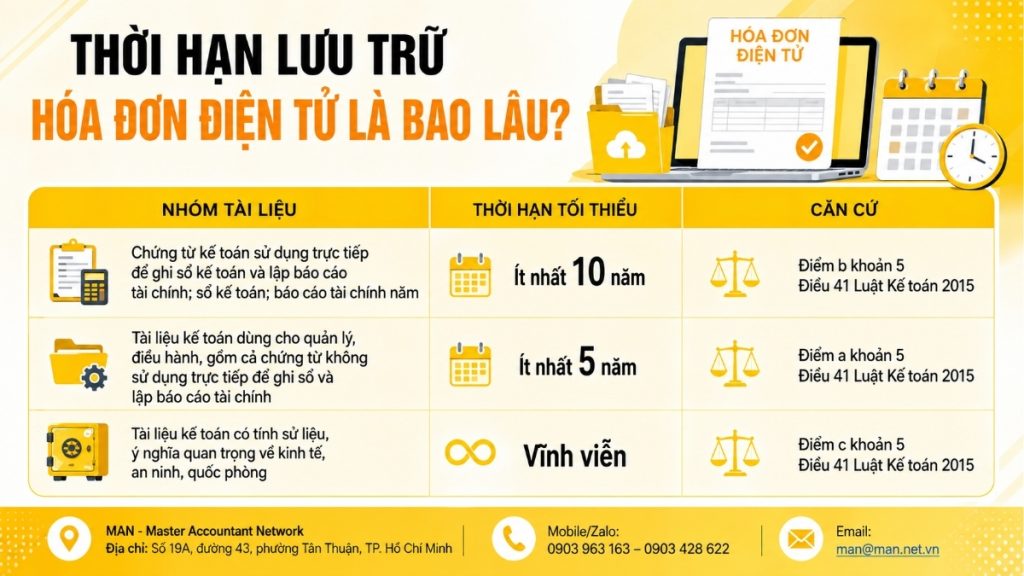
The retention period for electronic invoices is determined as follows: Clause 5, Article 41 of the Accounting Law 2015:
- At least 5 years old for accounting documents used for management and operation;
- At least 10 years for documents used directly for accounting entries and financial statement preparation;
- Permanent archiving is permitted for documents of historical value and those of significant economic, security, and defense importance.
What makes this obligation risky is the time lag. Errors don't become apparent immediately in the period they occur, but lie dormant for years, only to be discovered when the tax authorities request the documents – at a point when the business has almost no way to rectify the situation. Meanwhile, accounting personnel, invoicing software, and storage infrastructure all change constantly over those years.
Is it mandatory to print electronic invoices on paper for archiving?
The answer is Are notThe law does not require businesses to print electronic invoices on paper for storage. Electronic invoices are created, managed, and used as electronic data in accordance with the laws on electronic transactions, accounting, and taxation.
This principle is reinforced at Point b, Clause 5, Article 26 of the 2025 Law on Tax AdministrationThe registration, management, and use of electronic invoices must comply with the regulations of the law on electronic transactions, the law on accounting, and the law on taxation. In other words, the legal essence of an invoice is electronic data, not a printed copy.
The practical consequences are clear: printed copies are only for internal reference. What businesses are obligated to adhere to regarding the retention period for electronic invoices is... original data file in XML format, along with the ability to open, read, and export that file at any time the competent authority requests it. A filing cabinet full of printouts but without the original file is still considered non-compliant.
Three consequences of incorrectly determining the retention period for electronic invoices.
Firstly, they failed to present the necessary documents during the inspection. Input invoices with missing original data face the risk of being disallowed as deductible expenses when calculating corporate income tax, and may also result in adjustments to previously deducted input value-added tax.
Secondly, administrative sanctions arise. The act of losing, burning, or damaging invoices that have already been issued and declared for tax purposes during the retention period is subject to separate penalties, which will be analyzed in the following section.
Third, loss of the ability to defend oneself. This is the least talked-about but most serious damage. Without the original data, accountants cannot prove transactions, cannot reconcile accounts payable, and cannot refute audit findings.
Legal basis for determining the retention period of electronic invoices
The entire content regarding the retention period for electronic invoices is based on Article 41 of the 2015 Accounting Law, combined with the regulations on electronic invoices in Clause 5, Article 26 of the 2025 Tax Administration Law. This is a point many accountants overlook: the answer regarding the retention period is not found in the invoice regulations, but in accounting law.
Article 41 of the 2015 Accounting Law: Fundamental regulations on the preservation and storage of accounting documents.
Preservation and storage of accounting documents:
- Accounting documents must be fully and securely preserved by the accounting unit during use and storage.
- In cases where accounting documents are temporarily seized or confiscated, a record must be included along with photocopies of those documents; if accounting documents are lost or destroyed, a record must be included along with photocopies of the documents or a confirmation.
- Accounting documents must be archived for a period of 12 months from the end of the fiscal year or the completion of the accounting work.
- The legal representative of the accounting unit is responsible for organizing the preservation and storage of accounting documents.
- Accounting documents must be stored for the following periods: a) At least 5 years for accounting documents used for the management and operation of the accounting unit, including accounting vouchers not directly used for recording accounting entries and preparing financial statements; b) At least 10 years for accounting vouchers directly used for recording accounting entries and preparing financial statements, accounting books and annual financial statements, unless otherwise stipulated by law; c) Permanent storage for accounting documents of historical value and significant economic, security, and defense importance.
- The government shall specify the types of accounting documents that must be stored, the storage period, the time of calculation of the storage period as stipulated in Clause 5 of this Article, the storage location, and the procedures for destroying stored accounting documents.
Clause 5, Article 26 of the 2025 Tax Administration Law: Invoices legally exist in the form of electronic data.
Regarding electronic invoices, Principles, rights, and responsibilities for creating, managing, and using electronic invoices:
- Organizations, household businesses, and individual businesses must issue electronic invoices when selling goods or providing services to buyers in a standard data format and must include all the required information as stipulated by tax and accounting laws, ensuring that the invoices fully and truthfully reflect the economic transactions that occurred. They are legally responsible for the accuracy of the invoices issued, except in cases where the use of electronic invoices is not required according to government regulations.
- The registration, management, and use of electronic invoices must comply with the regulations of the law on electronic transactions, the law on accounting, and the law on taxation;
- The timing of issuing electronic invoices is in accordance with government regulations.
- Taxpayers are responsible for deploying technical infrastructure systems that meet the requirements for connectivity, data storage, etc.
Note: The responsibility for the technical infrastructure rests with the taxpayer. Businesses cannot cite reasons such as software provider downtime, policy changes, or account suspension to exempt themselves from the obligation to comply with the deadline for storing electronic invoices.
What is the retention period for electronic invoices?
The 2015 Accounting Law does not set a single number for all types of documents. Instead, Clause 5 of Article 41 divides accounting documents into three groups with three different timeframes, based on the document's function in the accounting system. The table below summarizes how to determine the retention period for electronic invoices according to each group, allowing accountants to quickly compare and classify documents.
Summary table of deadlines for storing electronic invoices.
| Document group | Minimum term | Base |
| Accounting documents used directly for recording accounting entries and preparing financial statements; accounting books; annual financial statements. | At least 10 years | Point b, Clause 5, Article 41 of the Accounting Law 2015 |
| Accounting documents used for management and operation, including vouchers not directly used for recording entries and preparing financial statements. | At least 5 years | Point a, Clause 5, Article 41 of the Accounting Law 2015 |
| Accounting documents are historical documents with significant economic, security, and defense implications. | forever | Point c, Clause 5, Article 41 of the Accounting Law 2015 |
10-year milestone: Applies to the majority of electronic invoices issued by businesses.
Electronic invoices, both incoming and outgoing, arising from sales and service provision activities are the direct basis for recording revenue, expenses, value-added tax, and preparing annual financial statements. Therefore, in the vast majority of cases, the retention period for electronic invoices of businesses is... at least 10 years.
It is important to emphasize: This classification is based on usage, not form or value. A 500,000 VND invoice that has been recorded in the ledger still falls into the 10-year category, the same as a 5 billion VND invoice. Therefore, the practice of "filtering out small invoices to reduce storage capacity" is fundamentally flawed.
5-Year Milestone: Documents for Management and Operation
The 5-year period is for accounting documents used for the management and operation of the accounting unit, including accounting vouchers not directly used for recording in the accounting books and preparing financial statements. In practice, this group usually consists of internal reference documents accompanying the set of vouchers, rather than the invoices themselves that have been recorded in the books.
Permanent storage: A specific group requiring early identification.
Accounting documents that are historically significant and have important economic, security, and defense implications must be permanently archived. This category is rare in typical commercial enterprises, but needs to be identified from the outset in state-owned enterprises, units participating in key projects, or operating in specialized fields. Late labeling often results in documents being destroyed through standard procedures before anyone realizes their value.
The time when the retention period for electronic invoices begins to be calculated.
This is the most overlooked detail in practice. Clause 3, Article 41 of the 2015 Accounting Law stipulates that accounting documents must be archived within a specified period. 12 months, from the date of the end of the fiscal year or the completion of the accounting work.
Thus, there are two distinct obligations that should not be confused:
- Obligation regarding the timing of action: Archive the documents within 12 months of the end of the fiscal year.
- Obligations regarding storage duration: Maintain the term for 5 years, 10 years, or permanently as stipulated in Clause 5 of Article 41.
Businesses may retain data for a full 10 years, but they are still in violation if the data is scattered outside the storage system for the first two or three years. Conversely, even if the data is stored on time, losing it in the eighth year also constitutes a failure to comply with the electronic invoice retention deadline. Both sides must meet the requirements.
Regarding responsibilities, Clause 4 of Article 41 clearly states: The legal representative of the accounting unit is responsible for organizing the preservation and storage of accounting documents. This is not solely the responsibility of the accounting department or the information technology department.
Regarding the specific time frame for calculating the retention period for each type of document, which falls under the authority of the Government as stipulated in Clause 6, Article 41, enterprises should refer to the relevant guidance documents when developing their internal archiving regulations.
The 5-step process for complying with the electronic invoice retention deadline.
Below is a 5-step process for complying with the electronic invoice retention deadline, specifically:
- Step 1 – Inventory and classification at the time of occurrence: Create a complete catalog of all electronic invoices by accounting period, labeling them for 10-year, 5-year, or permanent periods at the time of closing the books. Reclassifying them after many years is always more costly and often lacks sufficient information for accurate classification.
- Step 2 – Export and retain the original data: Download the XML file along with the representation, and store it on infrastructure directly controlled by the business. This eliminates complete dependence on the software provider's lookup portal: service contracts typically last one to three years, while the legally mandated retention period for electronic invoices is up to 10 years.
- Step 3 – Archive the data for the exact 12 months: Set an internal deadline earlier than required by law, for example, completion in the first quarter of the following year, to allow room for addressing any deficiencies that may be discovered. Document the archiving process with a signed handover record.
- Step 4 – Multi-layer backup and periodic testing: Maintain at least two copies in two different physical locations or infrastructures, along with an annual log of file openability checks. Regular checks are crucial; silently corrupted data only becomes apparent when someone attempts to open it. For businesses without dedicated personnel to maintain this process, this is a crucial consideration. What are the penalties for failing to comply with the deadline for retaining electronic invoices?This allows the testing process to operate continuously instead of relying on a single individual's memory.
- Step 5 – Record the incident immediately. In cases where documents are seized, confiscated, lost, or destroyed, Clause 2 of Article 41 requires a record accompanied by a photocopy of the document or a confirmation. A record made at the time of the incident has significantly higher explanatory value than a record made retrospectively after the inspection has begun.
What are the penalties for failing to comply with the deadline for retaining electronic invoices?
It's important to clarify a frequently misunderstood point: the common penalty associated with archiving isn't for "delayed archiving," but rather for other reasons. Invoices are lost, burned, or damaged during storage..
Based on Clause 4, Article 26 of Decree 125/2020/ND-CP, as amended by Clause 4, Article 1 of Decree 102/2021/ND-CP:
- Penalties for losing, burning, or damaging invoices: A fine of VND 5,000,000 to VND 10,000,000 shall be imposed for the act of losing, burning, or damaging invoices that have been issued and declared for tax purposes during use or storage, except in cases stipulated in Clauses 1, 2, and 3 of this Article.
The above-mentioned fine applies to organizations. For individuals, including households and business households, committing the same violation, the fine will be half the amount imposed on organizations, according to point a, clause 4, Article 7 of Decree 125/2020/ND-CP.
However, the actual financial damage is often many times greater than the administrative fine. A disallowed expense due to the inability to present an input invoice can lead to retroactive collection of corporate income tax, adjustments to deducted value-added tax, and accumulated late payment penalties over several years. That is why compliance with the deadline for retaining electronic invoices should be viewed as a financial risk management measure, not merely an administrative procedure.
Conclude
Three key takeaways from the entire article: the retention period for electronic invoices is determined by Article 41 of the 2015 Accounting Law, with three timeframes: at least 5 years, at least 10 years, and permanently, with the majority of business invoices falling under the 10-year term; documents must be archived within 12 months of the end of the accounting year; and while the law does not mandate printing on paper, it does require ensuring that electronic data is complete, secure, and accessible throughout its retention period.
If your company's document archiving process has any uncertainties, from categorization by expiration date and extraction of original data to long-term backup options, you should proactively seek advice to avoid potential risks. full accounting service Seek advice and support from specialized, experienced organizations like MAN – Master Accountant Network.
Contact MAN – Master Accountant Network For free support and advice!
Contact information MAN – Master Accountant Network
- Address: No. 19A, Street 43, Tan Thuan Ward, Ho Chi Minh City
- Mobile/Zalo: 0903 963 163 – 0903 428 622
- E-mail: man@man.net.vn
- Google Business Profile: View MAN – Master Accountant Network's Google Business Profile
- LinkedIn Founder: View expert Le Hoang Tuyen's LinkedIn profile.
Responsible for production and professional content review by: Mr. Le Hoang Tuyen – Founder & CEO of MAN – Master Accountant NetworkHe is a CPA Vietnam auditor with over 30 years of in-depth experience in accounting, auditing, taxation, and corporate legal consulting.
Frequently Asked Questions about the Retention Period for Electronic Invoices
What is the retention period for electronic invoices?
According to Clause 5, Article 41 of the 2015 Accounting Law: at least 5 years for accounting documents used for the management and operation of the accounting unit; at least 10 years for accounting vouchers used directly to record accounting entries and prepare financial statements, accounting books and annual financial statements; permanent storage for accounting documents with historical value and significant economic, security, and defense implications.
Is it mandatory to print electronic invoices on paper for archiving?
No. The law does not require printing on paper. Electronic invoices are created, managed, and used as electronic data in accordance with the laws on electronic transactions, accounting, and taxation.
When does the retention period for electronic invoices begin?
The law stipulates that accounting documents must be archived within 12 months from the end of the fiscal year or the completion of accounting work. The specific time for calculating the archiving period for each type of document is determined by the Government in detail according to Clause 6, Article 41.
What is the penalty for losing an invoice during the retention period?
A fine of VND 5,000,000 to VND 10,000,000 shall be imposed for the act of losing, burning, or damaging invoices that have been issued and declared for tax purposes during use or storage, according to Clause 4, Article 26 of Decree 125/2020/ND-CP (amended by Clause 4, Article 1 of Decree 102/2021/ND-CP).
Do electronic input invoices need to be stored in the same way as output invoices?
Yes. The classification criterion is the function of the document, not the direction of its use. Input invoices that have been used directly for accounting entries and financial statement preparation belong to the group that must be retained for at least 10 years.






