
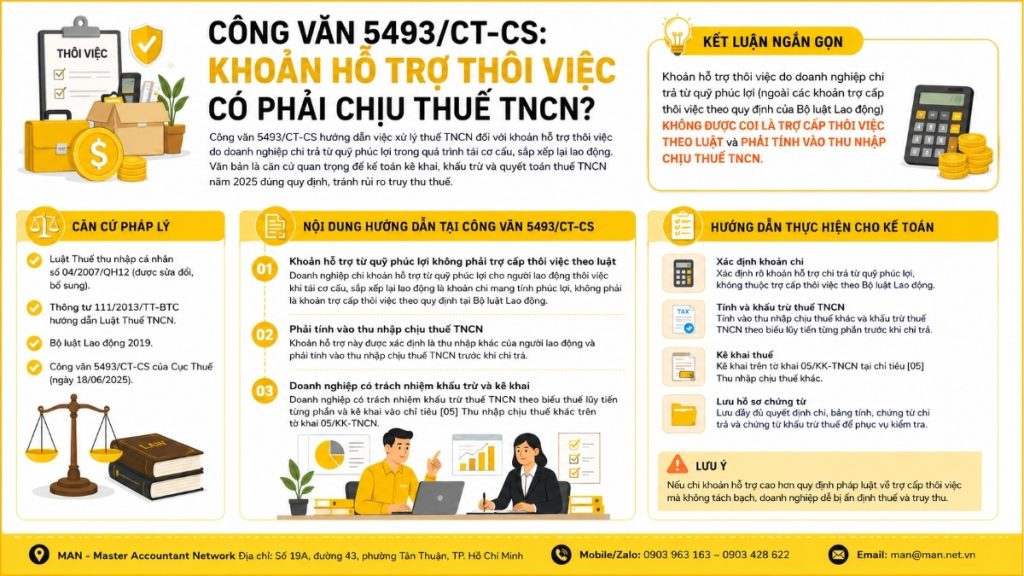
Official Document 5493/CT-CS Specific guidelines have been issued regarding the handling of personal income tax (PIT) on severance pay that businesses provide to employees from their welfare fund during restructuring and workforce reorganization. However, many accountants are still confused: should this support be considered severance pay under the law and excluded from taxable income, or is it mandatory to include it in taxable personal income?
This document serves as an important basis for corporate accountants to correctly declare, deduct, and settle personal income tax for employees in 2025. This article will provide a detailed analysis of the content of Official Letter 5493/CT-CS, the relevant legal basis, and specific implementation guidelines to ensure accurate application by accountants and avoid the risk of tax arrears during tax audits and inspections.
What is Official Document 5493/CT-CS?
Official Document 5493/CT-CS is a guidance document from the tax authorities aimed at addressing businesses' concerns regarding personal income tax policies on severance pay. This document was issued in the context of many businesses implementing labor restructuring plans, i.e., restructuring and downsizing personnel, resulting in severance pay for laid-off employees.
Key points to note: This support is not taken from the unemployment benefit fund stipulated by labor law, but is paid from a welfare fund established and managed by the enterprise itself.
It is precisely because of this difference in payment sources that the question arises: Are severance pay from the welfare fund eligible for tax exemption like severance pay or unemployment benefits under the Labor Code? Circular 5493/CT-CS clearly answers this issue, and the guidance provided has the following scope of application:
- Businesses are currently implementing or have implemented plans for workforce restructuring and downsizing;
- Employees who are laid off as part of a workforce restructuring program are entitled to receive financial support from the company's welfare fund.
- The accounting department is responsible for calculating, deducting, and settling personal income tax for employees.
Why is Circular 5493/CT-CS important for corporate accountants?
For accountants, Circular 5493/CT-CS is not only a document clarifying a specific situation, but also a legal basis for correctly determining the nature of income, thereby deciding whether or not to include severance pay in taxable income. This is a crucial step in the personal income tax calculation process, directly affecting the tax withholding obligation of businesses and the tax settlement obligation of employees.
If accountants apply the wrong regulations, for example mistakenly considering severance pay from the welfare fund as tax-exempt, similar to severance pay under the law, businesses may face the risk of tax arrears, late payment penalties, or even administrative penalties for tax violations during tax audits and inspections.
Conversely, employees may also underdeclare taxable income when self-calculating personal income tax, leading to avoidable errors. Therefore, correctly understanding and accurately applying the content of Circular 5493/CT-CS is a mandatory requirement for any accountant responsible for personal income tax in enterprises that have labor restructuring plans.
This is also why many businesses, especially small and medium-sized enterprises that do not have a dedicated tax accounting department, choose to use such services. full package tax accounting services We rely on specialized and experienced organizations like MAN – Master Accountant Network to ensure that new regulations are updated and applied promptly, minimizing risks in year-end tax filing and settlement.
The main content of Official Letter 5493/CT-CS regarding personal income tax on severance pay.
The guidance contained in Official Letter 5493/CT-CS is based on specific regulations. Circular 111/2013/TT-BTC Guidance on the Personal Income Tax Law and Decree 65/2013/ND-CP, including:
- Point b, Clause 2, Article 2 of Circular 111/2013/TT-BTC: Stipulates that allowances and subsidies are excluded from taxable personal income when these are amounts prescribed by competent state agencies.
- Clause 2, Article 2 of Circular 111/2013/TT-BTC: General regulations on income from salaries and wages subject to personal income tax.
- Clause 2, Article 8 of Circular 111/2013/TT-BTC: stipulates the time and principles for determining taxable income from salaries and wages.
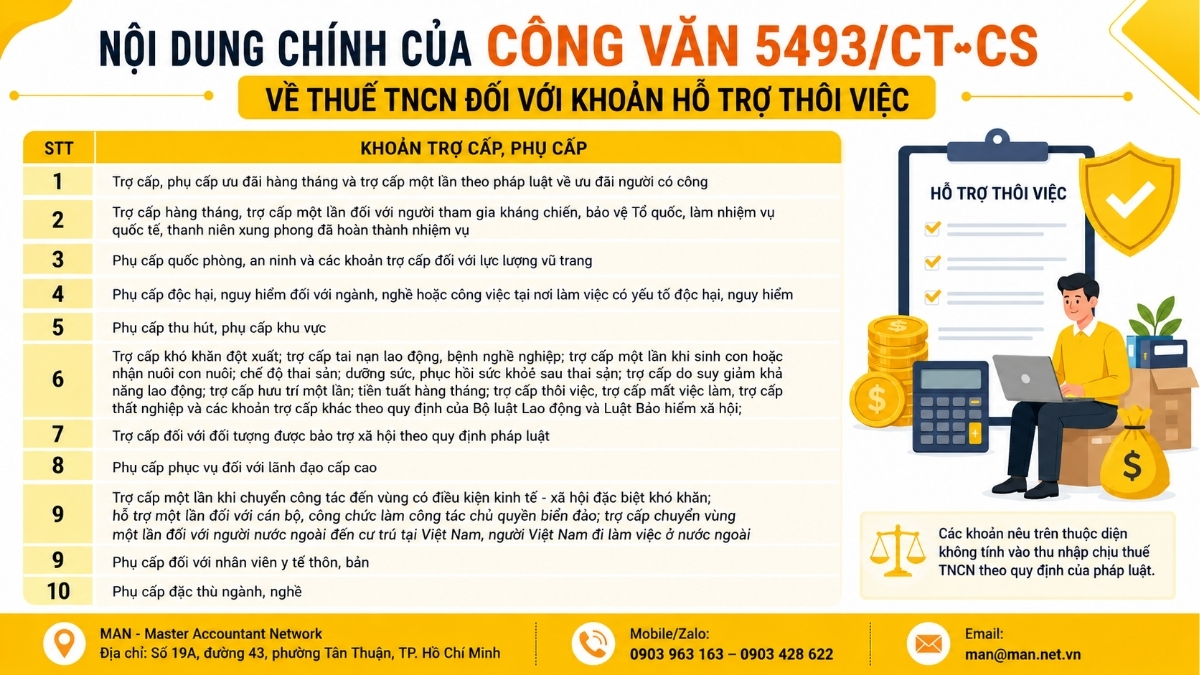
List of allowances and subsidies excluded from taxable income.
To understand why severance pay from the welfare fund is not tax-exempt, accountants need to grasp the general principle in point b, clause 2, Article 2 of Circular 111/2013/TT-BTC. Basically, all allowances and subsidies must be included in taxable income, except for those excluded from taxable income.
| No. | Subsidies and allowances |
| 1 | Monthly allowances, preferential subsidies, and one-time grants as stipulated by law on preferential treatment for meritorious individuals. |
| 2 | Monthly allowances and one-time payments for those who participated in the resistance war, defended the Fatherland, performed international duties, and volunteer youth who have completed their tasks. |
| 3 | Defense and security allowances and subsidies for the armed forces. |
| 4 | Hazardous and dangerous work allowance for occupations or jobs performed in workplaces with hazardous or dangerous elements. |
| 5 | Attraction allowance, regional allowance |
| 6 | Emergency hardship allowance; work accident and occupational disease allowance; one-time allowance for childbirth or adoption; maternity benefits; convalescence and health recovery after childbirth; allowance for reduced working capacity; one-time retirement allowance; monthly survivor's benefits; severance pay, job loss allowance, unemployment benefits and other allowances as prescribed by the Labor Code and the Social Insurance Law; |
| 7 | Subsidies for beneficiaries of social welfare programs as prescribed by law. |
| 8 | Service allowance for senior leaders |
| 9 | One-time allowance for transferring to areas with particularly difficult socio-economic conditions; one-time support for officials and civil servants working on maritime sovereignty and islands; one-time relocation allowance for foreigners residing in Vietnam and Vietnamese citizens working abroad. |
| 9 | Allowances for village health workers. |
| 10 | Special allowances for specific industries and occupations |
Remarkable: Right This regulation clearly states the mandatory principle: The allowances, subsidies, and their respective levels can only be excluded from taxable income when stipulated by a competent state authority. If the actual amount of allowances or subsidies received exceeds the amount stipulated by the competent authority, the excess amount must still be included in taxable income.
Comparing this with the above list, it can be seen that severance pay and unemployment benefits are only excluded from taxable income when they are actually paid. In accordance with the provisions of the Labor Code and the Social Insurance LawThat is, it is correct in terms of the recipient, the basis, and the amount as stipulated by law. This is the key basis for Circular 5493/CT-CS to draw conclusions regarding the severance pay disbursed from the enterprise welfare fund.
Is severance pay from the employee benefits fund considered severance pay under the law?
This is the core content clarified in Official Letter 5493/CT-CS. According to the guidelines, severance pay under the labor restructuring plan, paid from the company's welfare fund, is not considered:
- Severance pay as stipulated in the Labor Code;
- Unemployment benefits are provided according to the provisions of the Labor Code;
- Other allowances as prescribed by the Social Insurance Law;
- Allowances and subsidies prescribed by competent state agencies are excluded from taxable income according to point b, clause 2, Article 2 of Circular 111/2013/TT-BTC.
In other words, although this is essentially a severance payment for employees upon termination of employment, because the source of payment is the company's own welfare fund, not an allowance stipulated by labor law or social insurance law, this amount does not qualify for the personal income tax exemption policy like regular severance pay or unemployment benefits.
Why is this severance pay included in taxable personal income?

Based on Clause 2, Article 2 and Clause 2, Article 8 of Circular 111/2013/TT-BTC, Official Letter 5493/CT-CS clearly states:
Severance pay is income paid by the employer to the employee, and this amount is not included in the list of items excluded from taxable income according to the law.
Therefore, the most important thing accountants need to keep in mind is: The severance pay for employees laid off under the labor restructuring plan is included in... taxable income from salaries and wages, and must be included in the taxable income when settling the 2025 personal income tax of the employee in accordance with current legal regulations.
The key point lies in source of paymentIf severance pay or unemployment benefits are paid in accordance with the Labor Code or the Social Insurance Law, then those amounts are considered exempt from taxable income. However, if a company proactively provides additional support from its internal welfare fund, even with a humanitarian purpose to help employees stabilize their lives after leaving their jobs, legally speaking, this is still considered income from salary and is subject to personal income tax as prescribed.
Distinguish between severance pay as stipulated in the Official Letter and severance pay/employment benefits as stipulated in the Law.
To help accountants understand and apply the terms accurately, these two types of expenses can be distinguished through the following comparison table:
| Criteria | Severance pay under the Law | Support for termination of employment as per the Official Letter. |
| Payment basis | Labor Code, Social Insurance Law | Internal labor restructuring plan for the enterprise. |
| Source of expenditure | According to labor law or social insurance regulations. | Company's self-funded welfare fund |
| Does it fall under the category of income excluded from taxable income? | Exclusions may be granted if they are appropriate and cover the correct amount according to the law. | Not excluded |
| How to handle personal income tax | Applicable according to the respective exemption provisions. | Including salaries and wages in taxable income. |
Clearly distinguishing between these two types of expenses helps accountants avoid confusion when recording and declaring taxes, especially in cases where businesses simultaneously pay both severance pay as stipulated by law and additional support from the welfare fund as per the official document. These two types of expenses require different tax treatment principles and cannot be subject to the same tax exemption policy.
For businesses with a large workforce and multiple labor restructuring events throughout the year, careful consideration is necessary. outsource accounting services To review and compare each specific case according to the instructions at Official Document 5493/CT-CS This is the solution to minimize the risk of errors in tax declaration and settlement.
Conclude
Understanding the content of Official Letter 5493/CT-CS and the relevant legal basis in Circular 111/2013/TT-BTC, especially clearly distinguishing between allowances and subsidies excluded from taxable income and severance pay as stipulated in the Official Letter, will help business accountants correctly fulfill their tax deduction, declaration, and settlement obligations, minimizing the risk of tax arrears or penalties later on.
If your business is in the process of restructuring its workforce and needs to learn more about how to handle taxes on severance pay and unemployment benefits. Contact MAN – Master Accountant Network For free support and advice!
Contact information MAN – Master Accountant Network
- Address: No. 19A, Street 43, Tan Thuan Ward, Ho Chi Minh City
- Mobile/Zalo: 0903 963 163 – 0903 428 622
- E-mail: man@man.net.vn
- Google Business Profile: View MAN – Master Accountant Network's Google Business Profile
- LinkedIn Founder: View expert Le Hoang Tuyen's LinkedIn profile.
Responsible for production and professional content review by: Mr. Le Hoang Tuyen – Founder & CEO of MAN – Master Accountant NetworkHe is a CPA Vietnam auditor with over 30 years of in-depth experience in accounting, auditing, taxation, and corporate legal consulting.
Frequently Asked Questions about Official Document 5493/CT-CS
Which types of severance pay does Circular 5493/CT-CS apply to?
This document specifically applies to severance pay under labor restructuring plans, paid by enterprises from their welfare fund, and is not severance pay or unemployment benefits as stipulated in the Labor Code or the Social Insurance Law.
Are severance pay payments from the employee welfare fund subject to personal income tax?
Yes, this amount is not excluded from taxable income; it is taxable income from salaries and wages and must be included in the personal income tax return.
Why are severance pay legally exempt from tax, but support from welfare funds is not?
Because severance pay and unemployment benefits under the Labor Code and the Social Insurance Law are provisions regulated by competent state agencies regarding eligibility and payment levels, they fall under the exclusion list in point b, clause 2, Article 2 of Circular 111/2013/TT-BTC. Meanwhile, support from the welfare fund is decided by the enterprise itself according to its internal plan.
If a company pays both legally mandated severance pay and additional support from its welfare fund, how is it taxed?
These two amounts must be separated and treated according to two different principles. Severance pay and unemployment benefits, paid in accordance with the Labor Code and the Social Insurance Law, are excluded from taxable income. However, additional support from the company's welfare fund must be added to taxable income from salaries and wages; the same tax exemption policy as the allowance under the Law does not apply.
What tax method is used to calculate severance pay from the employee benefit fund?
Since this amount is identified as taxable income from salaries and wages, it is added to the total taxable income from salaries and wages of the employee in the period in which it arises, and then taxed according to the principles applicable to income from salaries and wages as stipulated in current regulations.