Issuing invoices for product samples is a recurring issue after each new product launch, when businesses release large quantities of trial products to distribute to customers at points of sale, send samples to dealers, or include them with main orders. Because these batches are free, many accountants automatically skip the invoicing process. During audits, discrepancies between inventory figures and declared figures become apparent, leading to the risk of disallowed expenses and penalties related to invoicing. So, what does current law stipulate regarding the issuance of invoices for product samples? This article provides a definitive and thorough explanation. Decree 254/2026/ND-CP and the latest guidance from the tax authorities.
What are samples? Why is it easy to overlook issuing invoices for samples?
Samples are goods that businesses give to customers or partners for the purpose of introduction, testing, or trade promotion—that is, to facilitate sales activities but without generating any cash flow at the time of delivery. This characteristic is why this type of transaction is often mistakenly categorized as "not requiring output documentation."
In practice, sample orders arise in many different forms:
- Distribute free samples directly at points of sale, supermarkets, fairs, and trade shows;
- Send samples to distributors and dealers to offer and introduce the new product line;
- Send samples along with the main order, for example, offer a free sample pack when a customer makes a purchase;
- Send test samples and production approval samples to corporate clients before signing large-quantity contracts.
The common thread in all four situations is that the goods have actually left the warehouse and been delivered to the external party. The most common accounting mistake is equating "no payment received" with "no invoice required." Meanwhile, invoicing law determines the obligation to issue an invoice based on the seller's act of shipping the goods, regardless of whether payment is received or not. This is also why regulations regarding invoicing for samples need to be read directly from the original document, rather than inferred based on professional practice.
Is it necessary to issue invoices for samples to customers?
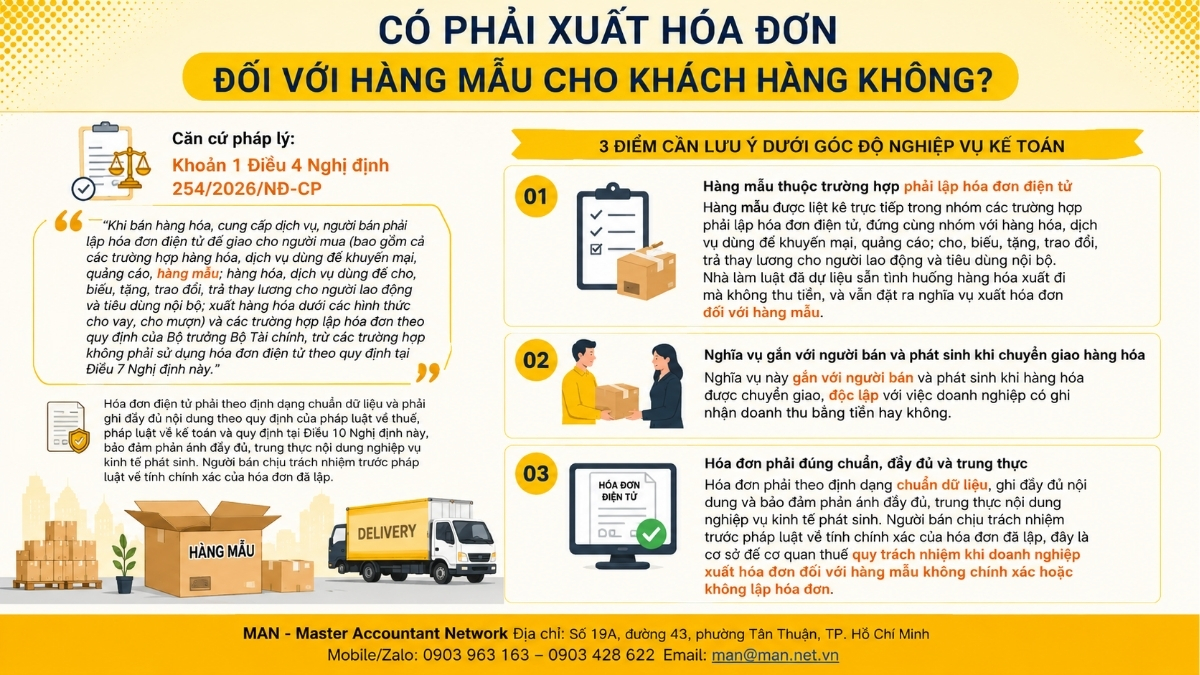
Based on the provisions of Clause 1, Article 4 of Decree 254/2026/ND-CP, the principles for the creation, management, and use of electronic invoices and documents are as follows:
When selling goods or providing services, sellers must issue electronic invoices to buyers (including cases where goods and services are used for promotions, advertising, samples; goods and services used for giving, gifting, exchanging, paying as wages to employees, and internal consumption; goods exported in the form of loans or borrowings) and cases where invoices are issued as prescribed by the Minister of Finance, except for cases where electronic invoices are not required as stipulated in Article 7 of this Decree.
Electronic invoices must conform to standard data formats and must contain all the information required by tax laws, accounting laws, and the provisions of Article 10 of this Decree, ensuring that they fully and truthfully reflect the economic transactions that have occurred. The seller is legally responsible for the accuracy of the issued invoice.
From the above content, there are three points to note from an accounting perspective:
- Firstly, samples are directly listed in the group of cases requiring electronic invoicing, alongside goods and services used for promotions, advertising; gifts, donations, exchanges, payment in lieu of wages for employees, and internal consumption. In other words, lawmakers have anticipated the situation where goods are exported without payment, yet still impose the obligation to issue invoices for samples.
- Secondly, this obligation rests with the seller and arises when the goods are delivered, regardless of whether the business recognizes revenue in cash or not.
- Thirdly, invoices must follow standard data formats, contain complete information, and accurately and truthfully reflect the economic transactions that occurred. The seller is legally responsible for the accuracy of the invoices issued; this is the basis for the tax authorities to hold businesses accountable when they issue invoices for inaccurate samples or fail to issue invoices at all.
Dưới đây là bảng so sánh xuất hóa đơn hàng mẫu có thu tiền và không thu tiền:
| Criteria | Có thu tiền | Không thu tiền (trong nước) | Không thu tiền (xuất khẩu) |
| Có phải lập hóa đơn | Có, như bán hàng thông thường | Có. Hàng mẫu được nêu đích danh tại khoản 1 Điều 4 Nghị định 254/2026/NĐ-CP | Có, cùng căn cứ; lập tại thời điểm xuất hàng |
| Invoice date | Khi chuyển giao quyền sở hữu hoặc quyền sử dụng hàng hóa, không phân biệt đã thu tiền chưa | Khi giao hàng mẫu cho bên nhận | Khi xuất hàng, không lùi ngày sau thời điểm thông quan |
| Giá tính thuế GTGT trên hóa đơn | Giá bán thực tế chưa có thuế GTGT | Đúng thủ tục khuyến mại theo pháp luật khuyến mại:
Bằng 0 theo khoản 2 Điều 6 Nghị định 181/2026/NĐ-CP Không đúng thủ tục như hàng biếu, tặng, cho, tức giá hàng hóa cùng loại hoặc tương đương |
Xác định như cột trong nước(Công văn 15677/DON-QLDN1 năm 2026) |
| Thuế GTGT đầu ra | Phát sinh theo thuế suất; xuất khẩu đủ điều kiện thì thuế suất 0% | Đúng thủ tục: Không phát sinh. Không đúng thủ tục thì có phát sinh | Đúng thủ tục: Không phát sinh; không đúng thủ tục thì có phát sinh.
Không có chứng từ thanh toán không dùng tiền mặt thì không phải tính đầu ra |
| Input VAT | Khấu trừ theo điều kiện chung | Khấu trừ theo quy định chung | Theo quy định chung; không có chứng từ thanh toán không dùng tiền mặt thì không được khấu trừ |
| Cách ghi trên hóa đơn | Tên hàng như bán thông thường | Ghi rõ “hàng mẫu” hoặc “hàng mẫu không thu tiền” | Như cột trong nước; số lượng và tên hàng khớp tờ khai hải quan và phiếu xuất kho |
| Hồ sơ cần lưu | Hợp đồng hoặc đơn hàng, chứng từ thanh toán | Kế hoạch hoặc quyết định phát mẫu, phiếu xuất kho, kho biên bản nhận mẫu, hồ sơ khuyến mại (nếu áp dụng) | Thêm tờ khai hải quan xuất khẩu, vận đơn, yêu cầu gửi mẫu của đối tác, tài liệu xác định giá hàng cùng loại |
| Accounting | Ghi nhận doanh thu và giá vốn | Giá trị xuất kho vào chi phí bán hàng; có GTGT đầu ra thì ghi nhận thêm nghĩa vụ thuế | Tương tự; phần thuế đầu vào không được khấu trừ kết chuyển vào chi phí |
Important Note: Thuế suất 0% áp dụng cho hàng xuất khẩu có thu tiền khi đủ điều kiện, còn giá tính thuế bằng 0 áp dụng cho hàng mẫu khuyến mại không thu tiền thực hiện đúng thủ tục. Hai khái niệm này khác nhau. Chi tiết hàng mẫu xuất khẩu xem tại Issue invoices for free export samples..
Tax authority's guidance on issuing invoices for samples is provided in Official Letter 6927/TNI-QLDN2 of 2026.
Accordingly, in Official Letter 6927/TNI-QLDN2 of 2026, the procedure for issuing invoices for samples to customers is as follows:
Electronic invoicing is carried out in accordance with Clause 1, Article 4 of Government Decree No. 254/2026/ND-CP dated June 30, 2026, regulating electronic invoices and documents; and Clause 2, Article 6 of Government Decree No. 181/2025/ND-CP dated July 1, 2025, detailing the implementation of a number of articles of the Value Added Tax Law.
Accordingly, in principle, when selling goods or providing services, the seller is obligated to issue an invoice to the buyer, including for samples (except in cases where electronic invoices are not required as stipulated in Article 7 of Decree 254/2026/ND-CP).
Therefore, for sample goods, sellers must also issue invoices to customers in accordance with the law.
In short, the obligation to issue invoices for samples is mandatory and applies to all businesses. Businesses are only exempt if their transactions fall under the cases where electronic invoices are not required as stipulated in Article 7 of Decree 254/2026/ND-CP. Outside of that scope, distributing samples without issuing invoices constitutes a violation of invoicing principles.
Required information on electronic sample invoices
Clause 1, Article 4 of Decree 254/2026/ND-CP sets out three technical and legal requirements that accountants must ensure when issuing invoices for sample goods:
- Electronic invoices must follow a standard data format;
- The content must be fully recorded in accordance with the tax law, the accounting law, and the provisions of Article 10 of Decree 254/2026/ND-CP;
- The content of the economic transactions that occur must be fully and truthfully reflected.
Please note the third requirement: The item name on the invoice should clearly indicate that it is a sample, so that the invoice itself can explain the nature of the transaction when the tax authorities conduct a review. Regarding the remaining detailed items, accountants should directly refer to Article 10 of Decree 254/2026/ND-CP and Clause 2, Article 6 of Decree 181/2025/ND-CP.
Note regarding accompanying documents and records.
Issuing invoices for samples is a mandatory requirement, but invoices alone are not enough to fully explain the nature of the transaction. Based on experience working with tax audit teams, the following internal documentation should be prepared concurrently:
- The decision or plan for distributing samples has been approved (clearly stating the purpose, quantity, time, and location);
- The delivery note corresponds to each batch of samples distributed;
- List of customers, dealers, and sales points who have received product samples (with signed receipts or handover documents);
- The electronic invoice has been issued and the data has been submitted to the tax authorities.
This documentation helps businesses prove that the samples were used in their production and business operations, thereby protecting the reasonableness and validity of the expenditure when determining taxable income.
For businesses that frequently issue forms but have a small accounting department, this document standardization process is often outsourced to a service provider. full accounting service We utilize specialized and experienced units like MAN – Master Accountant Network to ensure that invoices, delivery notes, and approval documents are prepared consistently, rather than requiring reverse verification when tax authorities conduct an audit.
Risks when businesses do not issue invoices for product samples.
Neglecting the obligation to invoice samples is not merely a procedural oversight, but entails a chain of interconnected risks:
- Legal risk: Failure to issue invoices for samples violates the invoicing principles stipulated in Clause 1, Article 4 of Decree 254/2026/ND-CP, falling within the scope of administrative penalties in the field of invoices.
- Data risk: Goods have been shipped from the warehouse but there are no corresponding sales invoices, creating discrepancies between inventory records, accounting records, and tax declaration data. When the tax authorities conduct a review, the business must provide explanations for each shipment, and failure to do so risks being assessed negatively.
- Cost risk: Sample costs lacking valid documentation are easily disallowed when determining taxable income for corporate income tax purposes, increasing tax liability compared to expectations.
- Compliance risk: Repeated invoice violations affect a taxpayer's compliance record and may result in the business being identified as high-risk for tax purposes, leading to changes in the type of electronic invoice being used, as discussed in the following section.
If a business is unsure whether its sample distribution service falls under the exemptions of Article 7, it should seek professional advice through relevant channels. accounting consulting services Before finalizing the course of action, it's crucial to note that adjusting invoices after they've been declared is always significantly more expensive than creating them correctly from the start.
In what cases are taxpayers allowed to switch to using electronic invoices?
After understanding the principles of invoicing for samples, businesses need to determine which type of electronic invoice they are using, whether it has a tax authority code or not, and when they are required to switch.
Based on Article 11 Circular 91/2026/TT-BTC The regulations regarding the transition to electronic invoices are as follows:
- Taxpayers currently using electronic invoices without a tax authority code who wish to switch to electronic invoices with a tax authority code must update their electronic invoice usage information as stipulated in Article 6 of Circular 91/2026/TT-BTC.
- Taxpayers who are subject to using electronic invoices without a tax authority code as stipulated in point b, clause 1, Article 6 of Decree 254/2026/ND-CP, if they are identified as high-risk taxpayers according to Circular No. 94/2026/TT-BTC and are notified by the tax authority using Form No. 01/TB-KTT, Appendix IV attached to this Circular, regarding the conversion to electronic invoices with a tax authority code, must convert to using electronic invoices with a tax authority code.
Within 10 working days from the date of notification by the tax authority, taxpayers must change their electronic invoice usage information (switching from using electronic invoices without a tax authority code to electronic invoices with a tax authority code) as stipulated in Article 6 of Circular 91/2026/TT-BTC.
After 12 months from the date of switching to using electronic invoices with tax authority codes, if taxpayers wish to use electronic invoices without codes, they must change their electronic invoice usage information as stipulated in Article 6 of Circular 91/2026/TT-BTC. The tax authority will then consider and approve or reject the change based on the provisions of Article 6 of Decree 254/2026/ND-CP and Circular 94/2026/TT-BTC.
The three transition scenarios can be summarized as follows:
| Case | Conversion direction | Terms/Conditions |
| Voluntary | From invoices without a tax code to invoices with a tax authority code. | Changes to information for using electronic invoices are governed by Article 6 of Circular 91/2026/TT-BTC. |
| Mandatory, identified as high-risk for tax purposes, notification must be given using Form No. 01/TB-KTT | It is mandatory to use invoices with tax authority codes. | 10 working days from the date the tax authority notifies |
| Return to the invoice without a code. | With code, without code. | After 12 months, the tax authorities will review and either approve or reject the application. |
For businesses that frequently issue product samples, it is essential to track the type of invoice being used when issuing invoices for samples, because each change entails a change in the issuance process and the timing of sending invoice data to the tax authorities.
Reference: Principles for handling erroneous invoices according to Circular 91/2026.
Conclude
In summary, issuing invoices for samples is a mandatory obligation for sellers according to Clause 1, Article 4 of Decree 254/2026/ND-CP, reaffirmed by the tax authorities in Official Letter 6927/TNI-QLDN2 of 2026. Businesses are only exempt if they fall under the cases where electronic invoices are not required as stipulated in Article 7 of this Decree.
During this accounting period, the business should review three things:
- Procedure for approving and releasing sample goods from the warehouse;
- Completeness of electronic invoices issued for sample distribution batches;
- And the type of electronic invoice currently in use is in accordance with Article 11 of Circular 91/2026/TT-BTC.
Standardizing these three stages early will help businesses avoid most of the risks when tax authorities conduct audits.
If a business has not yet assigned dedicated personnel to monitor outgoing invoices for transactions that do not require payment, it may consider the following alternative options. outsource accounting services To maintain the proper creation and storage of sample invoices without expanding the organizational structure.
Contact MAN – Master Accountant Network For free support and advice!
Contact information MAN – Master Accountant Network
- Address: No. 19A, Street 43, Tan Thuan Ward, Ho Chi Minh City
- Mobile/Zalo: 0903 963 163 – 0903 428 622
- E-mail: man@man.net.vn
- Google Business Profile: View MAN – Master Accountant Network's Google Business Profile
- LinkedIn Founder: View expert Le Hoang Tuyen's LinkedIn profile.
Responsible for production and professional content review by: Mr. Le Hoang Tuyen – Founder & CEO of MAN – Master Accountant NetworkHe is a CPA Vietnam auditor with over 30 years of in-depth experience in accounting, auditing, taxation, and corporate legal consulting.
Frequently Asked Questions about Invoicing for Samples
Do we need to issue invoices for free samples?
Yes. Clause 1, Article 4 of Decree 254/2026/ND-CP lists sample goods as belonging to the group of cases where the seller must issue an electronic invoice to the buyer, regardless of whether payment is received or not.
Is there a difference in invoicing for samples sent to distributors compared to sending them to individual customers?
In principle, there is no difference. The obligation to issue invoices for samples arises from the seller's act of shipping the goods, regardless of the recipient's status.
In which cases is it exempt to issue electronic invoices for product samples?
Only when the transaction falls under the cases where the use of electronic invoices is not required as stipulated in Article 7 of Decree 254/2026/ND-CP.
Who is responsible for the accuracy of the sample invoice?
The seller is legally responsible for the accuracy of the invoice issued, according to Clause 1, Article 4 of Decree 254/2026/ND-CP.
Businesses currently using invoices without codes are required to switch to invoices with codes.
When a case is identified as high-risk for tax purposes and a notification is received from the tax authority using Form No. 01/TB-KTT, the deadline for implementation is 10 working days from the date of notification.