
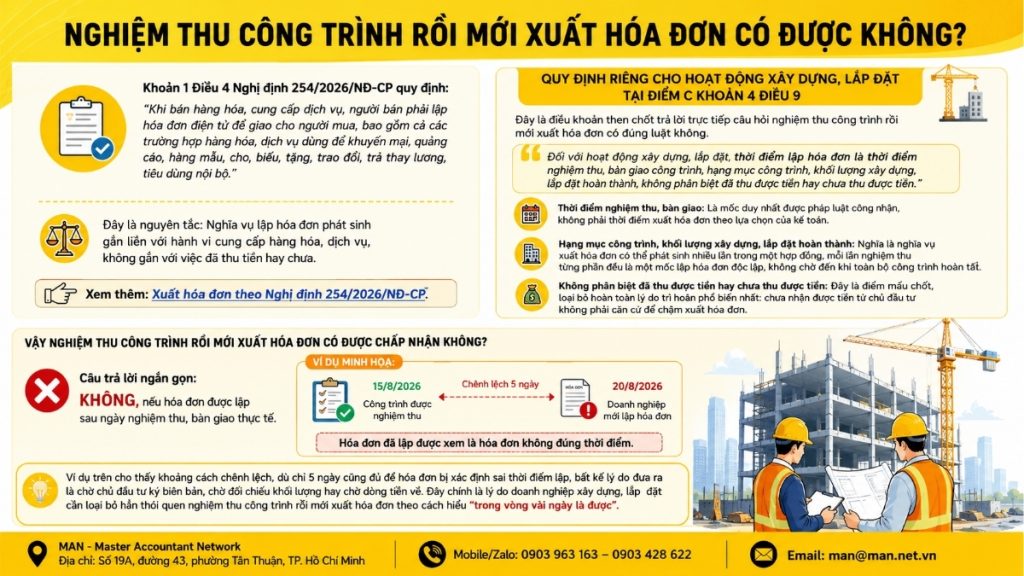
Nghiệm thu công trình rồi mới xuất hóa đơn có được không? Hóa đơn xây dựng, lắp đặt phải lập đúng ngày nghiệm thu, bàn giao công trình, hạng mục hoặc khối lượng hoàn thành, kể cả khi chưa thu được tiền (điểm c khoản 4 Điều 9 Nghị định 254/2026/NĐ-CP, hiệu lực từ 01/7/2026). Nghiệm thu nhiều đợt thì lập hóa đơn theo từng đợt. Lập sau ngày nghiệm thu là lập sai thời điểm và có thể bị phạt theo Nghị định 310/2025/NĐ-CP.
Khi nào phải xuất hóa đơn xây dựng, lắp đặt?
Hóa đơn xây dựng, lắp đặt phải lập đúng ngày nghiệm thu, bàn giao công trình, hạng mục hoặc khối lượng hoàn thành, kể cả khi chưa thu được tiền (điểm c khoản 4 Điều 9 Nghị định 254/2026/NĐ-CP, hiệu lực từ 01/7/2026). Nghiệm thu nhiều đợt thì lập hóa đơn theo từng đợt. Lập sau ngày nghiệm thu là lập sai thời điểm và có thể bị phạt theo Nghị định 310/2025/NĐ-CP.
Dưới đây là bảng tóm tắt nhanh:
| Situation | Ngày lập hóa đơn |
| Nghiệm thu, bàn giao toàn bộ công trình | Ngày ký biên bản nghiệm thu, bàn giao |
| Nghiệm thu theo từng hạng mục hoặc đợt khối lượng | Ngày ký biên bản của từng đợt, mỗi đợt một hóa đơn |
| Chủ đầu tư chưa thanh toán | Vẫn là ngày nghiệm thu, không chờ tiền |
| Nhận tạm ứng hợp đồng thi công | Reference: Thời điểm xuất hóa đơn tạm ứng tiền trong dịch vụ lắp đặt |
| Bất động sản, nhà để bán thu tiền theo tiến độ | Ngày thu tiền hoặc ngày đến hạn thanh toán theo hợp đồng |
What does Decree 254/2026/ND-CP stipulate regarding the timing of issuing invoices for construction and installation services?

To accurately answer the question of whether it is permissible to issue invoices only after the project has been completed and accepted, it is necessary to adhere to the two original provisions of Decree 254/2026/ND-CP.
General principles in Article 4
Clause 1, Article 4 of Decree 254/2026/ND-CP stipulates:
When selling goods or providing services, sellers must issue electronic invoices to buyers, including cases where goods or services are used for promotions, advertising, samples, gifts, donations, exchanges, as payment in lieu of salary, or for internal consumption.
Here's the principle: The obligation to issue invoices arises directly from the act of providing goods or services, not from whether or not payment has been received.
See more: Invoices must be issued in accordance with Decree 254/2026/ND-CP.
Specific regulations for construction and installation activities are stipulated in point c, clause 4, Article 9.
This is a key provision that directly answers the question of whether it is legal to issue invoices only after the project has been completed and accepted. Point c, Clause 4, Article 9 of Decree 254/2026/ND-CP clearly states:
For construction and installation activities, the time of invoice issuance is the time of acceptance and handover of the project, project item, or completed construction and installation volume, regardless of whether payment has been received or not.
Three keywords in this sentence determine the entire application:
- Time of acceptance and handoverThis is the only legally recognized date, not the invoice issuance date chosen by the accountant.
- Project items, completed construction and installation volumes: This means that the obligation to issue invoices can arise multiple times within a single contract, with each partial acceptance being a separate invoice date, not waiting until the entire project is completed.
- Regardless of whether the money has been received or not: This is the key point that completely eliminates the most common reason for delay: not having received payment from the investor is not a basis for delaying invoice issuance.
In other words, the act of issuing invoices only after the project has been completed and accepted, even if only a few days late, constitutes issuing invoices at the wrong time if it exceeds the actual completion and handover date.
Is it acceptable to issue invoices only after the project has been completed and accepted?
The short answer: Are not, if the invoice is issued after the actual acceptance and handover date.
For example: If the project is accepted on August 15, 2026, but the company only issues the invoice on August 20, 2026, then the invoice issued is considered to be out of date.
The above example shows that even a difference of just 5 days is enough for an invoice to be incorrectly dated, regardless of the reason given—waiting for the investor to sign the handover document, waiting for quantity verification, or waiting for cash flow. This is precisely why construction and installation businesses need to completely abandon the habit of issuing invoices only after project acceptance, based on the understanding that "it's acceptable within a few days."
Instructions for creating invoices for each delivery, acceptance, and handover of the project.
Official Document 7189/CTH-QLDN1 In 2026, specific guidance will be provided on how to apply Article 9 of Decree 254/2026/ND-CP to each type of transaction, helping accountants avoid confusion when handling situations where construction work is completed before issuing invoices in different business models.
- Deliver in multiple installments or hand over each item/stage of the service: Each delivery or handover must be accompanied by a separate invoice detailing the quantity and corresponding value, as stipulated in Clause 3, Article 9.
- Selling regular goods: The time of invoicing is the time of transfer of ownership or the right to use the goods, regardless of whether payment has been received or not, according to Clause 1, Article 9.
- Construction and installation activities: The time of invoicing is the time of acceptance and handover of the construction project, project item, or completed construction and installation volume, regardless of whether payment has been received or not, according to point c, clause 4, Article 9. This regulation directly governs all situations where a project is accepted before issuing an invoice.
- Real estate business, infrastructure construction, building houses for sale, and property transfer: If ownership or usage rights have not yet been transferred but payments are collected according to the project progress or the schedule specified in the contract, the invoice date is the date of payment collection or according to the payment agreement in the contract, as per point d1, clause 4, Article 9.
Common features of the four groups aboveThe law always links the time of invoice issuance to a specific point. actual events (Handover, transfer of ownership, acceptance, or collection of payment) rather than allowing businesses to choose a convenient time.
The risks arise when construction companies mishandle the situation of project acceptance before issuing invoices.
When invoices are issued after the actual acceptance and handover date, businesses face multiple risks simultaneously:
- Penalized for administrative violations related to invoices. For issuing invoices at the wrong time, the penalty increases with the number of violations and the value of the invoice.
- Incorrect VAT declaration periodThis leads to discrepancies in the amount of tax payable between periods and results in late payment penalties when back taxes are collected.
- Impact on revenue and expense recognition. This occurs during the correct accounting period, resulting in financial statements that do not accurately reflect the nature of the transactions, which is particularly disadvantageous when a business has multiple contracts for individual items.
- Being asked to provide an explanation by a partner, auditor, or tax authority. When comparing the acceptance report with the invoice date on the electronic invoicing system.
Given the unique nature of the construction industry, with numerous contracts, acceptance tests, and projects running simultaneously, this risk doesn't just stop at a single invoice but can become systemic if internal processes aren't standardized from the outset.
A solution to help construction companies avoid issuing invoices late compared to the acceptance date.
To completely eliminate the practice of issuing invoices after project acceptance is completed but not yet completed, construction and installation companies should establish a closed-loop process between the technical department (preparing acceptance reports) and the accounting department (issuing invoices), ensuring that invoices are issued on the same day the acceptance and handover reports are signed, without waiting for cash flow or debt reconciliation.
For businesses with limited internal accounting departments, where it's difficult to closely monitor each acceptance process to issue invoices on time, a practical solution is to use... full accounting service From specialized and experienced units like MAN – Master Accountant Network, you can find professionals to monitor the progress of acceptance testing and issue invoices promptly in accordance with Decree 254/2026/ND-CP. If a business only needs to review its current process and identify risk areas in construction and installation invoicing, it can seek out such services. accounting consulting services To have each contract reviewed by experts. For businesses with multiple projects and partners, the approach... outsource accounting services This helps to separate responsibilities between the construction department and the invoicing and tax compliance department, minimizing the possibility of issuing invoices late compared to the acceptance date.
Quick checklist before issuing invoices for construction projects.
Here's a quick checklist to help businesses avoid risks when issuing invoices:
- Have the acceptance and handover documents been fully signed by all parties?
- Was the invoice issued on the correct date as stated in the acceptance and handover report?
- If the handover involves individual items, have separate invoices been issued for each item?
- Are invoices being delayed due to unpaid bills? If so, they need to be issued immediately in accordance with regulations.
- Have you compared the date of the electronic invoice with the acceptance date in the technical documentation??
Conclude
Invoices are only issued after the project has been completed and accepted, in accordance with point c, clause 4, Article 9 of Decree 254/2026/ND-CP, and are only valid when the invoice is properly prepared. on the same day The acceptance and handover process must be completed no earlier and no later, and is completely independent of whether payment has been received or not. Any delay from this point, even just a few days as illustrated in the instruction document, will result in the invoice being deemed to have been issued at the wrong time.
For construction and installation businesses, strictly controlling the timing of invoices issued after each acceptance phase is not only about complying with the law but also about protecting cash flow and reputation with partners and tax authorities.
Contact MAN – Master Accountant Network For free support and advice!
Contact information MAN – Master Accountant Network
- Address: No. 19A, Street 43, Tan Thuan Ward, Ho Chi Minh City
- Mobile/Zalo: 0903 963 163 – 0903 428 622
- E-mail: man@man.net.vn
- Google Business Profile: View MAN – Master Accountant Network's Google Business Profile
- LinkedIn Founder: View expert Le Hoang Tuyen's LinkedIn profile.
Responsible for production and professional content review by: Mr. Le Hoang Tuyen – Founder & CEO of MAN – Master Accountant NetworkHe is a CPA Vietnam auditor with over 30 years of in-depth experience in accounting, auditing, taxation, and corporate legal consulting.
Frequently Asked Questions about Invoice Issuance After Project Acceptance
Is it considered a violation of regulations to issue invoices only after the project has been completed and accepted?
Yes, if the invoice is issued after the actual acceptance and handover date. According to point c, clause 4, Article 9 of Decree 254/2026/ND-CP, the time of issuing the construction and installation invoice is the time of acceptance and handover, regardless of whether payment has been received or not.
Is it permissible to delay issuing invoices if payment has not yet been received from the investor?
No. The regulations state that the time of invoice issuance does not distinguish between receiving payment or not receiving payment, so the fact that payment has not been received is not a legal basis for delaying invoice issuance.
How should invoices be issued when a project is handed over in multiple phases?
Each time a project or completed stage is handed over, a separate invoice must be issued for the corresponding quantity and value, in accordance with Clause 3, Article 9 of Decree 254/2026/ND-CP.
Will there be a penalty for issuing invoices a few days late compared to the acceptance date?
You may be subject to administrative penalties for invoice violations due to issuing invoices at the wrong time, and this can also affect the timely filing of tax returns.
Do real estate businesses apply the same timeline as construction and installation businesses?
Not entirely. For real estate businesses, infrastructure construction, and houses for sale or transfer where ownership has not yet been transferred but payments are collected according to progress, the invoice date is the date of payment collection or according to the payment agreement in the contract, as per point d1, clause 4, Article 9.






