Accounting services for sole proprietorships are becoming a mandatory option for millions of sole proprietorships and individual business owners from January 1, 2026, the date when the lump-sum tax mechanism officially ends and the obligation to record and declare based on actual revenue is uniformly legalized. Decree 68/2026/ND-CP and Circular 152/2025/TT-BTCNo longer subject to fixed monthly tax figures, household businesses must record their revenue themselves, issue electronic invoices according to the correct thresholds, classify taxes correctly using appropriate methods, and retain documentation for a minimum of 5 years. This article outlines the legal basis, scope of work, and criteria for selecting suitable accounting services for household businesses, helping business owners make informed decisions before their tax obligations are determined.
Why should sole proprietorships start using accounting services as early as 2026?

Before 2026, most household businesses were familiar with the lump-sum tax mechanism: the tax authorities determined a fixed monthly tax amount, and household businesses hardly needed to keep records. The notion was that "small household businesses don't need accountants," but since then... Tax Administration Law 2025 Along with the effective guiding decrees, the lump-sum tax has been abolished, replaced by a declaration mechanism based on actual revenue, documents, and invoices. This is why accounting services for household businesses are no longer just a "token" service but have become a condition for household businesses to correctly determine their tax obligations and avoid being overtaxed.
Three pressures are driving a sharp increase in demand for accounting services for sole proprietorships in 2026:
- The obligation to record accounting entries becomes mandatory based on revenue categories: Circular 152/2025/TT-BTC stipulates that business households must maintain accounting records according to the corresponding forms based on their revenue threshold and tax obligations, and are no longer allowed to arbitrarily choose their own record-keeping methods as before.
- Electronic invoices are directly linked to revenue thresholds: Household businesses with taxable value-added tax revenue of VND 1 billion or more per year are required to use electronic invoices with tax authority codes or electronic invoices generated from cash registers connected to the tax authority's data system. Incorrect, incomplete, or inconsistent invoice data with accounting records are the most common errors leading to tax arrears for household businesses.
- Errors in record-keeping lead to double financial consequences: If a business does not maintain proper accounting records or keep valid documents to prove revenue and expenses, the tax authorities have the right to determine the amount of tax payable, which is often significantly higher than the actual tax payable if the records were properly kept. This is also a topic you can find more detailed information about. risks of violating accounting regulations which many business owners have not fully grasped.
In other words, accounting services for sole proprietorships are not simply about "doing the bookkeeping for the sake of appearances," but rather a tool to help sole proprietorships determine the correct tax calculation method, the correct tax liability threshold, and avoid the risk of being subject to back taxes during audits and inspections.
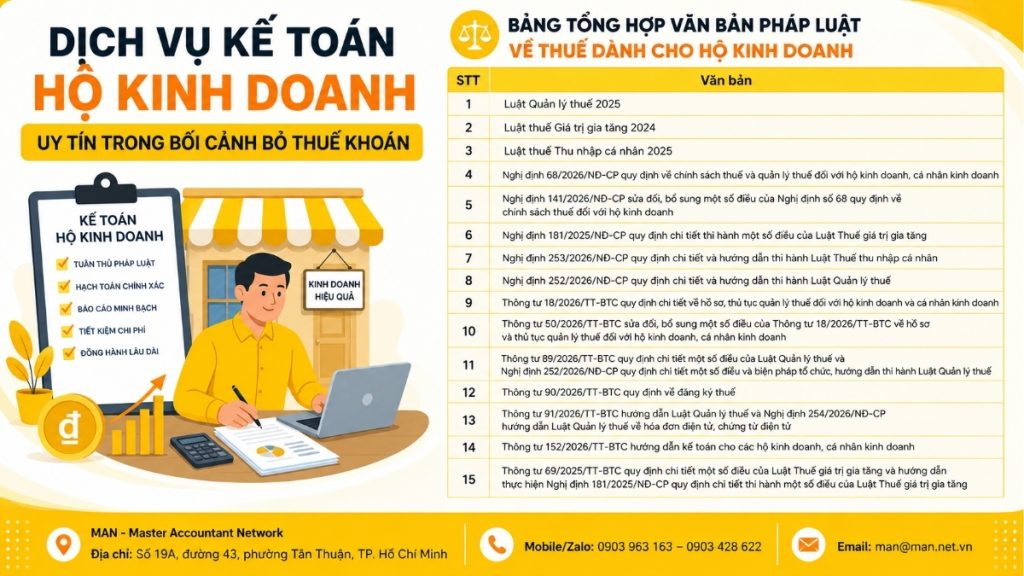
A compilation of the latest tax laws and regulations for household businesses.
The current implementation of accounting services for sole proprietorships adheres closely to a comprehensive system of legal documents. Below are the latest legal documents on taxes for household businesses:
| No. | Document |
| 1 | Tax Administration Law 2025 |
| 2 | Value Added Tax Law 2024 |
| 3 | Personal Income Tax Law 2025 |
| 4 | Decree 68/2026/ND-CP stipulates tax policies and tax management for business households and individual businesses. |
| 5 | Decree 141/2026/ND-CP amends and supplements several articles of Decree No. 68 regulating tax policies for business households. |
| 6 | Decree 181/2025/ND-CP provides detailed regulations for the implementation of several articles of the Value Added Tax Law. |
| 7 | Decree 253/2026/ND-CP provides detailed regulations and guidance on the implementation of the Law on Personal Income Tax. |
| 8 | Decree 252/2026/ND-CP provides detailed regulations and guidance on the implementation of the Law on Tax Administration. |
| 9 | Circular 18/2026/TT-BTC provides detailed regulations on tax management documents and procedures for business households and individuals. |
| 10 | Circular 50/2026/TT-BTC amends and supplements several articles of Circular 18/2026/TT-BTC on tax management documents and procedures for business households and individual businesses. |
| 11 | Circular 89/2026/TT-BTC provides detailed regulations on some articles of the Law on Tax Administration and Decree 252/2026/ND-CP provides detailed regulations on some articles and organizational measures and guidance for the implementation of the Law on Tax Administration. |
| 12 | Circular 90/2026/TT-BTC regulates tax registration. |
| 13 | Circular 91/2026/TT-BTC provides guidance on the Law on Tax Administration and Decree 254/2026/ND-CP providing guidance on the Law on Tax Administration regarding electronic invoices and electronic documents. |
| 14 | Circular 152/2026/TT-BTC provides accounting guidance for business households and individual business owners. |
| 15 | Circular 69/2025/TT-BTC provides detailed regulations on some articles of the Value Added Tax Law and guidance on the implementation of Decree 181/2025/ND-CP detailing the implementation of some articles of the Value Added Tax Law. |
Three key points that any sole proprietorship accounting service must master:
- The revenue threshold determines the tax liability. According to Articles 3 and 4 of Decree 68/2026/ND-CP, business households with annual revenue of VND 500 million or less are exempt from value-added tax and personal income tax. For revenue between VND 500 million and VND 3 billion, the tax calculation method is based on a percentage of revenue; if actual revenue exceeds VND 3 billion, from the following year onwards, the business household must switch to the method of calculating taxable income by multiplying it by the tax rate – a complex transition that is prone to errors when done independently.
- Electronic invoices linked to the 1 billion VND milestone: According to point a, clause 5, Article 8 of Decree 68/2026/ND-CP, business households with annual VAT taxable revenue of VND 1 billion or more are required to use electronic invoices; business households with revenue from over VND 500 million to under VND 1 billion are not yet required to use them but can register to do so.
- Accounting system based on revenue groups and tax obligations: Circular 152/2025/TT-BTC (replacing Circular 88/2021/TT-BTC, effective from January 1, 2026) stipulates that business households not subject to VAT and not paying personal income tax only need to use the Sales Revenue Register for Goods and Services according to mẫu S1a-HKD; those with higher revenue must open additional corresponding registers. The Circular also allows the business household representative to keep records themselves, assign relatives or managers to perform this role concurrently, or outsource accounting services This is the legal basis for outsourcing accounting work as mentioned in the article.
What specific tasks are included in accounting services for sole proprietorships?

A comprehensive and standardized accounting service for sole proprietorships, in accordance with Circular 152/2025/TT-BTC and related tax regulations, should cover the entire tax obligation lifecycle, from registration to final settlement.
Tax registration and determination of initial tax calculation method.
Review the business sector and projected revenue to determine whether the household business belongs to the tax-exempt group, the group subject to a percentage-based tax on revenue, or the group subject to the income-based tax calculation method; complete the initial tax registration dossier according to the guidelines in Circular 90/2026/TT-BTC.
Open and record accounting books using the correct forms as prescribed in Circular 152/2025/TT-BTC.
Establish the S1a-HKD Revenue Register and corresponding supplementary registers for each revenue group, fully record all transactions arising during the period, and compare them with electronic invoice data to ensure that the figures match between the books and the tax authority's system..
Issue and control electronic invoices according to the correct revenue threshold.
Tracking cumulative revenue by month and quarter helps to alert businesses when they reach the 1 billion VND threshold and must switch to electronic invoices with codes or invoices generated from cash registers, avoiding late detection that could lead to deadline violations.
Declare and pay VAT and personal income tax periodically.
Calculate the correct amount of tax payable using the applicable method, prepare and submit tax returns according to the instructions in Circular 18/2026/TT-BTC (amended by Circular 50/2026/TT-BTC), ensuring compliance with deadlines to avoid late payment penalties.
Documents and records must be kept for a minimum of 5 years.
Organizations must store paper or electronic copies of documents within the deadline stipulated in Circular 152/2025/TT-BTC; this is a crucial set of documents when the business household is subject to tax audits and inspections later on.
Periodic review and risk warning for tax liability reclassification.
Monitoring actual revenue provides early warning when a business exceeds the 3 billion VND threshold, the point at which a change in tax calculation method is mandatory from the following year, preventing the application of the wrong method leading to retroactive tax collection.
Overall, accounting services for sole proprietorships are not just about "bookkeeping" but rather a continuous compliance control system, closely linked to specific revenue thresholds as stipulated by current regulations.
Benefits of using accounting services for sole proprietorships instead of doing it yourself.
Compared to household owners keeping their own records, hiring a business accounting service offers three distinct sets of benefits:
- Reduce the risk of being taxed: Properly maintained accounting records, kept on time and cross-referenced with supporting documents, ensure that business households always have evidence to prove actual revenue and expenses when requested by the tax authorities, instead of being subject to a higher assessed tax rate due to incomplete documentation.
- Save time and reduce technical errors: Properly classifying tax calculation methods, monitoring electronic invoice thresholds, and calculating the correct percentage for each industry requires continuous updating of guidance documents. This is a task that a specialized business accounting service can handle much faster and more accurately than a business owner trying to figure it out on their own.
- Be proactive in preparing for tax audits and inspections: A standardized set of accounting records from the outset helps businesses avoid being caught off guard when tax authorities compare electronic invoice data with their accounting books, a trend that is becoming increasingly common as electronic invoicing systems are directly connected to the tax authorities.
If you are considering between arranging your own internal staff or dTax accounting servicesFor further information, please refer to the detailed analysis on... Should you hire accounting services? to compare with the actual scale and budget of their business.
5 common mistakes when sole proprietors handle their own accounting.
There is confusion between the taxable revenue threshold and the electronic invoice threshold. The two thresholds of 500 million VND (exempt from VAT and personal income tax) and 1 billion VND (mandatory electronic invoices) are two independent milestones, but many businesses confuse them, leading to incorrect declarations or delays in switching to electronic invoices.
Failure to update revenue figures promptly when they exceed 3 billion VND. Missing the deadline to switch from the percentage-based method to the income-based method resulted in incorrect tax declarations starting from the beginning of the following year.
The entries were not recorded in the correct form as stipulated in Circular 152/2025/TT-BTC. Using outdated ledger templates according to Circular 88/2021/TT-BTC, which is no longer in effect, or designing ledgers that do not include all the required information, renders the records unenforceable during inspections.
Do not compare electronic invoice data with revenue records. Discrepancies between the figures on the tax authority's electronic invoicing system and internal records are the first sign that a file will be subject to review.
Failure to retain documents for the required period or destruction of documents before the expiration date. Documents and records must be stored for a minimum of 5 years; premature destruction or loss will leave the business owner with no basis for explanation when an inspection is requested.
These mistakes not only lead to tax arrears but also carry the risk of administrative penalties for accounting violations.
Criteria for choosing a reputable accounting service provider for sole proprietorships.
Not all accounting services for sole proprietorships meet the new legal requirements. Before making a decision, sole proprietorships should compare four criteria:
- Thorough understanding and continuous updating of the current legal system.
- There is a standardized accounting process in accordance with the forms specified in Circular 152/2025/TT-BTC, linked to each specific revenue group of household businesses.
- Capable of processing electronic invoices in sync with tax declaration data, ensuring no discrepancies arise when tax authorities conduct reconciliation.
- Transparency regarding the scope of work, service costs, and a commitment to accountability in case of errors arising during the declaration process.
These are also the standards that MAN – Master Accountant Network's accounting service team applies to each client, from reviewing initial tax registration documents and setting up proper accounting records to providing ongoing support throughout all tax filing and settlement periods.
If you require a specific discussion about your business situation, our team of experts is ready to assist you. accounting consulting services To properly assess the scope of work and appropriate costs before signing the contract.
What preparations do sole proprietorships need to make when starting to use accounting services for their businesses?
Household businesses need to prepare:
- Determine the most recent annual revenue and projected revenue to categorize tax obligations.
- Gather all invoices and supporting documents for the purchase and sale of goods and services that occurred during the period.
- Check the tax registration status, tax identification number, and the tax calculation method currently in use.
- Confirm whether or not you have registered to use electronic invoices within the specified revenue threshold.
- Review existing records and compare them with the forms specified in Circular 152/2025/TT-BTC.
- Prepare information about the business locations (if there are multiple locations) to ensure accuracy on invoices.
- Schedule regular meetings with your business accounting service provider to avoid missing filing deadlines.
Conclude
From 2026, the abolition of lump-sum tax and the tightening of accounting regulations under Circular 152/2025/TT-BTC have fundamentally changed how household businesses fulfill their tax obligations: no longer fixed monthly figures, but the responsibility to record, issue invoices, and declare taxes accurately based on actual revenue. In this context, accounting services for household businesses are no longer a "recommended" option but a necessary tool for household businesses to accurately determine their tax liability threshold, avoid tax assessments, and proactively prepare for audits and inspections.
Three things business owners need to remember:
- Revenue thresholds determine the tax calculation method (500 million, 1 billion, and 3 billion VND are three key milestones);
- Accounting records must conform to the prescribed format as stipulated in Circular 152/2025/TT-BTC; arbitrary choice of format is no longer permitted.
- And the documents must be stored for a minimum of 5 years as a basis for explanation when necessary.
If your business is still unsure whether to keep its own records or outsource them, or if you're not sure which tax category you fall under, MAN's business accounting service team is ready to review everything with you before any unfortunate errors occur.
Frequently Asked Questions about Accounting Services for Sole Proprietorships
Do sole proprietorships with annual revenue under 500 million VND need accounting services?
Regarding tax obligations, this group is exempt from VAT and personal income tax, but must still maintain a Business Revenue Register (S1a-HKD) according to Circular 152/2025/TT-BTC to determine their tax exemption status. While not mandatory, hiring accounting services for household businesses helps ensure that the records are always in the correct format during audits.
When is it mandatory for household businesses to use electronic invoices?
According to Decree 68/2026/ND-CP, when annual VAT taxable revenue reaches VND 1 billion or more, business households are required to use electronic invoices with tax authority codes or electronic invoices generated from cash registers with data connectivity.
What should a household business do if its revenue exceeds 3 billion VND?
From the next tax year onwards, household businesses must switch from the percentage-based tax calculation method on revenue to the method of taxable income multiplied by the tax rate. This is the time when accounting services for household businesses need to review all declaration methods to avoid applying the wrong method.
Who is allowed to be an accountant for a sole proprietorship?
According to Circular 152/2025/TT-BTC, the business household representative can keep records themselves, assign a family member or manager to handle the task, or hire a professional business household accounting service.
What are the consequences for a business that doesn't keep accounting records?
The tax authorities have the right to determine the amount of tax payable when a business household does not have valid accounting records and documents proving actual revenue and expenses; violations of accounting regulations may also be subject to administrative penalties in accordance with accounting laws.
How long should accounting books and documents of a sole proprietorship be kept?
A minimum of 5 years, as stipulated in Circular 152/2025/TT-BTC, is required for storage in either paper or electronic format.