
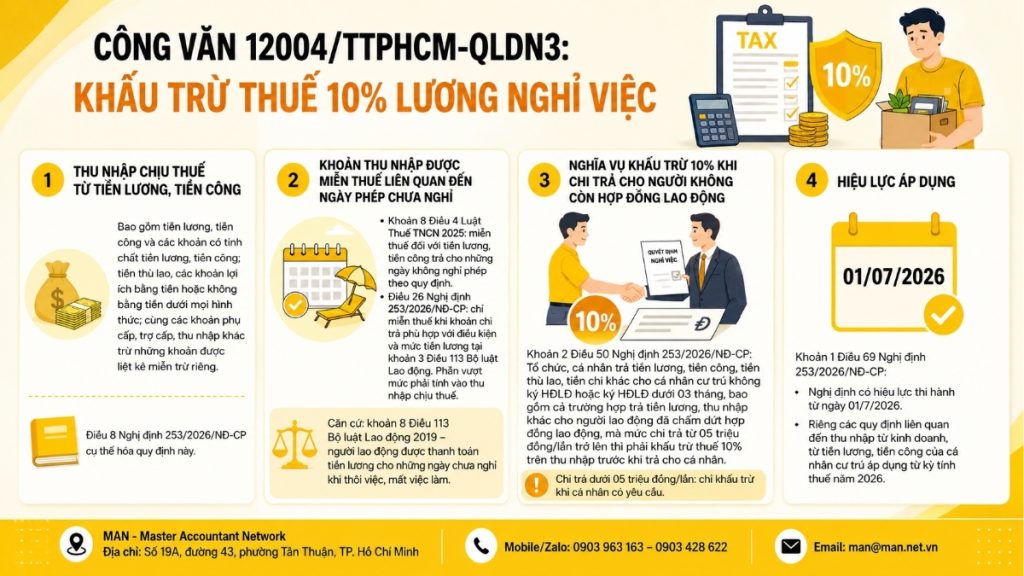
Official Letter 12004/TTPHCM-QLDN3 is the official response from the Ho Chi Minh City Tax Department, addressing a common issue faced by payroll accountants: whether or not to deduct personal income tax (PIT 10%) when paying salaries and allowances to employees after they have left their jobs, and on which amounts. Incorrect application risks both retroactive tax collection and over-deducting, potentially disadvantaging employees. This article systematically reviews all the legal basis related to Official Letter 12004/TTPHCM-QLDN3, helping accounting and human resources departments handle payments correctly from the very first payment.
Why is Circular 12004/TTPHCM-QLDN3 noteworthy for payroll accounting?
From July 1st, 2026, Decree 253/2026/ND-CP Officially effective and applicable to the 2026 personal income tax period, this regulation has led to a series of situations arising in the actual payment of salaries that were not fully listed in the original document. These include cases where businesses pay salaries, unused annual leave pay, and severance pay to employees. employment contract terminated is one of them.
Circular 12004/TTPHCM-QLDN3 was issued specifically to answer this question. This is not a new legal document, but rather a guidance circular on application. However, for accountants, it has very high practical value because it clearly specifies how to apply three groups of regulations simultaneously: determining taxable income, tax-exempt income, and the obligation to deduct tax.
Ignoring Circular 12004/TTPHCM-QLDN3 can lead to businesses forgetting to deduct payments made after employees have left their jobs, resulting in a shortfall in withheld and paid taxes, and subsequent tax recovery during final settlement or audits.
Legal basis for Official Letter 12004/TTPHCM-QLDN3

The response in Official Letter 12004/TTPHCM-QLDN3 is based on four layers of reasoning; accountants need to understand all four to apply it correctly, not just remember the number 10%.
Taxable income under the Personal Income Tax Law 2025
According to Clause 2, Article 3 of the Personal Income Tax Law 2025:
Taxable income from salaries and wages includes salaries, wages and payments of a similar nature; fees, monetary or non-monetary benefits in any form; and allowances, subsidies, and other income, except for those separately exempted.
Article 8 of Decree 253/2026/ND-CP specifies this regulation, defining income from salaries and wages as including salaries, wages, and other payments of a similar nature that employees receive from employers in any form, whether in cash or in kind, along with other remuneration and benefits.
Tax-exempt income related to unused vacation days.
This is the most confusing point when applying Circular 12004/TTPHCM-QLDN3. Clause 8, Article 4 of the Personal Income Tax Law 2025 stipulates tax exemption for night work wages, overtime pay, and wages paid for days not taken as leave as prescribed by law.
Article 26 of Decree 253/2026/ND-CP further clarifies:
Tax exemption for wages and salaries paid for non-vacation days only applies when such payments comply with the regulations on wage conditions and levels in Clause 3, Article 113 of the Labor Code. If the payment exceeds the regulations, the excess amount must be included in taxable income.
Regarding the basis for this payment, Clause 8, Article 113 of the 2019 Labor Code stipulates:
In cases of resignation or job loss where the employee has not taken their annual leave or has not used all of their annual leave days, the employer is entitled to pay the employee wages for the unused leave days.
The obligation to deduct 10% when paying employees who no longer have an employment contract.
This is the core content that Official Letter 12004/TTPHCM-QLDN3 applies to address the practical situation. Clause 2, Article 50 of Decree 253/2026/ND-CP stipulates that organizations and individuals paying salaries, wages, fees, and other payments to resident individuals who do not sign a contract or sign a labor contract for less than 3 months, This includes cases where wages and other income are paid to employees whose employment contracts have been terminated.For payments of 5 million VND or more per transaction, tax must be deducted at a rate of 10% on the income before payment to the individual. If the payment is less than 5 million VND per transaction, the deduction is only made upon the individual's request.
This clause directly names the case addressed in Official Letter 12004/TTPHCM-QLDN3: the employee. contract terminated It is still subject to deduction under Article 10% if the payment reaches the threshold of 5 million VND per transaction, regardless of whether it is outstanding salary, bonus, allowance, or other expenses that are taxable income.
Effective date as per Article 69 of Decree 253/2026/ND-CP
Regarding the timeframe, Clause 1, Article 69 of Decree 253/2026/ND-CP stipulates that the Decree takes effect from July 1, 2026; however, regulations related to income from business activities, salaries, and wages of resident individuals apply from the 2026 tax year. This is the basis for Official Letter 12004/TTPHCM-QLDN3 to determine the effective date as July 1, 2026.
The official response is contained in Official Letter 12004/TTPHCM-QLDN3.

Based on the aforementioned legal grounds, the Ho Chi Minh City Tax Department responded in Official Letter 12004/TTPHCM-QLDN3 with two clear principles that businesses can apply immediately:
- The first principle regarding the obligation to deduct: In cases where a company makes payments of 5 million VND or more in salary or wages to employees after the termination of their employment contract, from July 1, 2026, the company is responsible for deducting personal income tax from the employee at the rate of 10% on the total taxable income from salary and wages, based on Clause 2, Article 50 of Decree 253/2026/ND-CP.
- The second principle regarding the exclusions before calculating 10%: Payments for non-vacation days, if they comply with the regulations in Clause 3, Article 113 of the Labor Code, along with severance pay and unemployment benefits as prescribed by law, are exempt from personal income tax according to Clause 8, Article 4 of the Personal Income Tax Law and Article 26 of Decree 253/2026/ND-CP, meaning they are not included in the taxable income for the purpose of calculating deductions.
In other words, the overarching spirit of Official Letter 12004/TTPHCM-QLDN3 is: the deduction of 10% applies to... total taxable income, after clearly separating which income is taxable and which is tax-exempt according to the law, rather than deducting taxes indiscriminately from the entire amount paid.
The procedures are implemented in accordance with the spirit of Official Letter 12004/TTPHCM-QLDN3.
To avoid errors when applying Circular 12004/TTPHCM-QLDN3 to daily operations, the payroll accounting department should follow the following procedure:
- Step 1 – Break down the payments: List in detail all payments to be made to the former employee: outstanding salary, unused vacation days, severance pay, unemployment benefits, bonuses or other benefits (if any).
- Step 2 – Verify tax exemption conditions for each item: For payments for unused vacation days, check if the payment amount complies with Clause 3, Article 113 of the Labor Code; if it exceeds the prescribed limit, the excess amount must be included in taxable income according to Clause 3, Article 26 of Decree 253/2026/ND-CP. For severance pay or unemployment benefits, verify that the amount is correct according to current labor law regulations.
- Step 3: Determine the remaining taxable income: After deducting the tax-exempt portion, the remaining amount is the basis for determining the threshold of 5 million VND/transaction according to Clause 2, Article 50 of Decree 253/2026/ND-CP.
- Step 4: Withdrawal and Documentation: If the total taxable income is 5 million VND or more per payment, deduct the tax before payment, prepare a tax withholding certificate for the employee, and declare and pay the withheld tax as prescribed. If the total tax is less than 5 million VND per payment and the employee commits to not having the tax withheld, the business must still compile a list and income of these individuals and submit it to the tax authorities using the prescribed form at the end of the tax year.
For businesses with a high rate of employee terminations or a small accounting staff, standardizing processes from the outset is the most effective way to avoid recurring errors. Many organizations have chosen to do this. full accounting service With the expertise of specialized units like MAN – Master Accountant Network, the deduction, declaration, and archiving of documents, in accordance with the spirit of Circular 12004/TTPHCM-QLDN3, are carried out synchronously without interruption when internal personnel rotate.
Example illustrating how to apply Official Letter 12004/TTPHCM-QLDN3
Ms. H. resigned from Company B in August 2026. In September 2026, the company paid Ms. H. the remaining amounts, including:
- Unpaid August salary (12 million VND);
- Compensation for 6 days of unused leave as per Clause 3, Article 113 of the Labor Code (4 million VND);
- And severance pay in accordance with labor law regulations (10 million VND).
According to the Official Letter, the unused leave pay (4 million VND) and severance pay (10 million VND) are exempt from personal income tax and are not included in taxable income. However, the unpaid August salary (12 million VND) is taxable income, reaching the threshold of 5 million VND or more per payment, so the company must deduct 1.2 million VND before paying Ms. H.
The example above illustrates the key point when applying this: Do not deduct 10%. the entire amount one-time payment, which is only deducted from taxable income after excluding tax exemptions as required by law.
Common business mistakes
Here are some common accounting mistakes made by businesses:
- The most common misconception is that withholding tax is not applicable because the employee has left the job. Clause 2 of Article 50 of Decree 253/2026/ND-CP clearly states that the obligation to withhold tax applies even when paying income to employees whose employment contracts have been terminated.
- Deduction 10% on the entire amount paid, including the tax-exempt portion: Including severance pay and unused leave pay in taxable income for deduction calculation results in over-deduction for employees, contrary to the spirit of Official Letter 12004/TTPHCM-QLDN3.
- Do not compare the vacation pay rate with Clause 3, Article 113 of the Labor Code: If the company pays more than the legally stipulated rate for unused vacation days, the excess amount must be included in taxable income according to Article 26 of Decree 253/2026/ND-CP, and is not exempt from full tax.
- Failure to compile a list of individuals below the deduction threshold: Even if the payment is less than 5 million VND per transaction and no deduction is made as per the employee's commitment, the business is still obligated to compile and submit a list to the tax authorities at the end of the tax year.
Why businesses should review their severance pay processes now.
Circular 12004/TTPHCM-QLDN3, while addressing only a specific situation, reflects a general trend: tax authorities are tightening checks on deduction obligations for payments made after the termination of employment contracts, a group of transactions previously often overlooked in the standard timekeeping and payroll calculation process.
For businesses with significant employee turnover, proactively updating procedures in accordance with Circular 12004/TTPHCM-QLDN3 not only helps avoid the risk of tax arrears and late payment penalties, but also protects the legitimate rights of employees by ensuring they receive their tax-exempt income as stipulated by law. If a business is unsure about how to separate taxable or tax-exempt income for each specific case, it should proactively seek advice from a relevant agency. accounting consulting services This allows for review before payments are made, instead of waiting until settlement or inspection to discover errors.
Conclude
Circular 12004/TTPHCM-QLDN3 summarizes two key points that payroll accountants need to remember:
- Firstly, the obligation to deduct tax on taxable income (10%) applies to payments to employees whose contracts have been terminated, provided that the amount is 5 million VND or more per payment;
- Secondly, before calculating deductions, it is necessary to correctly exclude amounts that are exempt from tax according to the law, including money for unused vacation days and legitimate severance pay or unemployment benefits.
Applying the spirit of the Official Letter correctly from the payroll calculation stage helps businesses avoid two risks: under-deducting taxes leading to retroactive collection, and over-deducting taxes causing losses to employees. For businesses wanting to reduce the workload of payroll and personal income tax for internal departments, this solution... outsource accounting services This is a worthwhile option to ensure that all payments to laid-off workers are handled properly from the outset.
Contact MAN – Master Accountant Network For timely advice and support!
Contact information MAN – Master Accountant Network
- Address: No. 19A, Street 43, Tan Thuan Ward, Ho Chi Minh City
- Mobile/Zalo: 0903 963 163 – 0903 428 622
- E-mail: man@man.net.vn
- Google Business Profile: View MAN – Master Accountant Network's Google Business Profile
- LinkedIn Founder: View expert Le Hoang Tuyen's LinkedIn profile.
Responsible for production and professional content review by: Mr. Le Hoang Tuyen – Founder & CEO of MAN – Master Accountant NetworkHe is a CPA Vietnam auditor with over 30 years of in-depth experience in accounting, auditing, taxation, and corporate legal consulting.
Frequently Asked Questions about Official Document 12004/TTPHCM-QLDN3
If an employee has left the company, is the company still required to deduct personal income tax when paying outstanding wages?
Yes. According to Official Letter 12004/TTPHCM-QLDN3 and Clause 2, Article 50 of Decree 253/2026/ND-CP, if the payment is 5 million VND or more per payment to an employee whose employment contract has been terminated, the company must deduct tax on the taxable income before making the payment.
Are severance pay payments included in taxable income for the purpose of deducting tax under form 10%?
No. Severance pay and unemployment benefits, as stipulated by law, are exempt from personal income tax according to Clause 8, Article 4 of the Personal Income Tax Law 2025 and Article 26 of Decree 253/2026/ND-CP.
Are unused vacation days paid upon termination of employment fully tax-exempt?
The exemption is only granted if the payment amount complies with the provisions of Clause 3, Article 113 of the Labor Code. Any payment exceeding the prescribed amount must be included in taxable income.
Is a severance payment of less than 5 million VND subject to tax deduction?
It is not mandatory; deductions are only made upon individual request. However, businesses must still compile a list and income of these individuals and submit it to the tax authorities at the end of the tax year.
From what date does Official Document 12004/TTPHCM-QLDN3 come into effect?
The deduction content 10% applies to payments made from July 1, 2026, as effective from Decree 253/2026/ND-CP, as stipulated in Clause 1, Article 69 of this Decree.






