
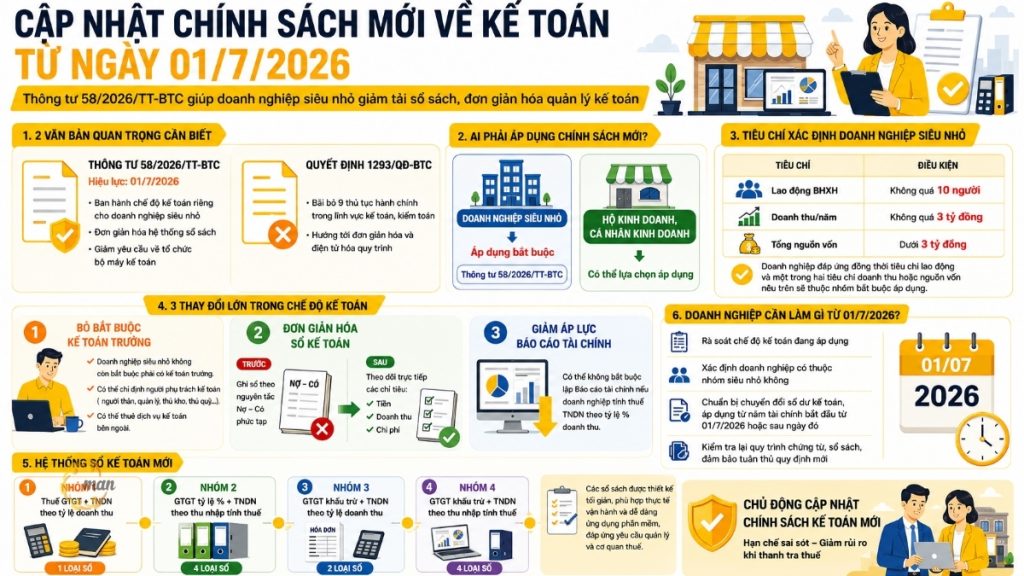
The new accounting policy, which officially takes effect from July 1, 2026, is becoming a top topic of interest for accountants and micro-business owners in the second quarter of this year. Circular 58/2026/TT-BTC The regulations issued by the Ministry of Finance on May 25, 2026, have officially resolved many long-standing issues related to the organization of accounting systems, bookkeeping, and financial reporting for the smallest businesses in the economy. This is not merely a technical adjustment, but a shift in state management thinking towards reducing the administrative burden on the small and micro-sized private sector.
In parallel with Circular 58/2026/TT-BTC, Decision 1293/QD-BTC The year 2026 will also abolish 9 central-level administrative procedures in the field of accounting and auditing, effective from the same time. From the perspective of MAN – Master Accountant Network, this is a period when businesses need to review their entire current bookkeeping process to avoid applying incorrect accounting regulations, leading to the risk of tax arrears or administrative penalties during tax audits and inspections in subsequent periods.
Summary of key points regarding the new accounting policy.
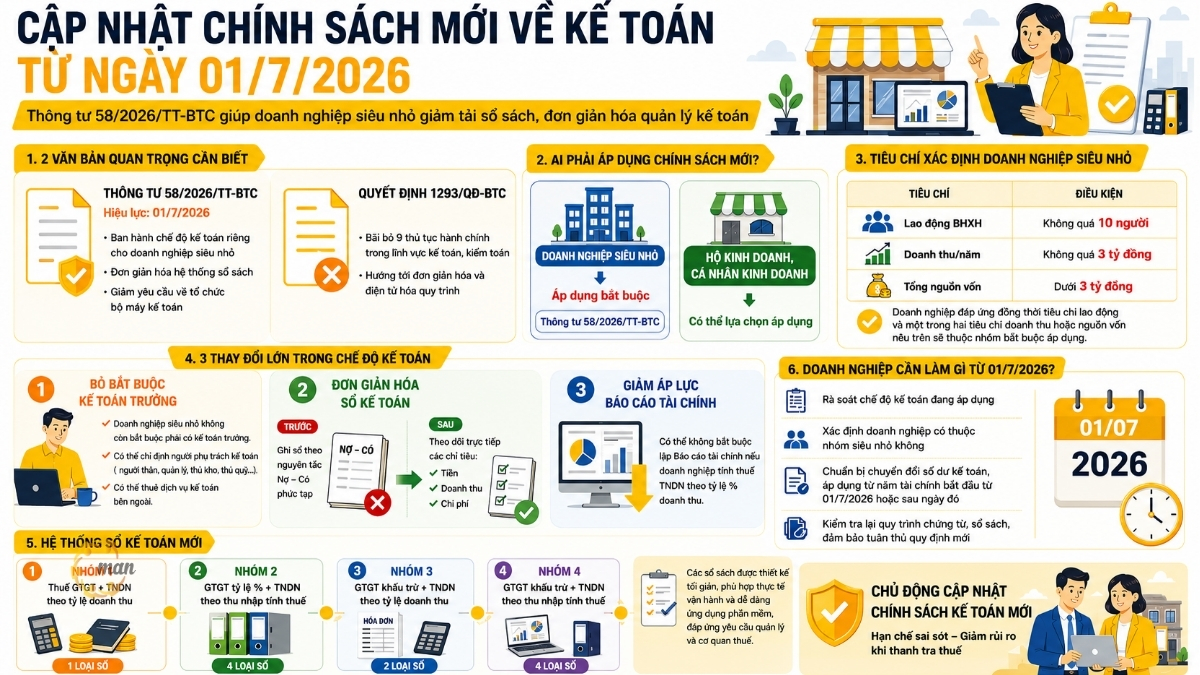
The new accounting policy is the general name for Circular 58/2026/TT-BTC (effective from July 1, 2026) guiding the separate accounting regime for micro-enterprises and Decision 1293/QĐ-BTC of 2026 abolishing 9 administrative procedures in the field of accounting and auditing. This policy aims to simplify the accounting system, reduce the requirement for chief accountants, and streamline financial reporting. It is mandatory for micro-enterprises according to the specified criteria. Decree 80/2021/ND-CP, and it applies voluntarily to household businesses and individual business owners who wish to do so. Businesses need to apply it immediately from the fiscal year beginning on or after July 1, 2026.
What is the new accounting policy?
The new accounting policy, effective from July 1, 2026, is essentially the Ministry of Finance issuing a separate legal framework for accounting, distinct from the accounting regime for small and medium-sized enterprises under the previous Circular 132/2018/TT-BTC. Circular 58/2026/TT-BTC clearly defines the scope of regulation specifically for micro-enterprises, while also expanding the options for household businesses and individual business owners if they deem it suitable to their actual operating model.
The fundamental difference lies in the approach. While the old accounting system still required recording entries according to the debit and credit principle with a complex chart of accounts, the new system allows taxpayers to directly record cash, revenue, and expenses. This method is closer to the practical cash flow management mindset of a family business than a traditional corporate accounting model.
Which legal document stipulates the new accounting policy?
Two fundamental documents that you need to understand include:
- Circular 58/2026/TT-BTC dated May 25, 2026, issued by the Ministry of Finance, provides guidance on accounting regulations for micro-enterprises, effective from July 1, 2026, and applicable to fiscal years beginning on or after July 1, 2026.
- Decision 1293/QD-BTC of 2026, announcing the list of administrative procedures that have been amended, supplemented, and abolished in the field of accounting and auditing, takes effect at the same time.
In addition, businesses still need to refer to the Accounting Law 2015 (amended and supplemented in 2024) as a general principle, and Decree 80/2021/ND-CP to accurately determine the criteria for micro-enterprises.
Which entities are required to apply the new accounting policy?

This is the most frequently asked question when new accounting policies are announced, because incorrectly identifying the scope of application can lead to improper bookkeeping, causing difficulties in explaining the situation to the tax authorities.
How are micro-enterprises defined?
According to Article 5 of Decree 80/2021/ND-CP, the criteria for identifying micro-enterprises are based on three factors: the number of employees participating in social insurance, annual revenue, and total capital.
| Area of activity | Social insurance number | Annual revenue | Total capital |
| Agriculture, forestry, fisheries, industry, construction | No more than 10 people | Not exceeding 3 billion VND | Under 3 billion VND |
| Trade and Services |
Businesses that simultaneously meet the labor criteria and one of the two revenue or capital criteria mentioned above will be subject to Circular 58/2026/TT-BTC.
Is it mandatory for household businesses and individual business owners to apply?
No. Household businesses and individual business owners can only choose to apply Circular 58/2026/TT-BTC if they wish; it is not mandatory. This is an open provision, creating conditions for this group to gradually professionalize their financial record-keeping without creating an additional mandatory legal burden.
How will the accounting system change under the new policy?

One of the biggest bottlenecks for micro-sized family businesses in the past was the requirement to have a chief accountant or someone meeting certain professional standards. Circular 58/2026/TT-BTC has removed this barrier.
Specifically, micro-enterprises are no longer required to appoint a chief accountant; instead, they can designate an accounting officer to sign on their behalf regarding documents, ledgers, and financial reports. Personnel requirements have also been significantly relaxed: businesses are allowed to appoint relatives of the legal representative, such as parents, spouse, children, siblings, or assign accounting duties to managers, warehouse keepers, or cashiers. Businesses can also outsource accounting services to handle all bookkeeping.
Experts at MAN, with 30 years of experience, note that relaxing personnel requirements does not mean reducing legal responsibility. Even if the person in charge of accounting is a family member, they are still responsible for the accuracy and truthfulness of the data before the tax authorities during audits and inspections.
How is the new accounting system designed?

Circular 58/2026/TT-BTC significantly simplifies the accounting system compared to the old regime. Businesses no longer have to record transactions according to the complex debit and credit principles, but only need to directly track cash, revenue, and expenses. The list of applicable accounting books is divided into four groups based on tax payment methods.
Pay VAT and corporate income tax as a percentage of revenue.
This group only needs to use one type of ledger: the Sales Revenue Ledger for Goods and Services (Form S1-DNSN), based on invoices and accounting documents as prescribed.
Pay VAT at a percentage rate and corporate income tax on taxable income.
This group must use four types of ledgers, including:
- Sales Revenue Register for Goods and Services (Form S2a-DNSN)
- Detailed Revenue and Expense Ledger (Form S2b-DNSN)
- Detailed register of materials, tools, products, and goods (Form S2c-DNSN)
- Cash Ledger (Form No. S2d-DNSN).
Value Added Tax (VAT) is paid using the deduction method, and Corporate Income Tax (CIT) is paid as a percentage of revenue.
This group only needs two types of notebooks:
- Sales Revenue Register for Goods and Services (Form S3a-DNSN)
- VAT Obligation Tracking Register (Form No. S3b-DNSN).
Pay VAT using the deduction method and corporate income tax on taxable income.
This group has the most comprehensive record-keeping requirements, with 4 types of ledgers:
- Detailed Revenue and Expense Ledger (Form S2b-DNSN)
- Detailed register of materials, tools, products, and goods (Form S2c-DNSN)
- Cash Ledger (Form S2d-DNSN)
- VAT Obligation Tracking Register (Form No. S3b-DNSN).
One notable point is that if a business has already used electronic invoices and the tax authority's system has assisted in determining the tax payable, the business only needs to use the forms specified in Circular 58/2026/TT-BTC to track and reconcile, significantly reducing the time spent on manual data entry.
Financial reporting under the new accounting policy.
The biggest difference lies in the classification of financial reporting obligations according to the corporate income tax filing method.
If a business pays corporate income tax based on taxable income, it must still prepare financial statements as guided by Circular 58/2026/TT-BTC, including the Statement of Financial Position (Form B01-DNSN) and the Statement of Business Results (Form B02-DNSN).
Conversely, if a business pays corporate income tax as a percentage of its revenue from the sale of goods and services, it is not required to prepare financial statements to submit to the competent state authorities, unless otherwise required by law.
This regulation significantly reduces the burden on micro-enterprises that apply a simplified lump-sum tax method, which account for a large proportion of household businesses transitioning to the corporate model.
What should businesses do when switching accounting methods?
Principle of consistency in application
The selection or conversion of accounting methods must be consistent within a financial year. Any changes can only be made on the beginning of the next financial year; changes cannot be made during the financial year.
How to transfer balances in the accounting ledger.
Businesses shall use the balances of accounting accounts as stipulated in Circular 132/2018/TT-BTC to transfer funds to the relevant accounting books when Circular 58/2026/TT-BTC comes into effect. In cases where the accounting system changes due to a change in tax payment method or the selection or cancellation of the accounting system for small and medium-sized enterprises, businesses shall use the ending balances in the previous accounting books to transfer funds to the beginning balances of the corresponding accounting books in the subsequent period.
This is the most error-prone technical step in practice, because comparing balances between two fundamentally different accounting systems requires the person performing the task to have a thorough understanding of both the old and new systems.
Nine administrative procedures in the accounting field have been abolished.
According to Decision 1293/QD-BTC of 2026, from July 1, 2026, 9 central-level administrative procedures in the field of accounting and auditing will be abolished, mainly related to:
- Registration for the issuance or renewal of a Certificate of Registration for Accounting Services is required in various situations, including new issuance, expiration, change of workplace, or revocation of the certificate.
- Registration for issuance and re-issuance of Certificates of Eligibility to conduct accounting services for domestic enterprises and branches of foreign enterprises in Vietnam.
- Request for issuance of a Certificate of Eligibility to conduct cross-border accounting services for a foreign accounting service enterprise.
- Register to take the first-time Certified Public Accountant (CPA) certification exam.
The abolition of these procedures does not mean the abolition of professional practice requirements, but is usually associated with the integration and simplification of implementation processes through digitalization or merging them into other related procedures. Accounting service businesses and practicing accountants need to monitor specific implementing guidelines to update their procedures and replace the old ones.
The fundamental accounting principles remain in effect according to the 2015 Accounting Law.
Although there are separate accounting regulations for micro-enterprises, the core accounting principles stipulated in Article 6 of the 2015 Accounting Law remain the mandatory reference framework, including:
- Assets and liabilities are initially recognized at their original cost, although in some cases they are recognized at their fair value at the end of the period.
- The chosen accounting method must be applied consistently throughout the accounting year.
- Accounting units must collect and reflect data objectively, completely, accurately, and within the correct accounting period.
- Financial reports must be prepared and submitted to the competent authority in a complete, accurate, and timely manner.
- The methods for valuing assets and allocating revenue and expenses must be used cautiously, without distorting the operating results.
- Financial reporting should accurately reflect the nature of the transaction rather than its form or name.
A real-world scenario when micro-enterprises implement new accounting policies.
Let's assume a household furniture manufacturing facility in Binh Duong, with 8 employees and annual revenue of approximately 2.8 billion VND, is paying VAT and corporate income tax as a percentage of revenue. Before July 1, 2026, accountants were still required to record transactions using a complete debit and credit system, even with very small revenue.
When transitioning to Circular 58/2026/TT-BTC, this establishment only needs to maintain the Sales Revenue Register for Goods and Services (Form S1-DNSN). The owner can delegate the task of recording sales to their daughter, who is currently in charge of sales, without needing to hire a dedicated chief accountant. The reconciliation of opening balances is performed once during the transition, based on the closing balances of the old accounting records as per Circular 132/2018/TT-BTC.
Based on MAN's practical consulting experience, the most common oversight businesses face during the transition isn't choosing the right accounting system, but rather correctly identifying their current VAT and corporate income tax filing methods before applying the corresponding system. Applying the wrong accounting system from the beginning of the period will lead to discrepancies in all data when the tax authorities conduct a review at the end of the year.
Expert opinion: Common risks faced by Vietnamese businesses.
Through advising hundreds of micro-enterprises on transitioning to household business models, experts at MAN have identified three most frequently recurring risks.
- Firstly, many businesses confuse voluntary and mandatory application. Household businesses arbitrarily apply the accounting system for small and medium-sized enterprises even without registering, leading to discrepancies between the figures and previously submitted tax returns.
- Secondly, relaxing the requirements for accounting personnel creates a false sense of security. Relatives are assigned to record transactions but lack understanding of proper expense allocation principles, leading to the recording of expenses without valid documentation, posing risks during year-end tax settlements. Thirdly, businesses changing their VAT payment method mid-year without proper notification disrupts the transfer of accounting balances, directly affecting the continuity of financial reporting if they are required to prepare such reports.
Solutions from MAN – Master Accountant Network For these situations, the process always begins with reviewing all current tax records, accurately identifying the tax payment method being applied, and then redesigning the accounting system to comply with the new regulations. This approach helps businesses avoid having to correct errors while transitioning, which is far more costly than getting it right from the start.
Conclude
The new accounting policy, effective from July 1, 2026, marks a significant shift in the government's approach to financial management for micro-enterprises. It moves from imposing a complex accounting system to a more flexible model, closer to the operational realities of family-owned businesses. Simplifying accounting records, easing accounting staff requirements, and classifying financial reporting obligations according to tax payment methods significantly reduces compliance costs. However, it also requires businesses to understand and apply the policy correctly from the transition period to avoid errors during tax settlement.
In 2026, with continuously updated and changing policies and increasingly stringent tax risk management requirements, MAN – Master Accountant Network, with a team of experts boasting over 30 years of practical experience and a deep understanding of risk management practices in Vietnam, will partner with businesses in these areas. full accounting service, tax accounting services and accounting consulting servicesChoosing the right consulting partner right from the accounting system transition stage will help businesses save time and costs and proactively control legal risks in the long term.
Contact MAN – Master Accountant Network For expert support and advice!
Contact information MAN – Master Accountant Network
- Address: No. 19A, Street 43, Tan Thuan Ward, Ho Chi Minh City
- Mobile/Zalo: 0903 963 163 – 0903 428 622
- E-mail: man@man.net.vn
- Google Business Profile: View MAN – Master Accountant Network's Google Business Profile
- LinkedIn Founder: View expert Le Hoang Tuyen's LinkedIn profile.
Responsible for production and professional content review by: Mr. Le Hoang Tuyen – Founder & CEO of MAN – Master Accountant NetworkHe is a CPA Vietnam auditor with over 30 years of in-depth experience in accounting, auditing, taxation, and corporate legal consulting.
Frequently Asked Questions about the New Accounting Policy
Circular 58/2026/TT-BTC takes effect from July 1, 2026 and applies to fiscal years beginning on or after July 1, 2026.
No. Circular 58/2026/TT-BTC only applies mandatory to micro-enterprises according to the criteria of Decree 80/2021/ND-CP; other small and medium-sized enterprises still apply accounting regulations as prescribed by law.
It is not mandatory. Micro-enterprises can appoint a person in charge of accounting, including a relative of the legal representative, to sign on their behalf on documents, ledgers, and financial reports.
Depending on the method of corporate income tax payment. If tax is paid based on taxable income, financial statements must still be prepared. If tax is paid as a percentage of revenue, financial statements are not required to be submitted to the state authorities unless otherwise required by law.
Changes can only be made on the start date of the following accounting year; no changes are permitted during the current fiscal year. When will the new accounting policies come into effect?
Can small and medium-sized enterprises (SMEs) that are not micro-enterprises apply?
Is it necessary to hire a certified chief accountant?
Do micro-enterprises have to submit financial reports?
When can a business change its current accounting system?






